guides
1000 Hours Outside: How Many Hours a Day? Questions Answered
1000 Hours Outside is about 2 hours 45 minutes a day. What counts, how to track it, the UK winter, the app, and how it fits NHS guidance.
1000 Hours Outside works out at about 2 hours 45 minutes outside a day, every day for a year. The challenge's own site frames it as roughly 20 hours a week, done in long outdoor stretches a few days a week rather than daily. Below: what the challenge is, what counts, the UK winter, tracking, the app, and how it sits against NHS guidance.
We're a UK company with no link to the movement. Everything we say about it comes from its own site, and everything about children's activity from NHS and Chief Medical Officers' guidance.
How many hours a day is 1000 Hours Outside?
About 2 hours 45 minutes a day, if you spread it evenly: 1,000 hours divided by 365 days. The founder's own family doesn't do it that way. The movement's About page says the founder's family spread "4-6 hour chunks out over a few days (shooting for roughly 20 hours a week)".
The founder is open that it isn't daily. In a post on why she aims for 4 to 6 hours, she writes: "Let me begin by saying we are not outside for 4-6 hours everyday. We aim for 4-6 hours outside at least three to four times a week (a little more in the nicer months and a little less in the worse ones)."
Here's what 1,000 hours looks like broken down. The sums are ours.
- A day, Works out at: About 2 hours 45 minutes
- A week, Works out at: About 19 hours
- A month, Works out at: About 83 hours
- Long days only, 4 a week, Works out at: About 4 hours 50 minutes each
What is the point of 1000 Hours Outside?
The point is to get children outside for long, unhurried stretches, and to match the time they would otherwise spend on screens. The challenge was started by Ginny Yurich, a mother of five from Michigan in the US, and it describes itself as "a for-profit, social good company and movement".
On the About page she explains the thinking: families track steps and budgets, so "why not track something so beneficial to our children as well?" The aim, she writes, is to try to at least match the time a child spends in front of screens each year with time outdoors.
The time recommendation comes from Charlotte Mason, an English educator who lived at the turn of the 20th century. The founder says the goal is "loosely based on the writings of Charlotte Mason" and adapted "to make room for daily life".
The 4 to 6 hours a day is the movement's aim, not UK health guidance. More on that below.
What counts as time outside?
The challenge doesn't publish a rulebook that we could find, so you set the rules. The app's timer is simple: you "press 'play' when you walk out the door".
So most of the rules are yours. Some questions to settle before you start, with the answers we'd suggest:
- The walk to school? Yes. It's outside, and it adds up fast.
- Sitting in the car? No. Getting out at the other end does.
- The garden while you cook tea? Yes, if they're out there and not watching through the patio door.
- Eating outside? Yes. A picnic tea in the garden counts.
Write the house rules on the tracker so nobody relitigates them in March.
Can you do 1000 Hours Outside in the UK winter?
Yes, but expect to bank most of your hours in spring and summer and keep winter ticking over. The founder does the same in Michigan: "a little more in the nicer months and a little less in the worse ones".
Winter here brings early dark and wet weekends. The hours that work are short and reliable: the walk to school and back, half an hour in the park straight after pick-up while it's still light, and one longer outing at the weekend in proper waterproofs. A snowy morning is a gift. Our snow day ideas fill one easily.
Summer is where the total grows. Long light evenings make a two-hour garden session after tea easy. The NHS's sun advice for children in the UK runs from March to October: cover up, use SPF30 or higher, and spend time in the shade, particularly between 11am and 3pm. So plan the longest stretches for mornings and evenings. Its sun safety page has the detail.
Because the goal is any 365 days, you don't have to start in January. Starting in spring means the habit is formed before the dark evenings arrive.
How does it compare with NHS activity guidance?
UK guidance sets activity targets, not outdoor-time targets. For 1 and 2 year olds, the NHS sets a minimum of 180 minutes of activity a day, "including playing outdoors". For 3 and 4 year olds it's the same 180 minutes, "including active and outdoor play", with an hour of it moderate to vigorous.
From 5, the NHS target is a weekly average of no less than 60 minutes a day of moderate or vigorous activity. The UK Chief Medical Officers' guidelines mention outdoor play for under-5s but set no figure for hours outside. Neither do the NHS pages.
Two things follow. First, outdoor time and activity aren't the same. An hour on a picnic rug counts for the challenge but not much towards the 60 active minutes. An hour of chasing, climbing and scooting counts for both. Second, the movement's 4 to 6 hours a day is its own aim, well beyond anything UK guidance asks. Our page on how much exercise children need covers the UK figures in full.
How do you keep track of 1000 Hours Outside?
The simplest way is a printable tracker: one shape to colour in for every hour. The movement offers its tracker sheets free; you fill in a form and they send the full set to print.
A paper tracker on the fridge has one advantage over anything else: your child can colour in their own hours, and see the total grow. Rounding to the nearest half hour is plenty. Nobody needs a stopwatch on a walk.
If paper goes missing in your house, a note on your phone with a running total works as well as anything.
Is the 1000 Hours Outside app worth it?
Whether it's worth it depends on how much you like streaks. The 1000 Hours Outside app has paid extras, including a membership, so check the current price on the listing before you pay.
The movement's own app page describes a timer you start as you go out, a calendar view of your progress and milestone badges. Members get extras, including an adventure map of places other families have visited and interactive tracker charts.
There's a small irony in a screen counting your screen-free hours, and the movement's answer is on its app page, which says it believes "technology, with balanced use, can be a great tool". A paper tracker does the counting for nothing.
Making the hours add up in a real week
The hours come from routine more than from big days out. A walk to school and back can be 40 minutes before you've planned anything. Tea in the garden, a scoot round the block after school and a Saturday morning in the woods take a week past ten hours.
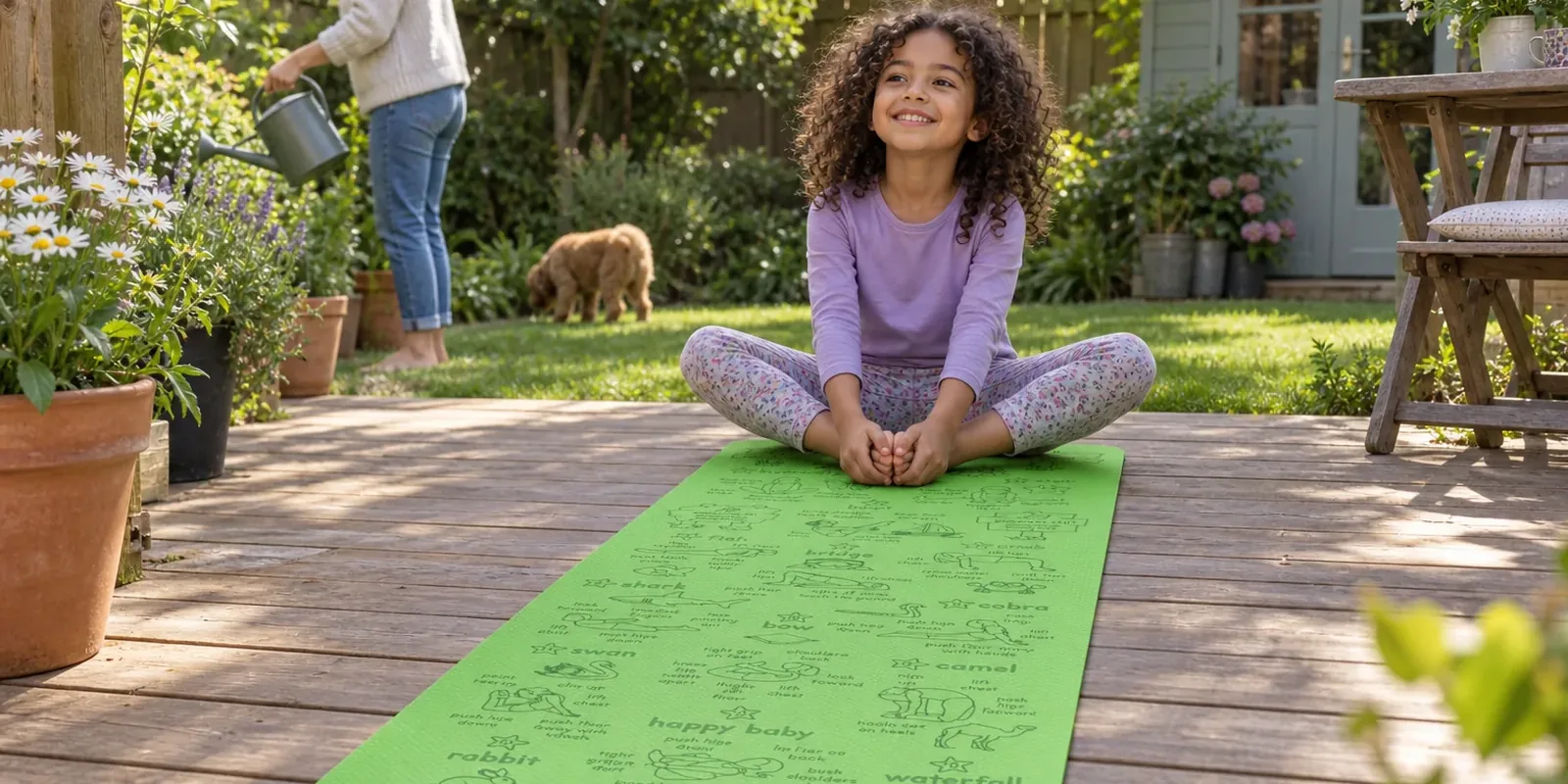
Give children something to do once they're out there. There are games for the garden that need almost no kit, and a longer list of screen-free activities that work in a park. A few minutes of outdoor yoga on the lawn counts too, and the 15 numbered poses on a children's yoga mat are there for them to try.
When to ask a GP or health visitor
If your child seems unusually tired, breathless or unwell after time outdoors, or you're unsure how much activity suits a health condition they have, ask your GP, or your health visitor for an under-5. They can tell you what's right for your child, which no challenge can.
Frequently asked questions
When should you start 1000 Hours Outside?
Any day you like. The movement's own site talks about trying to spend 1,000 hours outside in a 365-day period, not in a calendar year. Starting in spring gives you the long evenings while the habit forms. Starting on 1 January puts the hardest weeks first, which suits a family that likes the hard part out of the way.
Does time at nursery or school count?
The site doesn't publish a rule on it that we could find, so it's your call. You could count only time outside together, or add school playtimes too. Either works, as long as you decide at the start and stick to it. A tally that changes its rules halfway through stops telling you anything.
What if we don't reach 1,000 hours?
Then you've still spent more time outside than you would have. The founder's own line is 'Even if you fail, you win', and she writes that some families have found 1,000 hours too lofty and adjusted the goal. Halving it to 500 is still more than an hour and a quarter a day.
Is 1000 Hours Outside suitable for toddlers?
Yes. The movement describes itself as designed for any age child, and NHS guidance already wants 1 and 2 year olds moving for 180 minutes or more a day, with outdoor play part of it. A toddler's hours come in short bursts, so a buggy-free walk to the shops and twenty minutes in the garden both add to the total.
Sources
- 1000 Hours Outside: home page
- 1000 Hours Outside: About us
- 1000 Hours Outside: Children should be outside for 4-6 hours every day
- 1000 Hours Outside: Trackers
- 1000 Hours Outside: Mobile app
- Apple App Store (UK): 1000 Hours Outside
- NHS: Physical activity guidelines for children (under 5 years)
- NHS: Physical activity guidelines for children and young people
- GOV.UK: UK Chief Medical Officers' physical activity guidelines
- NHS: Sunscreen and sun safety