guides
Physical Development in the EYFS: A Parent's Guide
Physical development EYFS guide for parents: the two early learning goals, what expected and emerging mean, and simple ways to help at home.
Physical development in the EYFS is how children from birth to five learn to control their bodies. It is one of three prime areas in the early years foundation stage, the framework every nursery, childminder and reception class in England follows. It has two parts, gross motor skills and fine motor skills, and teachers assess both at the end of reception.
Gross motor skills are whole-body movements like running, climbing and balancing. Fine motor skills are the small hand movements behind holding a pencil, using scissors and eating with a knife and fork. At the end of reception, your child's teacher records whether they've reached the "expected" level in each.
What is the physical development of early childhood?
Early years physical development is the way young children gain control of their bodies, from tummy time to a tripod pencil grip. The Department for Education's EYFS statutory framework names it as one of three prime areas, alongside communication and language, and personal, social and emotional development. Together, it says, the prime areas "build a foundation for children to thrive and provide the basis for learning in all areas".
The framework applies to England. It says adults can support children "to develop their core strength, stability, balance, spatial awareness, co-ordination and agility" through games and play, indoors and outdoors.
What are the early learning goals for physical development in the EYFS?
There are two early learning goals (ELGs) for physical development: gross motor skills and fine motor skills. They describe where a child at the "expected level" should be by the end of reception, the school year in which they turn five. They are two of 17 early learning goals across seven areas of learning.
The gross motor skills goal says children at the expected level of development will:
- negotiate space and obstacles safely, with consideration for themselves and others
- demonstrate strength, balance and coordination when playing
- move energetically, such as running, jumping, dancing, hopping, skipping and climbing
The fine motor skills goal says children at the expected level will:
- hold a pencil effectively in preparation for fluent writing, using the tripod grip in almost all cases
- use a range of small tools, including scissors, paint brushes and cutlery
- begin to show accuracy and care when drawing
The framework says the goals "should not be used as a curriculum", and staff working with children below reception age don't need to use them. If your three-year-old's nursery isn't talking about pencil grips, that's by design.
What does "expected" or "emerging" mean on my child's report?
"Expected" means your child's teacher judges them to be at the level an early learning goal describes by the end of reception. "Emerging" means, in the framework's words, "not yet reaching expected levels". It's a professional judgement recorded in the EYFS Profile, not a test score and not a diagnosis.
The Profile must be completed in the final term of reception, no later than 30 June, and the results shared with you, with an explanation of when and how you can discuss them.
In the Department for Education's EYFS Profile results for 2024/25, covering 589,500 children in England, gross motor skills had the highest percentage at the expected level of all 17 goals, as it has every year since the 2021 reforms.
What happens at the progress check at age two?
Between the ages of two and three, your child's nursery or childminder must give you a short written summary of their development in the three prime areas, physical development included. It must highlight where your child is progressing well, where some extra support might help, and any concern about a possible developmental delay.
What you'll be told about movement, and when:
- Age 2 to 3: progress check at age two. Nursery or childminder. A written summary of the prime areas.
- Age 2 to 2 and a half: NHS health and development review. Health visiting team, sometimes at nursery. The NHS says it covers general development "including movement".
- End of reception, by 30 June: EYFS Profile. Reception teacher. "Expected" or "emerging" for each of the 17 goals.
Why does handwriting start on the climbing frame?
In the EYFS, a good pencil grip is built from the shoulders and the middle of the body outwards. Development Matters tells reception staff to check that children have enough upper arm and shoulder strength, and can rotate their lower arms and wrists, before teaching pencil grip, scissors or a knife and fork. Its suggestion for building that strength isn't more colouring but "tummy-crawling, crawling on all fours, climbing, pulling themselves up on a rope and hanging on monkey bars".
The Department for Education's core strength and co-ordination guidance puts it plainly: "Writing, drawing and painting should be considered as whole-body skills." Its fine motor skills page says the development of fine motor skills "depends on the development of gross motor skills". So a four-year-old hanging off the climbing frame isn't time away from writing. In the guidance's terms, it's part of the route there.
What are examples of physical development activities for EYFS?
Good EYFS physical activities are mostly ordinary ones: running, climbing, dancing, ball games, musical statues, rolling dough, pouring drinks, pegging washing and cutting with child-safe scissors. The Department for Education suggests them to nurseries, and nearly all work at home.
Whole body (gross motor)
- Musical statues. Development Matters gives it as the example for 3 and 4-year-olds learning to "stand on one leg and hold a pose".
- Getting out of breath. Development Matters asks reception staff to "Encourage children to be highly active and get out of breath several times every day."
Hands (fine motor)
- Cooking. The Department for Education says mixing, squeezing, pouring and spreading help develop fine motor and hand-eye coordination.
- Pegging washing on a line, stirring a "magic potion" or playing in wet and dry sand, all from the same guidance.
- Big painting. Chalk or water on a wall or fence. Development Matters suggests large vertical surfaces to work the shoulders and arms.
Everyday independence
- The last bit of the zip. Development Matters suggests starting the zip and leaving your child to pull it up, then doing less each time.
For age-by-age ideas, see our activities for 3-year-olds. For the gross motor milestones from babyhood to age 8, see what are gross motor skills.
How much physical activity does an EYFS child need?
The NHS says toddlers aged 1 to 2 and pre-schoolers aged 3 to 4 should be active for at least 180 minutes (3 hours) a day, spread throughout the day and including outdoor play. For 3 and 4-year-olds, at least 60 minutes of that should be moderate to vigorous.
The NHS guidelines for under-5s add that children under 5 shouldn't be inactive for long periods except when they're asleep, naming watching TV and being strapped into a buggy as examples. And the Department for Education's screen use guidance for early years settings says screen time should be avoided for under-2s and limited to 1 hour a day, less if possible, for children aged 2 to 5.
How can you support physical development at home?
Give your child time, floor space and a reason to move every day, and let them do things for themselves even when it's slower. Development Matters asks reception classes to provide "regular access to floor space indoors for movement" and to "Encourage children to conclude movements in balance and stillness".
An illustrative ten minutes, not a prescription, for a four-year-old home from nursery full of beans: musical statues to one song, three animal poses, then lying still while you count ten slow breaths together. That's balance, a held pose and stillness, all named in the guidance.
For words to say for each pose, our yoga poses for preschoolers guide has 15, with the ones that suit age 3, 4 or 5. If yoga is new to you too, see how to start yoga with your child.
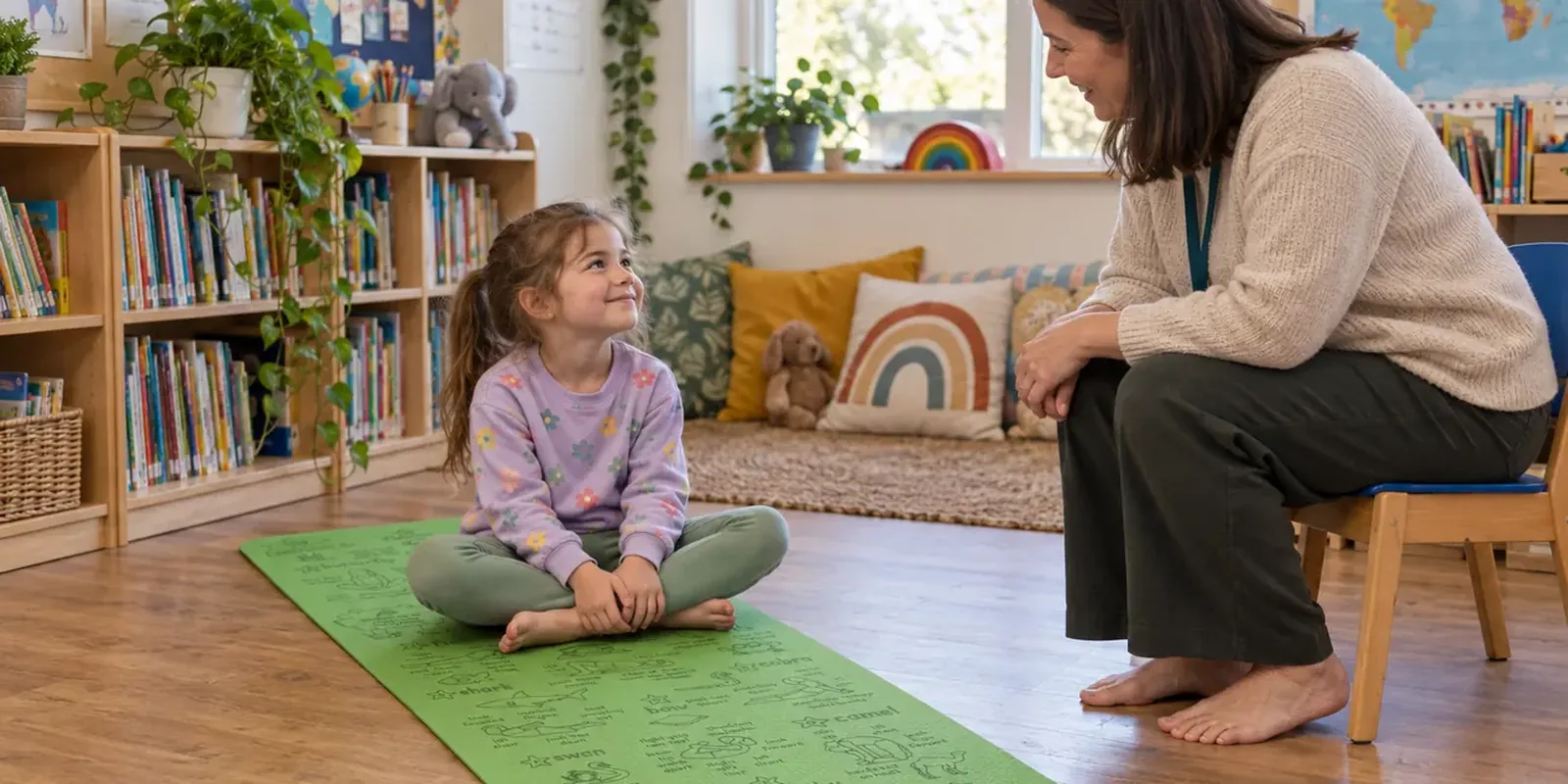
A yoga mat is one way to give that floor space a shape. Our Sun Salutation design is a full-length mat with fifteen numbered poses, laser-engraved into the surface as prompts. A rug and a game of musical statues do much the same job. A mat won't hurry a milestone, and nothing should promise to. It just makes the moving easier to start.
When should you raise physical development with nursery or a GP?
Talk to your child's key person or teacher, your health visitor or your GP whenever you're worried about how your child moves or uses their hands, without waiting for the progress check or the EYFS Profile. The NHS says that if you have concerns between reviews, you can contact a health visitor or GP, or go to your local baby clinic.
The progress check must also say what the setting will do about any concern, involving you and, where appropriate, its special educational needs co-ordinator (SENCO) or health professionals. Development Matters says "Every child can make progress if they are given the right support." An "emerging" judgement is the start of that conversation, not the end of one.
Frequently asked questions
What are 5 examples of physical development?
Running, climbing, balancing on one leg, holding a pencil and using scissors are five examples, covering both halves of EYFS physical development. Others include hopping, skipping, catching a ball, pouring a drink and using a knife and fork. There's no official list of five.
What are the 7 stages of physical development?
There's no official seven-stage model in England's early years guidance. The nearest official seven is the EYFS's seven areas of learning, of which physical development is one, and that is a list of subjects, not stages. Development Matters groups development into three broad bands instead: birth to 3, 3 and 4-year-olds, and children in reception.
What does emerging mean in the EYFS?
"Emerging" means a child is not yet at the expected level for an early learning goal at the end of reception. It's the teacher's professional judgement in the EYFS Profile, which is shared with parents and passed to the Year 1 teacher. It isn't a diagnosis, and the school must explain how you can discuss it.
How can I tell if my child's physical development is on track?
Three routine checks look at it: your nursery or childminder's progress check at age two, the NHS health and development review at 2 to 2 and a half, which covers movement, and the reception teacher's assessment at the end of reception. Children develop at different rates, so a wobble on one skill is common. If something worries you, talk to your health visitor, GP or your child's key person.
A mat for the ten minutes after nursery
A Yogi-Me mat is a full-length mat for children with 15 numbered poses laser-engraved into the surface, so there's nothing to set up and no screen to follow. It's designed for ages 3 to 8. Three- and four-year-olds copy the poses with a little help; older children lead their own sessions. Under three, we'd wait.
At 183 x 61 cm it's full length on purpose, with room to stretch out at three and still at eight. If your three-year-old wants to carry their own mat to nursery, a shorter one is easier; ours weighs 800 g and rolls up with a carry strap.
It's non-toxic, PVC-free TPE, according to our supplier's specification, with 6 mm of cushioning. Use it on a dry, flat floor. Playdough trodden in? Wipe it with a damp cloth and a little mild soap, then let it dry flat.
Sun Salutation is a standing sequence, for children who want to move. Freedom Flow keeps to the floor, for children who need to settle. Both are the same size, material and price, and standing or floor poses, side by side helps you pick.
Asked what to buy this Christmas? It's a present that can still come out on a wet Saturday in January, and our screen-free Christmas gift ideas have more like it. Doing the nursery run as a grandparent? There's room on it for you too. Two or more mats are 10 per cent off.
Pick a colour for after nursery from our full-length yoga mats for children. £34.99 each, with free UK delivery and 30-day returns.
Sources
- Department for Education - Early years foundation stage statutory framework
- Department for Education - Development Matters, updated 4 September 2023
- Department for Education, Help for early years providers - Core strength and co-ordination
- Department for Education, Help for early years providers - Fine motor skills
- Department for Education, Help for early years providers - Screen use
- Department for Education - Early years foundation stage profile results, academic year 2024/25
- NHS - Physical activity guidelines for children (under 5 years)
- NHS - Baby and toddler health and development reviews, reviewed 30 November 2023