guides
Back to School Routine: Reset After Any Holiday, Ages 3 to 8
A back to school routine for ages 3 to 8: how many nights to start, the steps in order and a checklist that works after half term, Christmas or summer.
A back to school routine brings your child's term-time bedtime and wake-up back gradually over the last few nights of a holiday. The Sleep Charity suggests moving bedtime earlier by around 10 to 20 minutes every couple of nights, and wake-up with it. At 15 minutes, half an hour of drift takes about three nights to undo and an hour takes about a week.
It's half past nine on the last Sunday of the holidays, school is in the morning, and nobody in the house is remotely tired. Here's a back to school routine for kids aged 3 to 8 that starts on the Wednesday instead, and works after a half term, Christmas or the summer.
What is a back to school routine?
A back to school routine is your child's term-time routine brought back gradually in the last few nights before school, so the first school morning isn't the first early one. It's mostly two times, bedtime and wake-up, plus what hangs off them: breakfast, screens and the bedtime steps. It isn't a new routine, just the one you already had, without the jolt.
When should you start a back to school routine?
Count back from how far bedtime has slipped. At the Sleep Charity's pace, moving 15 minutes every two nights:
- Half an hour later than term time: about 3 nights.
- 45 minutes later: about 5 nights.
- An hour later: about a week, as in the Sleep Charity's own example, which takes a 9.30pm bedtime to 8.30pm by night 7.
- More than an hour, after the summer: start at least a week before, as the Sleep Charity advises, and expect some catching up in the first week.
A one-week half term usually leaves less to undo than the summer, but check rather than guess. Term dates are set locally; gov.uk points you to your council's website.
There's a gentler option for younger children. The NHS, writing about under-5s, suggests bringing a bedtime routine forward by 5 to 10 minutes each week, or 15 if your child is used to going to bed very late. For a three-year-old who finds change hard, we think that slower pace, started earlier, is worth considering.
How do you get kids back into a school routine, step by step?
Getting kids back into a school routine takes eight steps over the last few nights. An illustrative example: a five-year-old in Reception whose term-time bedtime is 7.30pm and wake-up 7am, both slipped by 45 minutes over half term, with school on Monday.
- Wednesday: bed at 8.00pm, up Thursday at 7.30am.
- Thursday: bed at 8.00pm, up Friday at 7.30am.
- Friday: bed at 7.45pm, up Saturday at 7.15am.
- Saturday: bed at 7.45pm, up Sunday at 7.15am.
- Sunday: bed at 7.30pm, up Monday at 7.00am for school.
That's 11 and a half hours from 7.30pm to 7am, inside the Sleep Charity's guide of 10 to 12 hours a night for ages three to six.
1. Write down the two times
Note the term-time bedtime and wake-up, and how far each has drifted. You'll want the numbers when your child insists it isn't bedtime yet.
2. Count back the nights
Use the list above and start on that night, not "at the weekend". Missed it? Start tonight.
3. Move the wake-up time with the bedtime
The Sleep Charity suggests the same gradual approach for wake-up times, and getting outside, particularly in the morning. Open the curtains straight away, even if the first morning or two is grumpy.
4. Breakfast at the school time, then five minutes moving
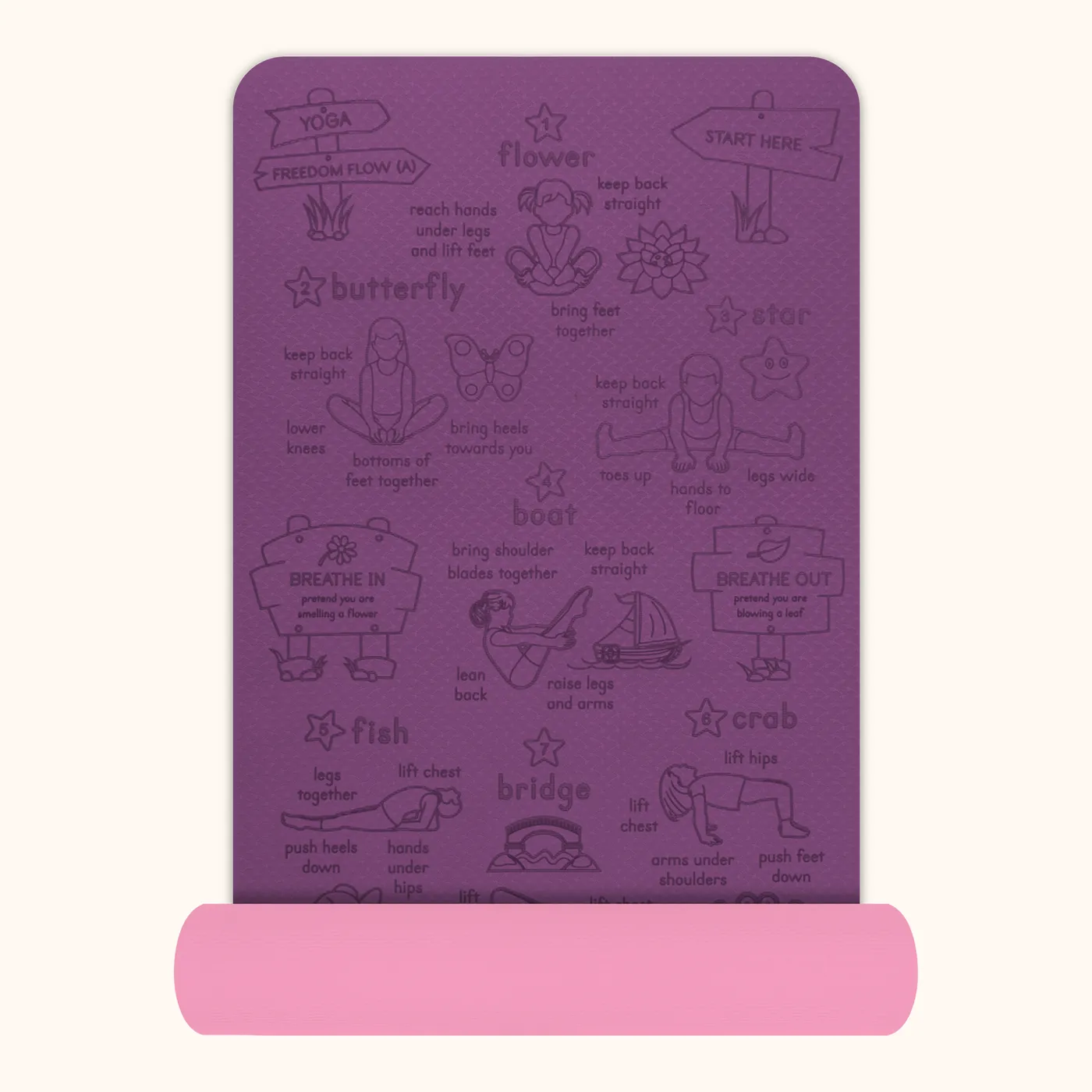
The Sleep Charity suggests breakfast at around the same time each morning, with daylight and movement afterwards. Our Sun Salutation mat has fifteen numbered poses marked into it, so a five-year-old can do cat, downward dog, tree, eagle and dancer without a screen while you find the other shoe. See the standing-pose mat, or try a five-minute morning yoga routine. Expect wobbles on the balances.
We're not claiming five minutes on a mat helps anyone settle back in. It's a morning slot that doesn't need a screen, and a small start on the NHS's daily activity guidelines for 3 and 4-year-olds and children aged 5 to 18.
5. Screens earlier each evening
Bring the screen cut-off earlier as bedtime moves, and swap in reading, drawing, music or talking about the day, as the Sleep Charity suggests. For under-5s, the government's Best Start in Life guidance says to try to avoid screens for the hour before bed. Our guide to screen time and sleep has more.
6. Bring the bedtime routine back
Bath or shower, pyjamas, teeth, story, lights out, in the order the Sleep Charity gives, every night of the countdown. If winding down is hard, add a calm floor sequence before bed.
7. Ask about tomorrow at tea, not at lights out
The Sleep Charity suggests three questions: "What are you looking forward to tomorrow?", "Is there anything you're worried about?" and "What could we do to help you feel ready?" It also suggests talking about worries away from the bedtime routine, so we'd ask them over tea or in the bath.
8. The night before: everything by the door, then lights out
Bag, uniform, shoes and lunchbox ready by the door, as the Sleep Charity and YoungMinds both suggest. Then the usual bedtime, the same goodnight words, and lights out.
On the first morning, keep the term-time wake-up and breakfast. Our school-morning checklist has the order for the rest of it. YoungMinds suggests focusing on the one thing your child needs to do next, such as "put your uniform on and then come and have breakfast".
What goes on a back to school routine checklist?
Here's the countdown for an hour's drift, to copy onto the fridge. It's a routine checklist, not a school supplies list.
- Seven and six nights out: bedtime and wake-up 15 minutes earlier. Full bedtime routine back. Breakfast at the school-day time, then daylight and five minutes on the mat.
- Five and four nights out: 30 minutes earlier. Screens off earlier.
- Three and two nights out: 45 minutes earlier.
- The night before: term-time bedtime. Questions at tea. Bag, uniform, shoes and lunchbox by the door. Lights out.
- First morning: term-time wake-up, curtains open, one thing at a time.
For 30 or 45 minutes of drift, use the same 15-minute steps and stop when you reach the term-time bedtime: start three nights out for 30 minutes, five nights out for 45.
How long does it take to get back into a routine?
Three nights to a week for the countdown, plus five minutes each morning. Even then, the Sleep Charity says a child's sleep can take several days, sometimes longer, to settle after the holidays, so the first week may still be a tired one.
When the countdown slips or the nerves kick in
- Not tired at the new bedtime. Keep the routine and carry on with the steps. The Sleep Charity's advice is not to panic.
- You ran out of nights. Start tonight. We'd move the wake-up time first, since you control it.
- Worried about going back. YoungMinds suggests a visual schedule for getting up, getting dressed, breakfast and leaving the house. Tears at home after the first day back? Read about after-school restraint collapse.
If the worry or the tiredness doesn't lift. If worry about school carries on past the first few weeks, or your child can't face going in, YoungMinds suggests talking to the class teacher, the pastoral lead or the school's SENCO, the special educational needs coordinator. For sleep problems, the NHS says to talk to your health visitor; your GP can help too.
How do you make it stick for the rest of term?
The back to school routine tips for parents that last are the boring ones:
- The same wake-up time seven days a week, which the Sleep Charity calls important. Then Monday isn't a reset, and neither is the morning the clocks go back on the last Sunday in October.
- Keep the five minutes on the mat on school mornings, so one part of the morning is the same in the holidays and in term.
- If grandparents have them for half term, the mat can travel: 800 g with a carry strap, so the countdown can start at theirs and come home already running.
- For the January return, if there's a mat under the tree, the countdown already has its morning slot. Our children's Christmas gift guide has more ideas.
If the morning slot is the part you keep, have a look at the mats: £34.99 each, free UK delivery, 30-day returns, and 10 per cent off two or more.
Frequently asked questions
How many days before school should you start a back to school routine?
Count back from how far bedtime has slipped. The Sleep Charity suggests moving bedtime 10 to 20 minutes earlier every couple of nights. At 15 minutes, half an hour of drift takes about three nights and an hour about a week. After the summer, the Sleep Charity suggests starting at least a week before.
What should you do the day before going back to school?
Get the bag, uniform, shoes and lunchbox ready, as the Sleep Charity and YoungMinds suggest. Keep the usual bedtime routine, ask about tomorrow over tea rather than at lights out, and aim for the term-time bedtime, so the first morning feels like any other.
Should the routine stay the same at weekends?
Mostly, yes. The Sleep Charity says a set wake-up time seven days a week is important. A later Friday bedtime is your call, but a steady weekend wake-up time means Monday isn't a small reset every week, and the routine you rebuilt doesn't slip again.
Is it normal for my child to be tired in the first week back?
Yes. The Sleep Charity says it can take several days, sometimes longer, for a child's sleep pattern to settle after the holidays, and new starters may need longer. If tiredness carries on for weeks, talk to your health visitor or GP.
Sources
- The Sleep Charity - Helping your child get back into a healthy sleep routine for school
- The Sleep Charity - Back to school sleep tips
- The Sleep Charity - How to get bedtimes back on track
- The Sleep Charity - How much sleep does my child need?
- NHS - Sleep and young children
- NHS - Physical activity guidelines for children and young people
- NHS - Physical activity guidelines for children (under 5 years)
- Best Start in Life (Department for Education) - Screen time guidance for under 5s
- YoungMinds - School anxiety and refusal
- GOV.UK - School term and holiday dates
- GOV.UK - When do the clocks change?