practice
Yoga Poses for Preschoolers: 15 Easy Poses for Ages 3 to 5
15 easy yoga poses for preschoolers aged 3 to 5, with the words to say out loud, which suit age 3, 4 or 5, and short sequences to try at home.
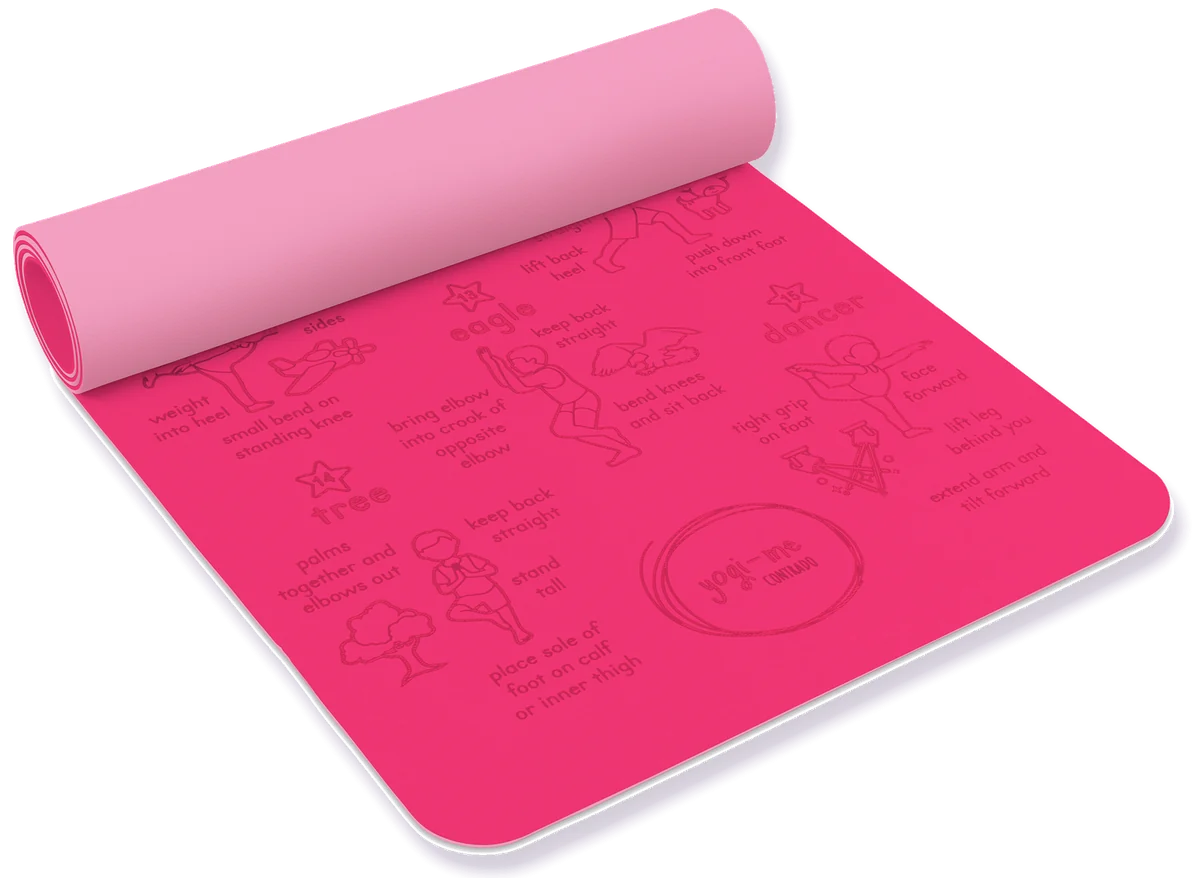
The best yoga poses for preschoolers are short, simple shapes with an animal or object to pretend to be: a mouse, a cat, a frog, a tree. Below are 15 of them, all engraved on our Sun Salutation mat, from mouse to dancer, with the words to say out loud for each.
The list starts on hands and knees and finishes on one leg. That's deliberate. We'd start a three-year-old on the first few, and the last few are meant to be wobbly. Start anywhere, stop whenever, and you'll need nothing more than a rug and a bit of floor.
Can a 3, 4 or 5 year old do yoga?
Yes. Yoga for preschoolers, or preschool yoga, is yoga for children aged roughly 3 to 5: simple poses with playful names, held for a few breaths and learned by copying a grown-up. There are no long holds and nothing to get right.
The Department for Education's Development Matters guidance says 3 and 4 year olds are learning to "stand on one leg and hold a pose for a game like musical statues", which is most of what a preschool yoga pose asks.
It also counts as movement. The NHS says pre-schoolers aged 3 to 4 should spend at least 180 minutes a day doing a variety of physical activities, spread throughout the day, and that activity of any intensity should be encouraged for under-5s. A few poses before tea is a small, easy part of that.
For safety, timing and setting up at home, see our beginner's guide to yoga for kids.
How do you use these poses with a preschooler?
Do the pose yourself, say the words, and let your child copy. Show rather than explain, so there's always something to watch. Hold each shape for three slow breaths, or for as long as they find it funny, then move on. You can start at any number.
Two breathing cues are engraved on our Sun Salutation mat, and they work without it. Breathing in: "Pretend you're smelling a flower." Breathing out: "Pretend you're blowing a leaf." Use them between poses, or whenever the giggling gets out of hand.
Your child should always move themselves into a shape. Never press or pull a limb. None of the 15 below is a headstand or a deep backbend, and we'd keep it that way at this age. If your child has a health condition, check with your GP or health visitor before you start.
What are some fun and easy yoga poses for preschoolers?
Fifteen fun and easy yoga poses for preschoolers are mouse, cow, cat, downward dog, dolphin, rag doll, mountain, chair, frog, rainbow, airplane, deer, eagle, tree and dancer. The first five are on hands, knees or forearms, the middle five are standing, folding and squatting shapes, and the last five are lunges and balances. The words in quotation marks follow the cues engraved beside each pose.
1. Mouse
Mouse is a small, curled-up kneeling rest. Say, "Knees wide, big toes touching, hips to heels, hands forward, stretch your spine." Preschoolers like it because it's a hiding place, and it's where every other pose can come back to.
Good for: age 3 and up. A natural place to start and finish.
Cow
Cow is a dipped back on hands and knees. Say, "Wrists under shoulders, knees under hips. Arch your back and lower your belly, chest forward, chin up." Add a long "moo". Children take to it because it comes with a noise, and the noise is the best bit.
Good for: age 3 and up. Pair it with cat.
3. Cat
Cat is the opposite of cow: a rounded back on hands and knees. Say, "Round your back and lift your belly, drop your head and neck." Then hiss or miaow. Going from cow to cat and back again makes a gentle rocking movement that's easy to pick up.
Good for: age 3 and up.
Downward dog
Downward dog is an upside-down V shape on hands and feet. Say, "Feet hip-width apart, push the floor away with your hands, lift your hips to the sky, arms by your ears." Looking at the room upside down between your legs is half the fun, and a bark is optional.
Good for: age 3 and up. Heels don't need to touch the floor.
Dolphin
Dolphin is downward dog on the forearms instead of the hands. Say, "Interlock your fingers, push your forearms down, lift your hips to the sky." It asks more of the shoulders than dog, so keep it short. Pretend to dive down into the sea, then swim back up to dog.
Good for: age 4 and up. Three breaths is plenty.
Rag doll
Rag doll is a floppy standing forward fold. Say, "Feet hip-width apart, small bend in your knees, tilt your hips forward, palms to your ankles." Then let the arms dangle and swing. Going floppy on purpose is the whole appeal.
Good for: age 3 and up. Come up slowly, one bit at a time.
Mountain
Mountain is standing tall and still. Say, "Feet together, stand tall, shoulders relaxed, open your chest, palms face forward." It looks like nothing, which is why it's useful: it's the starting point for every standing pose that follows, and a good spot for a smelling-a-flower breath.
Good for: age 3 and up. The reset between standing poses.
Chair
Chair is a half-squat, as if sitting on an invisible seat. Say, "Feet together, bend your knees and sit back, weight into your heels, arms by your ears, keep your back straight." Ask what kind of chair they are: a throne, a deckchair, a wobbly stool. Thighs tire quickly.
Good for: age 3 and up. Count to three, then stand.
Frog
Frog is a deep, wide squat. Say, "Heels in, toes out, elbows against your inner thighs, keep your back straight." Then hop forward and land back in the squat, with a croak. The hopping makes it the noisiest pose on the list, which is usually a selling point.
Good for: age 3 and up. Clear the space for hops.
Rainbow
Rainbow is a standing side bend. Say, "Stretch your arms overhead, palms together, lean to one side." Then come back up and lean the other way. Name a colour for each side. It's an easy one for a whole family to do in a row.
Good for: age 3 and up. Always do both sides.
Airplane
Airplane is a balance on one leg, with the other leg stretched behind. Say, "Small bend on your standing knee, weight into your heel, leg extends back, arms out to the sides." Then fly. Expect a real wobble, which is fine, and a fingertip on a wall helps.
Good for: age 5, or age 4 with a hand on a chair.
Deer
Deer is a lunge with arms up, like antlers. Say, "Push down into your front foot, back leg straight, lift your back heel, stretch your arms overhead." Both feet stay on the floor, so it feels steadier than the balances around it. Spread the fingers wide for antlers.
Good for: age 4 and up. Swap legs and do it again.
13. Eagle
Eagle is a wrapped-up squat. Say, "Bend your knees and sit back, bring one elbow into the crook of the other, keep your back straight." For preschoolers, wrap the arms only and leave both feet flat on the floor. Flapping the wrapped wings afterwards is optional but popular.
Good for: age 4 and up, arms only.
14. Tree
Tree is a balance on one leg with the other foot resting against it. Say, "Stand tall, place the sole of your foot on your calf, palms together, elbows out." For a three-year-old, rest the heel on the ankle and keep the toes on the floor. A tree that sways in the wind still counts.
Good for: age 3 with toes down, age 5 foot up.
15. Dancer
Dancer is the trickiest balance on the mat. Say, "Lift your leg behind you, tight grip on your foot, extend your other arm and tilt forward, face forward." Holding a foot behind you while standing on one leg is a lot for a five-year-old. Let them hop out of it and laugh.
Good for: age 5, with a wall nearby. Expect wobbles.
Which poses suit a 3, 4 or 5 year old?
We'd start a three-year-old on the floor poses, apart from dolphin, and the simple standing shapes. Yoga for 4 year olds can add dolphin, the deer lunge and the arms-only eagle. The one-leg balances suit five-year-olds best, though younger children can try them with a hand on a wall. This is our rough guide, not a milestone chart.
- Age 3: mouse, cow, cat, downward dog, rag doll, mountain, chair, frog, rainbow, and tree with the toes on the floor.
- Age 4: add dolphin, deer and eagle with the arms only.
- Age 5: add airplane, dancer, and tree with the foot on the calf.
Development Matters says children in Reception, the school year in which they turn five, are learning to develop "the overall body strength, coordination, balance and agility" they'll need for PE, dance and gymnastics. A three-year-old who can't yet do what a five-year-old can isn't behind. They're three. If your child is younger still, our post on yoga for toddlers has simpler shapes.
Which short sequences suit a preschooler?
Three to five poses in a row make a short session, and finishing on mouse or mountain gives it an ending. Here are three illustrative combinations using only the 15 above. Each takes a few minutes and suits a different moment, from the morning rush to a wet afternoon indoors.
An illustrative wake-up, standing. Mountain, rainbow to both sides, chair, rag doll, then roll slowly back up to mountain. Good for a three-year-old in pyjamas.
An illustrative animal parade, on the floor. Mouse, cow, cat, downward dog, then frog hops across the room, with every animal's noise. Siblings can take turns calling the next animal.
An illustrative wobble challenge, for a five-year-old. Mountain, tree on each leg, airplane, dancer, then mouse to rest. Count the breaths each balance lasts and try to beat it next time, not to beat anyone else.
If a sibling or grandparent wants to join in, our 3 person yoga poses turn some of these shapes into group ones. For a wider set, including butterfly, boat and star, see easy yoga poses for kids.
What if your preschooler only wants to watch?
Some preschoolers don't want to be shown anything, and some hate being watched while they try. That's normal. Do the poses yourself, out loud, and let them drift over when they're ready. Development Matters suggests letting less confident children in Reception spend time at first "observing and listening, without feeling pressured to join in".
Leave a mat or a rug out where they'll find it, and try again another day. Turning it into a game can help too: you call a number and they become that animal, or they call one for you.
If the real competition is a screen, the government's Best Start in Life guidance suggests children aged 2 to 5 keep screen time to one hour a day, less if possible. The aim is balance, not a ban, and a few poses are one more thing to reach for first.
Frequently asked questions
What are some good yoga poses for a 3-year-old?
Mouse, cow, cat, downward dog, rag doll, mountain, chair, frog and rainbow all suit a three-year-old. They're on the floor or on two feet, so there's nothing to fall from. Tree works too, with the toes kept on the floor.
What are five easy yoga poses for kids?
Mouse, cat, cow, downward dog and frog. All five are low to the floor, on hands and knees, hands and feet, or in a squat. Each is an animal with a noise to make, and they're the five we'd start a three-year-old on.
Can a 4 year old do yoga?
Yes. Development Matters says 3 and 4 year olds are learning to stand on one leg and hold a pose, which is what yoga asks. We'd give a four-year-old everything in the age 3 list, plus dolphin, deer and an arms-only eagle.
How long should a preschool yoga session be?
There's no official length, so follow your child. Three to five poses, each held for three slow breaths, is a good start. The NHS says pre-schoolers' activity should be spread throughout the day, so several short bursts through the day are fine.
Do preschoolers need a yoga mat?
No. A rug or carpet works for every pose on this list. A non-slip mat helps with balances such as tree and airplane, and a mat with the poses on it lets a child choose the next one without asking you.
A mat with all 15 poses on it
All 15 poses above are laser-engraved into our Sun Salutation mat, with the same short cues. Each has a number and a small picture beside it, which makes the mat a set of kids' yoga poses with pictures: a child who can't read yet finds the next pose by its picture, with no screen and nothing to set up.
It's designed for ages 3 to 8. Three- and four-year-olds copy the animal poses with a little help, and older children lead their own sessions. Under three, we'd wait for the mat and start with the toddler shapes.
At 183 x 61 cm it's full length on purpose, so there's room to stretch out at three and still at eight, and you can stand on it alongside. Buying as a grandparent? You can have a go at the tree pose too. The trade-off: if a three-year-old will carry it to nursery alone every day, a shorter mat is easier for them. Ours weighs 800 g and rolls up with a carry strap.
It's 6 mm of non-toxic, PVC-free TPE, according to our supplier's specification. Use it on a dry, flat floor. After sticky fingers, wipe it with a damp cloth and a little mild soap, then let it dry flat.
If it's for Christmas, will it just sit gathering dust? Not if it's left out. It's frog hops on Christmas afternoon and a wobble challenge on a wet January Saturday, because using it is just a matter of rolling it out. Our guide to gift ideas that aren't another screen has more for this age.
Sun Salutation suits a child who wants to move. Our Freedom Flow design has a different set of 15 poses, most of them on the floor, for a child who needs to settle, at the same size and price, and Sun Salutation or Freedom Flow puts them side by side. Buying for an older sibling or a cousin too? Two or more mats are 10 per cent off. As Becks, a yoga teacher and verified buyer, put it: "I just made the mistake of buying one, instead of two."
Start with mouse on the rug tonight, then choose a colour your preschooler will want to roll out. Each design comes in seven colours, and every mat is £34.99 with free UK delivery and 30-day returns.