guides
Autumn Activities for EYFS: 14 Ideas Led by Movement
Autumn activities for EYFS using leaves, conkers and puddles: 14 ideas across all seven areas of learning, and a woodland yoga story for Reception.
Good autumn activities for EYFS use what the season drops at your feet: leaves to chase, puddles to jump, conkers to count and a wind to dance in. The 14 ideas below cover all seven areas of learning, and they start with physical development, because autumn is when wet play arrives. Each works with a group in nursery, preschool or Reception, or with one child at home.
The EYFS (Early Years Foundation Stage) is the framework every nursery, childminder and Reception class in England follows for children from birth to five.
Planning by area of learning, and what to gather
These autumn ideas for EYFS are grouped by area of learning, with the area in brackets, so they drop straight into your planning. Most suit three- and four-year-olds; where one works in the baby room or needs Reception-age hands, it says so.
You need a collecting bag, wellies, a few scarves and a clear patch of floor. Start anywhere, and repeat the ones the children ask for. Conkers and acorns are for supervised play only: the NHS advises keeping small objects out of reach of young children because of the risk of choking.
Why start autumn with movement?
Physical development is one of three prime areas in the Department for Education's EYFS statutory framework, and its gross motor early learning goal asks children to "move energetically, such as running, jumping, dancing, hopping, skipping and climbing." The Department's Help for early years providers says adults can support core strength, balance and co-ordination by creating games indoors and outdoors.
The NHS says pre-schoolers aged 3 to 4 should spend at least 180 minutes a day being physically active, including at least 60 minutes of moderate-to-vigorous activity. In a wet October those minutes are the hardest to find, so the first four ideas are about moving. Our guide to physical development in the EYFS explains both early learning goals.
What are good autumn activities for EYFS?
1. Hedgehog, squirrel and owl (physical development)
Curl up small like a hedgehog going to sleep, crouch low like a squirrel burying an acorn, then stand tall and spread your owl wings. Call the animals in a different order each time so the children have to listen. Works on a carpet, age 3 up.
2. Catch a falling leaf (physical development)
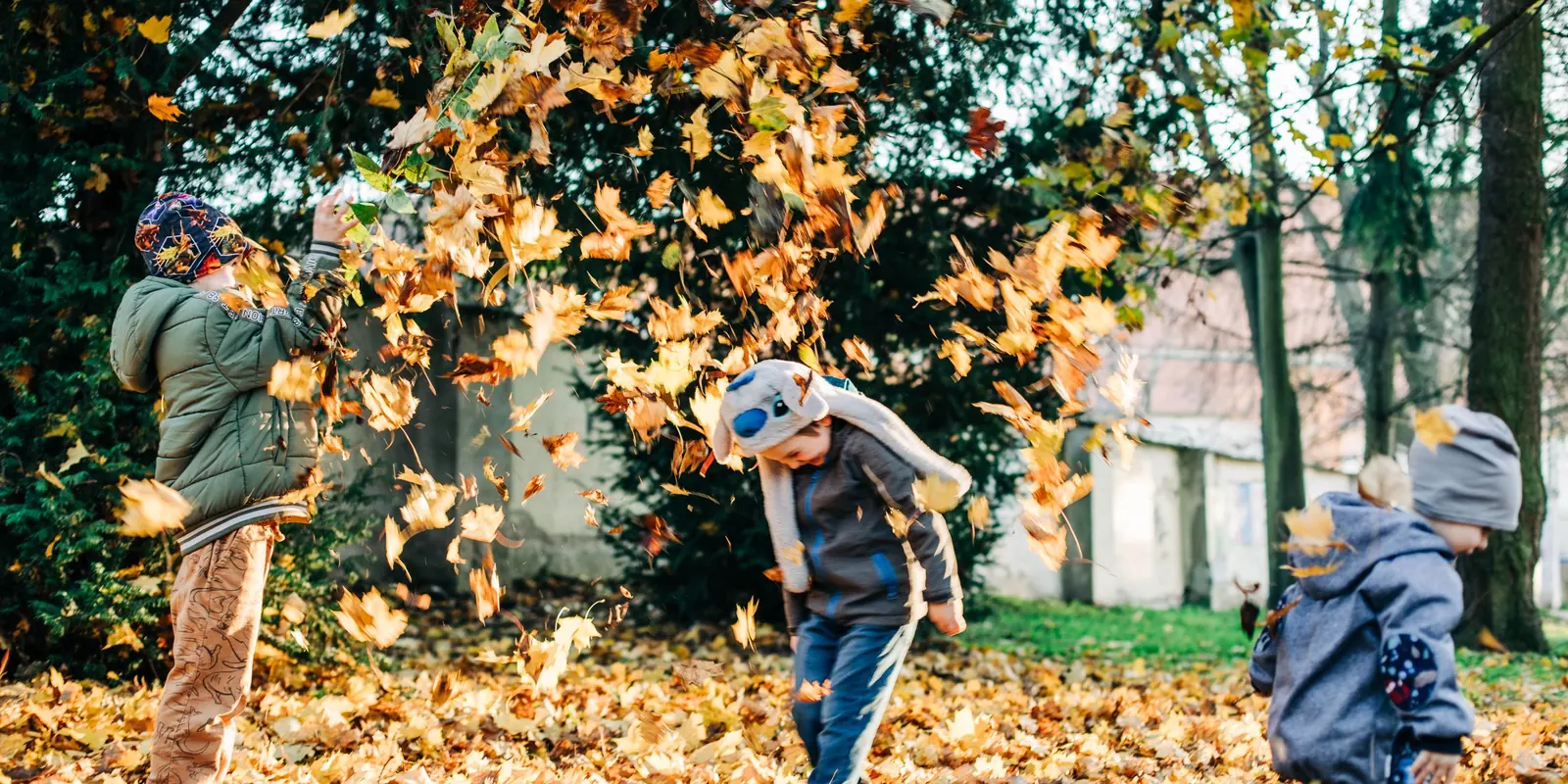
An autumn game for EYFS for a breezy day and an open space. Children chase falling leaves and try to catch one before it lands: running, stopping, turning and reaching at once. Two-year-olds can catch leaves you drop from above their heads.
3. Puddle and leaf-pile jumping (physical development)
Wellies on. Jump two-footed into a puddle, hop over a small one, then land in a pile of leaves. Try a big jump, a tiny jump and a silent jump, counting as you go. Toddlers step in with a hand to hold.
4. The conker carry (physical development)
Set out a short route: cones to weave round, a bench to step over, a tunnel to crawl through. Each child carries a conker on a large spoon, or in tongs, without dropping it. It covers moving round obstacles and a steady grip together.
5. A listening walk (communication and language)
Walk slowly and stop every so often to listen. Leaves crunching, rain dripping, a bird, the wind in the trees. Collect the words on the way back and say them together. Children who copy the sounds instead are joining in too.
6. The autumn feely bag (communication and language)
Put a pine cone, a conker, a smooth leaf, a crinkly leaf and a feather in a cloth bag. A child feels one without looking and describes it: bumpy, prickly, smooth, cold. The others guess. Quieter children get a turn without standing up.
7. Build a hedgehog house (personal, social and emotional)
Gather sticks and leaves and build a small heap in a quiet corner outside. Each child adds one thing in turn, so it becomes practice in waiting and sharing. Talk about why a hedgehog might want somewhere dry to sleep, then leave it be.
8. Still as a tree (personal, social and emotional)
A calm-down for the end of a busy session. Stand with feet planted like roots. Breathe in and lift your arms like branches, breathe out and sway in the wind, then stand still as the wind drops. Three rounds, then tidy-up time.
9. Story stones from autumn finds (literacy)
Draw a simple picture on flat stones or stiff card: a leaf, an owl, a pumpkin, a hedgehog, the moon. Children pick three from a bag and tell a story that joins them up. Reception children can try writing a word for each.
10. Count and compare conkers (mathematics)
Give each small group a pile of conkers and acorns. Count them, sort them, and ask which pile has more, then line them up to check. Reception children can add a handful and count on. Keep numbers small for three-year-olds.
11. Leaf sorting by size and colour (mathematics)
Collect leaves on a dry day. Sort them from green through yellow and red to brown, then line them up from smallest to biggest. Which is the longest? Which is the most spotty? Every child can join in at their own level.
12. A signs-of-autumn tally walk (understanding the world)
Draw five pictures on a clipboard before you go out: a falling leaf, a conker, a puddle, a bird, a bare branch. Children make a mark each time they spot one. Back inside, count which you saw most. Repeat in a few weeks.
13. The festivals of the autumn term (understanding the world)
Autumn brings harvest festival, Diwali and Bonfire Night. Invite children to share what their families do and talk about lights, food and coming together. Bonfire Night is 5 November; harvest and Diwali move each year, so check the dates first. For the evening itself at home, there are Bonfire Night activities for kids.
14. Wind-and-leaves dance (expressive arts and design)
Give each child a scarf or a strip of tissue paper. Put on some music and be the wind: swirl, twirl, run in circles, then float down and lie still. Switch from fast music to slow and watch the movement change.
What are some autumn yoga poses for kids?
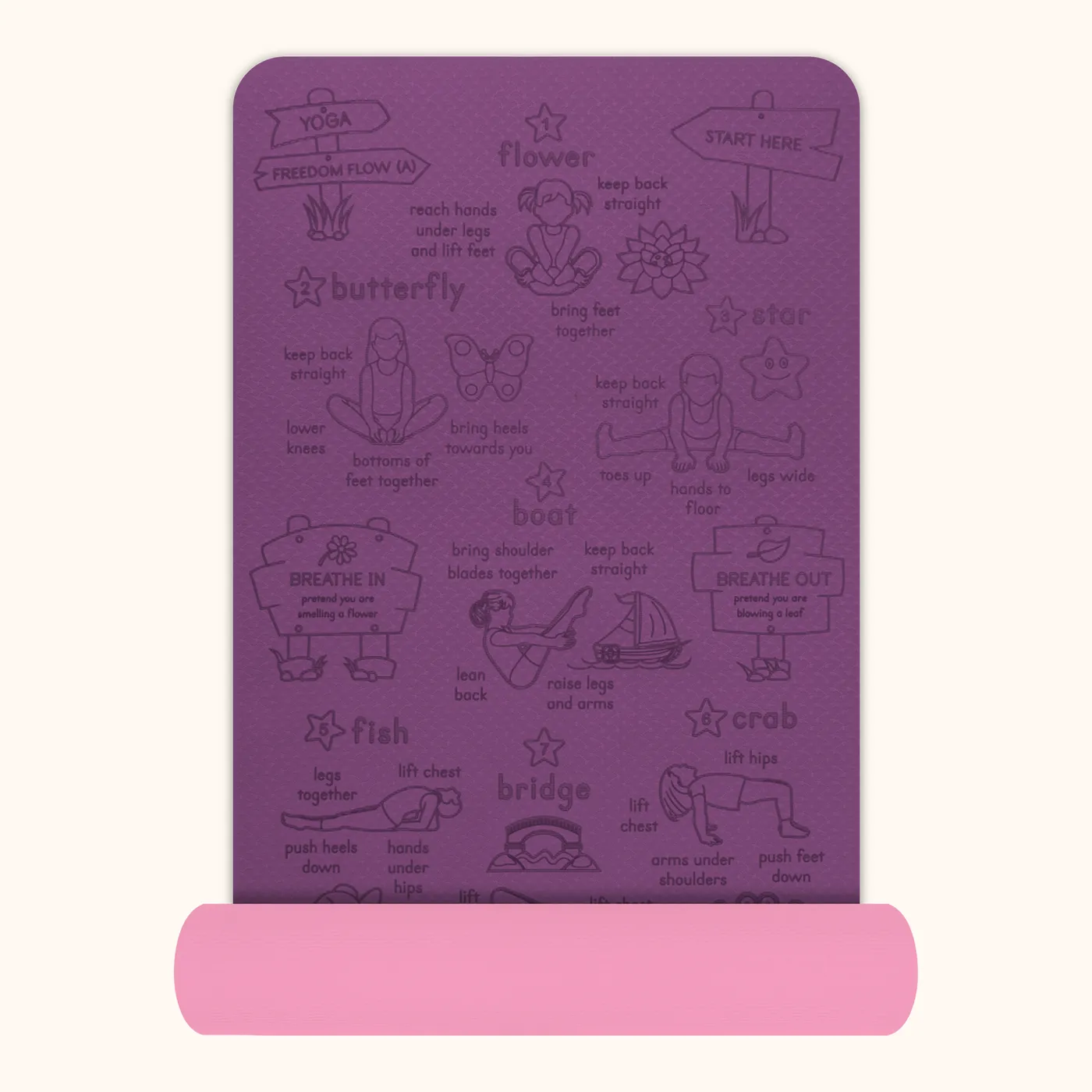
Autumn yoga for kids works best as a story. This one puts seven poses from our Sun Salutation mat together; the pose names are the mat's, and the woodland animals are the story we tell on top.
- The hedgehog curls up for winter. Mouse: knees wide, sit back on your heels, forehead down.
- The squirrel buries an acorn. Frog: a low squat, heels in, toes out.
- The deer listens in the wood. Deer: a lunge, arms up for antlers.
- The owl folds its wings. Eagle: knees bent, arms wrapped, wobbles allowed.
- The tree lets go of its leaves. Tree: on one leg, arms swaying.
- The leaves flop to the ground. Rag doll: a floppy fold with soft knees.
- The wood goes quiet. Mountain: feet together, standing still.
Hold each for three slow breaths. It takes about five minutes and runs on any carpet. On our Sun Salutation mat the poses are marked into the surface in order, from mouse to dancer, so children can find the next one themselves. New to this? Our beginner's guide to kids' yoga covers the first sessions.
Roll out the autumn story with the whole room. For one mat per child, see how class sets work: volume pricing starts at 10 mats, and settings can order on a purchase order. Each mat is 183 x 61 cm, so a set needs a hall or a cleared carpet. They're designed for ages 3 to 8, so they suit preschool and Reception. In the baby room, we'd wait.
What can you do on a wet autumn day in nursery?
Run three movement ideas back to back indoors: hedgehog, squirrel and owl, then the wind-and-leaves dance, then the yoga story to bring everyone down. That's about 15 minutes of moving with nothing but scarves. For Reception and Key Stage 1 there's a 10-minute yoga routine for a class, and more rainy-day movement ideas for home.
When children would rather watch the leaves fall
Some children want to watch first, and that's fine. Let them be the wind that tells the leaves when to fall, or the one who calls the next animal. If the whole group is flat, go outside, even briefly, and try the idea again another day with fewer words and more doing.
Parents and grandparents: children who've done the autumn story at nursery often want to do it again at home. Our list of presents that keep them moving has ideas that don't need a screen.
Frequently asked questions
Which autumn activities suit babies and toddlers?
Keep it sensory and close: catching leaves you drop, the feely bag with large items only, puddle stepping with a hand to hold, and the wind-and-leaves dance from a lap. The other movement ideas suit autumn activities for preschoolers aged 3 and 4. Keep conkers and acorns well out of reach of under-threes.
How can I add autumn to continuous provision?
Swap seasonal materials into areas the children already use: leaves and conkers in the maths area for counting, scarves by the music corner, story stones in the reading area and a tally clipboard by the door. For autumn activities in the early years, a small change in every area works better than one big autumn table.
Are conkers safe to use with nursery children?
Use them only in supervised activities with three- and four-year-olds, and count them back in at the end. Conkers and acorns are small enough to choke on, and the NHS advises keeping small objects out of young children's reach. Keep them away from under-threes altogether, including in the feely bag.
What are good autumn games for EYFS?
Catching falling leaves, the conker carry obstacle route, the signs-of-autumn tally walk and the hedgehog, squirrel and owl calling game. All four get children moving, need almost no equipment and work with a small group or a whole class, indoors or out.