practice
Wake and Shake: A 5-Minute Morning Routine
Wake and shake without the video: a five-minute morning movement routine for Reception and KS1 that any adult can call out loud, step by step.
Wake and shake is a short burst of whole-class movement at the start of the school day: a few minutes of copying a leader's moves, usually to music, before anyone sits down to learn. This version needs no video and no song. It's seven moves you can call out loud, and it takes five minutes by the clock.
It's 8.55. The register is done, two children are still taking their coats off, and the rest of Year 1 is either yawning or bouncing off the walls. Wake and shake is for that moment.
What is wake and shake?
Wake and shake, sometimes called wake up shake up, is a routine UK primary schools and nurseries use first thing, in the playground or the classroom. A teacher, a pupil or a video leads, and everyone copies the moves. Some schools pick a different song for each day of the week and change the list every half term. Others reuse the same videos as brain breaks between lessons.
It's not a PE lesson. PE is a taught subject: at Key Stage 1, the national curriculum expects pupils to be taught running, jumping, throwing and catching, team games and dances with simple movement patterns. Wake and shake in KS1 is shorter and simpler than any of that: a way to get the blood moving, not a lesson in how to move.
When does wake and shake work best?
At the start of the school day, before the first long sit on the carpet, which is why it's in the name. Straight after lunch is the other good slot.
The NHS guidelines for 5 to 18-year-olds ask children to cut the time spent sitting or lying down, interrupt long still stretches with some activity and "spread activity throughout the day". For nursery children, the NHS guidance for under-5s says children under five shouldn't spend long spells inactive while they're awake, and the UK Chief Medical Officers' guidelines make the same point about long sedentary spells. A wake and shake is one of the easiest ways to act on that inside a school timetable.
How do you keep a wake and shake safe?
Five minutes of jumping in a room full of furniture needs a few rules, set once and kept every day. They matter most with the youngest: a nursery class of three-year-olds needs more room and smaller jumps than a Year 3 class.
- Arm's length. Ask everyone to stretch their arms out and turn slowly. If they can touch someone or something, they move.
- Clear floor. Chairs pushed in, bags and coats off the floor, nobody next to a table corner.
- Feet. Bare feet or shoes, never socks on a hard floor.
- Soft landings. Bend the knees on every jump. For nursery and Reception, keep jumps small and two-footed.
- Sit out if it hurts. The NHS tells families to pick exercise that fits a child's age, ability and experience, and to build up a bit at a time. Our rule on top: a child who feels hurt or unwell sits down, and an adult checks on them.
A five-minute wake and shake to call out loud
Say each step, do it with them, and keep an eye on a clock with a second hand. The poses in steps 4 to 7 come from our Sun Salutation mat, but you don't need a mat to do any of this.
1. March on the spot (1 minute)
"Knees up, arms swinging, march like a band." Start slow, speed up for the last 20 seconds, then slow down again. Some children will march backwards round the room; steer them back to their spot.
2. The big shake (30 seconds)
"Shake your hands, your arms, your shoulders, your knees, your whole body, all floppy." Count down from ten out loud and freeze on zero. Expect giggling and at least one dramatic collapse.
3. Star jumps (30 seconds)
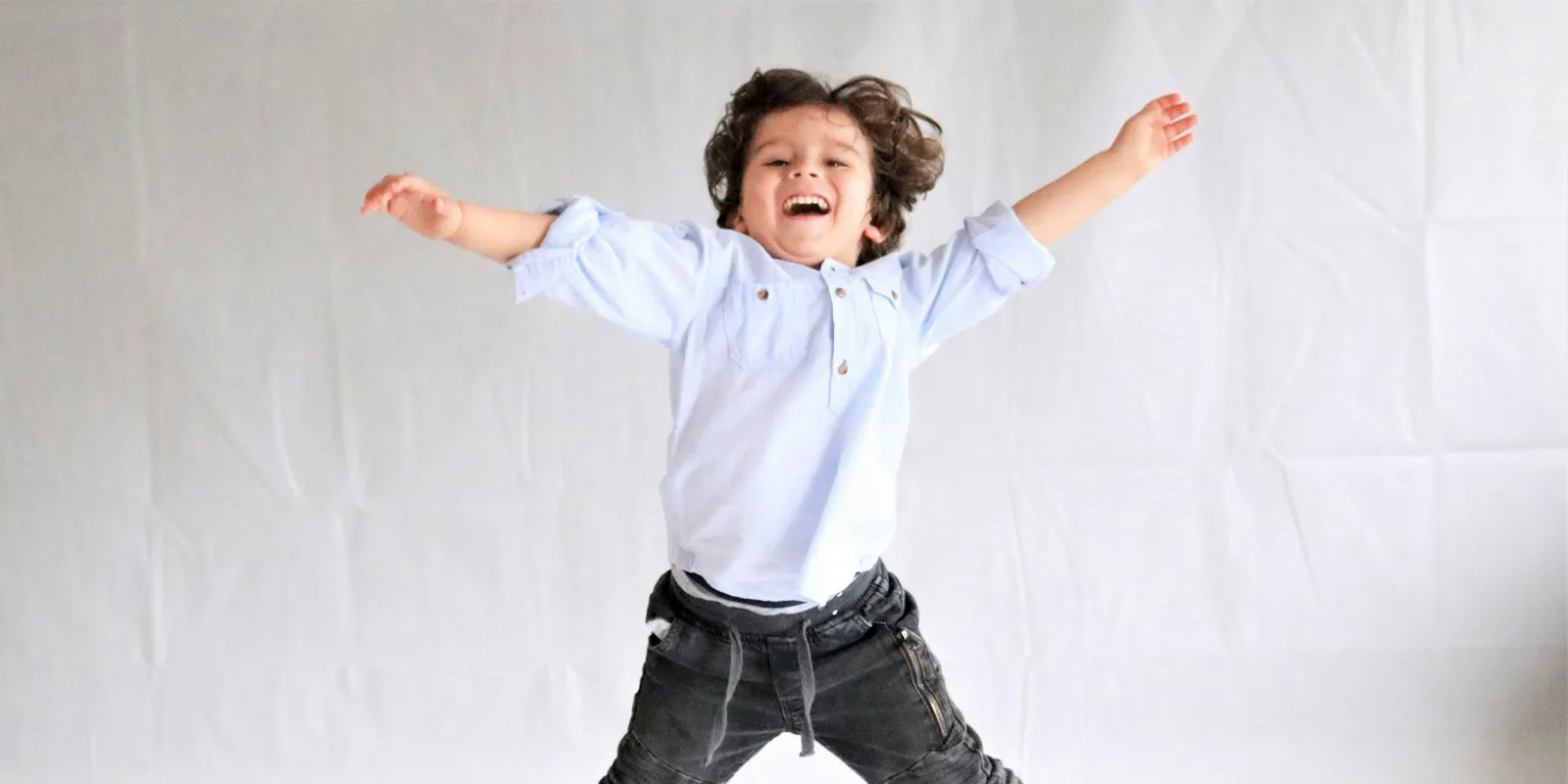
"Jump your feet out and your arms up into a star, then jump back in." Ten slow ones, counted together. For a small space or a child who'd rather not jump, step one foot out at a time instead.
4. Reach and flop (45 seconds)
"Stand tall like a mountain, reach both arms right up to the ceiling, then flop forward like a rag doll and let your arms hang." Rise slowly and do it three times. The flop is everyone's favourite; the slow rise is the hard bit.
5. Frog jumps (45 seconds)
"Squat down low like a frog, hands on the floor between your feet, then jump up and come down quietly into your squat again." Five jumps, with a rest between. Children will want to make them huge, so ask for the quietest landing in the room.
6. Tree (1 minute)
"Stand on one leg and rest your other foot against your calf, never your knee. Press your hands together." About 30 seconds on each side, eyes on one spot. Wobbles are fine; a hand on the chair back is fine too.
7. Still as a mountain (30 seconds)
"Feet together, arms by your sides, eyes closed if you like. Breathe in slowly, and out slowly." Three breaths. It's the step that turns a wiggly class into one that's ready to sit down.
That's 1 minute, plus 30, 30, 45 and 45 seconds, another minute, and 30 seconds: 5 minutes exactly.
How long does a wake and shake take?
Five minutes, as written. On a tight morning, steps 1, 2 and 7 together take two minutes and still do the job. On a wet day with no outdoor play, run it twice with a different leader each time. Whatever the length, end on the still mountain, not on the big shake, or the shake is what you'll get for the rest of the morning.
What if the class goes wild?
It happens, especially on a Monday and in December. Drop your own voice, slow the count right down and go back to step 7 early: a class that's still for three breaths has reset, even if they skipped the frog jumps.
A few children won't want to join in, or will join in only from the back. Let them. Give the reluctant ones a job: holding the clock, calling the countdown in the big shake, choosing tomorrow's extra move. Most join in properly within a week or two, once it's clearly the same every day and nobody's watching them.
If a child can't do a move, swap it rather than stop: steps instead of jumps, a hand on the wall for tree. Wake and shake works because everyone finishes it.
How do you make wake and shake a daily habit?
Same time, same place, every school day, so it stops being an activity and starts being part of the morning. Once the class knows the seven steps, hand the calling to a pupil. Change one move a week to keep it fresh, but keep the march at the start and the mountain at the end.
Some teachers like music for the march and shake. Any track with a steady beat works; there's no need to buy a "wake and shake song", but do check the words before you play it to six-year-olds. Families can do the same five minutes at home before school, in the hallway, on mornings that need it.
This routine is deliberately short, so the longer formats live elsewhere. Before a PE lesson, our PE warm-up games build up properly. For a calm start on the carpet, circle time games get a group talking and taking turns. Between lessons, movement breaks run from 30 seconds to five minutes, and brain breaks for kids include calming ones for after the shake. At home, morning yoga for kids is a slower start.
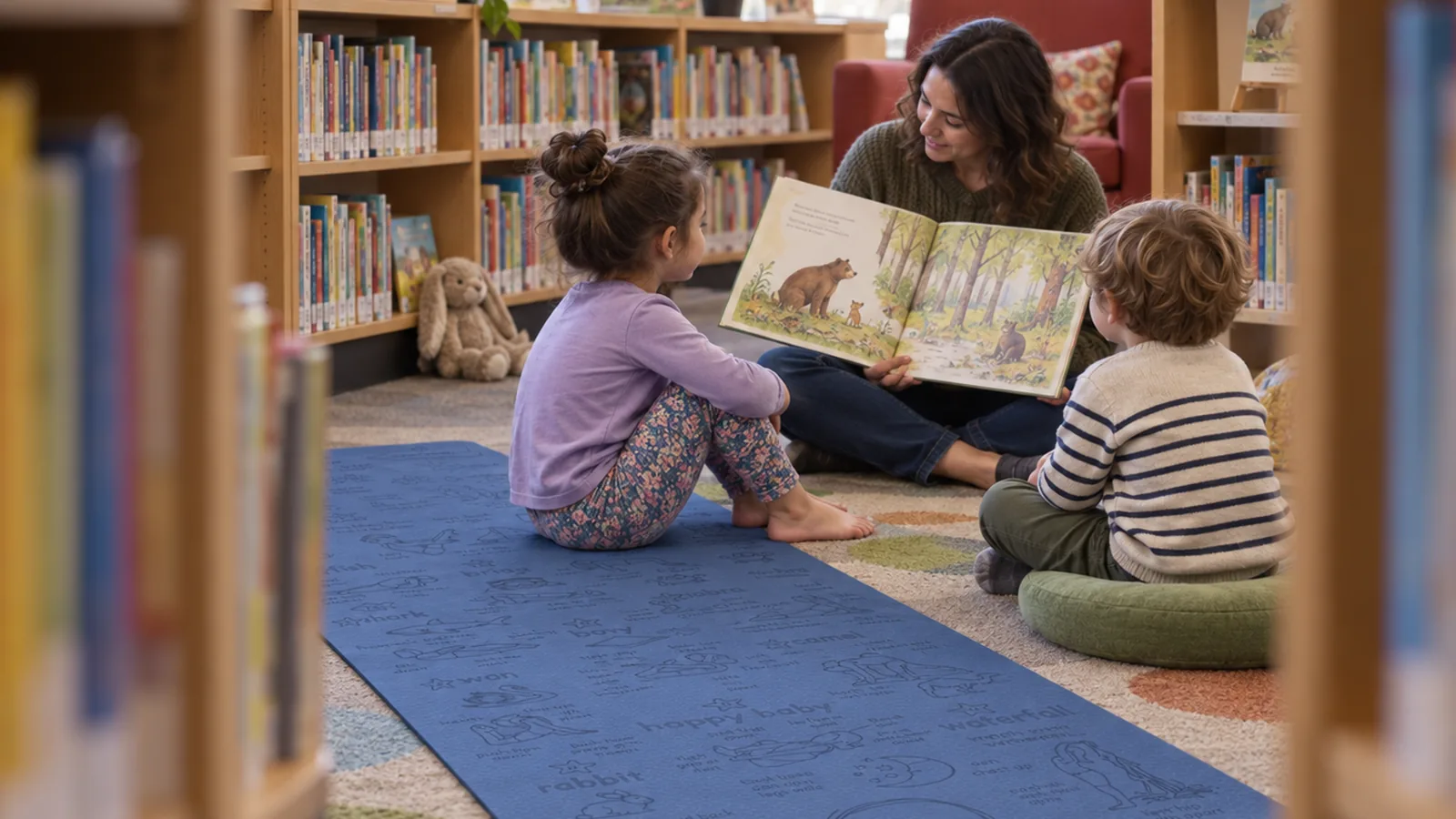
For a class that wants to lead itself, the Sun Salutation mat shows its 15 poses as numbered, laser-engraved shapes, so a child can check how mountain, rag doll, frog or tree should look without a screen. Tree is pose 14. It's 183 x 61 cm, full length, and made for ages 3 to 8. And if you're wondering how five minutes fits a whole day, our guide to how much exercise kids need sets out the NHS figures by age.
Frequently asked questions
Where can I find wake up shake up routines without a video?
The seven-step routine on this page is one: march, shake, star jumps, reach and flop, frog jumps, tree and a still finish, five minutes in total, called out loud. Once a class knows it, swap one move a week for a new one, or let a pupil invent the next move. Any adult can lead it without a screen.
Is wake and shake PE?
No. PE is a taught national curriculum subject, and at Key Stage 1 pupils should be taught to master basic movements, play team games and perform simple dances. Wake and shake is a few minutes of movement before lessons. It doesn't replace PE, but it does fit the Chief Medical Officers' advice to break up long spells of sitting.
Can you do wake and shake at home before school?
Yes, and it suits the gap between being dressed and leaving the house. Do it in the hallway or living room, barefoot or in shoes rather than slippery socks, with whoever is around. Five minutes is enough, and the march and the big shake work in a very small space. Skip the jumps if you live above someone.
How much activity do children need a day?
For ages 5 to 18, the NHS figure is at least an hour a day of moderate or vigorous activity on average over the week. For 3 and 4-year-olds it's at least 180 minutes of varied activity spread through the day, with an hour or more of that at moderate to vigorous effort. A wake and shake is a few minutes of that, not the whole of it.