practice
Yoga Stories for Kids: How to Tell One, Plus Three to Try
Three short yoga stories for kids aged 3 to 8, built from the poses on the mat, and a simple way to turn any picture book into one. No screen needed.
Yoga stories for kids are stories read aloud in which your child makes the shape of each character as it appears: a boat rocks, a crab scuttles, a cat stretches. Below are three short ones for ages 3 to 8, each about five minutes long and built from poses on our mats, plus a simple way to turn any picture book into one.
The same picture book has been read four times in a row, your child wants it again, and sitting still is no longer on offer. A yoga story lets you read it a fifth time with everyone up and moving.
What is a yoga story for kids?
A yoga story for kids is a story with the actions built in. Instead of listening on the sofa, your child becomes each character in turn: a butterfly flaps its knees, a mouse curls up small, a goat trip-traps over a bridge. You read, they move, and the story decides the order of the poses.
It isn't a class or a test of who can balance longest. A three-year-old's crab may be more of a scramble, and that's fine.
When is the best time for yoga story time?
Yoga story time for kids fits wherever a story already does: after nursery or school, on a wet weekend afternoon, or when a grandparent arrives with a bag of books. A floor story with a long rest suits the slower part of the day, and a standing one suits the restless part.
A story won't cover a day's moving on its own. The NHS asks pre-schoolers for at least 180 minutes a day, spread throughout the day, and school-age children for an average of at least 60 minutes of moderate or vigorous activity a day over the week.
How do you turn a picture book into a yoga story?
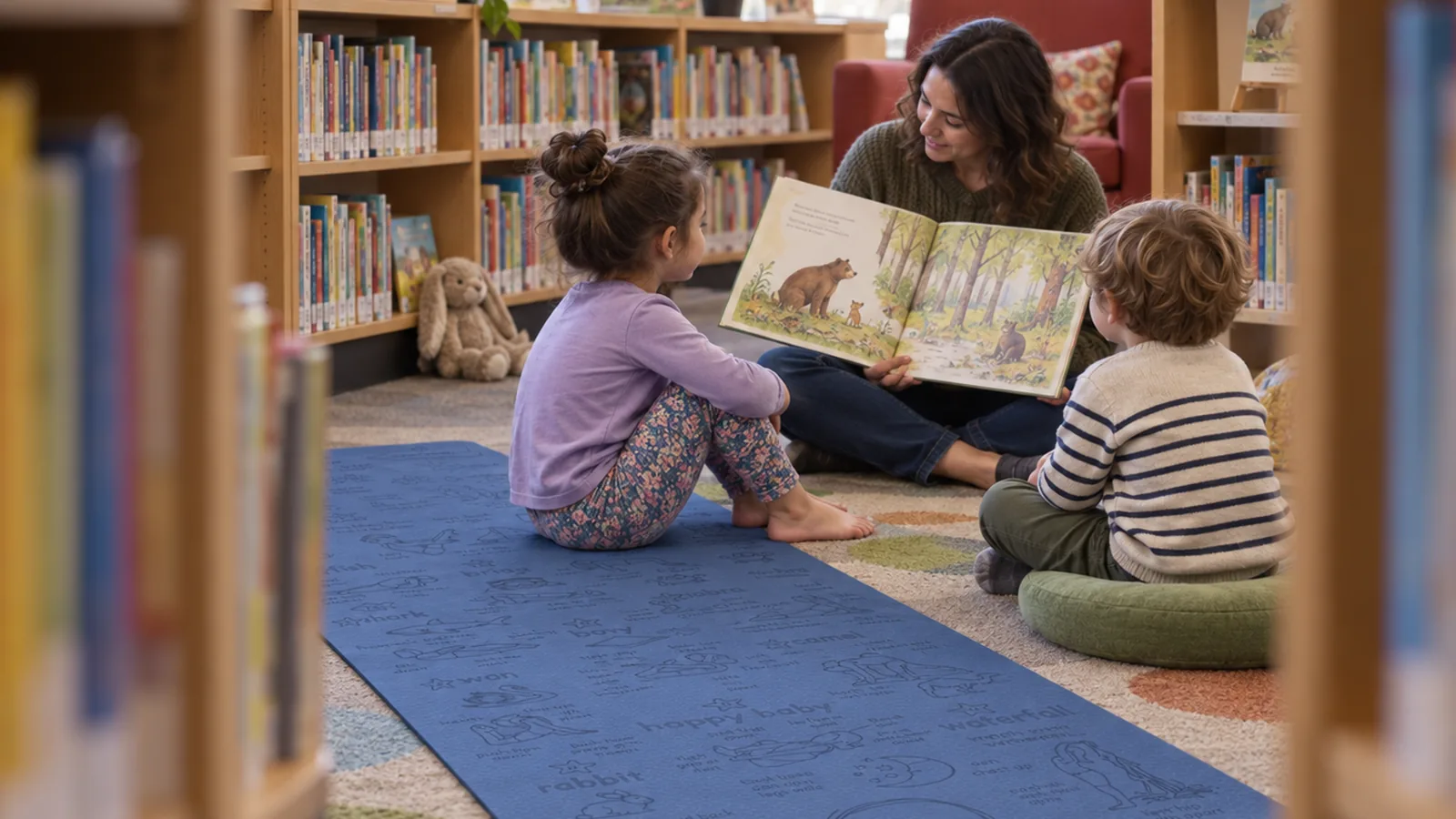
One page, one pose: read the page, make the shape of whoever is on it, hold it for three slow breaths, then turn the page. That's the whole method. It works with most picture books that have animals in them, and with traditional tales such as Goldilocks or The Gingerbread Man.
- Pick a book you already know. You'll be watching your child, not the words.
- One page, one pose. Ask "what shape is the duck?" and let your child decide before you help. Six or seven pages is plenty; skip the rest.
- When a character isn't on the mat, find the nearest picture. There's no lion on our mats, so ask which picture looks bravest. Your child becomes the casting director.
- End lying down, with the book closed. A minute of stillness tells everyone the story is over.
Three short yoga stories for kids to read aloud
These short yoga stories for kids each stay on one mat, take about five minutes and end lying still. Read the line in quotes aloud, then help with the shape.
A Day at the Seaside (age 3 and up, Freedom Flow)
- Butterfly. "A butterfly flies down to the beach." Sit down, bring your feet sole to sole and flap your knees like wings. If you're using our Freedom Flow mat, your child may spot the butterfly before you've finished the line.
- Star. "A starfish lies on the warm sand." It's number 3 on the mat: sit tall, legs wide, toes pointing up.
- Boat. "A little boat bobs on the waves." Lean back on your bottom and raise your feet off the sand. The youngest sailors can leave their feet down and just rock.
- Fish. "Fish swim under the boat." Lie on your back, tuck your hands under your bottom and raise your chest a touch, like a fish coming up for air. Small is plenty.
- Crab. "A crab scuttles home to its rock pool." Put your hands on the floor behind you, plant your feet and push your tummy up to the sky. Sideways shuffling is expected.
- Rest. "The tide goes out." Lie still. Breathe in as if smelling a flower, breathe out as if blowing a leaf, and listen for the sea.
The Farm Wakes Up (age 3 to 6, Sun Salutation)
- Mouse. "A mouse is fast asleep in the hay." It's number 1 on the Sun Salutation mat. Kneel, fold forward over your knees and rest your forehead down, arms stretched out in front.
- Cow. "The cow wakes up and says moo." On hands and knees, let your tummy dip and look up. The moo is compulsory.
- Cat. "The farm cat has a long stretch." Number 3: round your back up high and let your head drop. Swap between cow and cat a few times.
- Downward dog. "The sheepdog stretches, ready for work." Tuck your toes and lift your hips into an upside-down V. Heels can stay off the floor.
- Frog. "A frog hops to the duck pond." Squat low, heels in, toes out. The hop is optional.
- Mountain. "The farmer stands tall and looks over the fields." Feet together, very still. Five-year-olds can add tree, number 14: the old oak swaying in the wind.
- Mouse again. "Night falls, and everyone goes back to sleep in the hay." Curl up small and stay still.
The Three Billy Goats Gruff (age 5 to 8, Freedom Flow)
A traditional Norwegian tale, with a troll who is grumpy rather than scary. Nobody gets eaten, and nobody has to be the troll.
- Trip-trap. "Three goats trip-trap towards the bridge." March on the spot. Apart from the rest at the end, it's the one move that isn't a pose on the mat.
- Bridge. "Here's the bridge." Lie on your back, feet flat, and lift your hips. Now your child is the bridge.
- Crab. "A grumpy troll scuttles out from underneath." Lift into crab and grumble.
- Waterfall. "The biggest goat stands tall and strong." Number 15 on Freedom Flow: stand, reach your arms up and lean back just a little. Go gently.
- Fish. "The troll tumbles into the river and swims away." Lie back into fish and wiggle.
- Butterfly, then flower. "The goats reach a meadow full of butterflies and flowers." Flap in butterfly, then try flower, number 1: hands under your legs, feet lifted. It's a balance, so wobbles are part of it.
- Rest. "Three full goats lie down in the grass." Lie still for a minute.
Do yoga stories work for toddlers?
Yes, with fewer poses and more noise. Yoga stories for toddlers work best with three or four poses, plenty of sound effects, and you making the shapes for them to copy. Moo, flap and snap your way through.
- Under 3: our mats start at age 3, so we'd wait for the mat. If a two-year-old wants to join in, let them copy butterfly and star on a rug, and leave it there.
- Ages 3 to 5: the seaside and farm stories in full. Yoga stories for preschoolers go best when your child picks who to be next.
- Ages 5 to 8: the Billy Goats Gruff, then let them narrate while you do the poses.
For under-threes, there's more in our guide to yoga with a toddler.
How long should a yoga story take?
About five minutes: a minute to set the scene, about three minutes for the poses at roughly 30 seconds each, including moving between them, and a minute of rest. All three stories in a row take about 15 minutes. One page and one pose still counts. The World Health Organization's guidelines, summarised in its fact sheet on physical activity, highlight that any amount of physical activity is better than none.
What if your child only wants to be the crab?
Then let them be the crab on every page, and keep reading. The story still works. If they want the next page before you've finished, turn it. If giggles take over, wait for them in the rest. A story that dissolves into laughing hasn't gone wrong.
The child who won't join in is usually still listening, so carry on making the shapes yourself. Plenty of children watch the first read and join in on the third. The same poses also make good games, and here are some yoga games to play with them.
How do you make yoga stories a habit?
Keep the mat by the bookshelf, so the book and the mat come out together. Let your child choose the story and find the first character on the mat. After a few weeks, swap roles: your child tells it and you do the poses.
Themes keep it fresh: a space yoga story for a rocket fan, or a dinosaur yoga story that ends with everyone lying still as a fossil. If yoga itself is new in your house, our guide to starting kids' yoga at home covers the basics.
A mat that holds the whole cast
Fifteen pictures in a row is a story waiting to be told. Each Yogi-Me mat carries 15 numbered poses, laser-engraved, so your child can find the next character by its picture, with no phone propped up beside the book. The farm story lives on Sun Salutation, which opens with mouse curled up at number 1 and ends with the tree and dancer balances at 14 and 15. The seaside and the goats live on Freedom Flow, which starts at flower and finishes standing up, at waterfall. With one of each, two children can each tell a different story, and ordering two or more saves 10 per cent.
Both mats are made for ages 3 to 8 and measure 183 x 61 cm, an adult's length, so the grandparent reading on a Sunday afternoon can join in. Each costs £34.99, and UK delivery is free. Browse both designs in all seven colours, or find more ideas in our children's Christmas gift guide.
Frequently asked questions
What are yoga stories for kids?
Yoga stories for kids are stories told aloud in which the child acts out each character as a yoga pose: a butterfly flaps, a crab scuttles, a mouse curls up small. Ours take about five minutes each, need only a clear patch of floor, and suit children from about three to eight.
How do you explain yoga to a child?
Tell them it is a game of becoming things: a cat, a boat, a tree. Then add the one rule that makes it yoga, which is to hold the shape and breathe slowly for a moment before changing. Told through a story, the explaining mostly takes care of itself, because your child already knows what a cat does.
Do yoga stories need a video or a printable?
No. Everything you need is in the three stories on this page, and after a couple of reads you probably won't need the words. A rug works. On a mat with the pictures marked in, your child takes over the cast list, pointing to the next character before you've named it.
Can you use any picture book for a yoga story?
Almost any, as long as it has characters your child can turn into shapes. Animal books are easiest. Choose one you know well, pick six or seven pages rather than all of them, and finish lying down with the book closed. Traditional tales such as Goldilocks work well too.