guides
Brain Breaks for Kids: 20 Two-Minute Ideas for Home or Class
20 two-minute brain breaks for children aged 3 to 8: ideas to wake them up, calm them down or reset a busy head. No screen, almost no kit, home or class.
A brain break is a short pause, usually two to five minutes, when a child stops the task in front of them and does something completely different: moves, breathes slowly or plays a quick game. Below are 20 brain breaks for kids that take about two minutes each and need no screen, and only one of them needs any equipment: a dice.
They're sorted by what the child in front of you needs: wriggles out, calm down, a quick puzzle, or a stretch on the mat. Every idea can be adapted for ages 3 to 8, at the kitchen table or in a Reception, KS1 or lower KS2 classroom. The thinking ones suit children from about five.
What is a brain break, and why do children need one?
A brain break is a planned pause of a few minutes in the middle of sitting-down work, used to change what a child's body and attention are doing before they carry on. It's the opposite of a long sit, and UK health guidance asks for exactly that: breaking up long periods of not moving.
The UK Chief Medical Officers' physical activity guidelines, say children and young people aged 5 to 18 should "break up long periods of not moving with at least light physical activity". For younger children the NHS says under-5s should not be inactive for long periods, except when asleep, and the World Health Organization says 3 to 4 year-olds should not sit for extended periods.
One honest note: the same CMO guidance says the evidence doesn't support a specific time limit for sitting. There's no official rule for how often a brain break should happen. Watch the child, not the clock.
How long should a brain break be?
A brain break should last about two to five minutes: long enough to move, breathe or laugh properly, and short enough that settling back to the task is easy. For three and four year-olds, a minute or two is often plenty. Stop while they're still enjoying it, not after.
That fits NHS speech and language advice for young children. Leeds Community Healthcare NHS Trust suggests keeping activities short, around 5 to 10 minutes at most, and stopping when your child loses interest.
When to reach for one:
- The wriggles start: chair tipping, kicking the table leg, sliding off the seat.
- The eyes glaze: staring at the page, answering "what?" to every question.
- Between two tasks: after the reading book and before the spellings.
- Tempers fray: a sibling squabble or a "this is too hard" moment.
- After a long sit: a car journey, a long assembly or a wet playtime indoors.
Which brain breaks get the wriggles out?
When a child can't keep still, give the movement somewhere to go. These five energising brain breaks use the whole body for about two minutes, need only the space beside a chair, and end with a moment of stillness so it's easy to sit back down.
1. Shake it out
Shake your right hand eight times, counting out loud, then your left hand, right foot and left foot. Repeat with four shakes, then two, then one. Finish with a big stretch.
2. Freeze statues
Hum, play music or clap a beat while everyone dances on the spot. When the sound stops, they freeze. A wobble gets a giggle, not a penalty. End on the longest freeze, so the last thing they do is keep still.
3. Simon says
The old favourite, kept to two minutes. Mix big moves ("touch your toes") with small ones ("wiggle your nose"). For under-5s, skip the catching-out. Older children can take a turn being Simon.
4. March and count
March on the spot and count to 20 together. Then do it again in a whisper, a robot voice, a mouse voice and a giant voice, lifting the knees high on the giant round. It's movement and counting practice at once.
5. Animal walks
Call out an animal and move like it for 20 seconds: hop like a frog, plod like an elephant, stretch tall like a giraffe, scuttle sideways like a crab. In a small room, keep it on the spot.
For more lively ideas sorted by how long they take, from 30 seconds to five minutes, see our guide to movement breaks.
Which brain breaks calm children down?
A calming brain break slows the body first, because a child who is buzzing can't think their way to calm. These five use slow breathing, squeezing and letting go, listening, or balance, and most can be done sitting down. They suit the end of the day or after a squabble.
Slowing down your breathing and progressive muscle relaxation are two of the relaxation techniques described by the children's mental health charity Anna Freud. The first three ideas below are child-sized versions of both.
6. Balloon breathing
Hands on tummies. Breathe in slowly through the nose and feel the balloon fill up, then out slowly through the mouth and let it go down. Five breaths is plenty.
7. Five-finger breathing
Hold one hand up, fingers spread. Trace up the side of the thumb with a finger of the other hand while breathing in, and down the other side while breathing out. Carry on along all five fingers. It works at a desk, in the car or in a queue.
8. Squeeze and let go
Squeeze both fists tight for a count of five, then let them go floppy. Do the same with shoulders up to ears, then drop. Then scrunch faces up tight and relax. Children enjoy the scrunched faces, and the letting go is the point.
9. The listening minute
Everyone closes their eyes, or looks at the floor, and stays still for one minute, counting the different sounds they hear. Then compare: a clock, a bird, a car, a tummy rumble.
10. Tree balance
Stand tall, then rest the sole of one foot against the other ankle or calf, palms together at the chest. Hold for a slow count of five and swap. A wobbly tree still counts, and it's hard to chat while balancing.
Which brain breaks get children thinking?
Some brain breaks wake the brain as well as the body by adding a small puzzle: a pattern to follow, a partner to copy or a word to spell. These five suit children from about five upwards, younger ones can join in with help, and they slot easily between two pieces of schoolwork.
11. Cross-crawl
Touch your right elbow to your left knee, then your left elbow to your right knee, like marching in slow motion. Count to 20 together. It's trickier than it looks, which is half the fun. Speed up for the last five.
12. Mirror me
Pair up, facing each other. One person moves slowly, raising an arm or tilting their head, and the other copies like a mirror. Swap after a minute. At home, let your child lead first.
13. Body spelling
Spell a word out loud with your body. Tall letters such as b, d, k and l mean arms straight up. Letters that drop below the line, such as g, p and y, mean a squat. Every other letter means hands on hips. Use this week's spellings.
14. Clap the threes
Count from 1 to 30, around the room or between the two of you. On every number in the three times table, clap instead of saying it. Use the twos for younger children and the fours for older ones.
15. Whole-body rock, paper, scissors
Rock is crouching in a ball, paper is standing with arms and legs wide, scissors is one arm forward and one back. Count "one, two, three" with three little jumps, then show. Best of five.
Which brain breaks use a yoga mat?
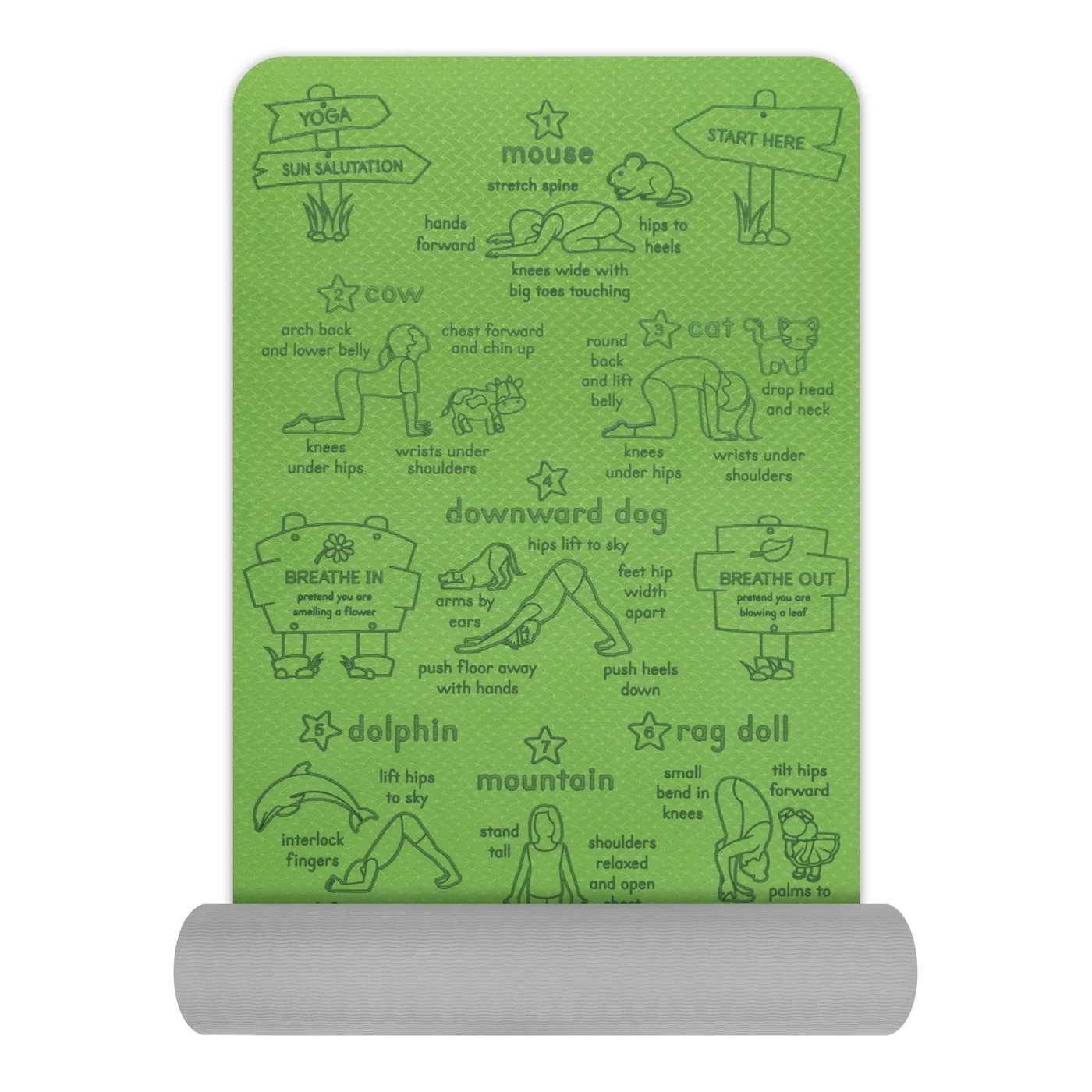
A yoga mat, or a strip of carpet, gives a brain break a clear spot to stand in and a reason to slow down. The first four use poses from the 15 numbered on our Sun Salutation mat, which run from mouse at number 1 to dancer at 15, and the fifth turns those numbers into a game. Any rug will do instead. Most are held for a slow count of five, with no screen to follow. If the poses are new to you, start with our beginner's guide to kids' yoga.
16. Mouse to downward dog
Kneel and curl up small, forehead down, like a mouse. Then tuck the toes, lift the hips high and push the floor away into downward dog. Back to mouse. Five times, slowly, finishing curled up small.
17. Eagle
Stand with knees slightly bent. Cross one arm over the other and bring the palms together if they'll reach; if not, a hug is fine. Hold for five, unwrap and swap. Eagle takes concentration, so it's a good last move before sitting down.
18. Dancer
Stand on one leg, hold the other foot behind you, and reach the free arm forward. Hold for five and swap. Everyone wobbles, adults included. Let them hold a chair or a wall the first few times.
19. Cat stretch
On hands and knees, round the back up high like a cross cat, chin tucked in. Then let the back go flat and look forwards. Move slowly between the two, five times. Good after a long spell hunched over a book.
20. Roll a pose
Number six poses from 1 to 6 on a piece of paper, or use the numbered poses on a mat. Roll a dice and do the pose with that number, holding for five. On a mat with more than six poses, roll twice and add the two numbers, and on a double, pick any pose you like.
Which brain breaks suit KS1 and KS2?
Key Stage 1 is Years 1 and 2, for children aged 5 to 7, and Key Stage 2 is Years 3 to 6, for ages 7 to 11, according to the national curriculum overview on GOV.UK. Most of the 20 ideas work from nursery to lower KS2, but some fit a younger class better than an older one.
- Nursery and Reception (ages 3 to 5): shake it out, freeze statues, animal walks, balloon breathing, mouse to downward dog. Keep them short and let everyone join in with no catching out.
- KS1 (Years 1 and 2): add Simon says, march and count, cross-crawl, body spelling and roll a pose.
- Lower KS2 (Years 3 and 4): add mirror me, clap the threes, whole-body rock, paper, scissors, eagle and dancer, and hand the leading over to the children.
If you want a ten-minute session rather than a two-minute pause, our guide to yoga in the classroom has a routine a whole class can do beside the desks.
What is a good Christmas brain break?
A good Christmas brain break takes an idea children already know and gives it a festive name, so it still takes two minutes and needs no props. In the last weeks of the autumn term, when excitement is high, use the calming ones as often as the lively ones.
- Elf says: Simon says, with "elf" in place of Simon.
- Reindeer freeze: freeze statues to a Christmas song.
- Melting snowman: stand tall and stiff, then melt very slowly to the floor over a count of ten. A calming one for the end of the day.
- Christmas tree: tree balance, with arms out as branches and fingers twinkling.
If you're choosing presents too, our screen-free Christmas gifts guide is sorted by age. For a present still in use after Boxing Day, a mat with numbered poses makes roll a pose a game they can play alone on a wet January Saturday.
How do you chain brain breaks into a five-minute reset?
Two or three brain breaks in a row make a short routine for a particular moment:
- Before homework: shake it out, then tree balance. Lively first, then still, then sit.
- Wet play: animal walks, freeze statues, then the listening minute to bring the noise back down.
- End of the school day: squeeze and let go, then balloon breathing, then cat stretch on the floor.
If your child isn't interested, don't make it a performance. Do the brain break yourself, quietly, and let them join in when they're ready. Some children prefer the calm ones, so offer a choice of two. For longer play once they're keen, try our yoga games for kids, and for how running, jumping and balancing develop by age, see what gross motor skills are.
Frequently asked questions
How often should children have a brain break?
There's no official number. UK Chief Medical Officers' guidance says children should break up long periods of not moving, but it doesn't set a time limit. At home, one between each piece of homework works well. In class, watch for fidgeting or glazed eyes rather than the clock.
What is the difference between a brain break and a movement break?
A movement break always involves moving the body. A brain break is any short pause from the task, so it can be a movement break, but it can also be slow breathing, a listening game or a thinking puzzle. Many of the 20 ideas above are both.
Can brain breaks be done sitting down?
Yes. Shake it out with arms only, balloon breathing, five-finger breathing, squeeze and let go, the listening minute and mirror me all work from a chair, in a small classroom, on a train or at the table. Keep the movements small so nobody knocks a drink or a neighbour.
Do you need any equipment for brain breaks?
Hardly any. Nineteen of the 20 ideas need nothing but a little space beside a chair, and roll a pose needs a dice. A mat or rug helps with the yoga ideas, and music helps with freeze statues, but humming or clapping does the same job.
A brain break your child can run on their own
Roll a dice, find that number on the mat, do the pose. That's a brain break a five-year-old can run without you, and without a screen.
Our Sun Salutation mat is designed for ages 3 to 8: three- and four-year-olds copy the poses with a little help, and older children lead their own sessions. At 183 x 61 cm it's full length on purpose, so it suits a Reception child and a Year 3 child alike, and a grown-up fits too. Buying as a grandparent? You can have a go at the dancer. It weighs 800 g, rolls up with a carry strap, and is non-toxic, PVC-free TPE, according to our supplier's specification, with 6 mm of cushioning. Use it on a dry, flat floor, wipe it with a damp cloth and a little mild soap, and let it dry flat.
Pick a colour for their roll-a-pose mat from our kids' yoga mats. Each is £34.99 with free UK delivery and 30-day returns, and two or more are 10 per cent off. Buying for a class? See Yogi-Me for schools.
Sources
- GOV.UK - UK Chief Medical Officers' physical activity guidelines, first published 7 September 2019
- NHS - Physical activity guidelines for children (under 5 years)
- World Health Organization - To grow up healthy, children need to sit less and play more, 24 April 2019
- Leeds Community Healthcare NHS Trust - Attention and listening
- Anna Freud - Relaxation techniques
- GOV.UK - The national curriculum: overview and key stages