guides
Movement Breaks: What They Are and 15 Ideas That Work
What movement breaks are, how long they should last, and 15 ideas for ages 3 to 8, from 30 seconds to five minutes, for home or KS1. Little or no kit.
A movement break is a short, planned burst of physical activity, usually 30 seconds to five minutes, that interrupts a stretch of sitting. It has a clear start and finish, then your child goes back to what they were doing. Below are 15 movement breaks for children aged 3 to 8, sorted by how much time you've got.
If your child slides off the chair halfway through their reading book, start here. Most need no kit at all.
What is a movement break?
A movement break is a planned pause in sitting-down work where a child uses their whole body, then goes back to the task. It is always physical: jumping, pushing, carrying, crawling or stretching. A brain break is any change of activity, including a puzzle or a listening game, so every movement break is a brain break, but not the other way round.
NHS Tayside's guidance for schools describes four features of a movement break:
- Planned: it alternates with seated work.
- Predictable and engaging: the child knows it's coming and wants to do it.
- Regular: it happens at intervals through the day.
- A clear start and finish: everyone knows when it begins and when it's over.
For calming and thinking games too, our guide to brain breaks for kids has 20 more.
What does UK guidance say about breaking up sitting?
Health guidance asks for exactly what a movement break does: fewer long sits. The UK Chief Medical Officers' physical activity guidelines, updated in 2019, say children and young people should "minimise the amount of time spent being sedentary" and "break up long periods of not moving with at least light physical activity".
The NHS guidance for 5 to 18 year-olds (last reviewed 23 October 2024) says the same.
The NHS says pre-schoolers aged 3 to 4 should spend at least 180 minutes a day being active, and that children under 5 should not be inactive for long periods, except when asleep. The World Health Organization's 2019 guidelines add that 3 to 4 year-olds should not be restrained for more than 1 hour at a time, or sit for extended periods.
How long should movement breaks be?
There's no official length. The same Chief Medical Officers' guidelines say the evidence doesn't currently support a specific time limit for sitting. In practice, 30 seconds to five minutes works: long enough to move properly, short enough to settle back.
Our rule of thumb:
- 30 seconds: between two bits of the same task, such as halfway down a page of sums.
- 2 minutes: between two different tasks, such as reading and then spellings.
- 5 minutes: after a long sit, such as a car journey, a rainy afternoon indoors or the end of the school day.
Stop while they're still enjoying it, so they'll want it again tomorrow.
Which movement breaks take 30 seconds?
Thirty-second breaks fit between two parts of the same task. They need only a wall, a sturdy chair or the floor. Do one, then straight back to work.
1. Wall press-ups
Stand an arm's length from a wall, hands flat at shoulder height. Bend the elbows to bring the nose towards the wall, then push away, ten times. NHS Tayside lists wall and chair press-ups among its classroom ideas.
2. Ten star jumps
Count them out loud together. Three-year-olds can just jump with arms up and down.
3. Chair push-ups
Sitting on a sturdy chair with no wheels, put hands flat on the seat either side and push down to lift your bottom off it for a count of three. Five times.
4. Reach and touch
Reach up to touch the ceiling, then fold down to touch the floor. Ten times, slowly on the way down.
5. The doorbell dash
Walk quickly to the front door, touch it, and walk back.
Which movement breaks take 2 minutes?
Two-minute breaks suit the gap between two different tasks. They use pushing, pulling and carrying, and several double as a real job around the house.
6. The book carry
Carry a stack of books up to their room, or the shopping in from the car. NHS Tayside's school ideas include fetching and carrying equipment.
7. Towel tug
Each hold one end of a rolled-up towel and pull gently, leaning back. Slow and steady, never a yank.
8. Bear and crab
Bear crawl (hands and feet, bottom up) down the hallway, then crab walk (tummy up) back. Younger children can just crawl.
9. Sock catch
Roll a pair of socks into a ball and throw it back and forth. Count the catches in a row, then try to beat it.
10. Bottom-stair step-ups
Step up onto the bottom stair and back down, holding the banister, ten times on each leg.
Which movement breaks take 5 minutes?
Five-minute breaks are for after a long sit, such as a car journey or the end of a school day. They're bigger and noisier, so end each one with something slower before anyone sits down.
11. Tape hopscotch
Stick a hopscotch grid onto the floor with masking tape, or chalk one outside. Hop the singles, jump the doubles.
12. Cushion obstacle course
Jump over a cushion, crawl under the table, hop to the door, walk along a line of tape. NHS Tayside suggests obstacle courses that mix jumping, climbing, hopping and changing direction.
13. One-song dance
Put on one song and dance until it ends. The song gives you the clear start and finish.
14. The outdoor lap
Run, skip or walk to the end of the garden and back, or round the block together. The NHS lists skipping and dancing among its examples of activity for 5 to 18 year-olds.
15. Three poses on the mat
A short yoga sequence ends still, so it makes a good last break of the day. NHS Tayside includes whole-class yoga among its ideas. Details below.
How do you use movement breaks at home?
Movement breaks at home work best tied to things that already happen: homework, the gap before tea, the drive home. One or two predictable breaks, used the same way each day, stick better than a long list you have to remember.
An illustrative example. Say your six-year-old has 10 minutes of reading and 10 minutes of spellings after school:
- After the car home: a one-song dance (about 3 minutes).
- Reading: 10 minutes, with ten star jumps at the halfway page.
- Between reading and spellings: the book carry, taking the reading book up to their room (2 minutes).
- Spellings: 10 minutes.
- Before tea: three poses on the mat (2 to 5 minutes).
That's 20 minutes of sitting with a break before, during and after. Our guide on how to help a child focus covers sleep and routine too.
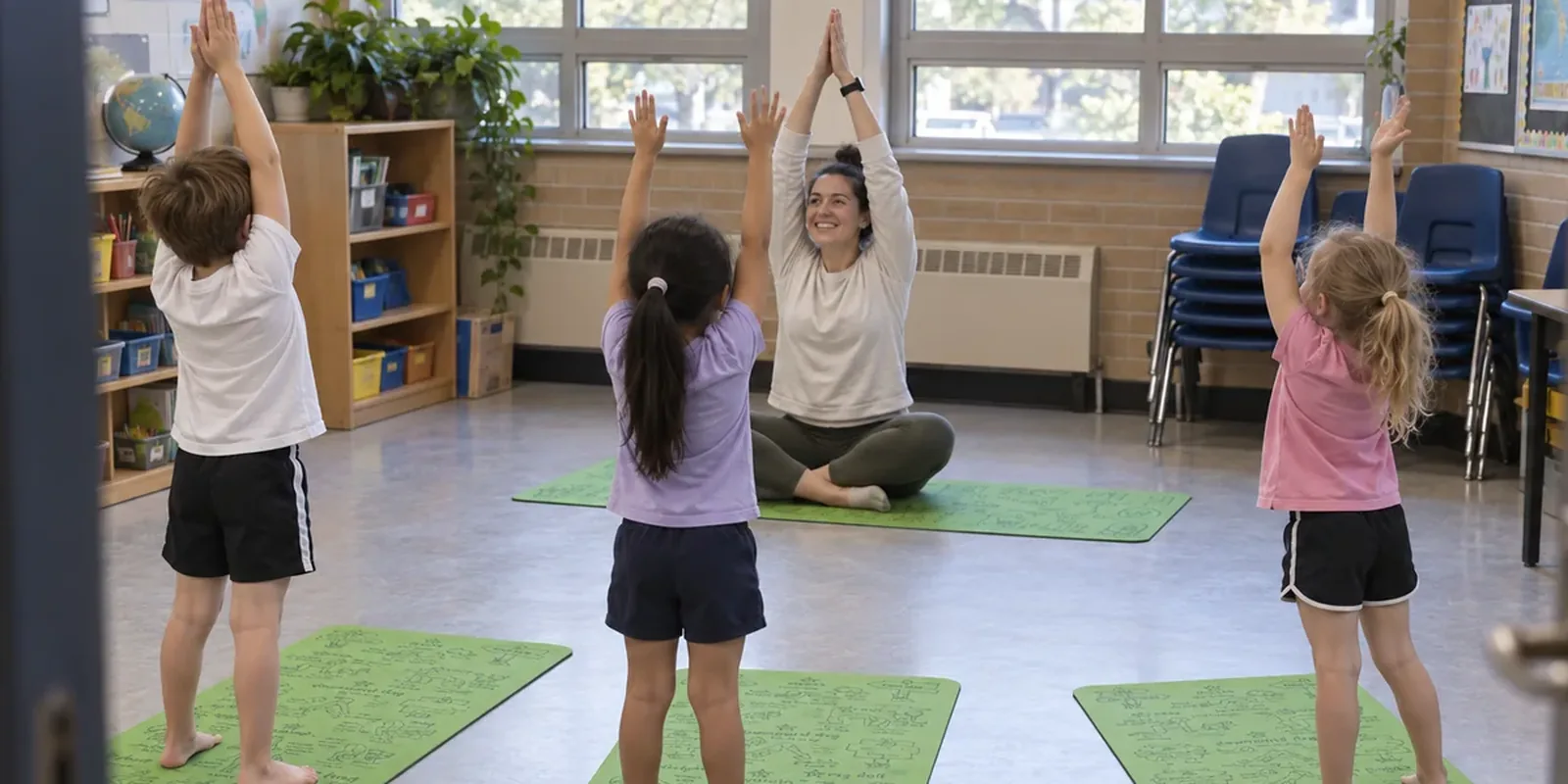
How do movement breaks work in Reception and KS1?
A movement break in KS1 works as it does at home: a short burst of activity between seated tasks, with a clear start and finish. Key Stage 1 covers Year 1 (age 5 to 6) and Year 2 (age 6 to 7), and Reception children are 4 to 5, according to the national curriculum on GOV.UK.
NHS Tayside's school ideas include taking a message to reception, wiping the whiteboard, stacking chairs, and letting children stand, kneel or lie on their tummy to read.
If your child's teacher uses movement breaks, ask which ones and use the same names at home. For what counts as a gross motor skill at each age, see our guide to what gross motor skills are.
How do you do a three-pose movement break on a yoga mat?
A three-pose movement break is three yoga poses done in order, each held for five slow breaths, then repeated two or three times: about two to five minutes in all. One pose stretches, one folds, one settles.
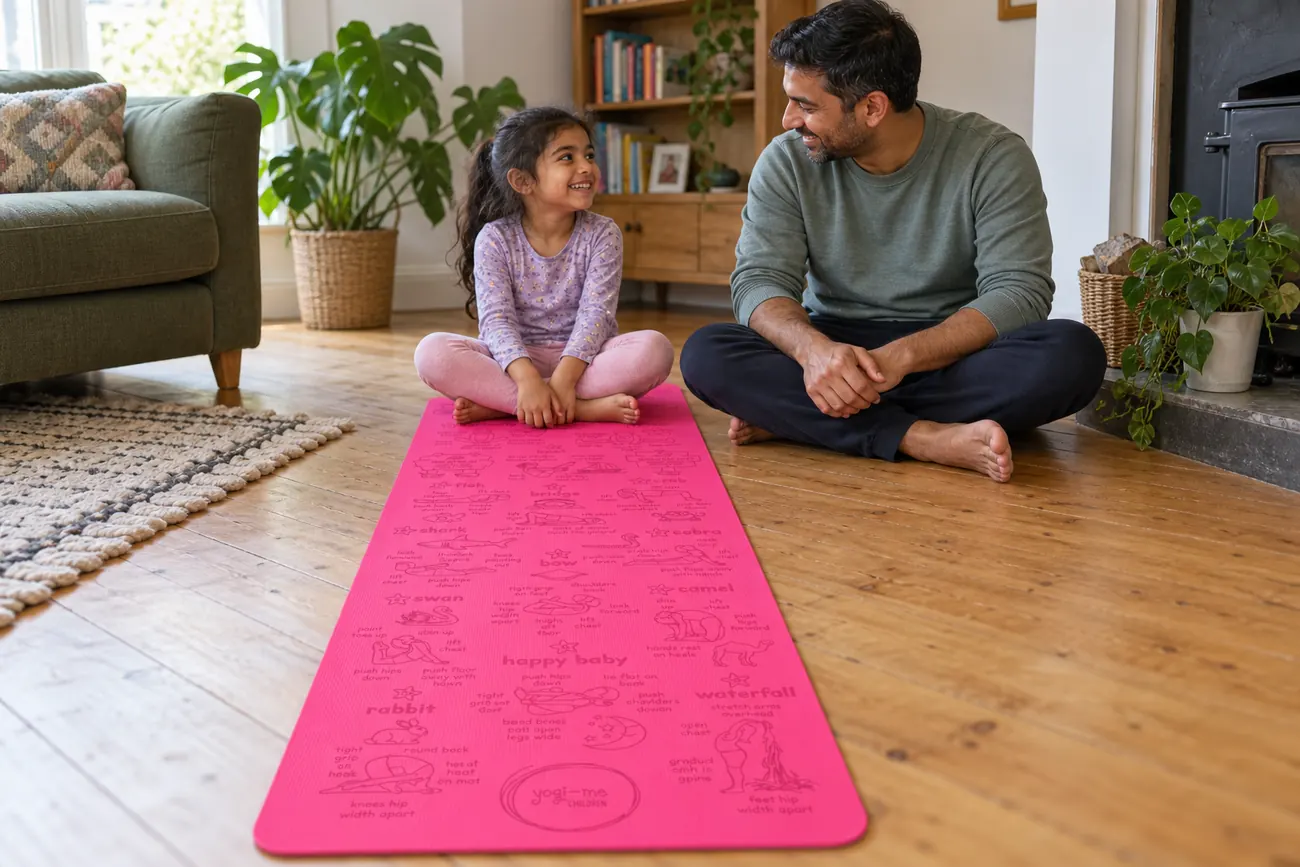
Three poses from the mat in the photo at the top make a simple sequence:
- Cobra. Lie on your tummy, hands under your shoulders, and gently lift your chest, keeping your hips on the mat. Hold, then lower.
- Rabbit. Kneel, hold your heels, tuck your chin and gently roll forward until the top of your head rests lightly on the mat near your knees. Keep almost no weight on the head. If it's tricky, curl up small instead.
- Happy baby. Roll onto your back, hold your feet with your knees bent towards your armpits, and rock gently from side to side.
Do it alongside them at first. If yoga is new to you both, our guide on how to start yoga with your child covers the basics.
All three come from our Freedom Flow design, a mat with a calmer floor sequence marked in. Its 15 poses are numbered and laser-engraved into the surface, so a child can follow the numbers with no screen and nothing to set up. It's made for ages 3 to 8: three- and four-year-olds copy the poses with a little help, and older children lead their own.
When is restlessness worth raising with school or your GP?
Movement breaks are an everyday habit, not a treatment, and they won't settle every restless afternoon. If your child's attention, activity or behaviour worries you, or school has raised a concern, get advice rather than adding more breaks. Your GP or health visitor is a good first step, or at school the class teacher or the special educational needs co-ordinator (SENCO).
Asking isn't the same as assuming something is wrong.
Frequently asked questions
What is a movement break?
A movement break is a short, planned burst of physical activity that interrupts a stretch of sitting, such as star jumps, wall press-ups or a quick dance. It has a clear start and finish, then the child returns to their task. They work at home as well as at school.
How long should a movement break be?
There's no official length. The UK Chief Medical Officers say the evidence doesn't support a specific limit on sitting time. Our rule of thumb for children aged 3 to 8 is 30 seconds to five minutes: 30 seconds within a task, two minutes between tasks, and five after a long sit.
How often should children have a movement break?
No guideline sets a number. The NHS asks children aged 5 to 18 to break up long periods of not moving, and says under-5s shouldn't be inactive for long periods except when asleep. Watch your child rather than the clock: wriggling or drifting off the task is a good cue to try one.
Do movement breaks work for under-5s?
Yes, though at 3 and 4 they look more like play than a routine. The NHS says under-5s shouldn't be inactive for long periods except when they're asleep, so a 30-second break between a jigsaw and a story suits them well. Keep it to one simple instruction, such as ten star jumps or bear walks to the door, and join in.
Do you need a mat for movement breaks?
No. Every break above works on a bare floor. A mat helps with one thing: rolling it out starts the break and rolling it up ends it. Ours is full length at 183 x 61 cm, so there's room to stretch out at three and still at eight. The trade-off: a three-year-old carrying it to nursery alone every day would find a shorter mat easier. It weighs 800 g, has a carry strap, and wipes clean with a damp cloth and a little mild soap.
Buying as a grandparent? At that length, you can do the cobra beside them. Buying for Christmas? It's a present with a job to do every afternoon, long after Boxing Day, and anything bought from 1 November can be returned up to 31 January. Our gift ideas that aren't another screen have more. For a classroom, see mats a whole class can follow without a screen, invoiced to a school purchase order.
Give the last break of the day its own mat: pick a colour from our kids' yoga mats. Each one is made for ages 3 to 8 and costs £34.99, with free UK delivery and 30-day returns.
Sources
- NHS Tayside: Movement or Sensory Breaks (guidance for schools)
- GOV.UK: UK Chief Medical Officers' physical activity guidelines (2019)
- NHS: Physical activity guidelines for children and young people (5 to 18 years)
- NHS: Physical activity guidelines for children (under 5 years)
- World Health Organization: To grow up healthy, children need to sit less and play more (2019)
- GOV.UK: The national curriculum