guides
Circle Time Games: 12 Easy Ideas for EYFS and KS1
12 easy circle time games for nursery, Reception and KS1, from name games to a calm finish, each matched to the EYFS goal it practises.
These 12 circle time games are screen-free and need nothing more than a soft ball, a teddy and a set of keys. They suit children aged 3 to 7, in nursery, Reception or KS1, and they follow the order a good circle time runs in: say hello, get moving, listen, then feelings and a calm finish. Each one is matched to the EYFS goal it practises.
What is circle time?
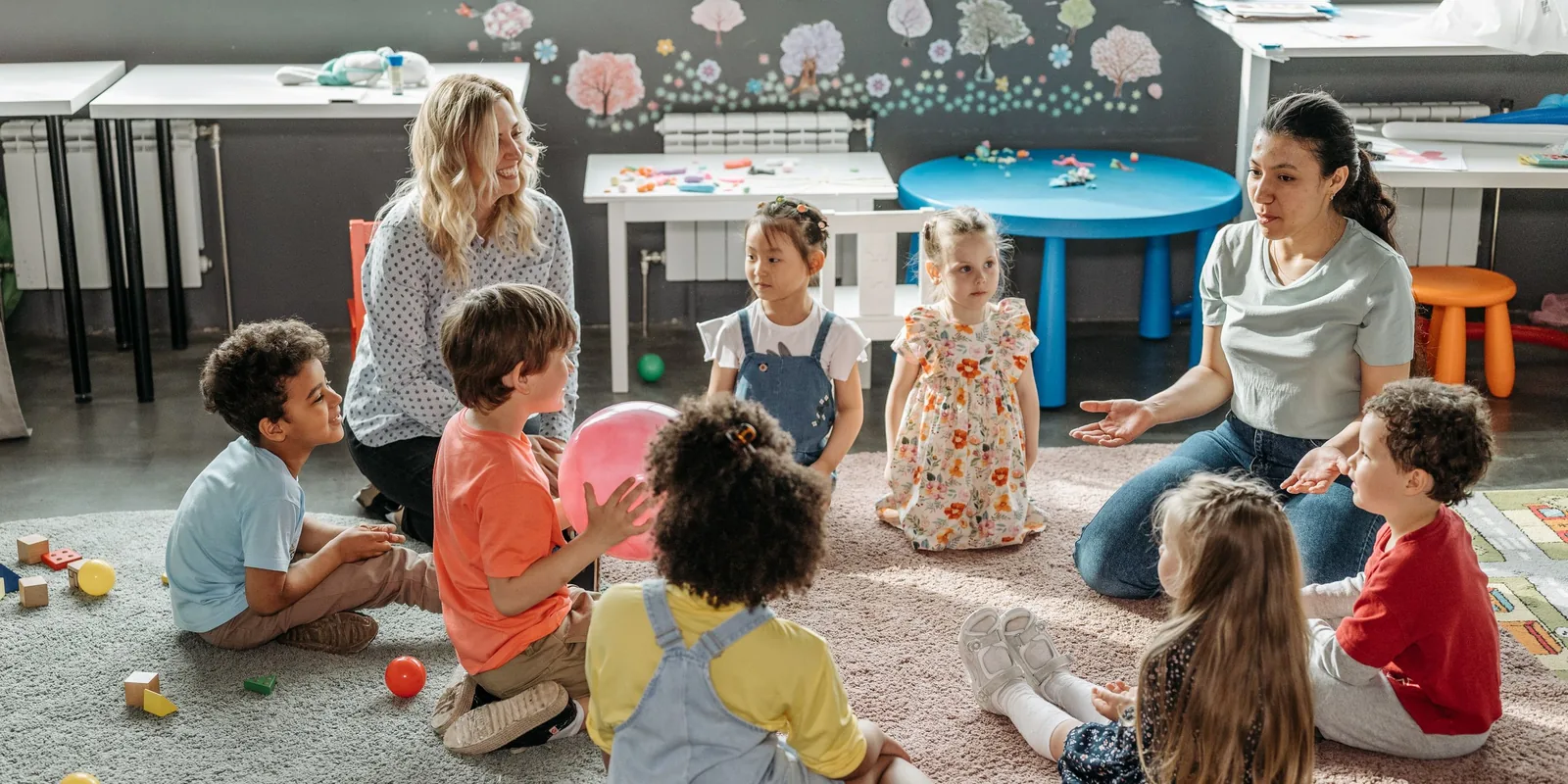
Circle time is a short group session where children and an adult sit or stand in a ring to play games, talk and take turns. The circle matters because everyone can see everyone else, and nobody is at the back. With a play parachute, the same ring turns into a set of parachute games.
It isn't a statutory requirement, but it turns up in official guidance. The Department for Education's Help for Early Years Providers suggests using feelings cards "when sharing a story, song or circle time activity which mentions a particular emotion". Oxford Health NHS Foundation Trust's primary school mental health pack is written to be "used in PSHE & circle time sessions", and it includes a sheet of circle games. Four of the games below come from it.
What do you need for circle time games?
A soft ball, a teddy, a bunch of keys and, for game 5, one mat or a rug. Nobody passes round anything small enough to swallow, and nobody wears a blindfold.
Start with the group that suits the moment: hello games at the start of the day, moving games when the carpet goes fidgety, listening games once they've settled, feelings to finish. Each game gives the age it suits, and most work from 3 if a grown-up plays too.
12 circle time games for EYFS and KS1
Say hello: the name games
These are the circle time name games, and they practise the Building Relationships early learning goal: "Work and play cooperatively and take turns with others."
1. Name roll
Roll a soft ball across the circle and say "Hello" and the name of the child you rolled it to. They roll it on to someone new. Everyone gets the ball once before anyone gets it twice. Three-year-olds can just say the name. Good from age 3.
2. Name and move
Each child says their name with a movement: a jump, a wave, a wiggle. The whole circle says it back and copies the move, so for two seconds one child has everyone's attention. A shy child can whisper the name and do a tiny wave. Good from age 3.
3. Change places if
Say: "Change places if you've got a pet." Everyone it's true of stands up and swaps seats with someone else, walking. Then: "Change places if you had toast for breakfast." Children find out what they share without anyone having to talk about it. It tends to be a favourite with Reception and KS1. Good from age 4.
Get moving: when the carpet goes fidgety
The NHS guidance on physical activity for under-5s says: "Children under 5 should not be inactive for long periods, except when they're asleep." So circle time doesn't have to mean sitting still. These games link to the Gross Motor Skills goal: "Negotiate space and obstacles safely, with consideration for themselves and others."
4. Fruit salad
Go round the circle giving each child a fruit: apple, banana, pear. Call "Bananas" and every banana changes places. Call "Fruit salad" and everyone moves. It's the first game on Oxford Health's circle time sheet. Use two fruits for three-year-olds, and walk, don't run, when the circle is tight. Good from age 3.
5. Pass the pose
This one is ours. Pass the pose is a circle game where the child whose turn it is picks a yoga shape and everyone copies it. Pass a beanbag while you sing; when the song stops, the child holding it picks a pose from the mat in the middle and everyone copies, sitting where they are. On our Freedom Flow mat the poses are numbered, so you can call "number 3" and a child who can't read yet finds star. No mat? The child invents a shape instead. Here's the floor-pose mat. Good from age 3.
6. Stop and turn
Everyone stands and walks round the circle in the same direction. Call "Stop" and they freeze. Call "Turn" and they walk the other way. Call "Knees" and they walk on their knees. It's straight from the Department for Education's Development Matters guidance for Reception: "run around in a circle, stop, change direction and walk on your knees going the other way." Walking keeps it safe in a small room. Good from age 4.
Listen: three quieter games
These are circle time listening games, and they link to the goal of listening attentively and responding "when being read to and during whole class discussions and small group interactions." For sound games beyond the circle, there are 15 more listening games for kids.
7. Pass the clap
One clap travels round the circle, child to child, as fast as it can go without getting lost. Then Oxford Health's twist: one clap keeps it going the same way, two claps send it back. Children have to watch the person beside them, not the grown-up. Good from age 3, with the reverse from 4.
8. Don't wake the teddy
A teddy sleeps in the middle of the circle. Pass a bunch of keys from hand to hand without a single jingle. If teddy "hears" it, everyone whispers "Shh" and it starts again from the beginning. Children hold their breath over it. No blindfold needed: the teddy does the listening. Good from age 3.
9. I went to the shops
The first child says: "I went to the shops and I bought an apple." The next repeats it and adds one thing: "an apple and a scarf." It's the shopping game on Oxford Health's sheet. Let the circle help anyone who gets stuck. KS1 can try to go round the whole circle. Good from age 4.
Feelings and a calm finish
These are the PSED circle time activities, practising the Self-Regulation goal: "Show an understanding of their own feelings and those of others and begin to regulate their behaviour accordingly."
10. Pass a smile, then pass a face
Smile at the child next to you; they turn and pass the smile on, as on Oxford Health's sheet. Once it's round, pass a sad face, then a surprised face, then a cross one. Nobody has to say how they feel, which makes it a gentle way into feelings. The cross face usually ends in giggles. Good from age 3.
11. Feelings check-in
Lay out four face cards: happy, sad, cross and worried. Each child points to the one that matches how they feel today, or says "pass". Help for Early Years Providers suggests feelings cards and talking "about how children feel as a group". Passing is always allowed, and you don't fix anything, you just say thank you. Good from age 3.
12. Breathing round
Everyone sits tall. Breathe in while your arms float up, and out while they float down, three times. Then a child chooses who leads the next breath. Development Matters suggests adults "Model ways that you calm yourself down, such as stopping and taking a few deep breaths." It's a quiet way to end. For more, see these breathing exercises for kids. Good from age 3.
How long should circle time be for 3 and 4 year olds?
There is no official length. Neither the EYFS framework nor Development Matters sets one. NHS speech and language therapists at Leeds Community Healthcare suggest spending "a short amount of time on any specific activity (5 to 10 minutes maximum)". So plan circle time as two or three short games rather than one long sit, and stop while it's still going well.
For circle time activities for 3 and 4 year olds, try one game they know and one new one. The same NHS therapists say of children starting school: "Concentration span can still be quite short, however, children can cope with group situations." Under-threes manage a song and a name game, briefly.
Which EYFS areas do circle time games support?
Circle time games in the EYFS mostly practise the three prime areas of the EYFS statutory framework: communication and language; personal, social and emotional development; and physical development. Four early learning goals line up with the games above:
- Building Relationships: "Work and play cooperatively and take turns with others." Games 1, 2, 3 and 5.
- Gross Motor Skills: "Demonstrate strength, balance and coordination when playing." Games 4, 5 and 6.
- Listening, Attention and Understanding: "Listen attentively and respond to what they hear". Games 7, 8 and 9.
- Self-Regulation: "Show an understanding of their own feelings and those of others". Games 10, 11 and 12.
The goals describe what children should have gained by the end of Reception, so a nursery uses them as direction, not a test. Circle time activities in the EYFS look the same with a childminder, whose version of the framework carries the same goals.
Circle time games in KS1 usually sit in PSHE, which is how Oxford Health's pack frames them. If a Year 1 or 2 class wants more than a game, there's a ten-minute routine for yoga in the classroom. One mat is enough for the middle of the circle; for a room, there's a set of mats for a nursery or class.
What does a good ten-minute circle time look like?
Take one game from each group, in order: a hello game, a moving game, a listening game, then the breathing round. Two versions that work:
- For 3 and 4 year olds: name roll (1), fruit salad with two fruits (4), don't wake the teddy (8), breathing round (12).
- For Reception and KS1: change places if (3), stop and turn (6), I went to the shops (9), pass a face (10).
Looking for circle time ideas for 3 year olds at home? The same four games work in a sitting room with two or three children, and a childminder with mixed ages can let the oldest lead. If you're new to the poses in game 5, start with our guide to yoga for kids.
If pass the pose becomes the game they ask for, our mats have 15 numbered poses laser-engraved into the surface, so any grown-up can run it without knowing any yoga. There's a mat for each child, in seven colours, at £34.99 with free UK delivery and 10 per cent off two or more.
Letting a child watch circle time first
Let them watch. Development Matters, writing about Reception children trying new movements, tells staff: "Allow less competent and confident children to spend time initially observing and listening, without feeling pressured to join in." Watching is a way of joining in.
A few things help. Give them a job: holding the sleeping teddy, or choosing the next game. Sit them next to you rather than across the circle. Invite them again next time, without making a fuss either way. Some children hate being looked at, so a moving game, where everyone is busy, can be an easier way in. If a child still only watches after several weeks, mention it to their key person or teacher.
Frequently asked questions
What are good circle time games for Reception?
Change places if, stop and turn, and I went to the shops all suit Reception, because each asks children to take turns and follow a rule. Development Matters asks Reception staff to "Make sure children are encouraged to listen to each other as well as the staff", which the turn-taking games do.
How do you make circle time fun?
Keep it short, get them moving early, and let a child lead at least one game: pass the pose and name and move both hand a child the spotlight for a moment. Stop while they still want more. In nursery or preschool, move a moving game to the front if the room is restless.
Do children have to sit still at circle time?
No. The NHS says children under 5 "should not be inactive for long periods, except when they're asleep", and Development Matters suggests Reception children run in a circle, stop and change direction. Mix sitting games with moving ones: a hello game, then fruit salad or stop and turn, then a listening game once they've settled.
Can you do circle time at home?
Yes, with two or three children and a sitting room floor. Name and move, pass the clap and pass a smile all work with three players, and you don't need any new kit. Play at a calm time of day, keep it to ten minutes, and let your child choose the last game.
Sources
- Department for Education: Early years foundation stage (EYFS) statutory framework
- Department for Education: Development Matters
- Department for Education: Help for Early Years Providers, emotions
- Oxford Health NHS Foundation Trust: Primary school resource pack, including "Circle time: Warm up activities and games"
- Leeds Community Healthcare NHS Trust: Attention and listening
- NHS: Physical activity guidelines for children under 5 years