guides
Screen Time and Sleep: What Helps Young Children Settle
Screen time and sleep for 3 to 8 year-olds: what UK guidance says about screens before bed, how long to leave, and a calm evening to copy tonight.
On screen time and sleep, the clearest UK advice for young children is to switch screens off for the hour before bed. The NHS says the light from screens can interfere with sleep, and government guidance for under-5s says screens in that last hour could affect it. The guidance and a small UK trial agree: turn the screen off earlier and put something calm in its place.
"No screens before bed" is easy to agree with and much harder to do at half past six with a tired four-year-old. This guide, for parents and grandparents of children aged 3 to 8, covers the guidance, a UK trial that tested it, and an evening routine to copy tonight.
Does screen time actually affect sleep?
UK health bodies say screen time can affect sleep, and their advice centres on the hour before bed. The NHS says the light from screens can interfere with sleep. Best Start in Life, where the UK government publishes its guidance for under-5s, says to try to avoid screens for the hour before bed "as this could affect sleep". Both choose their words carefully: can and could, not will.
Nobody is saying one cartoon after tea will ruin a night. The concern is the last hour, when a child should be winding down and a bright, absorbing screen pulls the other way.
How long before bed should screens go off?
Switch screens off an hour before bed. UK government guidance for 2 to 5 year-olds says so, and so does The Sleep Charity. The NHS gives 30 to 60 minutes. If you want one number, use the hour: it's the UK government's figure and it covers the NHS range too.
A screen-free hour means every screen off, television included, for the hour before your child goes to bed. There's no separate UK rule for 6 to 8 year-olds, so the same hour is a sensible default for the whole age range. Here's where the hour comes from:
- UK government (DfE and DHSC): avoid screens at mealtimes and in the hour before bed (ages 2 to 5).
- Best Start in Life (GOV.UK): avoid screens for the hour before bed, and keep bedrooms free from screens (under-5s).
- NHS: no laptops, tablets or phones in the 30 to 60 minutes before bed (sleep tips for under-5s).
- UK Chief Medical Officers, 2019: leave phones outside the bedroom at bedtime.
- The Sleep Charity: all screens off an hour before bedtime, television included.
A screen-free hour is not a screen-free day. For 2 to 5 year-olds the daily advice is no more than one hour in total, and our screen time by age guide covers the daily picture for every age from 2 to 8.
What is the 3/2/1 bedtime rule?
The 3/2/1 bedtime rule is one of several numbered countdowns shared online, and none of them is NHS or UK government guidance. Whatever the numbers, the UK advice for a young child comes down to one hour: screens off for the hour before bed, from GOV.UK, Best Start in Life and The Sleep Charity, which matches the top of the NHS's 30 to 60 minutes.
For 3-6-9-12 and the other numbered rules, our guide to family screen time rules says which ones have a real source.
What did the UK bedtime screen trial find?
A UK trial of 105 families with toddlers aged 16 to 30 months tested what happens when parents remove screens in the hour before bed and use calm activities from a "bedtime box" instead. Families found it workable, and the researchers saw modest early signs of better sleep. It was published in JAMA Pediatrics in December 2024.
Researchers from Birkbeck, King's College London, the University of Bath and Queen Mary University of London ran it from July 2022 to July 2023, with three groups:
- No screens in the hour before bed, plus a bedtime box of activities such as reading and puzzles.
- The bedtime box alone, with nothing said about screens.
- No change, carrying on as usual.
Sleep was measured with a small movement-tracking device, not by parent report. In the screen-free group, 33 of 35 families stuck to the plan. The researchers reported small to medium improvements in sleep efficiency and night waking, and no observable effect on their objective attention measures. In their own words, removing screen time before bed "was feasible and showed modest preliminary beneficial effects on sleep". They say a full confirmatory trial is needed before parents and doctors adopt the approach.
Two caveats: the children were toddlers, not 3 to 8 year-olds, and it was a small early trial. What carries over is the design. Families weren't just told to switch the screen off. They were handed something to do instead.
Why is the hour before bed so hard to make screen-free?
The hour before bed is usually the busiest hour in the house, and the screen is the one thing that keeps a tired child happy without help. At that time of day it entertains your child and frees your hands. Take it away without a replacement and a tired child will fill the gap loudly. That's why the trial's bedtime box is worth stealing: whatever replaces the screen needs to do both jobs, at least for ten minutes.
It also helps to move the switch-off earlier, so any protest happens while you're clearing up, not during teeth and stories. Give a warning, and let your child press the off button. If screens have crept into the whole day, not just bedtime, our guide on cutting screen time across the day has a four-week plan.
What does a screen-free evening look like?
A screen-free evening is the same steps at the same time every night, starting an hour before your child goes to bed. The NHS recommends a calming, predictable bedtime routine, with the wind-down starting around 30 minutes before your child usually drops off.
Here's an illustrative evening for a four-year-old whose bedtime is 7pm and who usually falls asleep around 7.30pm:
- 6.00pm, screen off at the end of an episode, after a warning: one hour before bed.
- 6.00pm to 6.30pm, a small job, then something calm to fill the gap: laying out pyjamas, feeding the cat, tidying toys, then a jigsaw or colouring.
- 6.30pm to 7.00pm, bath and pyjamas, in the same order every night.
- 7.00pm to 7.10pm, wind-down: five minutes of slow floor poses, then a story, starting 30 minutes before sleep as the NHS suggests.
- 7.10pm to 7.30pm, settling: lights low, a cuddle, quiet.
- 7.30pm, asleep or close to it.
For a seven or eight-year-old, keep the order and the gap, and slide the times later.
For the wind-down slot, our bedtime yoga routine for kids takes five to ten minutes and ends lying still. If yoga is new in your house, start with kids' yoga at home.
What can children do instead of a screen before bed?
The best replacements are calm, need little help from you, and can be done in pyjamas. UK government guidance suggests reading bedtime stories together, and the trial's bedtime boxes held things like books and puzzles. A few that work well in the last hour:
- A book together, the bedtime swap UK guidance names.
- A jigsaw or simple puzzle kept for the evening only, so it feels special.
- Colouring or drawing at the kitchen table while you clear up.
- Slow floor poses: butterfly, child's pose, or lying on the back hugging the knees.
- Quiet music while your child lies on the floor and counts slow breaths.
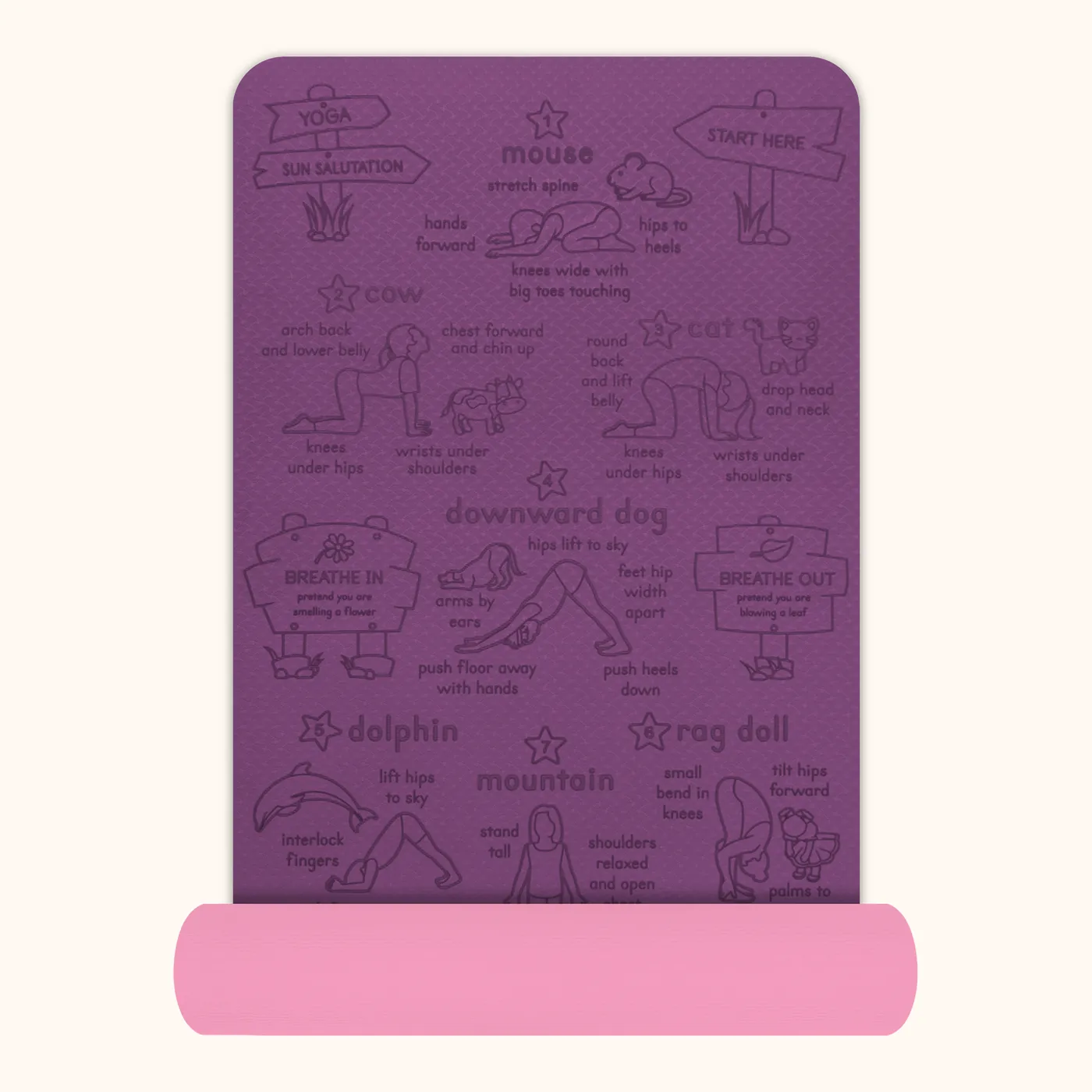
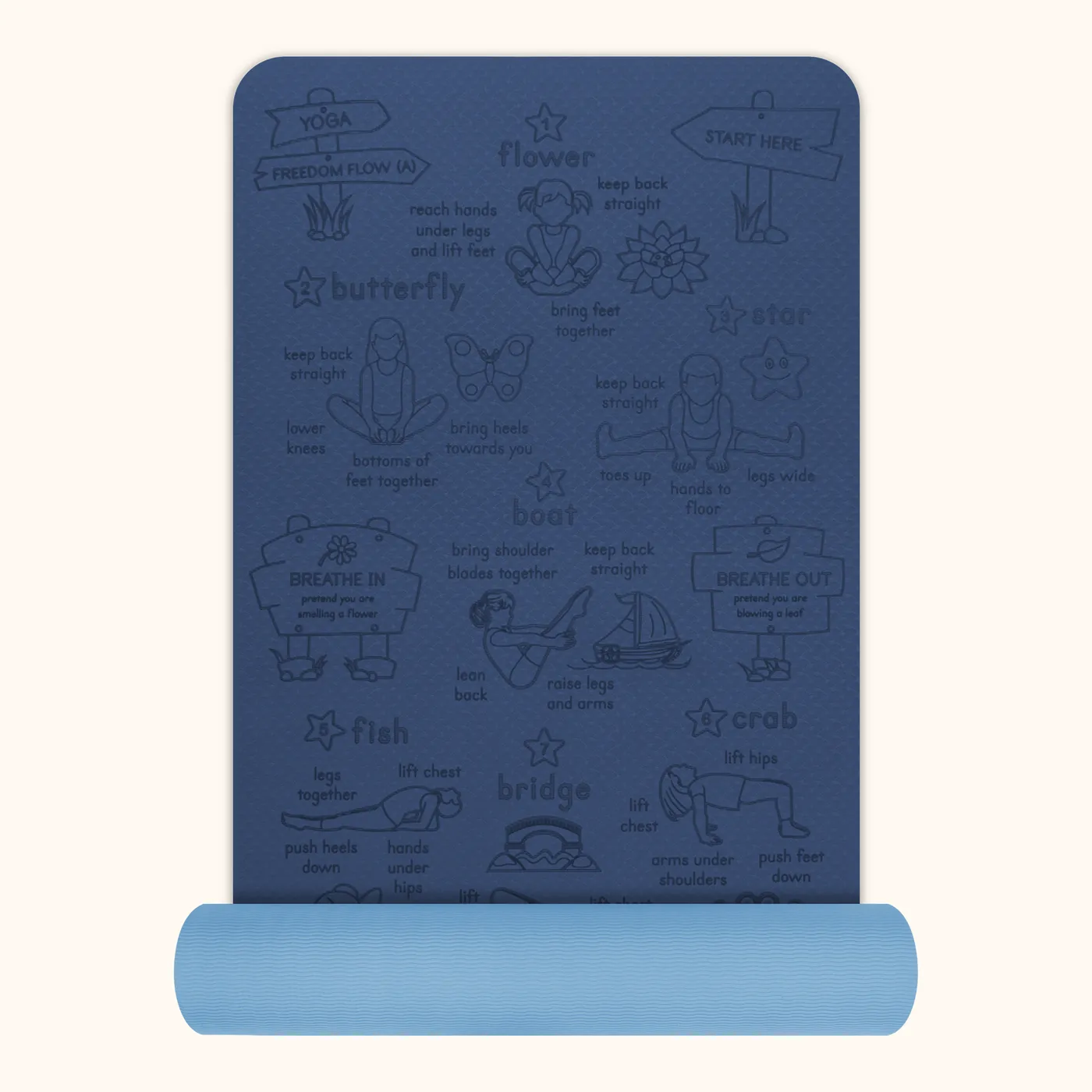
If you'd like the floor poses to have a home, our Freedom Flow mat is the floor-based design, butterfly included. Its fifteen poses are numbered and laser-engraved into the surface, so a child in pyjamas can start at 1 and work through a few on their own while you run the bath, with nothing to set up and no screen to follow. We're not claiming a mat helps anyone sleep. It's simply something calm for the hour a screen used to fill.
Should children have a TV or tablet in their bedroom?
UK guidance says no. Best Start in Life, the government's parenting site, advises keeping bedrooms and mealtimes free from screens, and the UK Chief Medical Officers advise leaving phones outside the bedroom at bedtime. A screen in the bedroom makes the hour before bed much harder to protect.
A practical rule: every device sleeps downstairs, yours included if it helps the rule stick. If a tablet is on a Christmas list, it's worth agreeing where it will sleep before it's wrapped; our children's Christmas gift guide has ideas that aren't another screen.
When is a sleep problem worth raising with your GP?
Speak to someone if your child's sleep is still difficult after a few weeks of a steady routine, or if you're worried about them. The NHS suggests talking to your health visitor, who may have other ideas or suggest a children's sleep clinic if there's one in your area. For an older child, your GP is a sensible place to start.
Taking screens out of the evening is a good first step, not a treatment.
Frequently asked questions
How much sleep does a child aged 3 to 8 need?
The World Health Organization recommends 10 to 13 hours of good-quality sleep for 3 and 4 year-olds, including any nap. The Sleep Charity gives 10 to 12 hours a night for children aged three to six, and 10 to 11 hours for seven to 12 year-olds. Regular sleep and wake-up times help.
Is it OK for a child to fall asleep with the TV on?
UK guidance points against it. Best Start in Life advises keeping bedrooms free from screens and avoiding screens for the hour before bed, and the NHS says screen light can interfere with sleep. If a programme has become how your child drops off, move it earlier and use a story instead.
Does calm, slow-paced content before bed count?
Yes, it still counts as screen time. The government's under-5s guidance favours slow-paced, age-appropriate content, watched together where possible, and still says to avoid screens in the hour before bed. For a child asleep by half past seven, a gentle programme at five beats any programme at seven.
Can my child still watch TV in the evening?
Yes. The guidance is about the last hour before bed, not the whole evening. A programme after school or before tea, watched together if you can, fits within UK advice as long as the screen goes off an hour before bed and the day's total stays within the guidance for your child's age.
Something calm for the screen-free hour
The hour before bed is easier to protect when the same calm thing is waiting every evening as the television goes off. If floor poses are that thing in your house, the Freedom Flow mat is designed for ages 3 to 8. Three- and four-year-olds copy the poses with a little help, and older children can lead their own wind-down. Under three, we'd wait.
It's full length at 183 x 61 cm and 6 mm thick, so there's room to stretch out at three and still at eight, and for you to lie down alongside. That does take a clear stretch of floor. It rolls up, weighs 800 g and comes with a carry strap. Our supplier specifies it as non-toxic, PVC-free TPE, and it wipes clean with a damp cloth and a little mild soap, then dries flat. Lay it on a dry, flat floor.
If you're looking for a Christmas present that gets used after Boxing Day, this is fifteen numbered poses for the hour before bed. Buying as a grandparent? There's room for you to have a go at the butterfly too. Two children sharing a bedroom? Two or more mats are 10 per cent off.
Roll out the poses tonight: choose a colour for their room, at £34.99 with free UK delivery and 30-day returns.
Sources
- GOV.UK (DfE and DHSC) - New screen time guidance for parents of under-5s
- Best Start in Life (GOV.UK) - Screen time guidance for under 5s
- NHS - Sleep and young children, reviewed 31 March 2023
- GOV.UK (DHSC) - UK Chief Medical Officers' commentary on screen time and social media, 7 February 2019
- World Health Organization - To grow up healthy, children need to sit less and play more, 24 April 2019
- Pickard H and others - Toddler Screen Use Before Bed and Its Effect on Sleep and Attention: A Randomized Clinical Trial, JAMA Pediatrics, December 2024 (full text on PubMed Central)
- The Sleep Charity - Relaxation tips for children
- The Sleep Charity - How much sleep does my child need?