
guides
Family Screen Time Rules That Hold, With a Simple Agreement
Screen time rules for 3 to 8 year-olds that hold: what UK guidance says, the real 3-6-9-12 rule, why 7 7 7 has no official source, and a family agreement.
Screen time rules are the limits a family sets on when, where and how long children use screens, and the ones that hold are few, written down and agreed together. For under-5s, UK guidance sets the core: no screens at meals, in bedrooms or in the hour before bed, and no more than an hour a day from 2 to 5. From 6, a family agreement does the work.
Then there are the numbered rules: 3-6-9-12, 7 7 7, 30 30 30. Only one has an author we could trace. Below: where each comes from, and a short agreement for parents and grandparents.
What do UK guidelines say screen time rules should cover?
UK guidance says screen time rules should cover when, where and what, as well as how long. The government's advice for under-5s asks families to "set clear boundaries for when and where little brains use screens". For school-age children, the UK Chief Medical Officers ask families to agree boundaries together.
The under-5s advice comes from the Department for Education and the Department of Health and Social Care. The Best Start in Life screen time page says:
- Under 2: avoid screens, except shared ones such as video calls with family.
- 2 to 5: try to keep it to one hour a day, less if possible.
- Background: try not to leave screens on in the background, especially during meals, play and family time.
- Together: slow-paced programmes, watched and talked about with a grown-up, who minds their own phone use too.
The World Health Organization sets the same one-hour ceiling for 2 to 4 year-olds, adding that less is better.
For older children, the UK Chief Medical Officers' advice, published in February 2019, sets no daily limit but suggests phones outside the bedroom at bedtime and screen-free meal times. The research behind that advice found links between screen use and problems such as anxiety and depression, but no clear evidence that screens cause them. That's a case for sensible rules, not panic.
Our screen time by age guide sets out each age in full.
What is the 3-6-9-12 rule for screen time?
The 3-6-9-12 rule is a set of age markers created in 2008 by the French psychiatrist Serge Tisseron. In its original form it says: no screens before 3, no personal device before 6, no internet before 9 and then only with an adult, and no internet alone before 12. It's widely shared but isn't UK guidance.
The 3-6-9-12 website adds detail. Before 6, a child can use a family tablet but shouldn't own one, because a device a child owns is very hard to limit. And no internet alone before 12 means, in practice, no smartphone before 13. Between 3 and 6, it suggests half an hour a day at 3, rising to an hour at most by 6.
Next to the UK advice it's stricter for toddlers (no screens before 3, where UK guidance says to avoid them under 2) and close on the rest.
What is the 7 7 7 rule for kids, and the 30 30 30 rule?
Neither the 7 7 7 rule nor the 30 30 30 rule has an official source. They aren't in the government's under-5s screen time guidance, the UK Chief Medical Officers' advice or the WHO's under-5s guideline, and we found nothing when we searched NHS and GOV.UK.
That matters. A rule with an author comes with a reason, and the reason is what holds the line with a five-year-old at the bottom of the stairs. "No screens before bed because it can affect your sleep" survives a debate. "Because it's the 7 7 7 rule" doesn't. If a numbered rule works in your house, keep it as a family rule.
Where each rule comes from, at a glance:
- Official UK guidance: the under-5s guidance (DfE and DHSC) and the Chief Medical Officers' advice (2019).
- International: the WHO under-5s guideline (2019).
- Not UK guidance: 3-6-9-12 (Serge Tisseron, France, 2008).
- No source found: 7 7 7 and 30 30 30.
Which screen time rules actually hold?
The screen time rules that hold are about places and moments, because a child can see whether they're being kept. "No screens at the table" is easy to check. "An hour a day" needs a clock and a referee. Pick four or five from this list; each is already in UK guidance or the 3-6-9-12 markers.
- No screens at mealtimes, grown-ups included. In both UK sources.
- No screens in bedrooms. Tablets and phones charge downstairs overnight, yours too.
- Screens off an hour before bed. The under-5s guidance says that hour could affect sleep.
- We watch together when we can, and talk about it.
- Screens belong to the family and live in a shared room. Tisseron's point about personal devices.
- After a long sit, we move. The Chief Medical Officers suggest a break after a couple of hours.
- Screens have a set time of day. A fixed slot, such as after tea, beats a running total.
How do you write a family screen time agreement?
A family screen time agreement, also called a screen time contract or a family media plan, is a short list of rules your family writes together and puts where everyone can see it. The UK Chief Medical Officers encourage parents to agree boundaries with their children.
The American Academy of Pediatrics recommends families make a plan, follow it together and revise it when needed. Paper and ten minutes is enough.
- Pick a calm moment, not straight after a row about the tablet.
- Ask four questions. The Chief Medical Officers recommend these, from the Royal College of Paediatrics and Child Health: is your family's screen time under control? Does screen use interfere with what your family want to do? Does it interfere with sleep? Can you control snacking during screen time?
- Choose four or five rules together, short enough for your child to repeat back, and let them pick one.
- Write it down. For pre-readers, draw it: a plate next to a crossed-out tablet.
- Everyone signs, grown-ups included, and you look at it again at half term.
For a five-year-old and a seven-year-old with a 7pm bedtime (an illustrative example), it might read:
- Screens live in the living room.
- No screens at the table, for anyone.
- Screens go off at 6pm on school nights.
- Before the screen goes off, we choose what's next.
What about grandparents and childminders?
Share the agreement with anyone who looks after your children, short enough to text. A clear list means grandparents aren't left to invent their own. If a grandparent asks what to buy instead of another tablet, send them our children's Christmas gift guide, all screen-free.
What if your child tries to get round the limits?
With 3 to 8 year-olds, getting round a limit usually means a tablet carried off to another room, or "one more episode" negotiated at the door. Keep devices family-owned and in a shared room, use parental controls as a backstop, and make the rule one your child helped write.
Parental controls, which the under-5s guidance suggests, block unsuitable content, and the Chief Medical Officers point to features that track screen time. Neither stops a five-year-old asking for "one more" twenty times. A rule they agreed to, a warning before the end and the next thing already out do more. Our guide to reducing screen time without a daily battle covers the switch-off itself.
What helps when the screen goes off?
What helps most is a next thing that's already out, because a rule that leaves a gap invites a row. The NHS says 3 and 4 year-olds need at least 180 minutes of activity spread through the day, and children aged 5 and over an average of at least 60 minutes of moderate or vigorous activity a day.
Many screen slots are also sitting slots, so a moving swap earns its place: a cushion obstacle course, a kitchen disco while the pasta boils, or a few yoga poses before bath. If you've never done yoga together, start with our guide to yoga for kids.
One option, and the one we make, is a mat left out in the room where the tablet lives. Our Sun Salutation mat has 15 numbered poses laser-engraved into the surface, so a five-year-old can start at 1 and work through on their own. "Poses 1 to 5, then it's tea" is a rule they can follow with no screen to copy.
To reset the whole house at once, try a screen-free week with your kids.
When do screen rows need outside help?
If your child's behaviour around screens, or more widely, seriously worries you, the NHS advises talking to your health visitor or GP. That advice is on the NHS temper tantrums page, which also points parents to Family Lives and its free helpline on 0808 800 2222, where you can speak to a trained family support worker.
You don't need to be sure screens are the cause before you ask.
Frequently asked questions
What is the 3-6-9-12 rule for screen time?
It's a set of age markers created in 2008 by French psychiatrist Serge Tisseron: no screens before 3, no personal device before 6, no internet before 9 and then only with an adult, and no internet alone before 12. It isn't UK guidance, which says to avoid screens under 2.
What is the 7 7 7 rule for kids?
There's no official 7 7 7 rule. It doesn't appear in the UK government's under-5s screen time guidance, the UK Chief Medical Officers' advice or the WHO's under-5s guideline, and we found no trace of it on NHS or GOV.UK. If a version works for your family, treat it as your own house rule.
What is the 30 30 30 rule for screen time?
There's no official 30 30 30 rule for screen time. It isn't in the UK government's under-5s guidance, the Chief Medical Officers' advice or the WHO's guideline. UK advice is to avoid screens under 2 and try to keep 2 to 5 year-olds to an hour a day, less if possible.
Should grandparents follow the same screen time rules?
It helps if they do. The UK Chief Medical Officers encourage families to agree boundaries together, and rules hold best when every grown-up keeps the same ones. Share your written agreement with grandparents and childminders, short enough to text. If that feels like a lot to ask, settle for two: no screens at the table and none in the hour before bed.
Something to leave out where the tablet lives
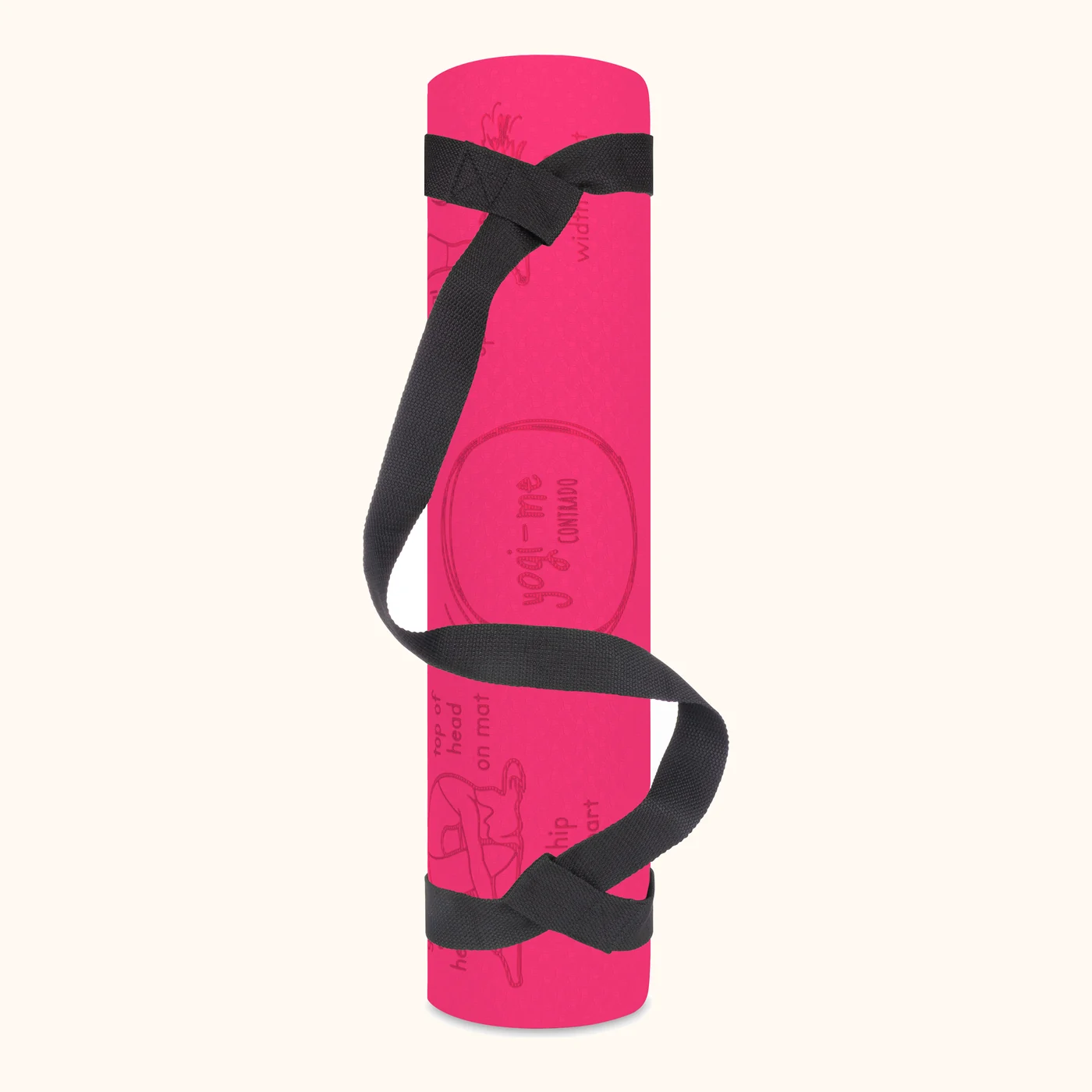
A Yogi-Me mat is a full-length mat for children with 15 numbered poses laser-engraved into the surface. It's designed for ages 3 to 8. Younger children copy the poses with a little help; older children lead their own sessions.
At 183 x 61 cm it's full length on purpose, so there's room to stretch out at three and still at eight, and room for you to join in. The trade-off is that a shorter mat is easier for a three-year-old to carry alone. Ours weighs 800 g and rolls up with a carry strap, so it can sit in a corner of the living room or go to Grandma's along with the agreement.
Will it just sit gathering dust? There's nothing to set up and no screen to follow, so it's as easy to start on a wet Saturday in January as on Christmas afternoon. That makes it a fair choice if you want a Christmas present that isn't another screen.
Buying as a grandparent? It's full length, so you can have a go at the poses too, and a mat at your house means the same rules work there.
There are two designs. Sun Salutation is a standing sequence, for moving after a long sit. Freedom Flow is floor-based, for the calmer hour before bed. Both are the same size, material and price, in seven colours each.
It's non-toxic, PVC-free TPE, according to our supplier's specification, with 6 mm of cushioning. Wipe it with a damp cloth and a little mild soap, let it dry flat, and use it on a dry, flat floor.
Two children sharing one set of rules? Two or more mats are 10 per cent off.
Write the agreement this week, and have the next thing ready before the first screen goes off. Our full-length yoga mats for children are £34.99 each, with free UK delivery and 30-day returns.
Sources
- GOV.UK (DfE and DHSC) - New screen time guidance for parents of under-5s
- Best Start in Life (GOV.UK) - Screen time guidance for under 5s
- GOV.UK (DHSC) - UK Chief Medical Officers' commentary on screen time and social media, 7 February 2019
- UK Chief Medical Officers - Commentary and advice for parents and carers (PDF), 7 February 2019
- World Health Organization - To grow up healthy, children need to sit less and play more, 24 April 2019
- 3-6-9-12 (Serge Tisseron) - Les balises 3-6-9-12+, in French
- American Academy of Pediatrics - Media and children, Family Media Plan
- NHS - Physical activity guidelines for children (under 5 years)
- NHS - Physical activity guidelines for children and young people (5 to 18 years), reviewed 23 October 2024
- NHS - Temper tantrums, reviewed 7 November 2022