
guides
How to Reduce Screen Time for Kids Without a Daily Battle
How to reduce screen time for kids aged 3 to 8 without daily rows: what UK guidance says, a four-week plan and swaps that fill each screen slot.
To reduce screen time for kids without a daily battle, take back one screen slot at a time (the after-school tablet, the episode before bed), put a ready alternative in that exact slot, and warn your child before every switch-off. Start with mealtimes and the hour before bed, which UK guidance names specifically. The goal is fewer rows, not zero screens.
If the tablet has drifted from treat to default, you're far from alone. When the government published its screen time guidance for under-5s, it said a quarter (24 per cent) of parents of 3 to 5 year-olds find it hard to control their child's screen time, and that 98 per cent of two-year-olds watch screens every day.
So this isn't a guide about guilt. It's a plan for a wet Tuesday at 5pm, for parents and grandparents of 3 to 8 year-olds.
What does UK guidance say about reducing screen time for kids?
UK guidance keeps mealtimes, bedrooms and the hour before bed free of screens, and the government's one-hour daily limit covers children aged 2 to 5. Its advice says under-2s should avoid screens except shared activities such as video calls, and 2 to 5 year-olds should try to keep it to no more than one hour a day. The UK Chief Medical Officers set no daily limit for school-age children.
That advice, from the Department for Education and the Department of Health and Social Care, is on the government's Best Start in Life screen time page. It also suggests:
- Slow-paced, age-appropriate programmes rather than fast, social media-style videos.
- Watching together and talking about it, rather than a child using a screen alone.
- No screens left on in the background during meals, play and family time.
The World Health Organization reaches the same figure for 2 to 4 year-olds: no more than one hour of sedentary screen time a day, and less is better.
For school-age children, the UK Chief Medical Officers' advice, published in February 2019, encourages families to agree boundaries together, leave phones outside the bedroom at bedtime, keep mealtimes screen-free, and get up and move after a couple of hours sitting at a screen.
The research behind that advice found links between more frequent or longer screen use and some mental health problems in children and young people, but no clear evidence that screens cause them. That's a reason for sensible boundaries, not for panic. Our screen time by age guide sets out every age in full.
Why are screen time tantrums worst at switch-off?
Screen time tantrums tend to flare at the switch-off, not over the total hours. A child is asked to stop something they enjoy, often mid-story, and nothing obvious takes its place. The row starts in that gap, so planning the next five minutes matters more than counting the minutes before them.
For the youngest, a meltdown here is also simply their age. The NHS says temper tantrums usually start at around 18 months, are very common in toddlers, and are far less common by age 4.
The same NHS page has two lines worth pinning to the fridge. Losing your temper or shouting back won't end a tantrum. And giving in doesn't help in the long term: if you've said the screen goes off, keep it off, or your child learns that a big enough reaction brings it back.
What makes the switch-off easier:
- Warn twice. "Two more minutes, then it's off," then "Last one now."
- Stop at a natural end. The end of an episode beats the middle of a scene.
- Let them press the button. Doing it themselves gives a small child some control.
- Have the next thing already out. Crayons on the table, a mat on the floor. The NHS suggests finding a distraction straight away when a tantrum is starting, which is easier when it's already out.
How do you stop kids having too much screen time?
To stop kids having too much screen time, cut it in stages over about four weeks rather than overnight. Each week, take back one daily screen slot and fill it with something specific. A small, predictable change is easier to hold than a sudden ban, and gives you time to find swaps your child likes.
A screen slot is a regular point in the day when the screen goes on by habit: after school, while tea cooks, before bed, Saturday morning. Write yours down for a few days before week one. You're changing a handful of moments, not counting minutes.
- Week 1, mealtimes. Conversation, music, or I spy with colours or letters.
- Week 2, the hour before bed. A bath, a story together and a few slow stretches.
- Week 3, the after-school or after-nursery slot. A snack, then something that gets them moving.
- Week 4, background TV. Off by default, on for one chosen programme watched together.
The slots in weeks 1, 2 and 4 come straight from the government's under-5s advice, which suggests table games or I spy at meals and bedtime stories instead of screens. Week 3 swaps a sitting slot for a moving one.
With 5 to 8 year-olds, agree the plan with them rather than announcing it, as the Chief Medical Officers suggest. Let them choose a protected slot of their own, such as a Saturday morning film. Write the rules down where everyone can see them, so the argument is with the list rather than with you. Our guide to family screen time rules has a simple agreement to start from, and explains where numbered rules such as 3-6-9-12 come from.
What can you replace screen time with?
The best alternatives to screen time fill the same slot with something that needs as little setting up as the screen did. If the tablet went on while you cooked tea, the swap has to work while you cook tea: ready to hand, already out, and fine with light supervision.
- While tea is cooking (you need 20 minutes): colouring or stickers at the table, or helping wash vegetables.
- Straight after school or nursery (everyone's tired): a snack, then a movement game or a few yoga poses.
- The hour before bed (winding down): a bath, a story together, slow stretches on the floor.
- A rainy weekend morning (a long stretch to fill): building a den, a kitchen disco, an obstacle course of cushions.
- Waiting rooms and car journeys (short and stuck): I spy, a sticker book, a small notebook and pencil.
Movement earns its place because many screen slots are also sitting slots. The NHS says children aged 3 and 4 should be active for at least 180 minutes a day, including at least 60 minutes of moderate to vigorous activity. For children aged 5 and over, it advises an average of at least 60 minutes of moderate or vigorous activity a day across the week, and breaking up long spells of sitting.
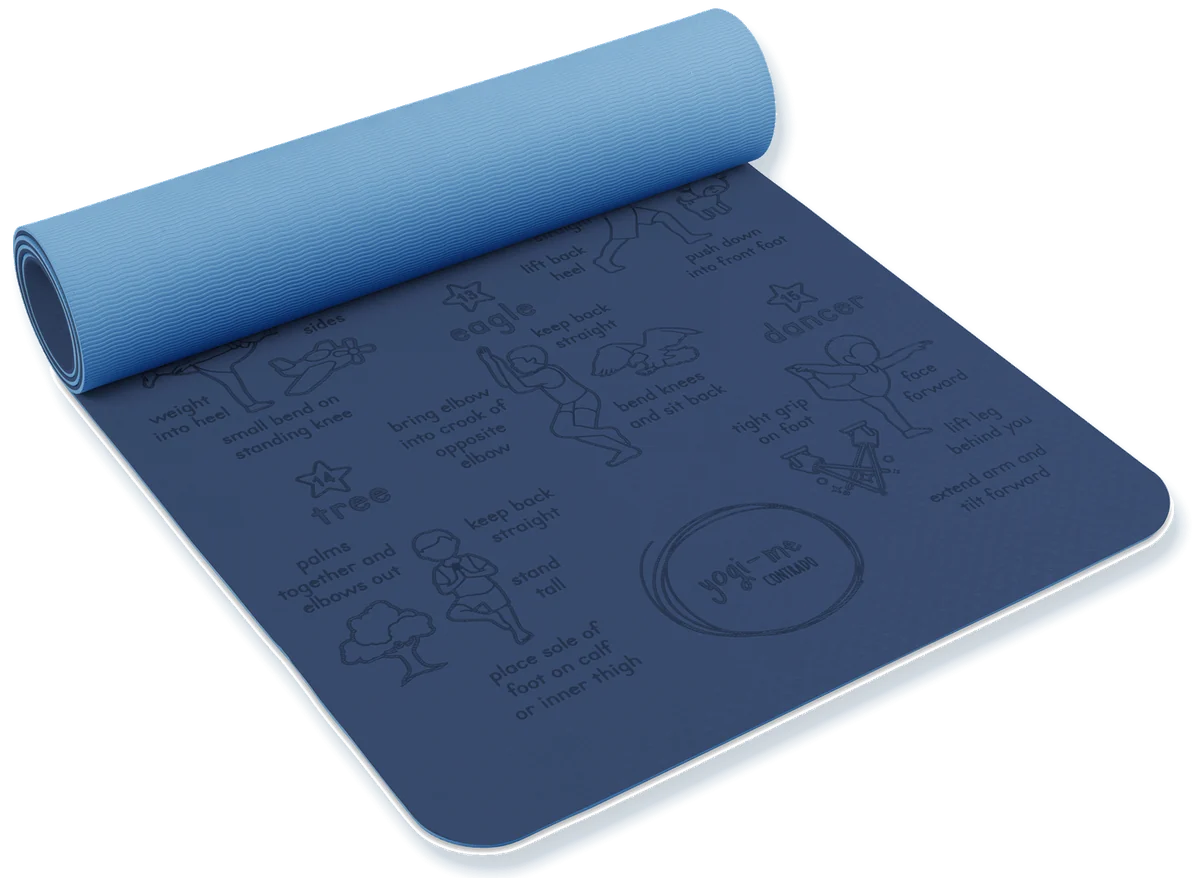
One swap, and the one we make, is a mat that stays rolled out where the tablet used to be. Our Sun Salutation design is a full-length mat with fifteen poses marked in, numbered 1 to 15, so after school a five-year-old can be told "do poses 1 to 5" and get on with it, with no screen to follow. It's one option among many. New to yoga yourself? Our guide covers how to start yoga with your child.
For more ideas sorted by age, see our 30 screen-free activities for 3 to 8 year-olds.
Do parents need to cut their own screen time too?
Yes, at least when your children are around. The government's Best Start in Life guidance says young children copy their parents' screen habits, and that long periods on your phone make it harder to notice what your child is doing or feeling. The UK Chief Medical Officers note that studies have found children worry about their parents' screen use.
That means a few visible habits, not a family detox:
- Phones go in a drawer at mealtimes, grown-ups' included.
- Say why you've picked your phone up: "I'm checking the bus times."
- Charge your phone outside the bedroom too, so the bedtime rule is the same for everyone.
If grandparents or a childminder look after your children, share the two or three rules you've settled on, so the plan doesn't reset every Wednesday. If they ask what to buy at Christmas, point them to our gift ideas that aren't another screen.
When a day goes wrong and the tablet does the heavy lifting, start again tomorrow. Our founder's own story of building screen-free habits that stick is about small, repeated rituals rather than big rules.
When do screen battles need a GP or health visitor?
The NHS advises talking to your health visitor or GP if you're seriously concerned about your child's behaviour. That holds whether or not screens seem to be the cause. The same NHS page points parents to Family Lives, which runs a free helpline on 0808 800 2222 with trained family support workers.
Frequently asked questions
How do I handle screen time tantrums?
Give two warnings, stop at a natural end, let your child switch it off, and have the next activity already out. If a tantrum still comes, stay calm and keep the screen off. The NHS says shouting back won't end a tantrum and giving in doesn't help in the long term.
Should I ban screens completely?
You don't need to. Government advice for 2 to 5 year-olds is no more than one hour a day, ideally watched together, and the UK Chief Medical Officers encourage parents of older children to agree boundaries with them. Only under-2s are advised to avoid screens, apart from shared activities like video calls.
How long does it take to reduce screen time?
Allow about four weeks if you take back one screen slot a week: mealtimes first, then the hour before bed, the after-school slot and background TV. Go more slowly if a week goes badly. What matters is that each change holds before you add the next one.
What if grandparents allow more screen time?
Share two or three rules rather than a long list, such as no screens at meals and none in the hour before bed, and pass on the swaps that work at home. Keeping the same few rules in every house means the plan doesn't reset each time a different adult is in charge.
Where does a yoga mat fit into the plan?
It fits week 3, the after-school slot, and only if it's already out. A Yogi-Me mat has 15 numbered poses laser-engraved into the surface, so there's nothing to set up: a five-year-old can start at 1 and work through to 15 on their own. It's designed for ages 3 to 8. Younger children copy the poses with a little help; older children lead their own sessions.
At 183 x 61 cm it's full length on purpose, so there's still room at eight and you can join in. That's a fair stretch of floor. It rolls up, weighs 800 g and comes with a carry strap, so it can go away when you need the room back. To clean it, wipe it with a damp cloth and a little mild soap, then let it dry flat.
Sun Salutation is the standing sequence, for children who come home wanting to move; Freedom Flow is a calmer floor sequence, which suits the hour before bed. Same size, material and price.
Buying as a grandparent, for Christmas or a birthday? It's a present that fits straight into the plan, with nothing to charge, and you can have a go at the poses too. Two or more mats are 10 per cent off, if brothers and sisters would rather not share.
Have it rolled out by week 3. Pick a colour from our full-length yoga mats for children: £34.99 each, with free UK delivery and 30-day returns.
Sources
- GOV.UK (DfE and DHSC) - New screen time guidance for parents of under-5s
- Best Start in Life (GOV.UK) - Screen time guidance for under 5s
- World Health Organization - To grow up healthy, children need to sit less and play more, 24 April 2019
- GOV.UK (DHSC) - UK Chief Medical Officers' commentary on screen time and social media, 7 February 2019
- NHS - Temper tantrums, reviewed 7 November 2022
- NHS - Physical activity guidelines for children (under 5 years)
- NHS - Physical activity guidelines for children and young people (5 to 18 years), reviewed 23 October 2024