guides
Do Yoga Mats With Poses Help Children? An Honest Look
Do yoga mats with poses help children? What the pictures do and don't do, how to judge one for ages 3 to 8, and when a plain mat is the better buy.
Yes, yoga mats with poses can help children aged 3 to 8, in one specific way: they show a child what to do next, without a grown-up reading out instructions or a video on the telly. A mat won't make a child calmer or bendier on its own. What it does is make starting easy.
Below: how to judge one on four points, how it compares with a plain mat or a video, and when it's the wrong buy.
What is a yoga mat with poses on it?
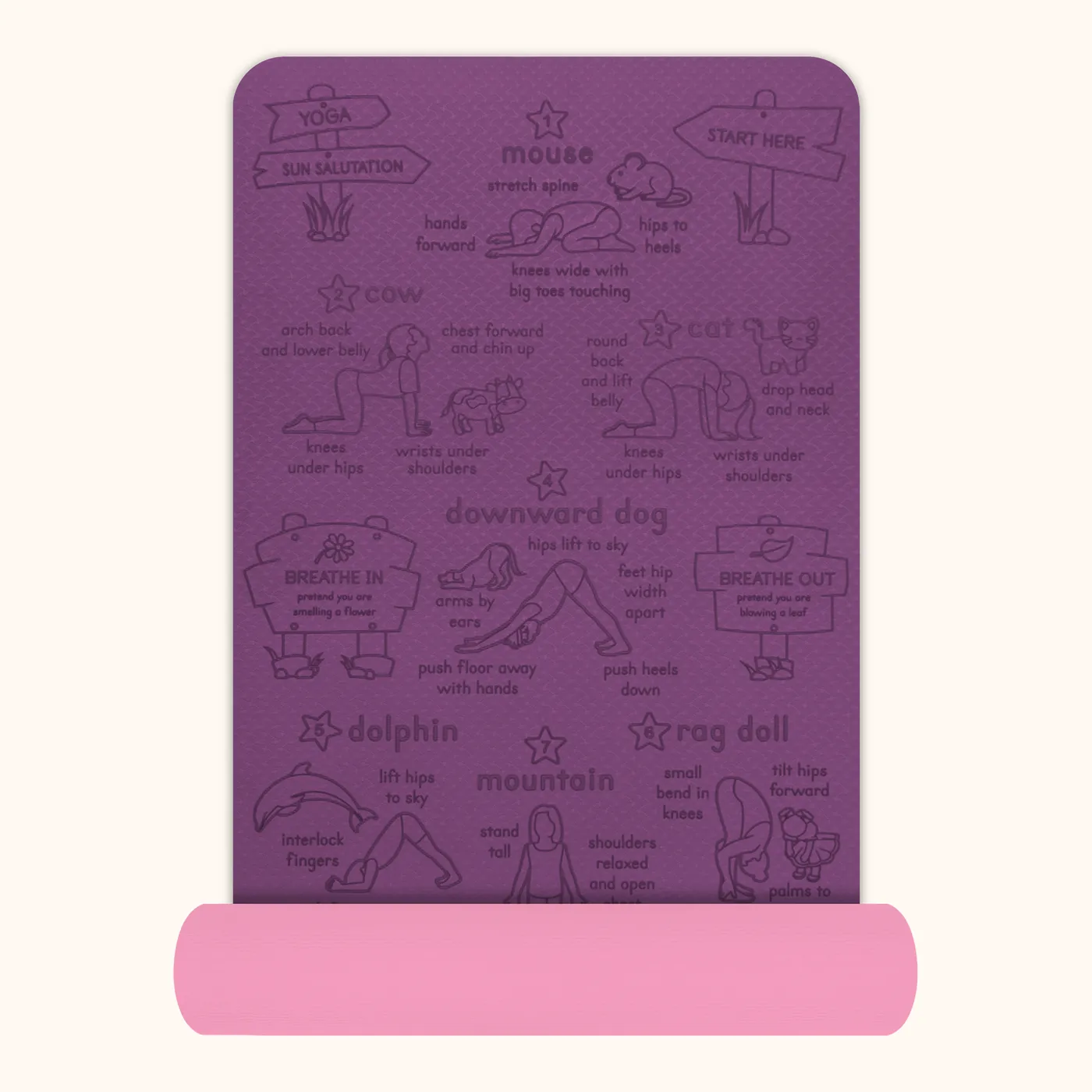
A yoga mat with poses on it is an exercise mat with a set of yoga positions shown on its surface, printed or engraved, so the instructions sit under the child's feet. Children's versions usually use simple animal and nature shapes, such as cat, tree or butterfly, and the better ones number them in order.
Do yoga mats with poses help children?
They help a child start and keep going without help, which is the hard part of yoga at home. They don't teach good form, and the novelty fades if the poses are too hard or too few. So judge the poses before the design, on these four points:
- Can your child use it alone? Clear pictures, numbered in order.
- Do the poses suit their age? Simple animal shapes for 3 to 5, balances for 6 to 8.
- Will the pictures last? Know whether they're printed or engraved.
- Is there room to do the poses? Long enough to lie down on, not just to look at.
Grip, weight and materials matter too, and our full guide to choosing a mat covers them.
Can a child follow the poses on the mat on their own?
A child can follow the poses alone if each picture is clear enough to copy and the order is obvious. Numbered poses running from one end of the mat to the other work best, because the child simply moves to the next number. Unnumbered pictures usually need an adult to choose what comes next.
Here's an illustrative example. Your five-year-old unrolls the mat after school, stands on number one and works along to number fifteen, without anyone finding a video or reading out the next step. That is the whole case for poses on a mat.
How to judge it on a listing: check the poses are numbered, and ask whether your child could copy each one from the picture alone.
Which poses should a children's mat show?
The best poses for a kids' mat are simple shapes a child can copy from a picture: all-fours animal poses such as cat, cow and downward dog, floor shapes such as butterfly, and standing shapes such as mountain and tree. We'd leave out any pose that puts a child's weight on their head or neck, such as a headstand.
Three and four-year-olds do best with floor shapes and animals to name. Six to eight-year-olds tend to enjoy balances such as tree or eagle. Bigger back bends, such as bow or camel, are best kept small, with a grown-up nearby.
The NHS advises that children aged 5 to 18 do exercise suitable for their age, ability and experience, and start any new exercise slowly. Our list of easy yoga poses for kids has a plain how-to for twelve gentle ones.
Will the pictures on a yoga mat wear off?
How long the pictures last depends on how they're put on. A printed design sits on the surface of the mat, while an engraved one is marked into the material itself. Feet, knees and cleaning all rub at a mat's surface, so it's worth knowing which kind you're buying before you choose.
How to judge it on a listing: look for "printed", "engraved" or "embossed". If a listing doesn't say how the poses are applied, ask the seller.
How big and how thick should a yoga mat with poses be?
A yoga mat with poses should be long enough for your child to lie down on, not just long enough to show the pictures, and around 4 to 6 mm thick. Thinner mats feel hard on knees and wrists, while much thicker ones can wobble in standing and balancing poses.
A full-length mat of about 180 cm leaves room for lying poses and for a child to grow. Our guide to how long a child's mat should be breaks the measurements down.
How to judge it on a listing: find the length in centimetres and the thickness in millimetres, not just "kids' size", and check your child could lie flat on it with arms stretched overhead.
Mat with poses, plain mat or a video: how do they compare?
A mat with poses lets a child practise alone. A plain mat with a parent leading works just as well when you have the time. A plain mat with a video gives the most variety but uses screen time. The right one depends on who'll lead and how much screen time your child already has.
A mat with poses on it
- Who leads: your child, following the pictures
- Screen time: none
- Suits: independent play, short sessions after school, a child who likes routine
A plain mat with a grown-up leading
- Who leads: you
- Screen time: none
- Suits: families doing it together, children who like inventing their own shapes
A plain mat with a yoga video
- Who leads: the presenter
- Screen time: the length of the video
- Suits: older children who want new routines, a longer rainy-day session
Is a mat with poses better than a yoga video?
Not better, but different, because a mat with poses is screen-free and a video isn't. UK government guidance suggests trying to keep screen time for children aged 2 to 5 to no more than one hour a day, so a yoga video spends part of that hour.
The fuller Best Start in Life guidance advises against young children using screens alone, because it reduces time for social and active play.
A video still gets a child moving; a mat with poses does it without spending that hour.
What do parents get wrong when buying one?
The easiest mistake is choosing on the theme rather than the poses. A mat covered in lovely pictures that don't form a sequence, or show shapes your child can't do yet, tends to sit gathering dust. Buying for the height they are now is another.
- Expecting a three-year-old to do every pose. Start with three or four and add one at a time. Our beginner's guide to kids' yoga has more on getting started.
- Expecting the mat to be the exercise. The NHS says children aged 3 to 4 should be physically active for at least 180 minutes a day, and 5 to 18-year-olds should average at least 60 minutes of moderate or vigorous activity a day across the week. A short pose sequence is part of that, not the whole of it.
Where can I find a mat with poses on it?
Online is easiest. Search for a children's mat with poses and you'll find specialist children's brands alongside the big marketplaces. Then judge each listing on four points: numbered poses, shapes that suit your child's age, printed or engraved pictures, and the size in centimetres.
What we made, and why
We made Yogi-Me mats so a child aged 3 to 8 can roll one out and follow along without a screen or a grown-up leading. Each has 15 numbered poses laser-engraved into the surface, not printed on top, so a five-year-old can start at 1 and work through to 15 on their own. It's 183 x 61 cm, 6 mm thick and 800 g, made of non-toxic, PVC-free TPE according to our supplier's specification, and it rolls up with a carry strap. To clean it, wipe it with a damp cloth and a little mild soap, then let it dry flat.
There are two designs of our mat with poses, and the only difference is the poses. Sun Salutation is for a child who wants to move: it starts on hands and knees with mouse and cat and rises to standing balances such as tree and dancer. Freedom Flow is for a child who needs to settle: a calmer floor sequence with poses such as butterfly, star, boat and bridge. Same size, material and price, seven colours each, and we've explained every pose on both mats by name.
The full length is deliberate. There's room to stretch out at three and still at eight, so they grow into it rather than out of it.
When is a mat with poses, including ours, not the right one?
A mat with poses, ours included, isn't the right buy for a child under 3, a child who'd rather invent their own shapes, tumbling, or a class with a teacher calling the poses. In those cases a plain or specialist mat may suit better.
- Under 3. Our poses are pitched at ages 3 to 8, so a numbered sequence will mean little to a toddler for now.
- A child who wants a blank space. Some children love inventing their own poses, and pictures get in the way.
- Tumbling and gymnastics. At 6 mm, ours is a yoga mat, not a mat made for forward rolls and cartwheels.
- A busy room with a teacher calling the poses. There, price per mat and how quickly they wipe down matter more than pictures.
Is a mat with poses a good Christmas present?
It is if you want a present that still gets used after Boxing Day. Fifteen numbered poses work on Christmas afternoon, on a rainy Saturday in January and on a spring evening after school, with nothing to charge and nothing to set up. Buying for brothers, sisters or cousins? There's 10 per cent off two or more.
Buying as a grandparent? It's full length, so you can have a go at the poses too. Our guide to screen-free Christmas gifts has more ideas.
Frequently asked questions
What material should I avoid in a child's mat?
Avoid any mat that doesn't say what it's made of, especially one with a strong chemical smell. Look for a clear material description, such as PVC-free TPE or natural rubber, and check for latex if your child has an allergy.
What age is a yoga mat with poses for?
Ours is designed for children aged 3 to 8. A younger toddler may enjoy copying a grown-up, but a numbered sequence makes more sense once a child can count along and hold a simple shape for a moment. Three- and four-year-olds usually copy the poses with a little help.
Can a grown-up use a mat with poses made for children?
Yes, if it's full length. A grown-up needs room to lie down with arms overhead, so a short children's mat won't do. Ours is 183 x 61 cm, so a parent can join in on the same mat or use it once the children are in bed.
Does a child need a grown-up to use a mat with poses?
Not every time. Once they've been through it with you a few times, numbered poses let a child of about five work from 1 to 15 on their own. Three- and four-year-olds usually copy the poses with a little help. Stay in the room for the balances, and keep the mat on a dry, flat floor.
Standing or floor: which design to pick
Pick the design and colour your child can follow on their own: Sun Salutation if they want to get up and move, Freedom Flow if they need to settle down. Each is £34.99 with free UK delivery, and you have 30 days to return it.