guides
12 Indoor Party Games for Kids Aged 3 to 8, No Equipment
Party games for kids indoors, ages 3 to 8: twelve that need no equipment, sorted from loud to quiet for a front room, not a hall.
The best party games for kids indoors need nothing but the children and some music, and they come in the right order. Play the loud games first, the listening games in the middle and the quiet games last, so the party ends calm rather than at full volume. These twelve suit ages 3 to 8, and every one fits in a front room.
What makes a game work in a front room?
A no-equipment party game is one you can play with nothing but the children and, at most, some music. Every game here is played on the spot, in a circle or across one room. Nothing is bought and nothing is made; one game borrows a single object from the house.
Some classics are missing on purpose. Musical chairs needs chairs and a lot of shoving. Tag and duck duck goose need running room. Pass the parcel and balloon games need kit.
These also work as group games for kids indoors at a playdate or a wet-weekend club, alongside our screen-free activities for kids. And if a grandparent, aunt or uncle is running the party, every game here can be run from a chair, by calling, judging and working the music.
12 indoor party games for kids, from loud to quiet
Loud: on their feet, for the first half hour
1. Musical bumps
Play music and everyone dances. When it stops, they sit down on the floor as fast as they can. With under-fives, nobody is out: the last one down pulls a funny face and carries on. With older children, the last one down becomes the DJ for the next round. Age 3 and up.
2. Grandmother's footsteps
One child stands facing the wall at the far end of the room. Everyone else creeps towards them. When the child at the wall spins round, the creepers freeze; anyone caught moving goes back to the start. The first to tap them on the shoulder takes over. It's loud in bursts and full of giggles. Age 4 and up.
3. Pose statues
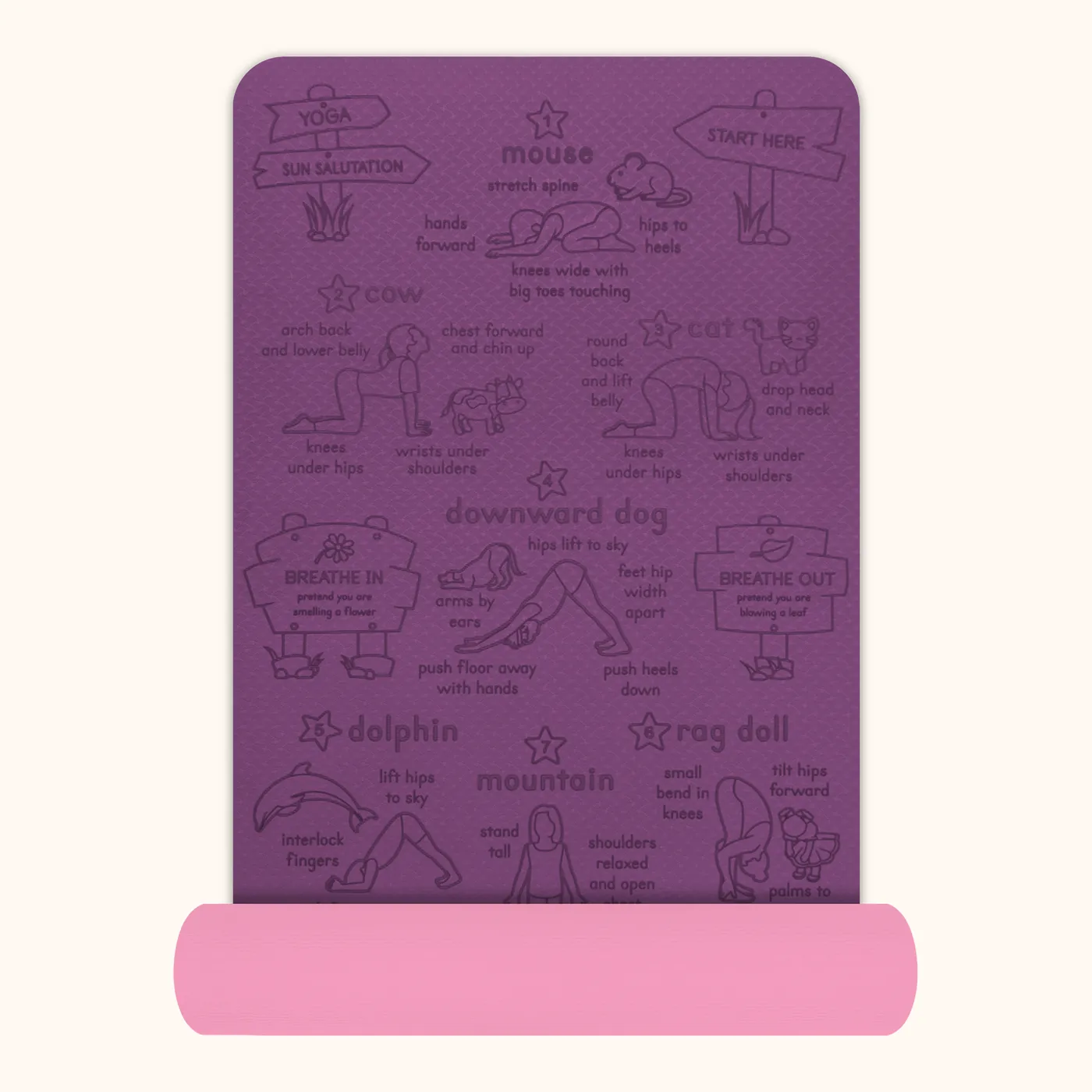
Musical statues with a twist: when the music stops, the caller shouts a pose and everyone freezes in it. On a mat with fifteen numbered poses, the birthday child calls a number and the room copies: 3 is a cat, 13 an eagle, 14 a tree. No mat? Call animal names instead. Age 3 and up.
4. Shake-out countdown
Everyone stands up. Shake your right hand ten times while everyone counts out loud, then the left hand, then each foot. Then do it all again with nine shakes, then eight, all the way down to one, getting faster and louder. It ends in a heap of noise, then sudden quiet. Age 3 and up.
Listening: still moving, but less noise
5. Simon says
The caller gives instructions, and the children only follow the ones that begin "Simon says". Keep every move on the spot: touch your nose, stand on one leg, wave like a tree. For four-year-olds, play without anyone out, so a wrong move just gets a laugh. Our Simon says ideas have plenty more commands. Age 4 and up.
6. Animal charades
One child acts out an animal without making a sound, and everyone else guesses. Whoever guesses right goes next. Elephants, penguins and snakes are quick to guess; a cat that's very cross is harder. Four-year-olds can play if a grown-up whispers an idea to them first. Age 5 and up.
7. Who's the leader?
The children sit in a circle and one goes out of the room as the detective. The circle chooses a secret leader, who starts an action, such as clapping or patting knees, and changes it every so often. Everyone copies. The detective comes back and has three guesses to spot who's leading. Age 6 and up.
8. Mirrors
The children pair up and face each other. One moves slowly, an arm up, a hand to an ear, a slow turn, and the other copies like a reflection. Then they swap. It works well with an older child and a three-year-old together, because slow is the whole point. Age 3 and up.
Quiet: sitting or lying down, before cake or home time
9. Sleeping lions
The children lie on the floor as lions and stay perfectly still. One or two hunters walk round trying to make a lion giggle or twitch, without touching. Anyone who moves becomes a hunter too. It's the best last game of a party, because it ends with every child lying still. Age 3 and up.
10. Pass the message
The children sit in a circle. The first whispers a short sentence to the next, once, and it travels round. The last child says it out loud and the first says what it started as. "The cat sat on Dad's toast" rarely survives a circle of six-year-olds. Keep sentences short for younger players. Age 5 and up.
11. Guess the animal
One child thinks of an animal and keeps it secret. The others take turns to ask questions that can only be answered yes or no: does it live in water, has it got four legs, is it bigger than a dog? Whoever guesses it thinks of the next one. Calm, and good for a circle. Age 6 and up.
12. Hunt the thimble
The one game that borrows an object. While the children cover their eyes, hide something small in plain sight, such as a thimble, a sock or a toy car. Then they search, and you steer them with "warmer" and "colder". Whoever finds it hides it next time. For three-year-olds, use something bigger. Age 4 and up.
Which party games suit which age?
Under-fives need one rule and nobody out for long; fives and sixes can take turns; sevens and eights want a challenge, or to run the game. Development Matters, the Department for Education's early years guidance, asks whether a child around the age of 3 can sometimes take turns with others, with adult guidance, so keep a grown-up close for the youngest. A guest who'd rather watch can still play with a job: DJ for musical bumps, judge for sleeping lions or caller for pose statues.
- Ages 3 to 4, one rule each: musical bumps (1), pose statues (3), the shake-out (4), mirrors (8) and sleeping lions (9).
- Ages 5 to 6, turns and a caller: the best party games for 5 year olds indoors add grandmother's footsteps (2), Simon says (5), animal charades (6), pass the message (10) and hunt the thimble (12).
- Ages 7 to 8, a challenge or a job: who's the leader? (7) and guess the animal (11). Let them run musical bumps and pose statues for the younger guests. For more, try our yoga games for kids.
How long should a kids' party be, and how many games do you need?
There's no official length for a children's party. Our suggestion at this age: games for about half the time, food and cake for the rest, and more games ready than you'll use, because some will flop and some will be demanded twice.
The loud games earn their place. The NHS says children aged 3 to 4 should spend at least 180 minutes a day doing a variety of physical activities, and children aged 5 to 18 should aim for an average of at least 60 minutes of moderate or vigorous activity a day across the week. A party is a good afternoon for some of it.
Two running orders, a birthday and a Christmas party
Examples, not timings. Each runs loud, listening, food, quiet.
A birthday party at home
For birthday party games for kids at home, start with musical bumps (1) and the shake-out (4), then pose statues (3) led by the birthday child. Calm things with mirrors (8) before food. After tea, play sleeping lions (9) while the candles are lit in the kitchen, then cake. If pose statues was the hit, our guide shows how to start yoga with your child.
A Christmas party with mixed ages
Older cousins run grandmother's footsteps (2) and musical bumps (1). Then animal charades (6), reindeer and robins included. After food, pass the message (10) and guess the animal (11), and finish with sleeping lions (9). Still shopping? Our gift ideas that aren't another screen suit the same ages.
If you'd like pose statues on the day, our children's yoga mats have 15 numbered poses laser-engraved into the surface, so the birthday child can call the game without knowing any yoga. They're designed for ages 3 to 8 and cost £34.99 with free UK delivery. Two or more are 10 per cent off, handy for brothers and sisters.
How do you get a front room ready for party games?
Clear the floor before the doorbell goes. Push the coffee table and anything breakable to the edges, roll up any rug that slides, and have the music ready on a phone. Write the running order on a sticky note by the door, so you're never thinking up the next game mid-party.
Put a few cushions in one corner, too, for any child who needs five quiet minutes, the birthday child included. If your guests are staying the night, our sleepover ideas for kids pick up where the party ends.
Frequently asked questions
What party games need no equipment?
Musical bumps, Simon says, mirrors, sleeping lions, pass the message and guess the animal need nothing at all, and grandmother's footsteps only needs a wall to stand at. Music from a phone is the only extra most of them use. Hunt the thimble borrows one small object from around the house, such as a sock or a toy car.
What age is musical statues for?
From about three. Development Matters, the Department for Education's early years guidance, lists holding a pose for a game like musical statues among the things 3 and 4-year-olds will be learning to do. Under-fives play it best with nobody out. Seven and eight-year-olds often prefer to be the one who stops the music.
How do you play sleeping lions?
Everyone lies on the floor as a sleeping lion and keeps perfectly still. One or two hunters walk round trying to make the lions move or laugh, without touching them. Any lion who moves joins the hunters. The last lion still sleeping wins, and the next round starts with everyone lying down again.
Do kids' party games need prizes?
No. At this age, being the next caller, judge or hunter is usually prize enough, and it keeps the game moving. If you'd like something to hand out, give every child the same small thing at the end, such as a sticker, so nobody goes home in tears over a single winner.