practice
Children's Pilates or Yoga? How They Compare for Kids
Children's pilates or yoga? What each asks of a child, which suits a 3 or an 8 year old, where to find a class, and when pilates is the better fit.
Children's pilates suits a child who likes to get something right: slow, controlled exercises with attention on how the body moves. Children's yoga suits a child who'd rather play: poses as animals and shapes, some breathing and a rest at the end. No UK health body says one is better for children. Both count as activity, so go with whichever your child asks to do again.
We make yoga mats, so weigh our view with that in mind. We've tried to give pilates a fair hearing, and the section on when it's the better fit is there because it sometimes is.
Which one suits your child?
The choice turns on temperament more than on fitness.
- Choose pilates if your child likes doing a thing properly, enjoys repeating something until it's neat, or finds stories and animal noises a bit young for them.
- Choose yoga if your child learns through pretending, can't resist a story, or needs something calming at the end of the day.
- Choose either if you mainly want a screen-free half hour that gets them moving. Both do that.
- Choose the one near you if there's a good children's class for one and not the other. A good class you can get to beats a better one you can't.
What are children's pilates and children's yoga?
Pilates is a form of exercise built on controlled, purposeful movement. The Pilates Foundation, which trains pilates teachers, says it "focuses on developing strength, mobility, balance and body awareness through controlled, purposeful movement", and that it "can be adapted for different ages, abilities and levels of experience". Joseph Pilates developed it in the early 20th century and called it Contrology.
Yoga is an ancient practice rooted in Indian philosophy, and it began as a spiritual one. The US National Center for Complementary and Integrative Health (NCCIH) says yoga as practised in the United States typically emphasises physical postures, breathing techniques and meditation, with styles "ranging from gentle practices to physically demanding ones".
For children, both are usually adapted: shorter, simpler and more playful than an adult class. What a children's yoga session can look like at home is in our beginner's guide to kids' yoga.
What does each ask of a child?
This is the real difference. Pilates asks a child to pay attention to how they move. The Pilates Foundation says it encourages you to notice "how you move" rather than simply repeating exercises, and that its founder believed exercises "should be performed slowly, smoothly and with the whole body engaged". For a child, that means lying still while one leg lifts, or rolling up one bit of the spine at a time.
Yoga asks a child to hold a shape and breathe. With young children, the shape usually comes with a name and a story: a cat arching its back, a tree that wobbles, a mouse curled up small. Most sessions end with lying still for a minute.
So a careful, precise child often takes to pilates, and a dreamy, imaginative one to yoga. A restless child can go either way. Some like pilates because there's always a next exercise; others like yoga because they get to be a lion.
What to look for: watch which part of a trial session your child enjoys. If it's getting the movement right, try pilates. If it's the story, try yoga.
Which suits a three-year-old, and which an eight-year-old?
Neither has an official starting age. NHS guidance encourages activity of any intensity for under-5s, and wants 3 and 4 year olds moving for at least 180 minutes a day, at least 60 of them moderate-to-vigorous. A short pilates or yoga session is part of that, not a substitute for running about.
From 5, it moves to a weekly average of at least an hour's moderate or vigorous activity each day, along with different kinds of activity to develop "movement skills, muscles and bones". Either practice can be one strand of that.
In practice, story-led yoga is easier to pitch at three or four, because a pretend animal doesn't need instructions. Pilates asks for more control, which tends to come with age, so it often clicks a little later. By seven or eight, plenty of children are ready for either, and some prefer pilates because it feels more grown-up.
What to look for: a class planned for your child's age band, not an adult class with a child in it.
Where do you find a class, and what does it cost?
Both organisations have a search. The British Wheel of Yoga's Yoga Search finds classes by town or postcode, and it says its teachers are "trained to the minimum 300-hour requirement". The Pilates Foundation's site has a teacher search by postcode too. Leisure centres, dance schools and community halls are worth checking too. If you're weighing a class against practising at home, we compare a class, a video and a mat at home for yoga.
Prices vary by area, length and group size, so check locally rather than going by anyone's average. Ask whether there's a taster session before you pay for a term.
What to look for: a teacher who has taught children before, and can say how they adapt the class for different ages.
How do pilates and yoga compare side by side?
- Where it comes from, Children's yoga: Developed by Joseph Pilates in the early 20th century
- What a session involves, Children's yoga: Controlled exercises, mostly on a mat, with attention on how the body moves
- What it asks of a child, Children's yoga: Concentration and control
- Easier to start at 3 or 4, Children's yoga: Harder: control comes with age
- Kit for home, Children's yoga: A mat and floor space
- Finding a teacher, Children's yoga: Pilates Foundation teacher search
- Cost, Children's yoga: Check locally
When is pilates the better fit?
Pilates wins more often than a yoga company might like to admit. Four cases:
- The child who feels too old for animal poses. An eight-year-old who rolls their eyes at "be a butterfly" may take happily to an exercise with a name and a target.
- The child who likes to get things right. Pilates gives clear feedback: the movement is either controlled or it isn't.
- The child who dances. The Pilates Foundation notes that pilates was particularly popular in New York's dance community in its early years. A child who already does ballet or modern may find the way it's taught familiar.
- The parent who already goes. If you do pilates yourself, doing a few exercises together at home is an easy start.
Yoga tends to win the other way round: with younger children, with a child who needs to calm down at bedtime, and when you want to join in without knowing anything. Our yoga stories for kids show how little you need to know.
When to check with a GP or a qualified teacher
On the NHS page for 5 to 18 year olds, children with a health condition are told to get medical advice about exercising, and every child to begin anything new slowly and increase it gradually. So if your child has a condition, or has had an injury, check with your GP before starting either.
The NCCIH's view of yoga is that it's generally safe for healthy people when done properly with a qualified instructor, and the same common sense applies to pilates. For what to leave out at home, see is yoga safe for kids? And whichever you choose, stop any movement that hurts.
Frequently asked questions
Which is harder for a child, pilates or yoga?
It depends on the class more than the name. Yoga runs from gentle styles to physically demanding ones, according to the US National Institutes of Health, and pilates asks for slow, smooth, controlled movement. For a young child the hard part is usually the control: moving one leg slowly is tougher at four than pretending to be a frog.
What age can children start pilates?
No UK health body sets a starting age for pilates or for yoga. The Pilates Foundation says pilates can be adapted for different ages, abilities and levels of experience. So the useful question is what age the class is pitched at. A class planned for 7 to 11 year olds will lose a four-year-old, whichever practice it is.
Are there any downsides to pilates for kids?
The usual ones are practical rather than medical: it can feel like exercises rather than play to a young child, and you may find fewer children's classes than you'd like. The NHS wants children's exercise matched to their age, ability and experience, and new things started gently. A child with a health condition should see their GP first.
Can kids do pilates or yoga at home?
Yes, both. The British Wheel of Yoga answers 'Can I do yoga at home?' with a plain yes, and Joseph Pilates' own 1945 book included a series of mat exercises. A clear patch of floor and a mat that doesn't slide is enough. The studio machines some adult pilates classes use aren't needed for children at home.
Either way, it starts on the floor
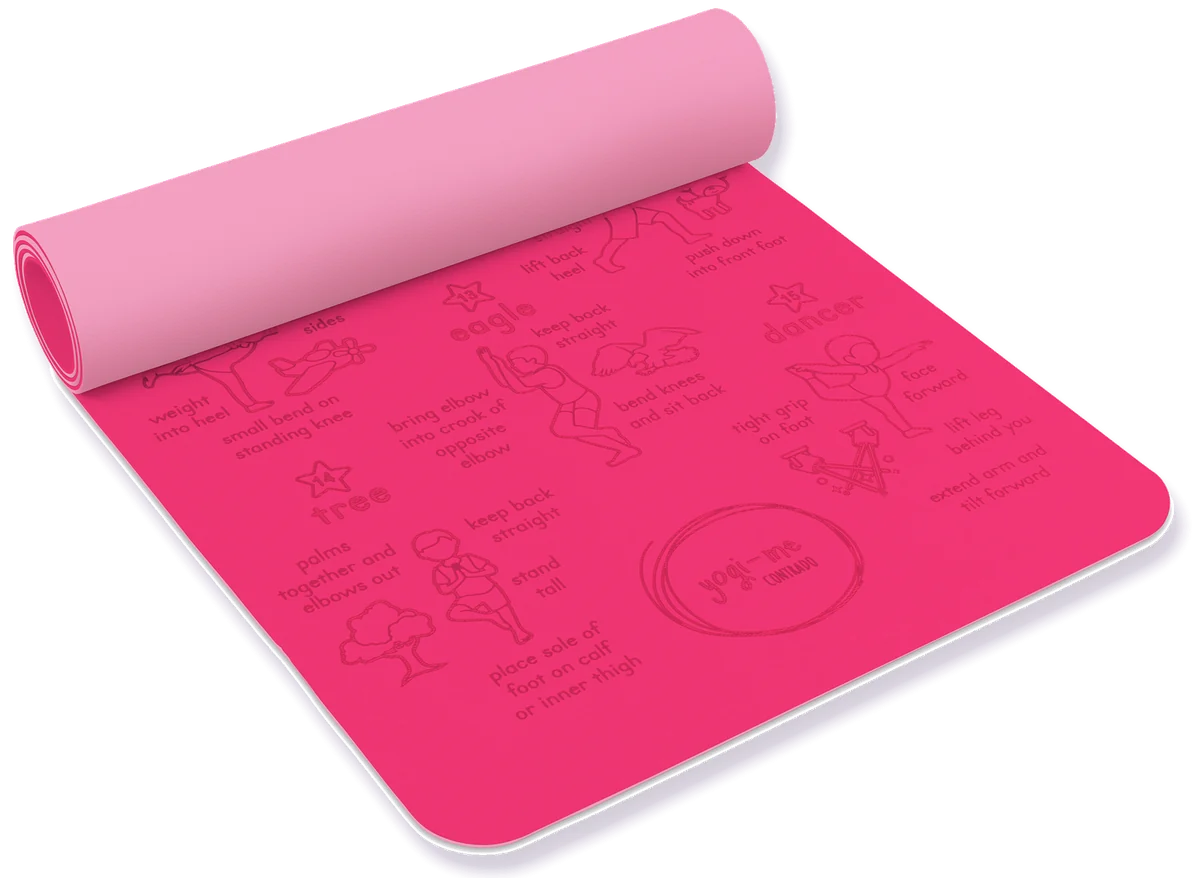
Whichever your child chooses, most of it happens lying, kneeling or standing on a mat. If you'll be joining in, a full-length one helps: ours is 183 x 61 cm, so an adult fits on it too, with poses pitched at ages 3 to 8. You'll find both designs in our kids' yoga mats. Choosing between mats for a child who also tumbles? Our guide to a gym mat or yoga mat sorts out which does what.