practice
Meditation for Kids: Five-Minute Scripts to Read Aloud
Meditation for kids aged 3 to 8 with no app or screen: three five-minute scripts you read aloud, when to use them and what to do if they giggle.
Meditation for kids is a few minutes of guided quiet in which your child pays attention to one thing: their breath, the sounds in the room or how their body feels. You don't need an app. Below are three five-minute scripts for children aged 3 to 8 that you read aloud in your own voice.
It's Sunday evening and your child has just remembered three things they're worried about tomorrow. Search for a guided meditation for children and the results are apps and videos, the last thing you want to hand over right now.
What is meditation for kids?
Meditation for kids is a short, guided practice in which a child rests their attention on one thing and gently brings it back when it wanders. For children aged 3 to 8 it lasts minutes, not half an hour, and a grown-up usually leads it out loud.
The NHS describes mindfulness meditation as "sitting silently and paying attention to thoughts, sounds, the sensations of breathing or parts of your body, bringing your attention back whenever the mind starts to wander". It isn't about emptying the mind: the NHS says mindfulness is about seeing thoughts come and go, not making them go away. For the everyday side, see our guide to mindfulness for kids.
At what age can kids start meditating?
There's no official starting age. You can begin as soon as your child can follow a simple instruction like "breathe in slowly", keeping it to a minute or two and making it a game. What changes with age is the length and the style.
Which script suits which age:
- Ages 3 to 4: Script 1, the balloon breath, cut to two or three minutes.
- Age 5: Script 1 or Script 2, the sound safari, at the full five minutes.
- Ages 6 to 8: any of the three, including Script 3, the floppy body.
When is the best time for kids to meditate?
The best time is one you can repeat: after school, before something your child is nervous about, or as part of the wind-down before bed. The NHS suggests starting a winding-down routine around 30 minutes before your child usually falls asleep, and a five-minute script fits neatly inside that window.
The NHS also advises no laptops, tablets or phones in the 30 to 60 minutes before bed, because screen light can interfere with sleep. For 2 to 5-year-olds, UK government guidance says to avoid screens in the hour before bed. So read the meditation rather than play one.
What is the best meditation for kids?
The best meditation for a child is the one they will happily do again tomorrow. For children aged 3 to 8, start with something short and physical, such as a balloon breath with a hand on the tummy, rather than sitting in silence. Add listening and body scripts as they get older.
Three five-minute meditation scripts to read aloud
Each script takes about five minutes. Read slowly, at about half your normal speed, and pause at every full stop. Use the same words each time, so the script becomes familiar and you won't need the page for long. Stopping early is always fine.
Script 1: The balloon breath (ages 3 and up)
The NHS suggests practising simple relaxation techniques with your child, such as three deep, slow breaths, breathing in for a count of three and out for three. This script turns that into a game.
- Settle (about 30 seconds). "Sit down and put the soles of your feet together, like a butterfly. Put one hand on your tummy."
- Find the balloon (about 30 seconds). "Close your eyes if you like. There's a balloon in your tummy. Let's see if we can feel it move."
- Blow it up (about 2 minutes). "Breathe in through your nose, 1, 2, 3. Feel your balloon get bigger. Now breathe out slowly, 1, 2, 3. Feel it go down." Repeat about ten times.
- Colour it in (about 1 minute). "What colour is your balloon? Each time you breathe in, fill it up with that colour."
- Let it float (about 1 minute). "Let your balloon float up to the ceiling. Breathe normally and watch it go. Wiggle your fingers. Open your eyes."
If your child puffs hard and fast, as if blowing out candles, slow your own breathing right down and invite them to match you. Our breathing exercises for kids guide has more breath games.
Script 2: The sound safari (ages 5 and up)
Anna Freud, a UK mental health charity for children and young people, describes mindfulness meditations as designed to awaken us to the sensations of the present moment, such as the sound of the birds. This script is a listening hunt.
- Settle (about 30 seconds). "Sit or lie down comfortably. Close your eyes, or look at one spot on the floor."
- Three slow breaths (about 30 seconds). "In through your nose, and out through your mouth. Three times."
- Far away (about 1 minute). "Listen for the furthest-away sound you can hear. A car? A bird? Just notice it. Keep it to yourself for now."
- In this room (about 1 minute). "Now find a sound inside this room. Maybe the clock, or me breathing."
- Inside you (about 1 minute). "Now the quietest sound of all. Can you hear your own breath?"
- Share (about 1 minute). "Open your eyes. Tell me one sound you found."
They'll want to call out every sound. Let them whisper it, then carry on. Naming a sound is still noticing it.
Script 3: The floppy body (ages 6 to 8, lying down)
Anna Freud lists progressive muscle relaxation among its relaxation techniques. For a child, that means squeezing one part of the body tight, then letting it go. Our guide to relaxation techniques for kids has a gentler body scan too.
- Lie down (about 30 seconds). "Lie on your back with your arms by your sides. Let your feet flop out."
- Feet and legs (about 1 minute). "Squeeze your toes tight, tight, tight. And let go. Press your legs into the floor. And let go. Feel them go heavy."
- Tummy and hands (about 1 minute). "Make your tummy hard like a drum. And let go. Squeeze your hands into fists. And let them open."
- Shoulders and face (about 1 minute). "Lift your shoulders up to your ears. And drop them. Scrunch up your whole face. And let it go soft."
- Rag doll (about 1 minute). "Now your whole body is floppy, like a rag doll. Breathe in, 1, 2, 3. And out, 1, 2, 3."
- Wake up (about 30 seconds). "Wiggle your fingers and toes. Roll onto your side, and sit up slowly." At bedtime, skip this and let them stay floppy. It pairs well with our bedtime yoga for kids routine.
Expect giggles at step four. Laugh with them, then carry on in the same calm voice.
A lying-down script is easier with room to stretch out. Our Freedom Flow design is a mat with a calmer floor sequence marked in, and at 183 cm long it fits a grown-up too if you want to join in.
What if my child won't sit still or keeps giggling?
Let them move. Wriggling and giggling don't mean it has failed. Swap sitting for lying down, or do a few slow stretches first. The NHS notes that some people find an over-busy mind easier to cope with while doing gentle yoga or walking.
- Eyes won't stay closed: they don't have to. Looking softly at one spot works too.
- "This is boring": stop at the end of a step and try again tomorrow.
- Gets upset or worried: stop. The NHS says mindfulness is not right for everyone, and some people find it makes them feel worse. A cuddle and a story is a fine swap.
Meditation is a quiet daily habit, not a treatment. If your child's anxiety is severe, persists and interferes with everyday life, the NHS says a visit to a GP is a good place to start.
Do you need an app for kids' meditation?
No. A guided meditation for kids is a calm voice and a few quiet minutes, and the voice can be yours. Reading aloud keeps screens out of the wind-down, and it lets you shorten or slow the script to suit your child on the night.
How do you make meditation a habit at home?
Tie it to something that already happens every day, such as straight after teeth are brushed, and keep the place the same. A cushion, a spot on the floor or a rolled-out mat tells your child what's coming. If you miss a week, restart with the shortest script.
Let your child pick the script on some nights. A few poses from our beginner's guide to kids' yoga make a good warm-up. And if a grandparent or godparent is asking what to get them this Christmas, here are some gift ideas that aren't another screen.
A quiet place to lie down and breathe
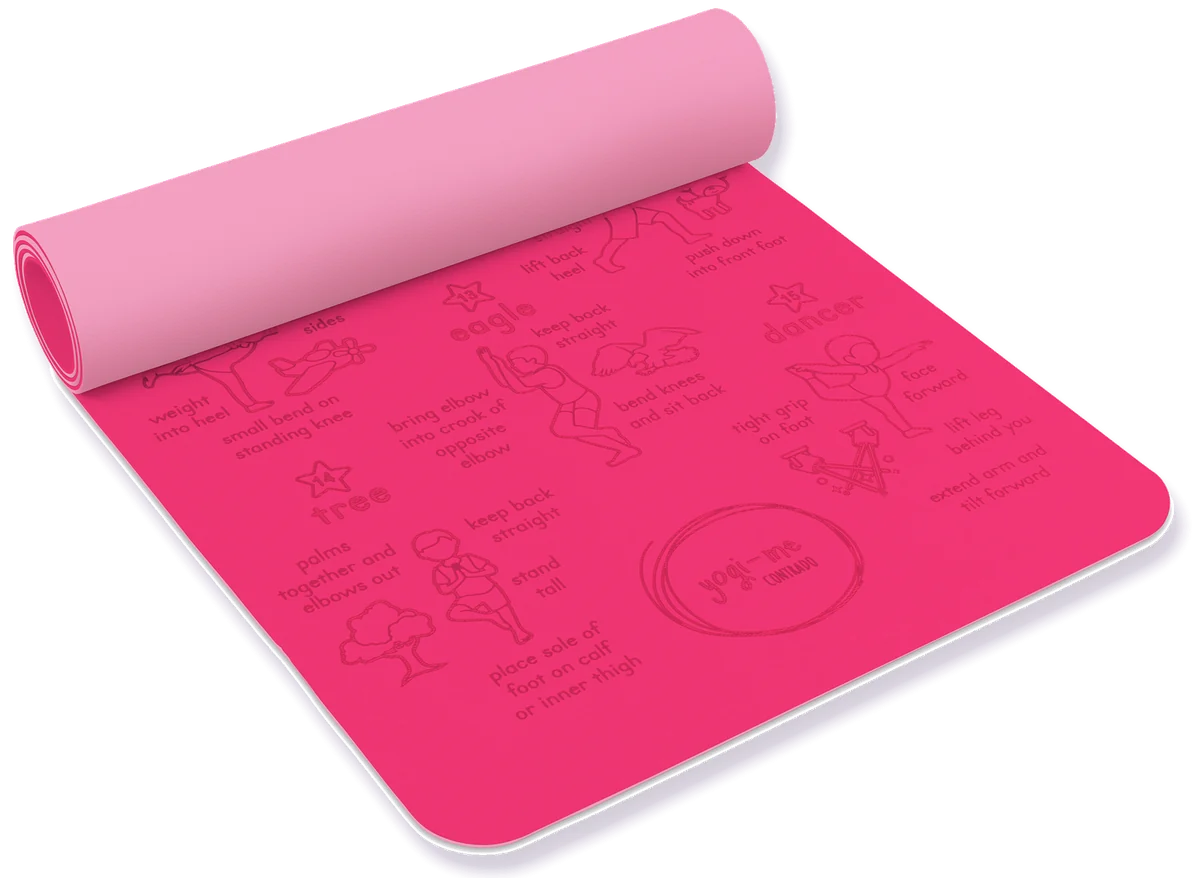
All three scripts work on a carpet, so there's nothing to buy before tonight. If you'd like a spot that's always ready, our Freedom Flow mat has 15 numbered poses laser-engraved into the surface, most of them on the floor, from flower to waterfall, with breathe-in and breathe-out prompts marked in. Your child can lie on it for the floppy body, then sit up and follow the poses in order, with nothing to set up and no screen to follow.
It's designed for ages 3 to 8. Three- and four-year-olds copy the poses with a little help, and older children lead their own sessions. At 183 x 61 cm it's the length of an adult mat, so an eight-year-old can still lie flat on it. It rolls up with a carry strap for the cupboard, though if it has to go to nursery every day, a shorter mat is easier for a small child to carry. It's non-toxic, PVC-free TPE according to our supplier's specification, with 6 mm of cushioning. Wipe it with a damp cloth and a little mild soap, then let it air-dry flat.
Looking for a Christmas or birthday present that gets used after Boxing Day? Tie it to the bedtime script and it can come out every night, not just on Christmas afternoon. Buying as a grandparent? It's full length, so you can have a go at the floppy body too.
It's £34.99 with free UK delivery and 30-day returns. Pick a colour for their wind-down spot from our kids' yoga mats.
Frequently asked questions
Can you give me a 10-minute meditation for kids?
For ages 6 to 8, read the balloon breath, then go straight into the floppy body, for about ten minutes in the same slow voice. At age 5, follow the balloon breath with the sound safari instead. For ages 3 to 4, two or three minutes of the balloon breath is a better start.
Is meditation the same as mindfulness?
Not quite. Mindfulness is the everyday habit of noticing what's happening right now. Meditation is time set aside to practise it, such as five minutes of guided breathing. The NHS describes mindfulness meditation as paying attention to thoughts, sounds, breathing or the body, and bringing attention back when it wanders.
How long should a child meditate?
Aim for two to five minutes with children aged 3 to 8. Begin with whatever your child manages comfortably, even one minute. A few minutes most days is a better target than a long session now and then, and it's worth stopping while they're still enjoying it, so they want to come back tomorrow.
Is meditation safe for children?
For most children, a few minutes of guided breathing or listening is a gentle thing to try. The NHS notes that mindfulness isn't right for everyone and that some people find it makes them feel worse, so stop if your child becomes upset or worried. If their anxiety is severe or won't go away, talk to your GP.