guides
Is Yoga Safe for Kids? What Parents Should Know
Is yoga safe for kids? Yes, for most healthy children aged 3 to 8, with a few poses left out. What the guidance says, plus hot yoga and bendy children.
Is yoga safe for kids? For most healthy children aged 3 to 8, yes: gentle yoga is generally considered safe, as long as three things hold. Your child moves into each pose on their own, stops when anything hurts, and leaves out the poses that put weight on the head or neck. A grown-up should be in the room.
That's for healthy children. If your child has a health condition, the NHS advises getting medical advice about exercising, so speak to your GP first, and do the same if an injury hasn't fully healed.
What does the guidance say about yoga for children?
The guidance says yoga is generally safe, with conditions. The US National Center for Complementary and Integrative Health (NCCIH), part of the National Institutes of Health, says yoga is "generally considered a safe form of physical activity for healthy people when performed properly, under the guidance of a qualified instructor".
NCCIH also says the most common injuries are sprains and strains, that serious injuries are rare, and that the risk is lower than for higher-impact activity. It adds that learning yoga alone, without supervision, has been linked to more risk. That's evidence about yoga in general, not children in particular; we found no source that publishes an injury rate for children specifically.
For children, the American Academy of Pediatrics said in a 2016 clinical report that "a growing body of evidence supports the effectiveness and safety of mind-body therapies in pediatrics", and yoga was one of the practices it looked at.
The NHS doesn't publish a page on yoga for children, so its general rules for children and exercise are the ones to follow. Its guidelines for 5 to 18-year-olds say children should do exercise "suitable for their age, ability and experience", start new exercise slowly and build up bit by bit, and get medical advice first if they have a health condition.
At home, most children aren't with a qualified instructor. Our view, not NCCIH's, is that a gentle session at home needs three things in its place: a grown-up in the room, a short set of simple poses, and a child who moves themselves. Our beginner's guide to kids' yoga covers the first few sessions.
Which yoga poses should children avoid?
Leave out the poses that put weight on the head or neck. NCCIH advises anyone new to yoga to avoid "headstands, shoulder stands, the lotus position, and forceful breathing". For children aged 3 to 8 at home, we'd add plough (legs over the head while lying on the back) and handstands against a wall. That last part is our call, not NCCIH's.
- Leave out at home: headstand, shoulder stand, plough, handstand, lotus, and any breathing that is forced or held.
- Keep small and slow, never pushed: bigger bends of the back, such as bow, camel and waterfall (a standing back arch). A little lean is plenty.
- Take care with: any pose where the head touches the floor. Rabbit, a kneeling curl, rests the top of the head lightly on the mat. Keep the weight in the knees, never press down on the head or neck, and never push a child further into the curl. If that's hard to judge, swap it for mouse, the curled-up rest often called child's pose.
None of the 30 poses on our two mats is a headstand, shoulder stand, plough, handstand or lotus. Rabbit (pose 14), waterfall (pose 15), bow and camel are all on our Freedom Flow mat, and they're done as above. You can read every pose on both mats, explained one by one, or compare the two pose sequences side by side.
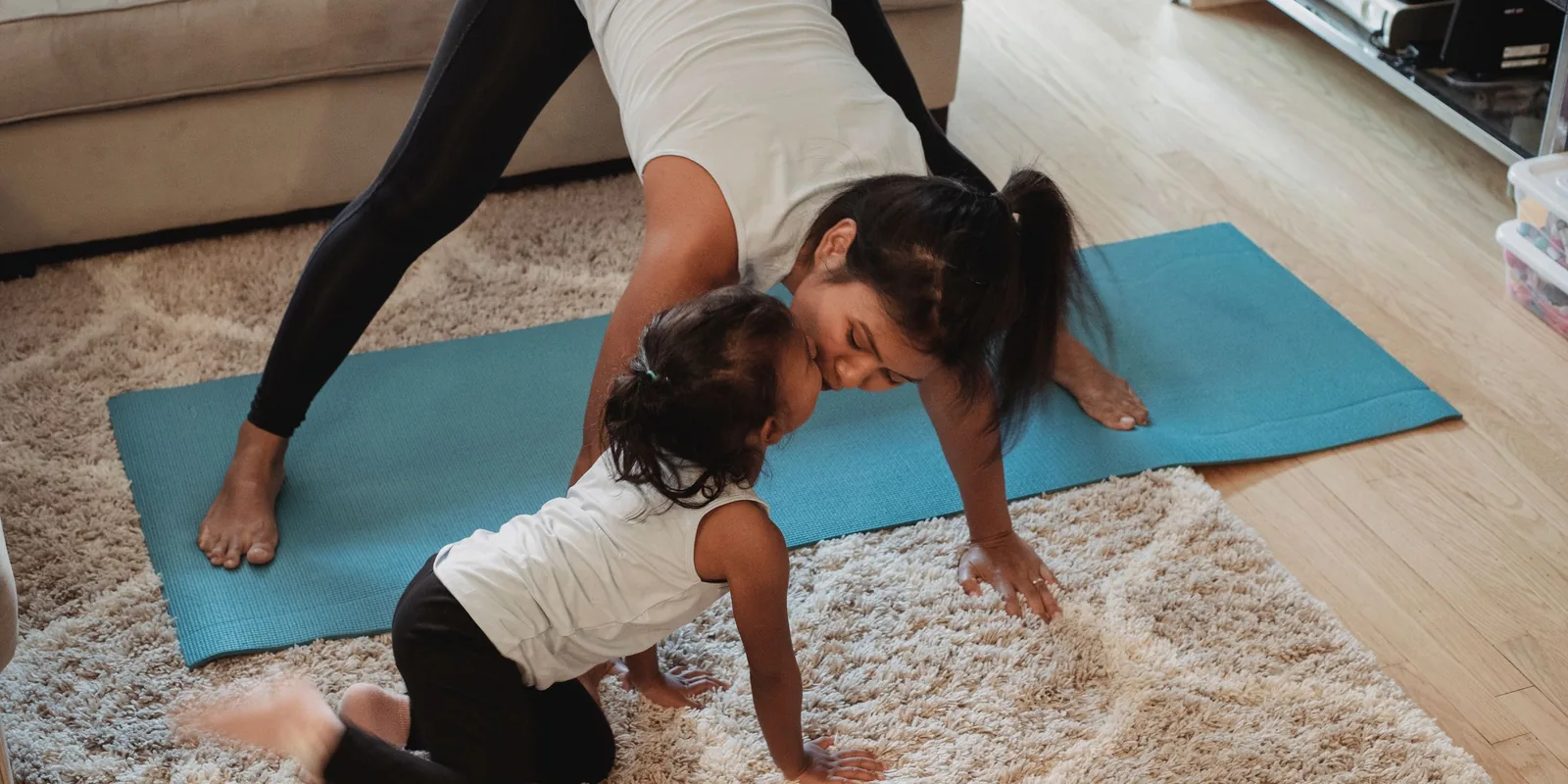
Here's an illustrative moment. Your six-year-old has seen a headstand on a video and is trying one against the sofa. Rather than a flat no, offer something upside-down that keeps the weight off their head: downward dog, with hands and feet on the floor and hips in the air, or dolphin, the same shape on the forearms. Our easy yoga poses for kids has more gentle ones to start with.
Are there any negative effects of yoga for children?
Is yoga bad for kids? Not for most. The negative effects NCCIH describes are mostly sprains and strains, with serious injuries rare and the risk lower than in higher-impact activities. That's evidence about yoga in general, not children in particular. No source we found gives an injury rate for children.
At home, the realistic risks are ordinary ones, and each has a simple fix:
- A slip in socks on a wooden or tiled floor. Bare feet, on a mat or rug that doesn't slide.
- A wobble into furniture during a balance. Clear an arm span all round, and keep a wall within reach instead.
- A stretch pushed too far, usually by a helpful grown-up. Never press or pull a child deeper into a pose.
The other side of the ledger is that it's time spent moving. The NHS says children aged 3 and 4 should be active for at least 180 minutes a day, and that for under-fives activity of any intensity should be encouraged. There's more on that in what yoga does for children.
Is yoga safe for a very bendy child?
Being bendy isn't a reason to stretch further, and a very flexible child follows the same rules as everyone else. It's easy to assume the bendiest child on the mat is the safest. The NHS says joint hypermobility syndrome, when someone has very flexible joints, "usually affects children and young people", so it's worth knowing the signs.
On a mat, every child stops at the comfortable end of a stretch, not the furthest point they can reach, and nobody presses them deeper, however impressive it looks. Poses that ask for steadiness, like mountain or chair, are as much a part of yoga as the bendy ones.
The NHS lists joints that keep hurting, repeated sprains and joints that "pop out" among the symptoms, and says to see a GP if you think your child has it. A GP checks with a flexibility test, so don't try to test for it at home, and ask them whether yoga suits your child.
Is hot yoga safe for kids?
We'd keep children out of heated yoga classes. We couldn't find any UK health body that publishes guidance on hot yoga for children. NCCIH says hot yoga "has special risks related to overheating and dehydration", and the NHS says there's a high risk of heat exhaustion or heatstroke during hot weather or exercise, and that children are more at risk.
So for children aged 3 to 8, yoga belongs in an ordinary room at an ordinary temperature, with water nearby. On a very hot day, do less, or do it later when it's cooler.
What helps keep yoga safe at home?
Most of what keeps yoga safe for a child is simple, and none of it costs anything. It comes down to who moves the child, how long you go on, what's on the floor, and a grown-up nearby.
- Your child moves themselves. Show the shape, let them copy, and never press or pull.
- Stop at pain. Stretching can feel like effort. If it hurts, that pose is done for the day.
- A grown-up in the room, especially for balances.
- Clear space and bare feet, on a surface that doesn't slide on your floor.
- Short sessions, especially at first.
- A short, fixed set of poses, so your child isn't copying whatever they saw last.
That last point is where a mat with the poses on it helps. Our mats have 15 numbered poses laser-engraved into each one, so your child has a short, fixed set to follow, and none of them is a headstand. They're 6 mm thick, full length at 183 x 61 cm, and designed for ages 3 to 8. See the Yogi-Me range, at £34.99 with free UK delivery.
Which aches and pains mean a trip to the GP?
Yoga shouldn't hurt. See your GP before your child starts if they have a health condition, and afterwards if any of these happen:
- Pain that doesn't settle once they stop and rest.
- Pain or stiffness in the joints that keeps coming back.
- Repeated sprains, or a joint that "pops out".
The last two are among the symptoms the NHS lists for joint hypermobility syndrome, and it says to see a GP if you think your child has it.
If your child seems unwell after being active on a hot day, the NHS heat exhaustion page sets out what to do, including when to call 111 or 999. For any worry about how your child moves, your health visitor is a good first call for under-fives.
Frequently asked questions
Is yoga ok for kids?
Yes, for most healthy children aged 3 to 8. Keep it gentle and playful, let your child move into each pose themselves, stop anything that hurts, and leave out poses that put weight on the head or neck, such as headstands and shoulder stands. A grown-up should be nearby. If your child has a health condition, check with your GP before starting.
Can 4 year olds do yoga?
Yes. Four-year-olds can do simple animal poses like cat, butterfly and mouse, in short, playful sessions of a few minutes with a grown-up joining in. The NHS says children aged 3 and 4 should be active for at least 180 minutes a day, and a little yoga can be part of that. Skip the harder balances and anything upside down on the head.
Who should not do yoga?
Most healthy children can join in, but some should check first. The NHS advises children with a health condition to get medical advice about exercising. The US National Center for Complementary and Integrative Health says some conditions, including existing knee or hip injuries and balance problems, may mean leaving out or changing some poses. If you're unsure, ask your GP before your child starts.
What age can kids do headstands?
No UK health body gives an age for headstands. The US National Center for Complementary and Integrative Health lists headstands among the practices people new to yoga should avoid, and we leave them out at home for children aged 3 to 8. Downward dog or dolphin give the upside-down feeling without any weight on the head or neck.
Sources
- NCCIH (US National Institutes of Health) - Yoga: Effectiveness and Safety
- American Academy of Pediatrics - Mind-Body Therapies in Children and Youth, Pediatrics 2016 (PubMed)
- NHS - Physical activity guidelines for children and young people (5 to 18 years)
- NHS - Physical activity guidelines for children (under 5 years)
- NHS - Joint hypermobility syndrome
- NHS - Heat exhaustion and heatstroke