guides
Morning Routine for Kids Before School: A Simple Checklist

A morning routine for kids before school, in the order that works: the night-before jobs, a 70-minute timeline and a checklist for the fridge.
The simplest morning routine for kids before school is seven jobs in the same order every day: up and toilet, dressed, breakfast, teeth, five minutes of something they choose, shoes and bag, then out of the door. Most of it is decided the night before, which is where a calm morning really starts.
It's 8pm. The uniform is in the wash basket, the reading book is somewhere under the sofa, and tomorrow morning is being decided right now. This is a morning routine for kids aged 3 to 8 that starts there.
What is a good morning routine for kids before school?
A morning routine is the same short list of jobs, done in the same order every school day, so your child knows what comes next without being told. The order matters more than the list. A child who knows breakfast comes after getting dressed has one less thing to argue about.
YoungMinds, writing for parents of children who find school mornings hard, says a routine for getting up, getting dressed, having breakfast and leaving the house can reduce stress. We think the same routine helps most children, anxious or not.
What should you do the night before school?
Do everything that doesn't need to happen in the morning, the night before. YoungMinds suggests packing bags and laying out clothes the night before. Ten minutes after tea saves twenty at 8.15. Five jobs:
- Uniform out, in the order it goes on.
- Book bag packed, with the reading book and reading record inside.
- PE kit, or anything needed for an after-school club.
- Lunch made, or decided, if they take a packed lunch.
- Shoes and coat by the door.
Then check the school's app or letters. The non-uniform day always announces itself at ten past eight.
The evening matters too: our bedtime routine that sets up the morning covers the other end of the day.
How do you get your child ready for school in the morning?
One job at a time, in the same order every day, naming only the next job rather than the whole morning. YoungMinds suggests focusing on the one thing your child needs to do next. Here's the morning routine checklist for kids, in order.
1. Up, toilet, hands washed
"Morning. Toilet first, then hands." Same wake-up time every school day. Some children are slow to surface.
2. Dressed
"Uniform on, then breakfast." Three and four-year-olds need help with buttons. Seven and eight-year-olds can manage it all, if not always the first time you ask.
3. Breakfast at the table, no screen on
"Toast or cereal?" Two choices, not an open menu. Keep the TV off: the UK Chief Medical Officers say screen-free meal times are a good idea, and it makes the next step much easier.
4. Teeth, face, hair
"Teeth, two minutes." The NHS advises brushing for about 2 minutes twice a day, last thing at night and at least one other time. For ages 3 to 6 it suggests letting them brush while you supervise. Children aged 7 and over should be able to brush their own teeth, but the NHS says it's still worth watching. Its own tip for the two minutes is an egg timer.
5. Five minutes on the mat
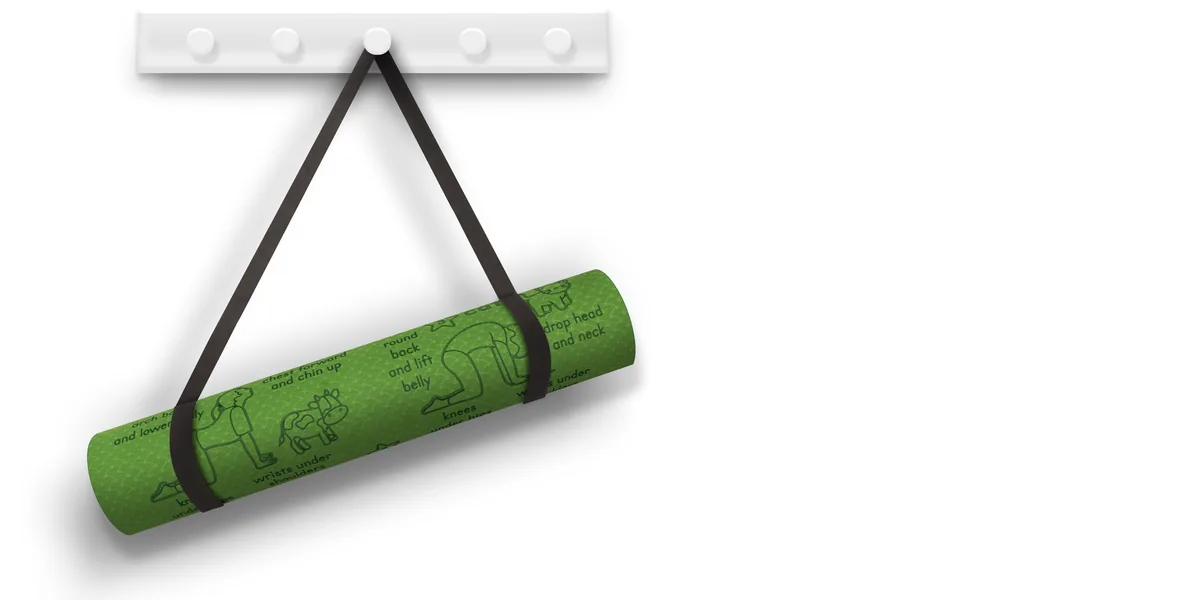
"Dressed, fed, teeth done? Mat time." This is the reward slot, where the telly would usually go. Keep it to standing poses, so nobody is lying on the floor in a clean school jumper: mountain, chair, tree or dancer, two or three of them, then shoes. The Sun Salutation design has its standing poses marked into the surface, so a five-year-old can roll it out and start without you: see the standing-pose mat. Expect wobbly trees. That's the point. For a longer sequence when there's time, try a longer morning yoga routine for the weekend.
6. Shoes, coat, book bag
"Shoes, coat, bag, in that order." Everything is already by the door from last night, shoes included.
7. Out the door
"Bag, water bottle, PE kit? Let's go." A last check at the door. If something's forgotten, a forgotten water bottle is a small thing.
How long does it take to get kids ready for school?
In our illustrative plan, about an hour to an hour and a quarter for a five-year-old, with a buffer for the thing that goes wrong. Each school sets its own start time, and the Department for Education's attendance guidance says the morning session begins at the start time the school publishes. So work back: start time, minus the journey, minus the routine.
Here's an illustrative morning. Say your five-year-old's school starts at 8.45am and the walk takes 15 minutes, so you leave at 8.25am and arrive at 8.40am.
- 7.15am, up, toilet, hands: 5 minutes
- 7.20am, dressed: 10 minutes
- 7.30am, breakfast: 20 minutes
- 7.50am, teeth, face, hair: 10 minutes
- 8.00am, five minutes on the mat: 5 minutes
- 8.05am, shoes, coat, book bag: 10 minutes
- 8.15am, buffer for the thing that goes wrong: 10 minutes
- 8.25am, out the door
That's 5 + 10 + 20 + 10 + 5 + 10 + 10 = 70 minutes. If the mornings are still a rush, look at the night before first, not at an earlier alarm. After the summer or a half term, our reset for the nights before term starts shifts both times back gradually.
An earlier wake-up also means an earlier bedtime. For a 7.15am start, the 10 to 12 hours the Sleep Charity gives as a general guide for ages three to six puts a five-year-old asleep between 7.15pm and 9.15pm. Our guide to what time kids should go to bed works it out for each age.
What if the morning doesn't go to plan?
Some mornings won't. Name the next job only, offer choices rather than orders, and remember that a late start is rarely the disaster it feels like at 8.30.
The child who won't get dressed. Name the one next job, not the whole morning. Offer a choice of two tops rather than asking what they want to wear.
The child who won't eat breakfast. Something small they can eat on the walk is fine. Some schools run a breakfast club, so it's worth asking yours.
The dawdler. A timer works best as a game ("Can you beat the sand timer?") rather than a threat.
The morning that falls apart anyway. In England, schools must take the register at the start of the morning session and keep it open for a maximum of 30 minutes. A child who arrives before it closes is marked late but counted as attending. Your school's attendance policy says how long its register is open. Five minutes late is a late mark, not a lost day.
The child who regularly can't face school. That may be worry rather than dawdling. YoungMinds suggests talking to the school and, if worry about school is affecting their daily life, says speaking to the GP is a good place to start. Our guide to when the problem is worry about school may help too.
How do you make a morning routine chart for kids that sticks?
Write the seven jobs down in order and put the list where your child will see it, on the fridge or the back of the front door. For a child who can't read yet, draw a picture beside each step together on the first evening. Let them tick off each job, so the chart does the reminding instead of you.
Keep the order the same every school day. Store the mat rolled up by the front door, so step 5 takes seconds to start.
If step 5 is the one your child looks forward to, the poses are on a yoga mat your child can follow on their own, at £34.99 with free UK delivery and 30-day returns. If a grandparent does the school run once a week, or brothers and sisters get ready together, there's 10 per cent off two or more mats. If the telly is the morning battle, our honest look at TV before school covers it.
Frequently asked questions
What time should a 5 year old wake up for school?
Work back from the school's start time. Take off the journey, then about 70 minutes for the routine. For a school that starts at 8.45am with a 15-minute walk, that's about 7.15am. Then check bedtime: the Sleep Charity's general guide for ages three to six is 10 to 12 hours a night.
Should kids get dressed before or after breakfast?
Before. Getting dressed is the job most likely to stall, so do it while there's still time, and breakfast becomes the thing they're moving towards. It also means a spill lands on a uniform you can see, not one you find at the school gate. That's our view, not official guidance.
What goes on a morning routine chart for kids?
Write the seven jobs in order: up and toilet, dressed, breakfast, teeth, five minutes of something they choose, shoes and bag, then out of the door. For a child who can't read yet, draw a picture beside each one. Put it on the fridge or the back of the front door and let them tick off each job.
What happens if we're late for school?
In England, the register stays open for a maximum of 30 minutes after it starts. A child who arrives before it closes is marked late but counted as attending. After it closes, it's recorded as an absence. Your school's attendance policy says how long its register is open.
Sources
- YoungMinds - School anxiety and refusal: a guide for parents
- NHS - Children's teeth, last reviewed 30 June 2025
- Department for Education - Working together to improve school attendance (statutory guidance, England)
- The Sleep Charity - How much sleep does my child need?
- UK Chief Medical Officers - Commentary on screen time and social media: map of reviews