guides
Activities for 4 Year Olds at Home: 12 Ideas Sorted by Mood
12 activities for 4 year olds at home, sorted by mood: wired, tired, cross or bored. Most use things you already have, and none needs a screen.
The best activities for 4 year olds at home are the ones that match the mood they're in. A wired four-year-old needs to move, a tired one needs something gentle, a cross one needs somewhere for the feeling to go, and a bored one needs a new idea. Below are 12 things to do with a 4 year old, three for each mood.
Our lists of activities for 3 year olds and activities for 5 year olds sit either side of this one. This list is sorted by mood instead, because the same child can be wired on Tuesday and cross on Wednesday.
Most need nothing more than cushions, a blanket, a box, scrap paper or a saucepan. Nothing needs a screen.
How do you entertain a four-year-old at home?
Entertain a four-year-old at home by mixing plenty of movement with talking, pretending and some quiet time. The NHS says children aged 3 to 4 should spend at least 180 minutes a day doing a variety of physical activities, spread throughout the day, including at least 60 minutes of moderate-to-vigorous activity.
The UK Chief Medical Officers' guidelines tell moderate from vigorous activity with a talk test: being able to talk but not sing means moderate.
Development Matters is the Department for Education's guidance on what children in England learn in the early years. For 3 and 4 year olds it includes holding a pose, snipping with scissors, listening, counting to 5, spotting patterns and pretend play. Several of the ideas below practise one of them, and we say which.
What can you do with a wired four-year-old?
A wired four-year-old needs to burn off energy, indoors if it's wet. An obstacle course, musical statues and a pots-and-pans marching band all get them moving, and the busiest of them can count towards the 60 minutes or more of moderate-to-vigorous activity the NHS recommends each day.
1. A blanket-and-box obstacle course
Drape a blanket over two chairs, add a box and a line of cushions, then say, "Crawl under the blanket, sit in the box, jump to the last cushion." The NHS Best Start in Life pages suggest it, with your child taking a turn giving the instructions.
Good for: burning off energy and following instructions.
2. Musical statues with poses
Dance until the music stops, then freeze in a pose. Anyone who wobbles does a silly walk to the kitchen and back. Development Matters lists holding a pose "for a game like musical statues" among the things 3 and 4 year olds are learning.
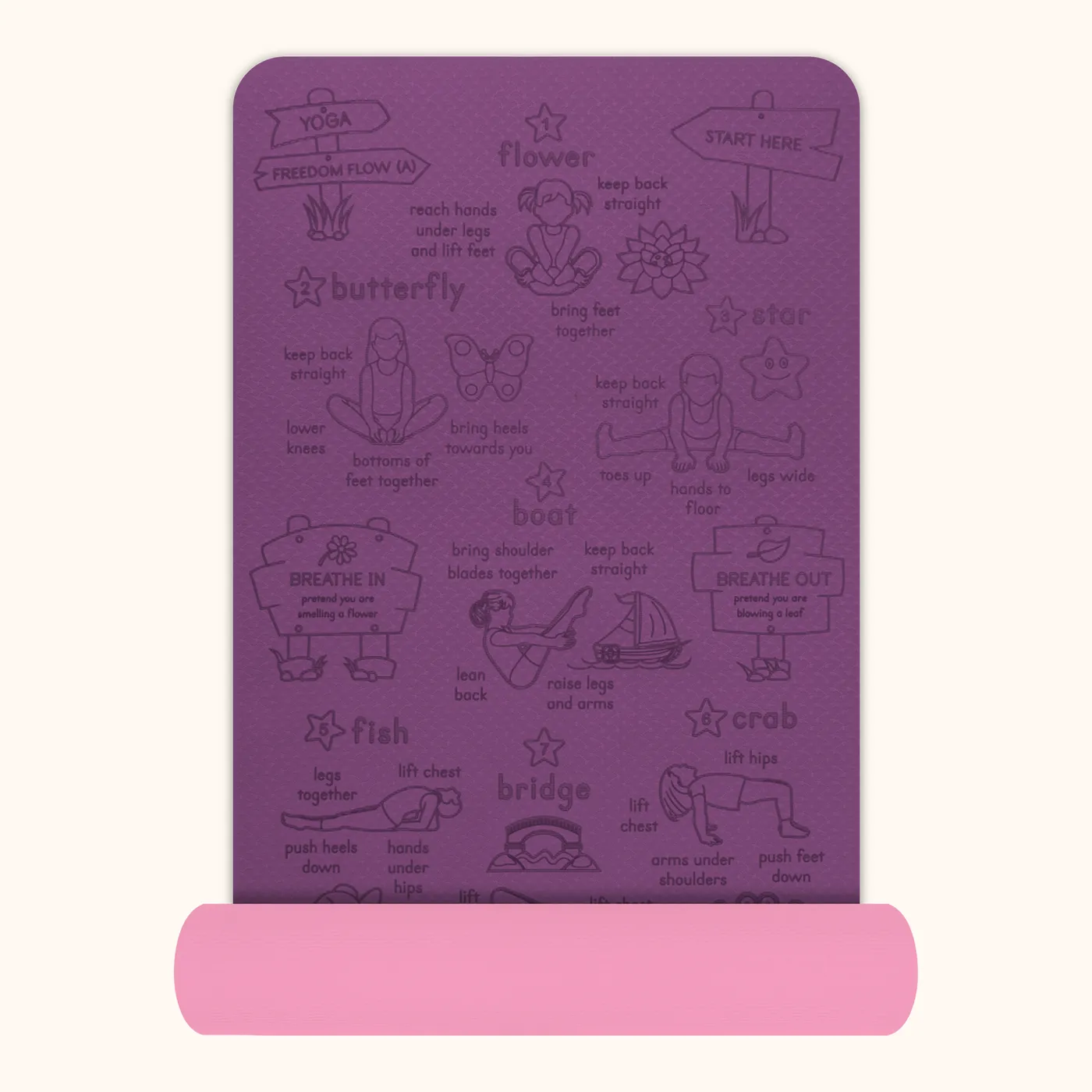
On our Sun Salutation mat, the 15 poses are numbered, so you call out a number when the music stops. A rug and made-up poses work too.
Good for: balance and stopping on cue.
3. A pots-and-pans marching band
Hand out a saucepan and a wooden spoon each and march round the house drumming: loud, quiet, fast, slow. The NHS Best Start in Life pages suggest drumming games for big body movements and hand-eye coordination.
Good for: rhythm, and noise you've agreed to.
What helps a tired four-year-old?
A tired four-year-old needs something gentle that still feels like doing something. A story they know, a listening game and a quiet job at the table keep them busy without asking for much energy, which helps in the hour between pick-up and tea.
4. A story they finish for you
Pick a picture book they know well and pause before the best bits so they fill in the words, then ask, "What happens next?" The NHS Best Start in Life pages suggest both for 3 to 5 year olds.
Good for: talking and remembering. On the sofa or in bed.
5. A window sound hunt
Sit by a window or an open back door, be very still, and take turns naming what you hear: a car, a bird, the kettle. Development Matters says 3 and 4 year olds are learning to listen with increased attention to sounds.
Good for: listening and new words.
6. Snip and stick
Give your child child-safe scissors, strips of scrap paper and a glue stick, and let them snip pieces to stick onto a sheet. Development Matters gives "making snips in paper with scissors" as a skill 3 and 4 year olds are learning. Stay close while the scissors are out.
Good for: hand control.
How do you help a cross four-year-old?
Check first whether they're hungry or tired, because the NHS says either can be behind a tantrum, and then the fix may be simple. After that, give the feeling somewhere to go: a burst of running, a word for it, or something slow to do with their body, with you close by.
7. Run and shout
Find a big space, such as a park or the garden, and let your child run and shout. The NHS suggests this as a way to help a child let their feelings out. Indoors, a race to the far wall and back is the next best thing.
Good for: letting feelings out in another way.
8. Name it, then draw it
Say what you see: "I know you're feeling angry about the tower falling down." The NHS says naming a feeling like this helps a child learn to name their own. Once things are calmer, draw a cross face and a happy one together.
Good for: finding words for big feelings.
9. Slow shapes on the floor
Lie side by side on your backs, hold your feet and rock gently. Then kneel, hold your heels and curl forward until the top of your head rests on the floor, with most of the weight in the knees. Take three slow breaths together. In yoga these are called happy baby and rabbit. If your child enjoys them, here is how to start yoga with your child.
Good for: a few quiet minutes together.
How do you mentally stimulate a bored four-year-old?
Give a bored four-year-old something new to think about: pretend play, counting and spotting patterns, with you asking questions that have lots of possible answers. The NHS Best Start in Life pages suggest role play and open questions like these, and Development Matters lists pretend play, counting and patterns for 3 and 4 year olds.
10. Play shops
Set out tins and packets on the sofa, hand over a bag and some pretend money, and take turns being the shopkeeper. The NHS Best Start in Life pages suggest this game. Count the shopping into the bag up to five.
Good for: counting and taking turns.
11. A cardboard-box rocket
Turn a big box into a rocket with crayons and a cushion, load in some toy passengers and count down from ten. Development Matters says 3 and 4 year olds are learning to use one object to stand for something else in pretend play.
Good for: imagination and making up stories.
12. A pattern hunt
Hunt for patterns: stripes on a jumper, squares on a tea towel, spots on a mug. Then make one on the floor, such as stick, leaf, stick, leaf, and ask what comes next. Development Matters says 3 and 4 year olds are learning to spot patterns around them and carry on repeating ones.
Good for: noticing things, and early maths.
Which activities for 4 year olds fit which mood?
Pick the mood first, then check you have the space and the energy. Each line gives the three activities for one mood and what you'll need.
- Wired: obstacle course, musical statues or a marching band. You need room to move.
- Tired: a story they finish, a window sound hunt, or snip and stick. You need a sofa, a window or a table.
- Cross: run and shout, name it and draw it, or slow shapes on the floor. You need to stay close.
- Bored: play shops, a cardboard-box rocket or a pattern hunt. You need a box, a few tins, or nothing at all.
How do you put a few together?
Two or three ideas in a row make a whole afternoon, and swapping a loud one for a quiet one stops it tipping over. A rainy Saturday, for example: the marching band after breakfast, the rocket mid-morning, play shops after lunch, and musical statues when everyone gets restless.
For more, see our rainy day activities for kids, or screen-free activities for 3 to 8 year-olds for the whole age range.
What if your four-year-old would rather not join in?
Don't push. Start the activity yourself and let them drift over when they're ready, or leave the box or the pans out for later. Some four-year-olds hate being organised or watched.
Wanting a screen instead is normal too. The government's Best Start in Life screen time guidance suggests keeping it to no more than an hour a day for ages 2 to 5, less if possible, so aim for balance, not a ban.
Frequently asked questions
What are fun activities for 4-year-olds at home?
Obstacle courses, musical statues, play shops, a cardboard-box rocket and a pattern hunt all need nothing special. Most practise something Development Matters lists for 3 and 4 year olds, such as holding a pose, counting or pretend play. Pick by the mood they're in rather than by the clock.
What are some fun things to do with a 4 year old in the UK?
Outdoors, a park, a garden or a walk will do: run and shout, or go on a pattern hunt. Indoors, try an obstacle course, play shops or a cardboard-box rocket. The NHS says children aged 3 to 4 need at least 180 minutes of activity a day, including outdoor play, so mix the two.
What can a 4 year old do on their own for a while?
Snip and stick, a pattern hunt around the house, play shops with a few tins, or a window sound hunt can all run for ten minutes or more once you've set them going. Stay in the room for anything with scissors, and expect to be called in to admire the results.
What are the red flags for 4 year old behaviour?
We're not the right people to judge that, so we won't guess. The NHS says tantrums are far less common by the age of 4, and that if you're seriously concerned about your child's behaviour, you should talk to your health visitor or GP.
Do you need a mat for these activities?
No. Musical statues and slow shapes both work on a rug. A mat makes them easier, because it's soft, long and has the poses on it already. Each Yogi-Me mat has 15 numbered poses laser-engraved into the surface, so there's nothing to set up and no screen to follow. You call out a number and they find it.
Pick the design by the mood you see most. Sun Salutation is a standing sequence, for the wired days. Freedom Flow is floor-based, for the tired and cross ones, and the happy baby and rabbit from idea 9 are two of its poses. Both are the same size, material and price.
They're made for ages 3 to 8. Three- and four-year-olds copy the animal poses with a little help; older children lead their own sessions. Under three, we'd wait.
At 183 x 61 cm, the mat is full length on purpose. There's room for a four-year-old to stretch out now and still at eight, and for you to join in. If they'll be carrying it to nursery on their own every day, a shorter mat is easier for them. Ours weighs 800 g, rolls up and comes with a carry strap.
It's 6 mm thick and made from non-toxic, PVC-free TPE, according to our supplier's specification. Use it on a dry, flat floor. To clean it, wipe it with a damp cloth and a little mild soap, then let it dry flat.
If it's a Christmas present, will it gather dust by January? The moods don't stop at Boxing Day. Wired, tired, cross and bored all come round again on a wet Saturday in January, and the poses are still on the mat. Buying as a grandparent? It's full length, so you can get down and try the happy baby too. For more presents sorted by age, from 3 to 8, see our gift ideas that aren't another screen.
Have one ready for the next wired afternoon: pick a design and a colour from our full-length yoga mats for children. Each mat is £34.99 with free UK delivery, and it's 10 per cent off two or more if a brother, sister or cousin wants one too.
Sources
- NHS: Physical activity guidelines for children under 5 years
- UK Chief Medical Officers' physical activity guidelines
- Department for Education: Development Matters, non-statutory curriculum guidance for the early years foundation stage (updated 4 September 2023)
- NHS Best Start in Life: Learning conversations and telling stories, 3 to 5 years
- NHS: Temper tantrums (reviewed 7 November 2022)
- Best Start in Life: Screen time guidance for under 5s