practice
Yoga in the Classroom: A Simple Guide for KS1 and KS2
Yoga in the classroom for KS1 and KS2: a 10-minute routine done beside the desks, with no screen or kit, and how it fits PE and health education.
Yoga in the classroom is a short, teacher-led spell of simple stretches, balances and slow breathing, done beside the desks or on the carpet, usually for five to ten minutes. It needs no hall, no specialist and no screen. Below is a 10-minute routine for KS1 and KS2, and how it fits the curriculum.
It's written for the moment after lunch, when thirty children come back in hot from the playground and the afternoon's maths is waiting.
What does yoga in the classroom actually involve?
Classroom yoga is movement and breathing, not a fitness class or a religious practice. Children copy a few simple poses, such as a tree balance or an eagle, hold each for a few slow breaths, then finish sitting still.
What it isn't: a video on the whiteboard, a test of flexibility, or a lesson anyone can fail. Nobody needs to touch their toes. A child who wobbles out of a balance and tries again has done it properly.
Should yoga be taught in schools?
Yoga in schools isn't compulsory, so whether to teach it is each school's choice. The skills it practises are already in the curriculum, though. The national curriculum for PE asks KS1 pupils to develop balance, agility and co-ordination, and KS2 pupils to develop flexibility, strength, technique, control and balance.
The PE programmes of study name athletics and gymnastics as the KS2 examples, not yoga. Standing balances and stretches practise the same skills, as a warm-up, a cool-down or a short spell in class.
Health education points the same way. The Department for Education's revised statutory guidance on relationships, sex and health education for England lists "the importance of building regular physical activity into daily and weekly routines and how to achieve this" among the health content to cover by the end of primary.
When in the school day does classroom yoga work best?
Classroom yoga works best at the joins in the day: after lunch, between two long sitting lessons, or before home time. The UK Chief Medical Officers' physical activity guidelines say children should break up long periods of not moving with at least light activity. They set no fixed interval, so pick moments that suit your timetable.
The NHS adds that children aged 5 to 18 should average at least 60 minutes of moderate or vigorous activity a day across the week. A slow stretching routine won't cover that alone, so treat it as a break from sitting, not a replacement for PE or playtime.
Is there a 10-minute yoga routine for a KS1 or KS2 class?
Yes. This seven-step routine takes ten minutes, suits ages 5 to 11 and needs only the space beside each desk. It warms up, moves through three standing balances, tree, eagle and dancer, and ends with two and a half minutes of sitting still.
Before you start, push the chairs in and get bags off the floor.
1. Stand tall and breathe (1 minute)
Feet hip width apart, arms by your sides. Breathe in as the arms float up, breathe out as they float down, five times, slowly. Someone will breathe in so hard their shoulders reach their ears, so ask for a quiet breath instead.
2. Reach and lean (1 minute)
Stretch both arms up, hold one wrist, and lean gently to one side, then the other, three times each way. Younger children often lean their whole body like a falling tree. Remind them to keep both feet planted.
3. Tree (2 minutes)
Stand tall, place the sole of one foot on the other calf or inner thigh, and bring the palms together with elbows out. Hold for five breaths, swap legs, then do both sides once more. Let anyone who wobbles rest a fingertip on the desk. A wobbly tree still counts.
4. Eagle (1 minute 30 seconds)
Bend the knees and sit back a little, then bring one elbow into the crook of the other and press the palms together if they reach. Hold for five breaths, swap arms, and hold again. If the arms won't wrap, a hug of the shoulders is fine.
5. Dancer (1 minute 30 seconds)
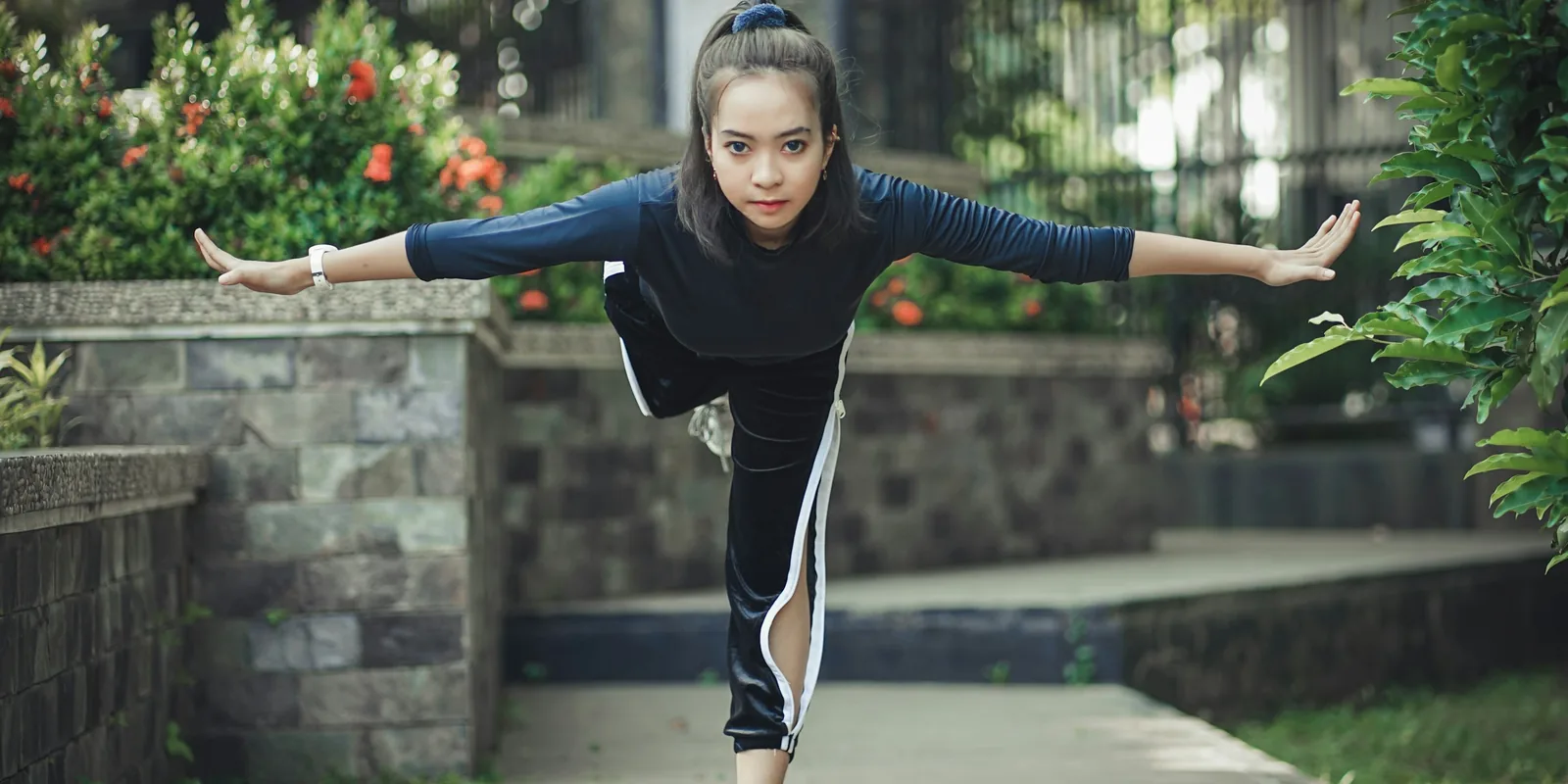
Stand side-on to the desk with one hand resting on it. Bend the other knee, hold that foot with the hand on the same side, and lift it gently behind you as you tilt forward a little. Hold for five breaths, turn round and swap. Expect giggles here, and let them happen.
6. Shake it out (30 seconds)
Shake the hands, then the arms, then one foot and the other, while the class counts down from ten together.
7. Still at the desk (2 minutes 30 seconds)
Sit down, feet flat on the floor, one hand on the tummy. Eyes closed or resting on the desk. Breathe slowly and silently count the sounds you can hear until the timer goes. If that's long for a new class, start with a minute and add a little each week.
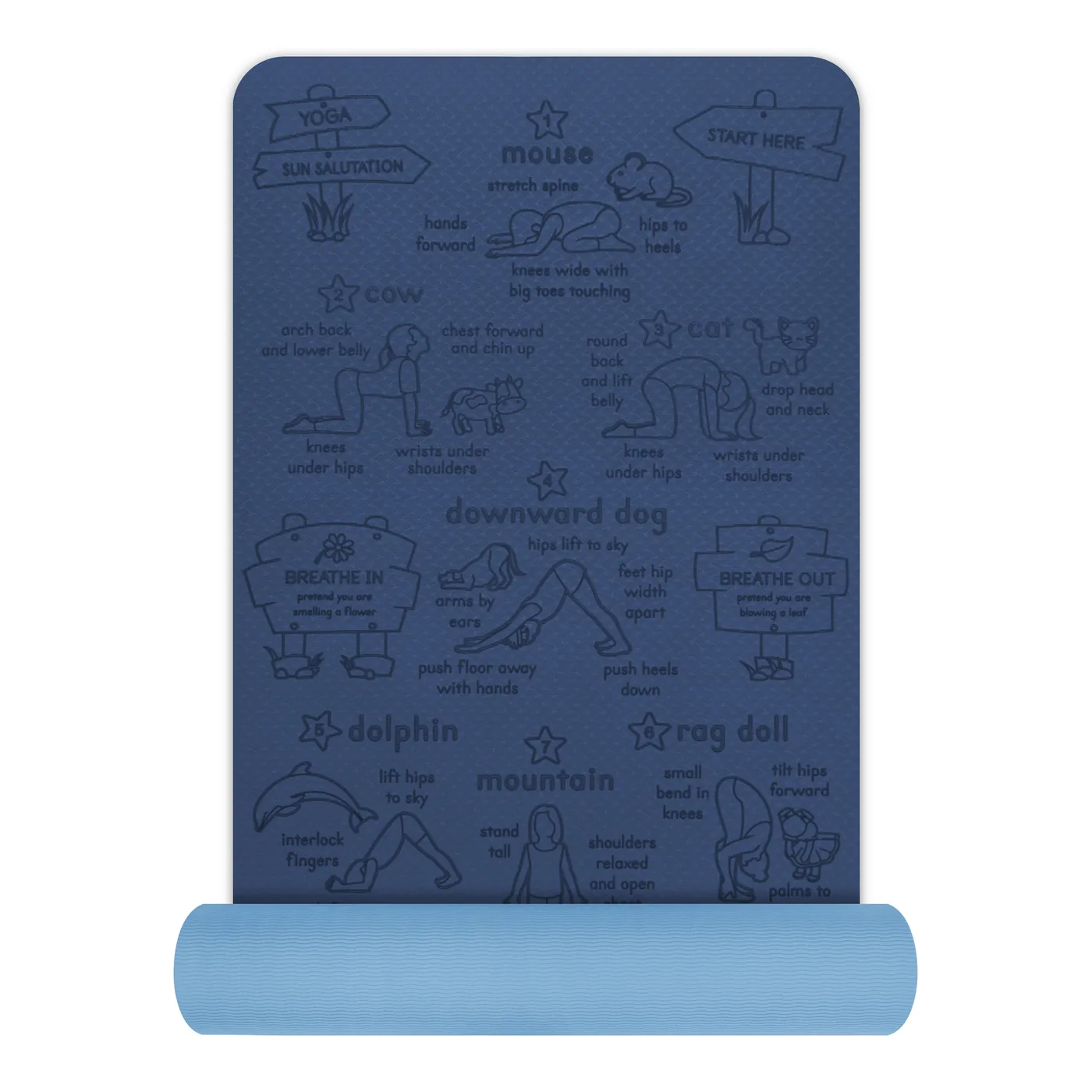
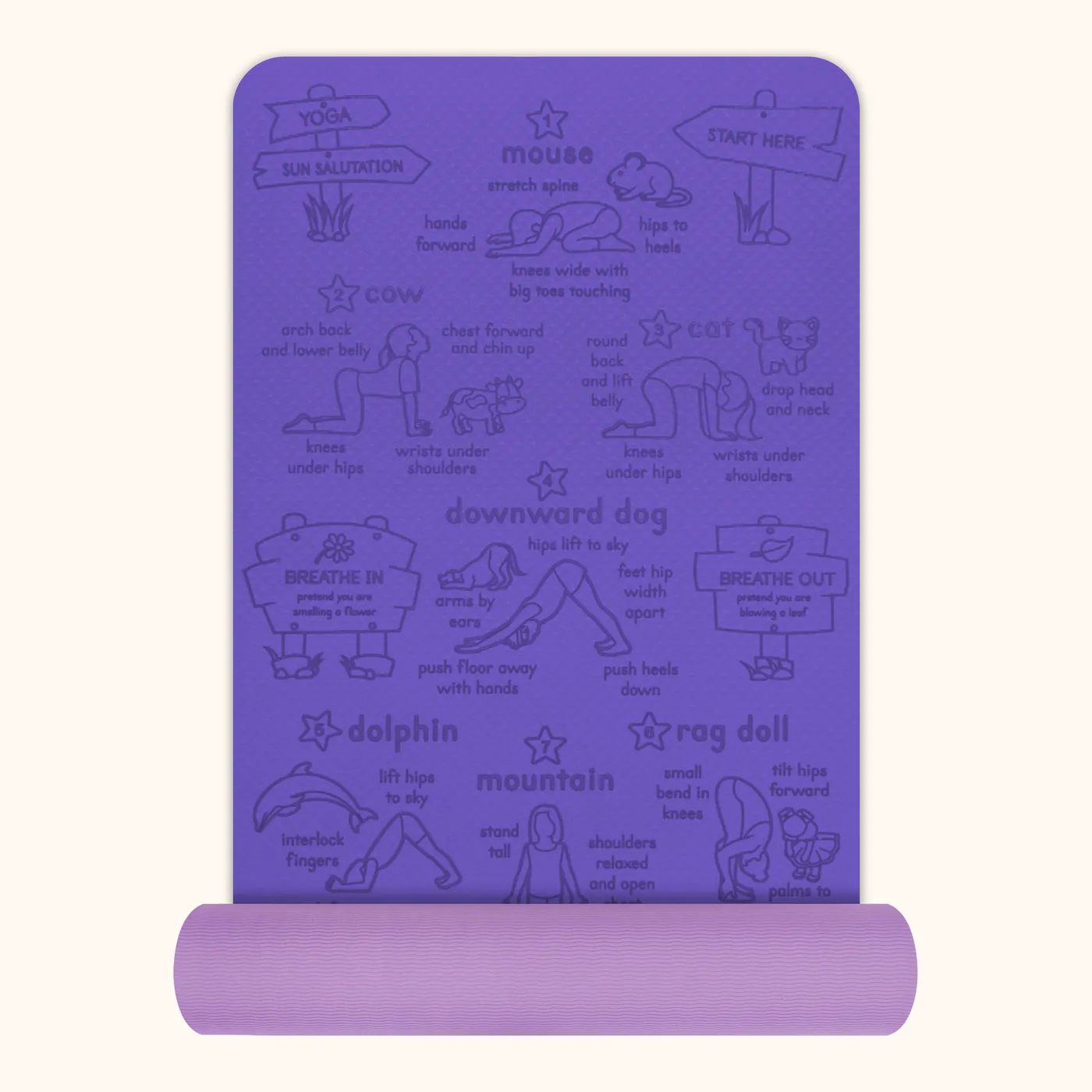
If you have a Yogi-Me Sun Salutation mat, eagle, tree and dancer are poses 13, 14 and 15 of the 15 numbered poses laser-engraved on it, with short cues beside each, so a pupil leading from the front can read the steps off the mat.
How do you adapt classroom yoga for Reception, KS1 and KS2?
Keep the same shape and change the length and the leader. Younger children need shorter holds and more play; older children can hold poses longer and run the session themselves. According to GOV.UK, KS1 is Years 1 and 2, ages 5 to 7, and KS2 is Years 3 to 6, ages 7 to 11.
Yoga for Reception (ages 4 to 5)
Holds of three breaths, plenty of animal noises, and a floor version on the carpet. Go from mouse (kneel and curl up small) to cat (on hands and knees, round the back) to downward dog (hips up high), then back to mouse to finish.
Yoga for KS1 (Years 1 and 2)
Yoga for KS1 works best with an adult leading. Use the seven-step routine as it stands, with holds of five breaths.
Yoga for KS2 (Years 3 to 6)
Yoga for KS2 can be led by the pupils. In Years 3 and 4, keep the same routine and let a pupil call the poses. In Years 5 and 6, hold for eight breaths and let groups plan and teach their own short sequence. That fits the KS2 PE aim of linking skills together "to make actions and sequences of movement".
How do you keep classroom yoga safe and inclusive?
Treat it like any PE activity: clear space, a floor that isn't slippery, and no forcing. Children stop if anything hurts, every pose has an easier version, and nobody is made to perform. Your school's own PE and safety policies apply, as they would to any lesson.
A quick checklist:
- Space: an arm's length clear all round.
- Feet: bare feet or trainers on a hard floor. Socks slip.
- No pain: a stretch should feel like a stretch. If it hurts, stop and sit down.
- Easier versions: a hand on the desk for every balance, or a seated reach in place of a standing one. The NHS suggests children living with a disability aim for challenging but manageable strength and balance activities three times a week, so keep seated and supported versions ready.
- Plain words: call poses by what they look like, and leave out chanting and spiritual language, so it suits every family. A line in the class newsletter saying what the ten minutes are helps too.
- A way out: a child who'd rather not join in can be the timekeeper.
What if the class won't settle?
Expect giggles the first few times and don't fight them. A room full of wobbling eagles is funny, and the novelty wears off as the routine becomes familiar. Keep your voice low, do every pose yourself, and keep the still step short until the class is ready for more.
- The performer: give them the timer, or the job of leading tomorrow.
- The refuser: let them watch from their seat and invite them again next time.
- The noisy finish: if the still step falls apart, go back to tree for five breaths and try sitting again.
How do you make classroom yoga a habit?
Fix a time, put it on the visual timetable, and keep the same seven steps for a half term so children know what's coming. Once they know it, hand it over: a different pupil leads each day, calling the poses and counting breaths while you join in. The same routine can be one of your Children's Mental Health Week activities for KS1 and KS2.
When ten minutes is too much, two-minute brain breaks such as five-finger breathing work sitting at the desk, and movement breaks cover the 30-second bursts between lessons. For a longer, more playful session on a wet-play day, try these yoga games for kids. If yoga is new to you too, our beginner's guide to kids' yoga covers what's safe at each age.
Mats for a class that leads itself
Classroom yoga doesn't need mats. They help when you want children to find the poses on their own. Every Yogi-Me mat has 15 numbered poses laser-engraved into the surface, so a class can find pose 14 without being shown it, with no screen to put up and nothing to prepare.
Before you order for a class:
- Which design: Sun Salutation runs from mouse at 1 to dancer at 15, so it has the Reception floor poses and this routine's three balances. Freedom Flow is a calmer floor sequence, better suited to a calm corner. Both can go in one order.
- Ages: designed for ages 3 to 8, which runs from Nursery to Year 3. Each mat is full length at 183 x 61 cm, the size of an adult mat, so older pupils fit on one too, and so do you.
- Space: that length is the trade-off in a classroom. A full-length mat won't lie beside a desk, so use mats on the carpet or in the hall, and do the standing routine without them.
- Cleaning and storage: wipe with a damp cloth and a little mild soap, then let it dry flat. Each mat is 800 g, rolls up and has a carry strap.
- Materials: non-toxic, PVC-free TPE, according to our supplier's specification, with 6 mm of cushioning. Use it on a dry, flat floor.
- Price: £34.99 a mat, with free UK delivery.
Buying for a child at home too? With Christmas coming, a mat with the same numbered poses makes a screen-free present. Our guide to presents for kids has ideas by age, or you can choose a colour for one.
Put a mat under every child in the class with our yoga mats for schools. Volume pricing starts at 10 mats, and the school can order on a purchase order and be invoiced, with no card needed.
Frequently asked questions
Is there a 10-minute yoga activity for kids?
Yes. A ten-minute classroom routine can run in seven steps: stand tall and breathe, reach and lean, tree, eagle, dancer, shake it out, then two and a half minutes sitting still. It needs only the space beside a desk, and no screen or equipment.
What are the benefits of yoga for students in school?
Ten minutes beside the desk practises balance, co-ordination, flexibility and control, which the PE curriculum asks primary pupils to develop. It also breaks up a long spell of sitting, which the UK Chief Medical Officers recommend. Better results or behaviour are a different claim, and a short routine shouldn't be sold on them.
Is yoga part of the national curriculum?
Not by name. The PE programmes of study ask KS1 pupils to develop balance, agility and co-ordination, and KS2 pupils flexibility, strength, technique, control and balance. Yoga-style poses are one way to practise those skills, so a short routine can sit inside PE rather than competing with it.
Do you need yoga mats for classroom yoga?
No. Standing poses work beside a desk on a dry, non-slip floor. Mats help with floor poses such as mouse, cat and downward dog, and they give each child a clear space of their own. If you only have a few, use them on the carpet and keep the standing routine mat-free.
How often should a class do yoga?
There's no official number. The UK Chief Medical Officers' guidelines ask children to break up long periods of not moving, but they set no time limit. A short routine at a fixed time each day is easier to keep going than an occasional long session.
Sources
- GOV.UK - National curriculum in England: physical education programmes of study, published 11 September 2013
- GOV.UK - Relationships education, relationships and sex education (RSE) and health education, revised statutory guidance
- GOV.UK - UK Chief Medical Officers' physical activity guidelines, published 7 September 2019
- NHS - Physical activity guidelines for children and young people (5 to 18 years), reviewed 23 October 2024
- GOV.UK - The national curriculum: key stages and year groups