guides
How Much Screen Time Is Too Much for Kids?
How much screen time is too much for kids? What UK guidance says by age, four signs screens are crowding out the day, and simple swaps that work.
Screen time is too much when it goes past the guidance for your child's age, or when it starts pushing out sleep, movement, play and time together. UK government guidance says under-2s should avoid screens except shared moments such as video calls, and 2 to 5-year-olds should try to keep it to an hour a day, less if possible. For older children, the trade-offs are the test.
If you have ever handed your child a tablet just to get five minutes of peace, you are not a bad parent. You are a normal one. Screens are everywhere, and every other child seems to have one. But the guidance on early screen habits is worth a calm read.
The concern is less about any single hour and more about what the screen is replacing: movement, imagination, sleep and face-to-face time.
What does the guidance say, by age?
For the youngest children, the answer is a number. UK government guidance for under-5s says children under 2 should avoid screen time other than shared family activities that encourage bonding and conversation, such as a video call with grandparents. From 2 to 5, it suggests no more than an hour a day, less if possible, and none at mealtimes or in the hour before bed. The WHO sets the same hour for 2 to 4-year-olds and adds that less is better.
From about six, there is no official hourly limit in the UK. NHS advice for families is to agree boundaries together and balance screens with other things, which is a judgement rather than a stopwatch.
- Under 2, Guidance: Avoid, except shared activities such as video calls with family; Source: UK government
- 2 to 5, Guidance: No more than 1 hour a day, less if possible; none at meals or in the hour before bed; Source: UK government (the WHO says the same for 2 to 4)
- 6 and over, Guidance: No fixed limit; agree family boundaries; Source: NHS
Our screen time by age guide goes through each age in more detail, and our look at average screen time for UK children gives the survey picture.
How can you tell when it's too much?
Ask four questions. If the answer to any of them is yes on most days, screens are taking more than their share.
- Is it eating into sleep? The NHS advises no laptops, tablets or phones in the 30 to 60 minutes before bed, because the light from screens can interfere with sleep. Our guide to screen time and sleep explains what helps.
- Is it crowding out movement? The NHS wants under-5s active for at least 180 minutes a day and 5 to 18-year-olds for an average of at least 60.
- Is it replacing meals and conversation? The UK Chief Medical Officers' advice to parents is that screen-free mealtimes are a good idea, so the family talks face to face.
- Is switching off a daily battle? Big reactions when the screen goes off are common, but if they happen every time, the screen may be doing the calming. Our list of signs of too much screen time covers what else to look for.
Is 4 hours of screen time a day too much?
For a child under 5, yes: it is four times the most the guidance suggests. For a school-age child, it depends on what it leaves room for, and a quick sum usually settles it.
Take an illustrative seven-year-old. The Sleep Charity suggests 10 to 11 hours of sleep a night for 7 to 12-year-olds. Add a school day of about six and a half hours and four hours of screens, and only two and a half to three and a half hours are left for meals, getting ready, homework, play and the hour of activity the NHS recommends. Something gives, and it is usually the movement or the sleep.
So four hours isn't against any rule for an older child, but on most days it is more than the day can hold.
Why does a swap work better than a ban?
The good news is that you do not need to ban screens to make a difference. Children respond best to a swap, not a subtraction: replace a chunk of passive screen time with something active they actually enjoy, and the habit tends to shift on its own.
The government's guidance suggests the same thing with what it calls safe screen swaps: I Spy or simple conversation at the table instead of a screen, and a bedtime story instead of a tablet. If the morning telly is your battle, here is our honest answer on TV before school.
The easiest swaps need no set-up at all. Our guide to reducing screen time for kids has a step-by-step plan, and screen-free habits that stick covers making the change last.
Does the kind of screen time matter?
Yes. The government's guidance for under-5s suggests slow-paced, age-appropriate content and says watching together and talking about it is better for young children's development than solo screen use. It advises avoiding fast-paced, social media-style videos for young children.
An hour of a gentle programme watched on the sofa together is a different thing from an hour of short clips alone.
Frequently asked questions
Is 2 hours of screen time too much for a 3-year-old?
It's more than the guidance suggests. UK government guidance for 2 to 5-year-olds is no more than an hour a day, less if possible, and the WHO gives the same limit for 2 to 4-year-olds. If two hours has crept in, trim it a little at a time, starting with mealtimes and the hour before bed.
Is 4 hours of screen time okay for a school-age child?
Usually it's more than the day can hold. With 10 to 11 hours of sleep, a school day and an hour of activity to fit in, four hours of screens leaves very little time for play, meals and homework. There's no official limit at this age, so judge it by what it pushes out.
Does educational TV count as screen time?
Yes, it still counts towards the total. Quality matters, though: slow-paced, age-appropriate programmes watched together are better for young children than solo viewing of fast-paced clips. A video call with grandparents is the kind of shared screen time the UK guidance is happy with, even for under-2s.
What should I replace screen time with?
Something active, easy to start and genuinely fun: a few animal yoga poses, a den, a dance, a jigsaw or a walk. At meals, try I Spy or simple conversation, and at bedtime a story. The swap works best when the alternative is ready before the screen goes off.
When should I worry about my child's screen use?
If screens are regularly costing sleep, if your child is losing interest in play and friends, or if you're worried about their speech, development or mood, talk to your GP or health visitor. Screens are rarely the whole story, and they can help you work out what's going on.
A swap that's ready when they are
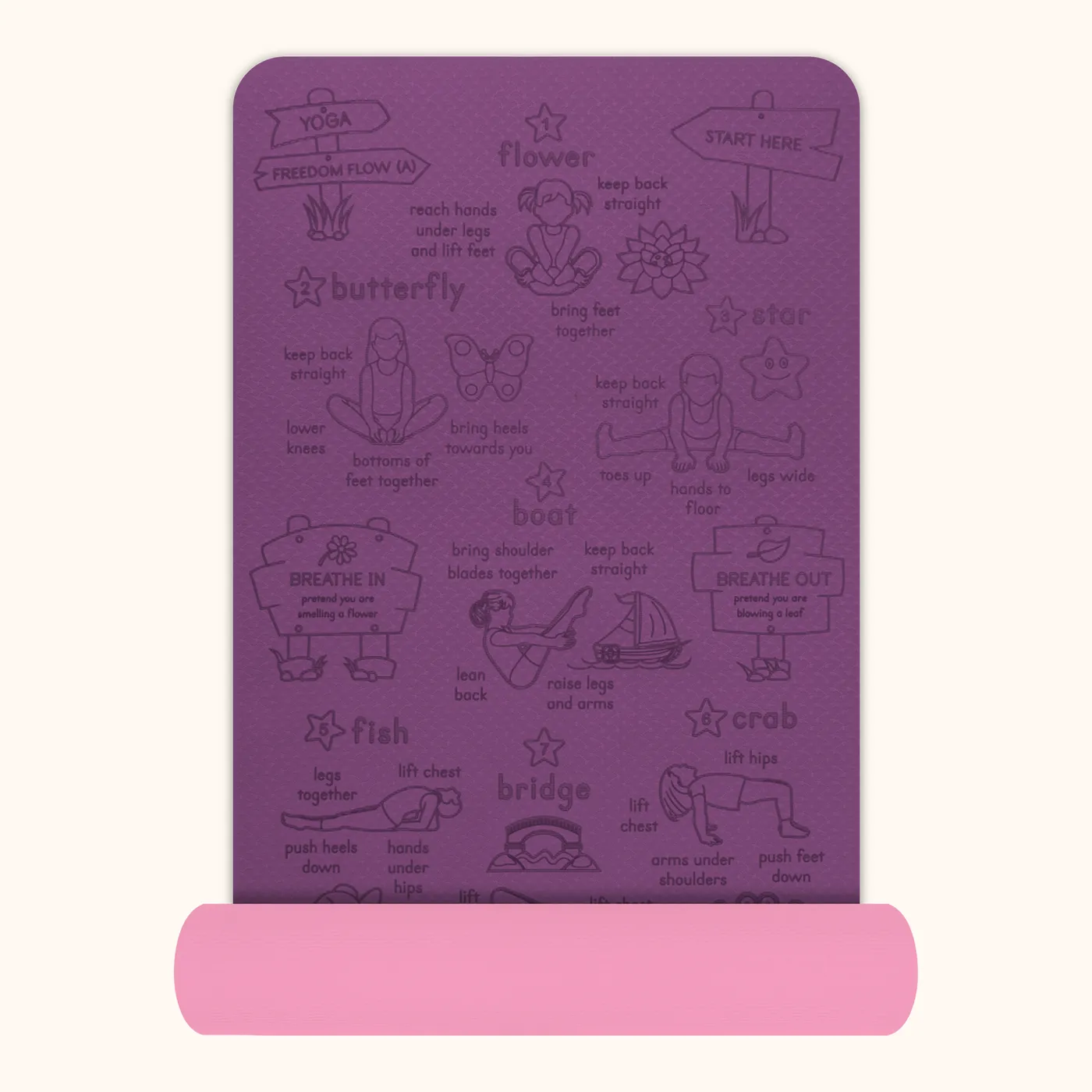
That is the whole idea behind Yogi-Me. A bright mat with the poses marked into it gives kids something to do the moment they would normally reach for a screen. No setup, no telly, just movement they can lead themselves. Our kids' yoga mat has 15 numbered poses marked into it, for ages 3 to 8.
Sources
- GOV.UK: New screen time guidance for parents of under-5s
- Best Start in Life (Department for Education): Screen time for under-5s
- World Health Organization: To grow up healthy, children need to sit less and play more
- NHS (Bedfordshire and Luton children's health): Screen time
- NHS: Sleep and young children
- NHS: Physical activity guidelines for children (under 5 years)
- NHS: Physical activity guidelines for children and young people
- GOV.UK: UK Chief Medical Officers' commentary on screen time and social media
- The Sleep Charity: How much sleep does my child need?