guides
Winter Activities for EYFS: 12 Ideas for Any Weather
Winter activities for EYFS for frosty, wet and dark days, led by movement, with a winter yoga story for when the hall is all you have.
Good winter activities for EYFS keep children moving whatever the weather does: outside on cold, dry days, in the hall when it's wet or icy, and something calmer when it's dark by mid-afternoon. Here are 12, grouped by the weather you've actually got, each tagged with its EYFS area.
The EYFS (Early Years Foundation Stage) is the framework that nurseries, childminders and Reception classes in England follow for children from birth to five.
Do EYFS children have to go outside in winter?
Yes, unless the weather makes it unsafe. The EYFS statutory framework says providers "must provide all children with daily access to an outdoor play area". If that isn't possible, outdoor activities must be planned and taken every day "unless circumstances make this inappropriate, for example unsafe weather conditions".
So cold on its own isn't a reason to stay in. Frost, ice and storms can be. Winter activities in the early years start with going out and plan for the days you can't.
How do you keep preschoolers active in winter?
Plan for the weather, not the calendar. The NHS says children aged 3 to 4 should spend at least 180 minutes a day doing a variety of physical activities, including active and outdoor play. Winter makes that harder, so have a movement idea ready for every kind of day.
These winter ideas for EYFS are grouped that way. Start anywhere, mix groups in one session, and keep outdoor spells short and well wrapped, coming in when hands get cold. Each idea notes which of the seven areas of learning in the EYFS it fits, with physical development first because it's a prime area.
What can you do outside on a cold, dry day?
On a cold, dry day, go out. Frosty mornings and bare trees give you things to find, puddles to jump, and room to run that the classroom can't offer. Keep spells short, mittens on, and avoid running games where the ground is icy.
1. Frost and footprint hunt (understanding the world)
Look for breath clouds, frost on leaves and car roofs, and footprints on the wet grass. Whose are they: a bird's, a fox's, a teacher's? Children press their own boots in and compare. Toddlers can join from a buggy or a hand held. Back inside, draw what you found.
2. Penguin waddle relay (physical development)
Feet together, arms by your sides, and waddle across the playground to the cone and back, then tag the next penguin. Add a "slide on your tummy" pretend at the end, standing up. It's balance and coordination, and a good warm-up when everyone has just come out.
3. Hibernation hide and seek (personal, social and emotional development)
The hedgehogs find a place to curl up and "sleep" while one bear counts. The bear then wakes them gently, one by one, by name. Children take turns being the bear, which practises waiting, turn-taking and being gentle with a sleeping friend.
4. Puddle and wellie jumping (physical development)
Find the best puddles and take turns: one jump, two-footed landing, then a hop, then a giant step over. Count the splashes together. Wellies on, waterproofs zipped, and skip any puddle with ice on top. It's the ELG's "move energetically" in one wet morning.
What can EYFS children do on a wet or icy day?
When it's pouring or the playground is icy, that's the framework's weather exemption, not a day off moving. Clear the carpet or book the hall, and plan as much movement as a playground session. DfE's physical development guidance says games and play "both indoors and outdoors" help children develop core strength, balance and coordination. For a Reception class, there's also a 10-minute yoga routine for a class.
5. The winter animal story on the mat (physical development)
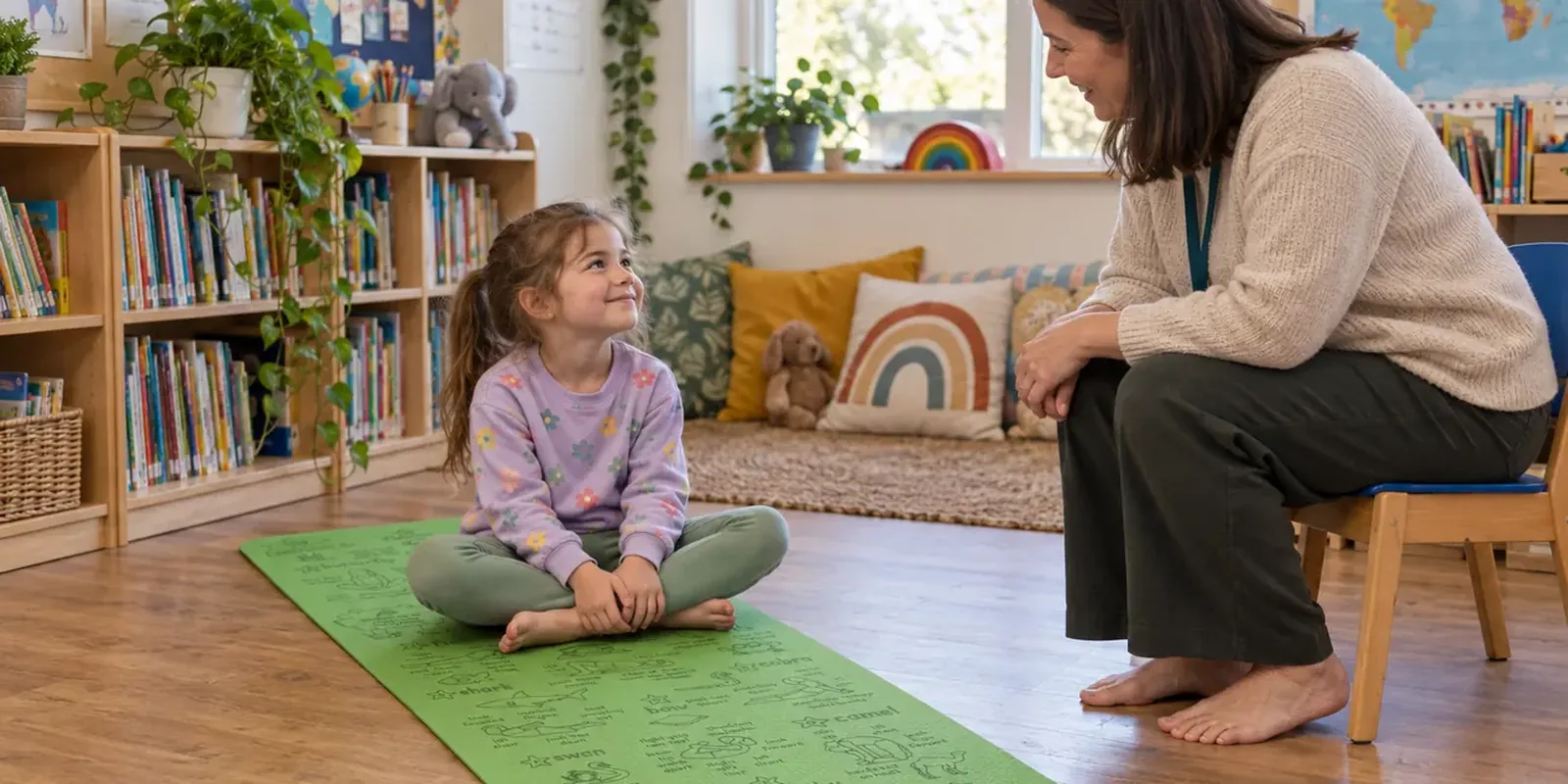
This one is ours. Children move through a winter story, each animal a pose: a hedgehog curls up, a polar bear walks across the ice, an owl spreads its wings. On a group set of mats with the poses marked in, every child has their own. The full story is in the yoga section below.
6. Snowball toss (physical development, mathematics)
Ball up scrap paper as snowballs, or use beanbags, and throw them into a hoop from a line on the floor. Step back a little each round. At the end, count how many landed in, and how many missed. Two-year-olds can drop rather than throw.
7. Jack Frost freeze dance (expressive arts and design)
Play music and let the children move like snowflakes, wind, or skaters. When the music stops, Jack Frost has frozen them, and they hold still as ice until it starts again. Ask what shape they froze in, and let one child be Jack Frost.
8. Polar bear crawl course (physical development)
Set up a course: under a table, over a line of cushions, round a chair and through a tunnel of hoops. Everyone crawls it on hands and feet as polar bears. It covers the ELG's "negotiate space and obstacles safely, with consideration for themselves and others".
What works when it's dark by mid-afternoon?
When it's dark by mid-afternoon, switch to smaller spaces and calmer play. In December, our Christmas activities for EYFS follow the same areas of learning. Torches, sorting and slow breathing suit the end of a winter day, and they give tired children something to do that doesn't need a big space or a lot of energy.
9. Torch shadow animals (communication and language, understanding the world)
Close the blinds and shine a torch on the wall. Make shadow animals with hands or cut-out shapes: an owl, a rabbit, a reindeer. Children name each one, describe it, and guess the next. Older children can tell a short winter story with the shadows.
10. Mitten pairs (mathematics)
Bring in a basket of odd mittens and gloves, or paper ones with patterns. Children find the matching pairs, count in twos, then sort them by size or colour. Finish by lining them up from smallest to biggest. It works at a table, on the carpet or in a tuff tray.
11. Hot chocolate breathing (personal, social and emotional development)
Everyone holds a pretend mug of hot chocolate in both hands. Smell it slowly through the nose, then blow gently across the top to cool it down. Repeat three times, then "drink" it. It's a breathing game, and a quiet way to gather the group at the end of a session.
What if it snows?
You can't plan a term around snow, so treat it as a bonus, not the plan. When it comes, get out while it's fresh, keep the spells short, and come in to warm up. For whole days off, see our snow day activities for kids.
12. Snow mark-making and footprint trails (literacy, understanding the world)
Give children sticks to draw and make marks in the snow: lines, circles, the first letter of their name. Then make footprint trails to follow: big steps, small steps, hops, a wiggly line. Look at how the marks change as the snow melts.
What are some winter yoga poses for kids?
Winter yoga for kids works best as a story, where every winter animal is a simple pose. These are all poses on our Sun Salutation mat, given winter names for the story. Say the name, show the pose, and hold each for three slow breaths:
- A hedgehog curls up to hibernate: mouse, curled up small.
- An arctic fox wakes and stretches: cow, then cat, on hands and knees.
- A polar bear walks across the ice: downward dog.
- A penguin stands tall in the wind: mountain.
- A reindeer listens in the snow: deer, a lunge with arms up.
- A snowy owl spreads its wings: eagle, or simply a big hug for younger children.
- A fir tree stands still in the frost: tree.
- Back to the hedgehog, curled up warm: mouse.
The winter names are the story's; the mat shows the pose names. If you're new to it, how to start yoga with your child covers the basics. Run the story on a dry, flat floor, with space for every child to lie down.
Give the wet-play days a mat each. Our mats have 15 numbered poses laser-engraved into the surface, so any adult can say "polar bear" and point to downward dog, with no screen, no setup and no specialist. They're designed for ages 3 to 8, so they suit the preschool room and Reception rather than the baby room. Each is 183 x 61 cm, so a full set needs a hall or a cleared carpet, and a damp cloth with a little mild soap cleans them. For a setting, see volume pricing and ordering: volume pricing starts at 10 mats, and schools can order on a purchase order and be invoiced.
Doing this at home? Parents and grandparents can find full-length yoga mats for children at £34.99 each with free UK delivery. A child who's done the winter story at nursery can do it at home on a dark January afternoon too. If you're buying for Christmas, that makes it one of the screen-free Christmas gifts that gets used after the day itself.
What about children who won't join in?
Some children won't want to waddle, crawl or curl up in front of their friends, and that's fine. Let them watch first: some join once they see it's a game rather than a performance.
Give the reluctant ones a job instead, such as counting the snowballs, choosing the next animal, or being Jack Frost with the music. Some prefer to move alone, so a corner of the hall with one mat can be a quieter option. If an activity isn't working, stop it and try another group's idea. For more ways to fill a wet day, there are more rainy-day movement ideas.
Frequently asked questions
Which winter activities suit babies and toddlers?
The frost and footprint hunt, puddle jumping, the snowball toss and the freeze dance all work for toddlers with an adult close by, and the baby room can join the footprint hunt from a buggy or a lap. The movement ideas suit preschoolers aged 3 and 4 best, and the yoga story is for 3 and up.
How do you teach winter to preschoolers?
Start with what they can see and feel: breath clouds, frost on leaves, cold hands, dark afternoons. Then add the animals: who sleeps through winter, who grows a thick coat, who flies away. Moving like those animals, in a waddle relay or a yoga story, gives a three-year-old a way to remember them.
When does winter start in the UK?
It depends which definition you use. The Met Office says meteorological winter always starts on 1 December and ends on the last day of February. Astronomical winter starts at the winter solstice, usually around 21 December, and ends around 20 March. For planning, most of it falls in the spring term.
How much physical activity should a 3 or 4 year old get?
The NHS says children aged 3 to 4 should spend at least 180 minutes a day doing a variety of physical activities spread throughout the day, including active and outdoor play, and that this should include at least 60 minutes of moderate-to-vigorous activity. Children under 5 shouldn't be inactive for long periods, except when they're asleep.