guides
The 7 Areas of Learning in the EYFS, for Parents
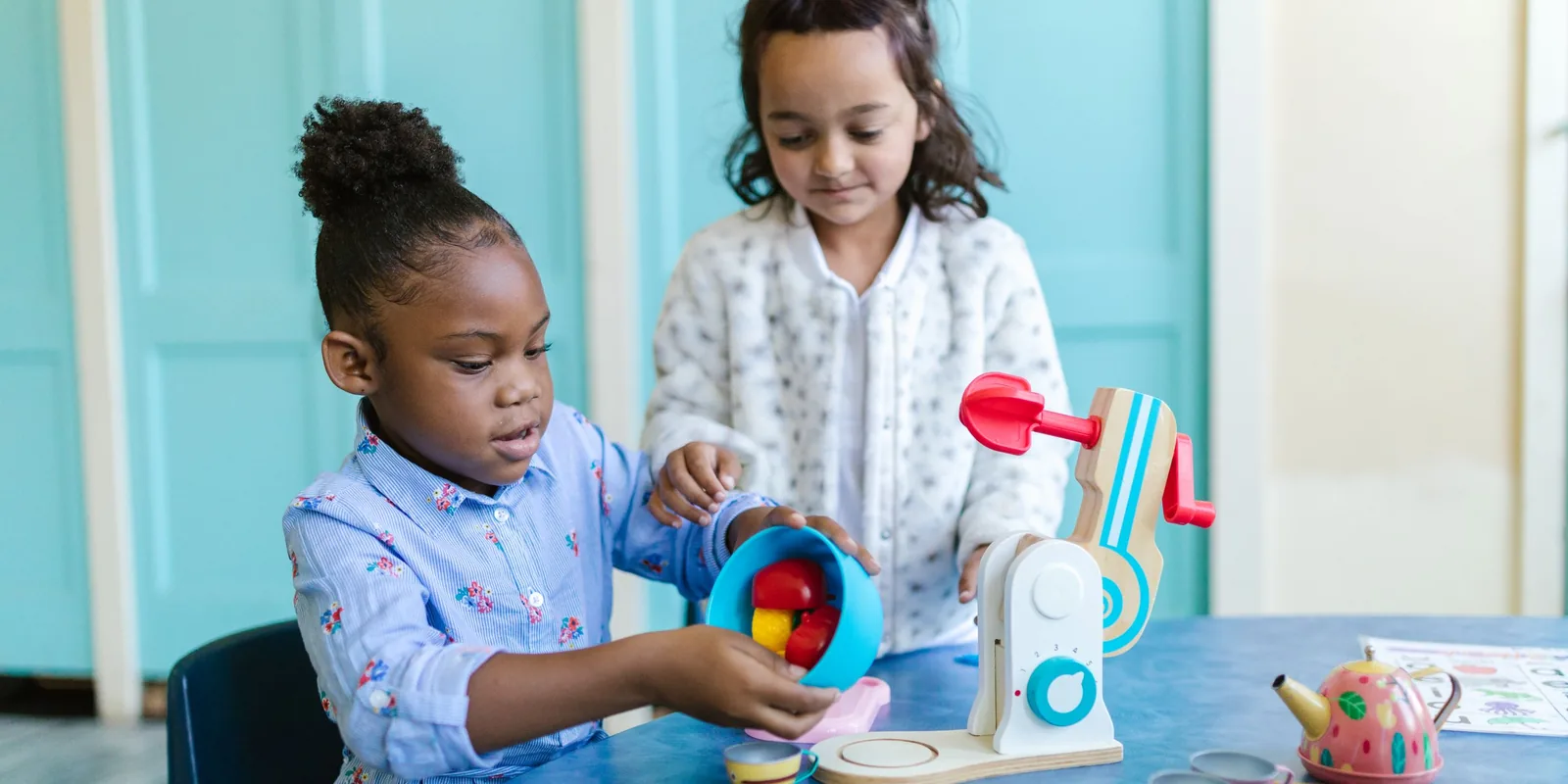
Three prime, four specific: the 7 areas of learning EYFS settings plan around, in the DfE's own words, with what each looks like at 3 and 4.
The 7 areas of learning in the EYFS are communication and language, physical development, and personal, social and emotional development (the three prime areas), plus literacy, mathematics, understanding the world, and expressive arts and design (the four specific areas). Nurseries, childminders and Reception teachers in England all plan around these seven, and your child's reports borrow the same words.
The EYFS, or Early Years Foundation Stage, is the statutory framework that sets the standards for learning, development and care for children in England from birth to five. If you've been handed a nursery report full of its vocabulary, this is the plain-English version, quoted from the Department for Education rather than from a school's summary of it.
What are the 7 areas of learning in the EYFS?
The EYFS statutory framework lists them in two groups and says all seven are "important and inter-connected". The prime areas are:
- Communication and language
- Physical development
- Personal, social and emotional development
The specific areas are:
- Literacy
- Mathematics
- Understanding the world
- Expressive arts and design
Each area has its own early learning goals (ELGs), the short descriptions a Reception teacher uses to judge a child's development at the end of the Reception year. There are 17, and their names are worth knowing because they appear in the end-of-Reception assessment that schools must share with you:
- Communication and language: Listening, Attention and Understanding; Speaking
- Personal, social and emotional development: Self-Regulation; Managing Self; Building Relationships
- Physical development: Gross Motor Skills; Fine Motor Skills
- Literacy: Comprehension; Word Reading; Writing
- Mathematics: Number; Numerical Patterns
- Understanding the world: Past and Present; People, Culture and Communities; The Natural World
- Expressive arts and design: Creating with Materials; Being Imaginative and Expressive
The framework says plainly that the ELGs "should not be used as a curriculum". They describe where most children are expected to be at around five, not a checklist for a three-year-old. The Department for Education's Development Matters guidance uses the same seven areas and fills in the steps along the way, from birth to three, at three and four, and in Reception.
Why do the three prime areas come first?
Because the other four are built on them. The framework says practitioners working with the youngest children "are expected to ensure a strong foundation for children's development in the three prime areas", and that the specific areas give children opportunities "to strengthen and apply the prime areas of learning".
Development Matters puts it more bluntly: "children who are not speaking in sentences are not going to be able to write in sentences." Talking comes before writing, steady movement before a pencil grip, and managing a disappointment before sitting through a phonics session.
You'll see the priority in your own paperwork. The progress check between two and three, the written summary your nursery or childminder gives you, must cover the prime areas, and anything beyond them is the practitioner's choice. There's more on one of the three, physical development in the EYFS, in our parent's guide, including its two goals.
What does each area look like at home at 3 and 4?
For each area, Development Matters sets out what children of three and four "will be learning to" do. Here is what that looks like away from nursery, with one small thing to try for each.
Communication and language
Talking and listening, which the framework says "underpins all seven areas of learning and development". At three and four, children are learning to follow an instruction with two parts, such as "Get your coat and wait at the door", and to use sentences of four to six words. Development Matters notes they may still say "runned" for "ran". Try asking a "why" question about tonight's story, then wait for the answer.
Personal, social and emotional development
Feelings, friendships and looking after themselves. Development Matters describes children learning to talk about feelings using words like "happy", "sad", "angry" or "worried", to remember rules without an adult reminding them, and to find solutions when everyone wants to be the same character in a game. Try naming the feeling first when a game ends in tears.
Physical development
Big movements and small ones. The list for this age includes skipping, hopping, standing on one leg and freezing in musical statues, next to snipping paper with scissors and doing up their own coat. Try musical statues where every freeze has to be an animal shape.
Literacy
Rhymes, books and marks on paper, long before neat handwriting. Children are learning to spot and suggest rhymes, to clap the syllables in a word, and to write their name, or part of it. Try clapping the syllables in each family member's name, then a long one like hippopotamus.
Mathematics
Number, shape, space and pattern. Children are learning to recognise up to three objects without counting, to know that the last number they say tells them how many there are, and to continue a pattern like "stick, leaf, stick, leaf". Try counting the stairs on the way up, then asking how many there were.
Understanding the world
People, places, nature and how things work. The examples include planting seeds and caring for them, showing interest in different jobs, and talking about how materials differ and change. Try planting a bean in a clear jar against wet kitchen roll, so you can both watch the root appear.
Expressive arts and design
Art, music, role play and making things up. At three and four, children are learning to sing entire songs, to let one object stand for another in pretend play (a banana as a telephone), and to explore colour mixing. Try giving them two paint colours and asking what will happen before they mix.
Why do the areas overlap in real play?
Reports split learning into seven boxes; children don't. Development Matters gives the example of a child gathering the materials for a den before they start building. In ten minutes that's talking and planning (communication and language), carrying and balancing (physical development), negotiating who goes in first (personal, social and emotional development), and counting cushions (mathematics).
The guidance also says the EYFS "is about how children learn, as well as what they learn". The framework names three characteristics of effective teaching and learning: playing and exploring, active learning, and creating and thinking critically. That's why a good nursery report talks about how your child tackles things (keeps trying, has their own ideas) as well as what they can do.
So you don't need a "maths activity" or a "literacy activity" at home. One game that holds their attention usually covers several areas at once. In December, the Christmas activities for EYFS are sorted the same way. The autumn activities for EYFS on our blog are tagged by area if you'd like to see how one idea maps across, and so are our spring activities for EYFS.
How can you support all seven at home?
Development Matters says "It is important to encourage all parents to chat, play and read with their children." That's the whole of it for most families: talk to them while you do ordinary things, read together most days, play outside, and let them do jobs themselves even when it's slower.
For physical development, the prime area that is easiest to squeeze in on a busy evening, a short spell of movement counts. Our yoga mats for children carry 15 poses, numbered and laser-engraved, which a child aged 3 to 8 can work through in order on their own: no screen, and no grown-up demonstrating each one. Nurseries and Reception classes can order class sets for a setting.
If your child is about to start Reception, our school readiness guide covers what the Department for Education actually expects, which is less than most parents fear.
What changed in the EYFS from September 2026?
New versions of both frameworks, one for childminders and one for group and school-based providers, came into force on 1 September 2026. The gov.uk change note lists the main changes as updates on safer sleep, a requirement for providers to have regard to screen use, prohibiting childcare where banned dog breeds are present, and other safeguarding clarifications. On screens, the group and school-based framework says providers "must have regard to" the Department for Education's guidance on children's screen use in early years settings.
None of that touches the seven areas or the 17 early learning goals. Their names are the same as in the framework that came into force on 1 September 2021, and the wording of the goals differs only in punctuation and a single word. For parents, the changes are about how settings keep children safe, not what they teach.
Who can you talk to if one area worries you?
Start with your child's key person. Every child in an EYFS setting must be assigned one, and they know your child's day better than anyone. The progress check between two and three must highlight any areas where some additional support might be needed, and describe what the setting plans to do about them.
The NHS health and development review, offered when your child is 2 to 2-and-a-half, looks at movement, speech, social skills, behaviour, hearing and vision. If you're worried about any of those at any age, speak to your health visitor or GP; you don't have to wait for a review. In Reception, the class teacher is the first conversation, and they can bring in the school's special educational needs co-ordinator (SENCO) if needed.
Frequently asked questions
What are the EYFS prime areas?
The three prime areas are communication and language, physical development, and personal, social and emotional development. The statutory framework treats them as the foundation for everything else, and the progress check between two and three must cover these three. The four specific areas (literacy, mathematics, understanding the world, and expressive arts and design) strengthen and apply them.
What are the 7 C's of learning?
The 7 C's is not a term used in the EYFS statutory framework or in Development Matters, so there is no official list. What the framework does name is three characteristics of effective teaching and learning: playing and exploring, active learning, and creating and thinking critically. If your nursery talks about 7 C's, ask them which ones they mean.
What is the difference between the EYFS framework and Development Matters?
The EYFS statutory framework is the document every registered nursery, childminder and school Reception class must follow. It sets the seven areas, the early learning goals and the safety and welfare rules. Development Matters is non-statutory curriculum guidance from the Department for Education. It shows the typical steps by age, and it guides rather than replaces professional judgement.
What is the EYFS progress check at age 2?
When a child is aged between two and three, the EYFS framework says practitioners must review their progress and hand parents a brief written summary covering the prime areas. It highlights what is going well and where some extra support might help. Where possible, it is meant to link up with the health visitor's review at around two.
Sources
- Department for Education - Early years foundation stage (EYFS) statutory framework
- Department for Education - Development Matters: non-statutory curriculum guidance for the EYFS
- Department for Education - Help for early years providers: Areas of learning
- NHS - Your baby's health and development reviews