guides
Sports Day Games: 12 Every Child Can Finish, Nursery to KS1
Sports day games for primary school and EYFS: 12 events every child can finish, with ages, kit, wet-weather swaps and three ready-made programmes.
Good sports day games are short, simple and finishable by every child. A flat race with an open finish line, egg and spoon, a beanbag head walk, target throw and a parachute finale cover every age from three. Below are twelve, for Nursery to KS1, each with a starting age, the kit, a wet-day swap and the one rule that gets the slowest child over the line.
That last part matters most. Every sports day has a four-year-old who stops halfway down the lane while the other five have finished. The answer isn't to cancel races. It's to build each event so that child still gets to the end. The same games work in a back garden.
What is a sports day for young children?
A sports day is an event, usually in the summer term, where a school or nursery runs short races and games for every child, often with families watching. For Nursery and Reception it's closer to a morning of play; by Year 2 it looks more like the sports days parents remember.
The national curriculum asks that KS1 pupils "engage in competitive (both against self and against others) and co-operative physical activities", according to the PE programmes of study. So a good sports day has all three kinds of event: races against others, events where children try to beat their own score, and team games.
Run it as a carousel: groups of five or six move between stations, with an adult at each, so nobody queues for long. The ages below are our suggested starting ages. And plan for the sun: the NHS says that in the UK the sun is strongest "between 11am and 3pm from March to October", so put the waiting areas in the shade.
The 12 sports day games every child can finish
The best sports day games for primary school and Nursery are the classics with one rule changed. Eight of these move into the hall on a wet day; four need the field.
1. Flat race
Run from the start to a rope or chalk finish line. Say: "Ready, steady, go." Keep heats small, four to six children, so nobody is far behind. The line stays open until the last runner crosses, and an adult greets every finisher by name.
Age from: 3. Kit: cones and a finish line. Wet day: hall, with a shorter lane.
2. Egg and spoon race
Carry an egg on a spoon to the finish. Say: "If it falls, stop, pick it up and carry on." Walking is allowed, and for Nursery it's encouraged. Use plastic eggs, or beanbags on big spoons for the youngest, so a drop costs a second, not the race.
Age from: 3. Kit: big spoons, plastic eggs or beanbags. Wet day: hall.
3. Beanbag head walk
Walk to the line with a beanbag balanced on your head. Say: "Walk tall, like a queen with a crown." It's a walking race by rule, so the fastest runners have no head start. A dropped beanbag goes back on and the child carries on from where it fell.
Age from: 3. Kit: beanbags. Wet day: hall.
4. Sack race
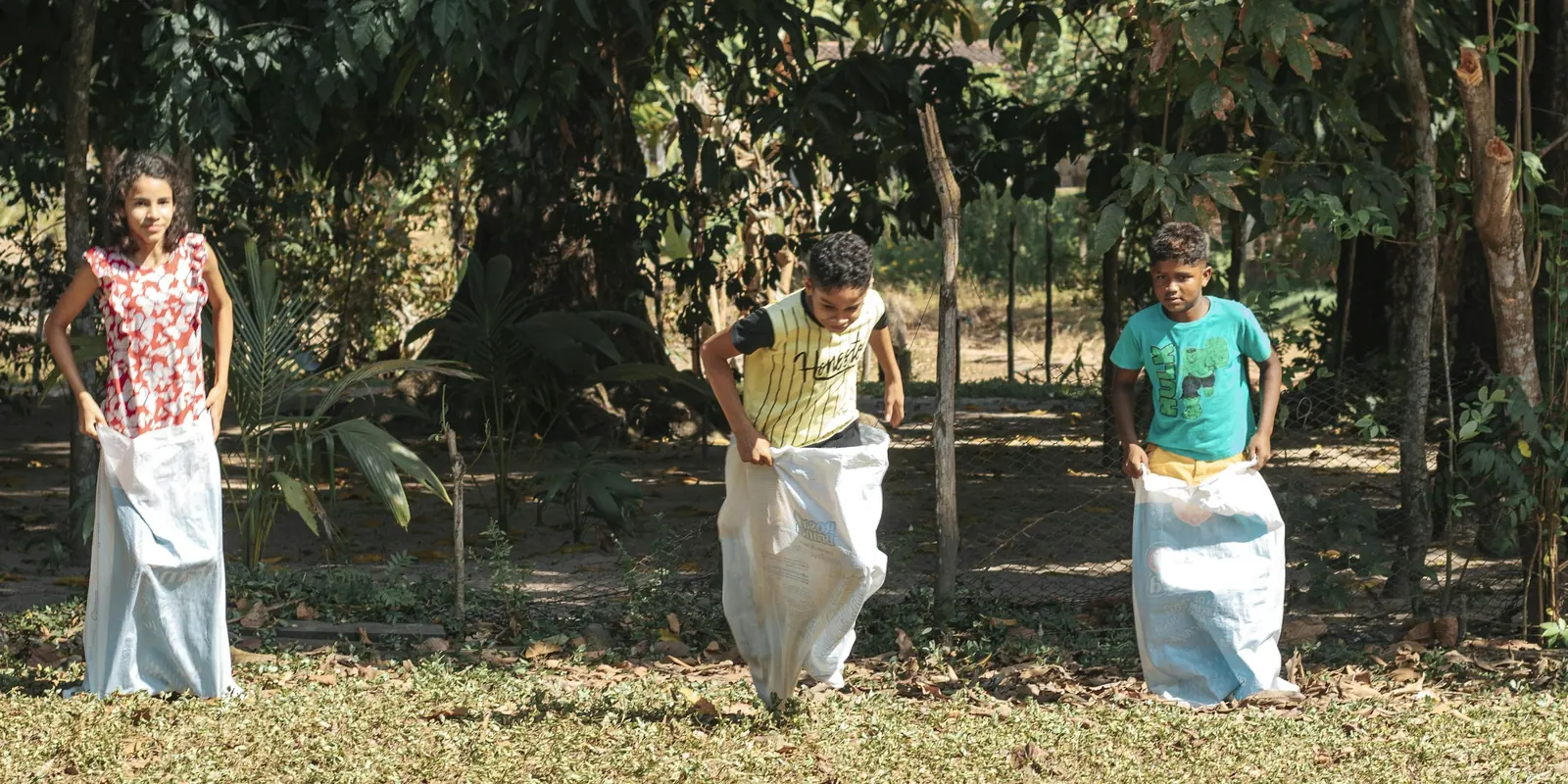
Jump to the finish inside a sack or an old pillowcase. Say: "Hold the top with both hands." Jumping, shuffling and walking in the sack all count, so the child who can't get the jump still finishes. Space the lanes wide, because sacks topple sideways.
Age from: 4. Kit: sacks or old pillowcases. Wet day: outside only, on grass.
5. Obstacle race
Over a bench, through a hoop, round the cones and back. Say: "Everyone does every bit, in any order." For Nursery it's untimed: the aim is to get round. For more course ideas, see our obstacle course ideas for kids.
Age from: 3. Kit: hoops, cones, a tunnel or a bench. Wet day: hall.
6. Target throw
Throw three beanbags into hoops or buckets, with more points for the further ones. Say: "Beat your own score on your second go." The youngest throw from a closer line. A child who goes from one point to two has beaten their own score, and that's the event.
Age from: 3. Kit: beanbags, hoops or buckets. Wet day: hall.
7. Standing long jump
Stand with both feet on the line and jump as far as you can, landing on two feet. Mark each child's best with chalk or tape. Say: "Can you beat your own mark?" Measuring against yourself means the smallest child in the class can win their own event.
Age from: 5. Kit: chalk or tape, a tape measure. Wet day: outside only.
8. Tree-hold relay, on our mats
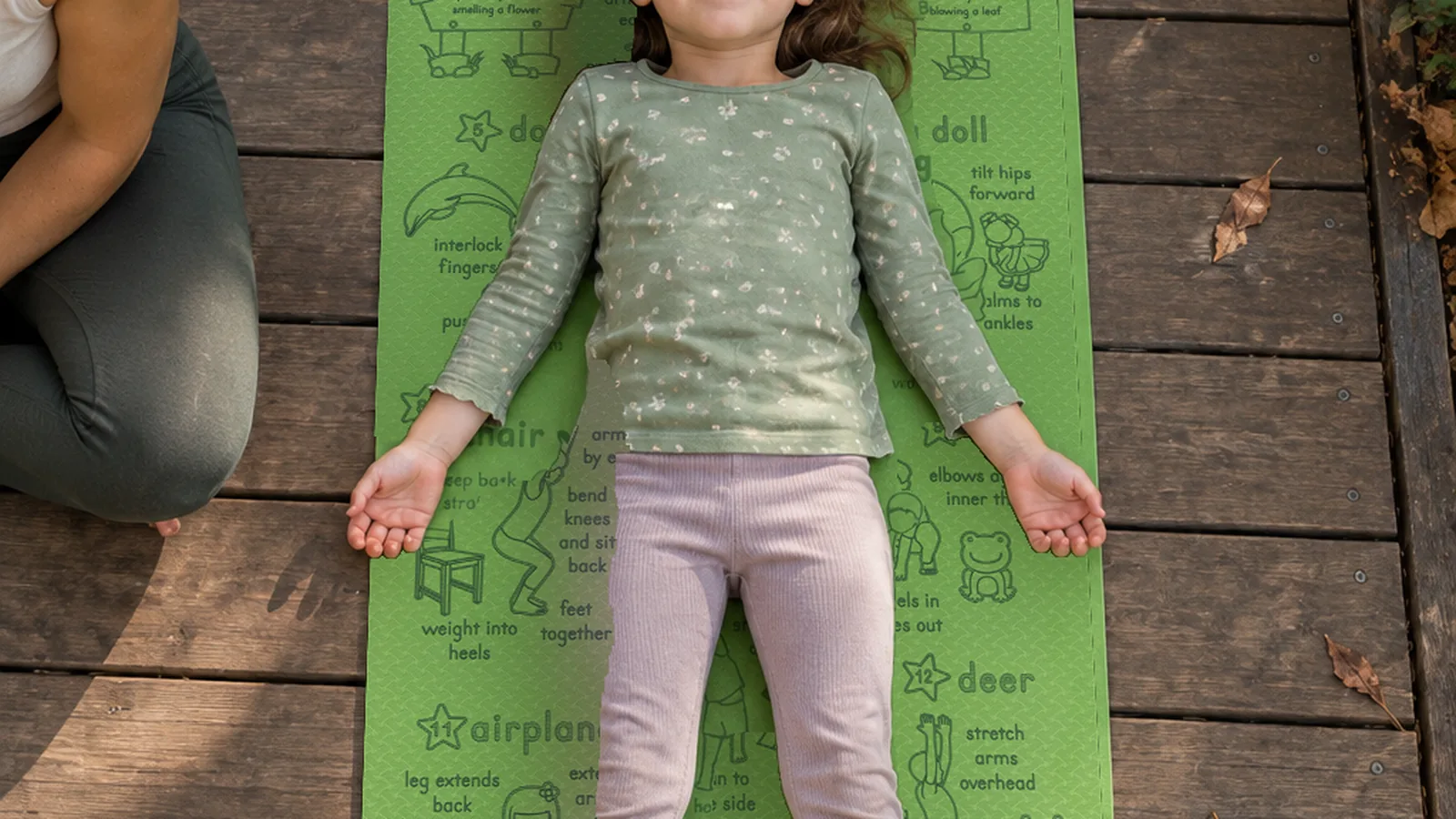
This one is ours. Each team has a Sun Salutation mat at the far end. The runner slows to a walk for the last few steps, steps onto it, finds number 14 and holds tree pose while the team counts to five, then runs back to tag the next. A wobble means the foot goes down and the count restarts; nobody is out. Year 1 and 2 can try eagle, number 13. Steady beats fast here. Step onto the mat, never jump. For a year group, there's a set of mats for school.
Age from: 4. Kit: one Sun Salutation mat per team. Wet day: hall.
9. Three-legged race
Pairs tie their inside ankles together with a soft tie and race to the line. Say: "Inside legs first, together." Pair children of similar height, and let them walk it once before the race. Walking to the line counts as finishing.
Age from: 5. Kit: soft ties. Wet day: outside only.
10. Water relay
Each team has a full bucket at the start and an empty one at the end. Runners carry water across in a sponge or cup and squeeze it in. The score is the team's total, so every turn adds to it, however little each child carries.
Age from: 4. Kit: two buckets and a sponge or cup per team. Wet day: outside only.
11. Dress-up relay
Each team has a bag of oversized clothes: a hat, a jumper, wellies. Each runner puts them all on, runs to the cone and back, takes them off, and the next one goes. Everyone dresses once, the team finishes together, and it usually gets the biggest laugh of the morning.
Age from: 4. Kit: a bag of big clothes per team. Wet day: hall.
12. Parachute finale
The whole group holds the edge of a play parachute. Lift it high, then call a group ("Everyone wearing blue") to swap places underneath. Finish by bouncing a soft ball on top. There's no winner and nobody is out, which makes it the right way to end. If the class loves it, here are more parachute games for nursery and school.
Age from: 3. Kit: a play parachute and a soft ball. Wet day: hall.
Sports day ideas for early years: what works in Nursery and Reception?
For a sports day in the EYFS, run a carousel rather than a line-up: walking races, an untimed obstacle course, the beanbag head walk and the parachute, with a sticker for every child. The early learning goal for gross motor skills, in the EYFS statutory framework, expects children to "Negotiate space and obstacles safely, with consideration for themselves and others."
The Managing Self goal adds that, by the end of Reception, children at the expected level will "Be confident to try new activities and show independence, resilience and perseverance in the face of challenge." That's a goal for five-year-olds, not a three-year-old's first sports day, so keep lanes short and races small. For practice in the weeks before, try these gross motor skills activities.
Sample timetables for Nursery, Reception, KS1 and the garden
Each adds up. Station times include moving on to the next one.
- Nursery, 30 minutes: four stations of six minutes each (egg and spoon with beanbags, beanbag head walk, obstacle race, target throw), then six minutes of parachute games.
- Reception and KS1, 60 minutes: these sports day games for primary school run as a morning. Start with five minutes of PE warm up games. Then five stations of seven minutes each: sack race, target throw, tree-hold relay, and for Reception the beanbag head walk and egg and spoon, or for KS1 the standing long jump and three-legged race. Then fifteen minutes of flat-race heats, and a five-minute dress-up relay to finish.
- In the garden, 20 minutes, two to four children: egg and spoon, a pillowcase sack race, rolled socks into a washing basket, a dress-up relay, then the tree-hold finish, four minutes each. A grandparent can run the whole thing from a garden chair: call the start, count the tree-hold, hand out the stickers.
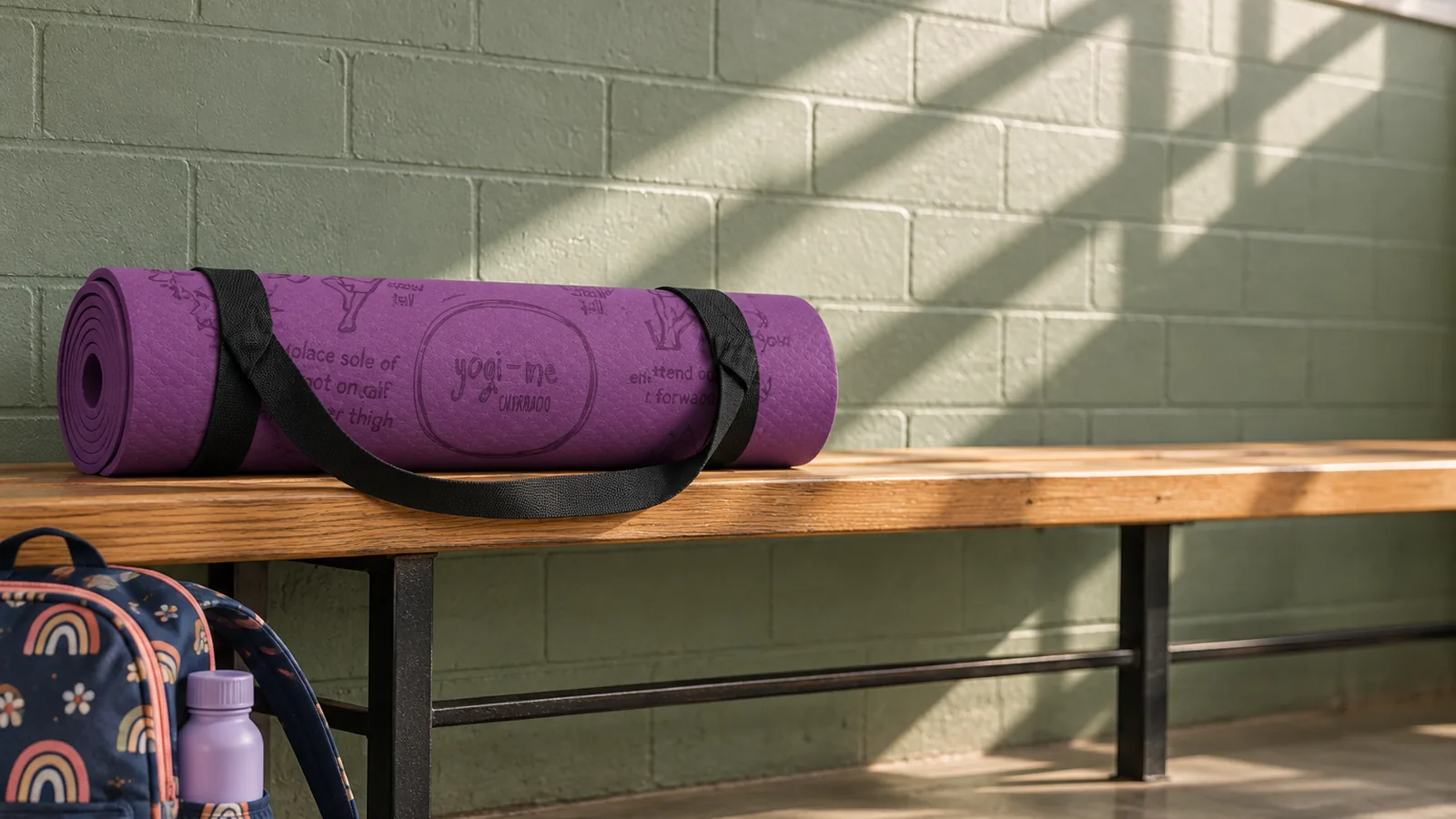
For the garden version, have a look at the mats: 15 numbered poses laser-engraved into the surface, tree is number 14, £34.99 with free UK delivery. A relay for two children needs two mats, and there's 10 per cent off two or more.
Jobs and events for the child who won't race
Give them a job. The child who hates being watched can be the starter, the counter for the tree-hold relay, or the scorer for target throw. They're still part of the day, without a lane to themselves. For Reception, the Department for Education's Development Matters suggests "low-pressure zones where less confident children can practise movement skills on their own, or with one or two others": a quiet station away from the parents works the same way.
The child who is always last has the personal-best events (target throw, standing long jump) and the team totals, built for exactly this. The child who is upset by losing has the parachute and the water relay, which have no loser. The child who won't get in the sack can walk the course. For the parent whose child dreads it, practise one event at home the week before, so nothing on the day is new. There's more on this in how to encourage kids to exercise.
Frequently asked questions
Is sports day part of the curriculum?
The national curriculum for PE in England doesn't mention sports day. At KS1 it asks for "competitive (both against self and against others) and co-operative physical activities" and team games, and a sports day is one way to offer those. Whether to hold one, and how competitive to make it, is up to the school.
How long should a Reception sports day be?
There's no rule. Our suggestion is an hour for Reception and KS1 together: a five-minute warm-up, five seven-minute stations, fifteen minutes of flat-race heats and a five-minute relay. For Nursery, thirty minutes is plenty: four short stations and a parachute game. Stop before the youngest children are tired, not after.
What do you do if it rains on sports day?
Move into the hall. Eight of these sports day games for kids work indoors: the flat race, egg and spoon, beanbag head walk, obstacle race, target throw, tree-hold relay, dress-up relay and parachute finale. Save the sack race, standing long jump, three-legged race and water relay for a dry day, or swap them out.
What should children wear on sports day?
Trainers, comfortable clothes in the school's colours if it asks for them, a sun hat and a named water bottle. The NHS advises taking extra care with children in the sun, spending time in the shade between 11am and 3pm, and using at least factor 30 sunscreen. Put it on before school, and pack more if the day runs long.