guides
Choosing Your Child's First Yoga Mat: What Matters
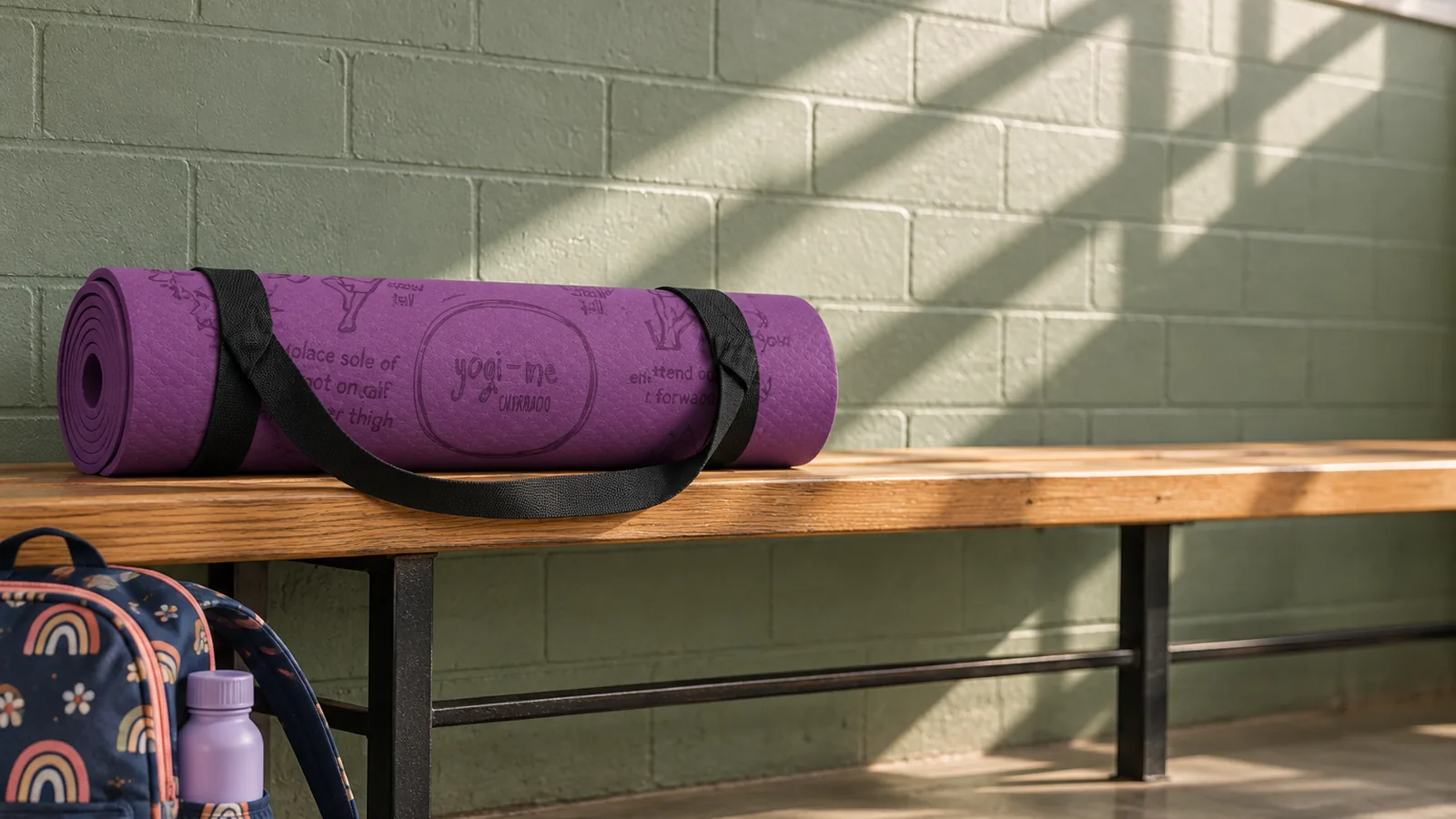
How to choose a yoga mat your child will use: PVC-free materials, the right size, thickness and weight, grip, and a one-glance buying checklist.
Choosing a yoga mat comes down to three checks for a young child: the material (PVC-free TPE or natural rubber, clearly named), the fit (about 4 to 6mm thick and light enough for them to carry) and the grip (non-slip on both sides). Weight matters more than length. Colours and printed poses are a bonus once those basics are right.
You want your child off the tablet and moving, but the living room isn't a gym, and a class across town is one more thing to organise.
A yoga mat at home is one of the simplest ways to fix that. Roll it out, and there's a clear invitation to move.
The tricky part is that not all kids' mats are equal. Some are cheap foam that you'd rather your child didn't lie face-down on. This guide walks you through exactly what to check, so you buy once and buy well.
What should you look for when choosing a mat?
Look for three things: a safe, non-toxic material that is named and PVC-free, a size and thickness that suits a small body, and a non-slip surface that grips the floor. Everything else, from colour to printed poses, is a bonus once those safety and sizing basics are right. If printed poses are what tips it, here is an honest look at whether mats with poses help.
The rest of this guide takes each of those in turn. Materials first, because that's the one that keeps most parents up at night. Then the practical fit (size, thickness and grip), and finally the honest question of whether a mat actually earns its place at home.
Which mat materials are safe and non-toxic?
The safest choices for children are named, PVC-free materials like TPE or natural rubber. PVC is the plastic most often softened with phthalates, which is why PVC-free is the first thing to check. Because a child lies face-down and touches the surface, materials matter most. If a mat is sold as a toy for under-14s, UK toy-safety rules apply.
This is the section worth slowing down for. A yoga mat is one of the few things your child presses their face, hands and bare feet against for a stretch at a time.
What the label should tell you
Reach for a named material described as PVC-free. Thermoplastic elastomer (TPE) and natural rubber are two of the more common non-toxic options. If phthalates are your particular worry, ask the seller directly. If your child has a latex allergy, check, because some natural rubber mats contain it.
Be wary of very cheap, strong-smelling foam mats with no material information at all. If a seller can't tell you what a mat is made of, that's your answer.
Where UK toy-safety rules come in
Here's a genuinely useful anchor. Products designed for play by children under 14 in Great Britain must meet the essential safety requirements of the Toys (Safety) Regulations 2011, which cover chemical, flammability and physical properties.
Not every yoga mat is sold as a toy, so this won't always apply. We go deeper on materials in our guide to non-toxic, PVC-free yoga mats.
What size and thickness should the mat be?
A mat made for children is usually around 120 to 150cm long, shorter than a 180cm adult mat, so it fits a small body without wasted space. Aim for a thickness of about 4 to 6mm: cushioned enough for comfort, thin enough for balance, and light enough to carry.
Getting the fit right matters more than parents expect. Too big and your child trips over the edges. Too thin and their knees complain during a tabletop pose.
Length and weight
A shorter mat suits a smaller frame and, just as importantly, your child can roll it up and carry it themselves. That small bit of independence is part of the appeal. They own the ritual of setting up. Weight decides this more than length does. A typical adult mat is often well over a kilogram, and that heft is what makes it unmanageable for a small child rather than the extra centimetres. Below about a kilogram the calculation changes: a child of four or five can roll and carry a full-length mat perfectly well, and the length becomes room to grow into rather than something to trip over. Check the weight before you rule a longer mat out.
Our separate guide to yoga mat size for children breaks the measurements down by age.
Thickness and grip
Around 4 to 6mm is the sweet spot for most children. Enough padding to be kind to knees and wrists, but not so squishy that balancing poses become a wobble-fest.
Grip is the quiet hero. A non-slip surface on both sides stops little feet sliding during a Downward Dog. For the full picture on cushioning, see our notes on yoga mat thickness for kids.
Why does a child need a yoga mat at all?
A mat gives your child a dedicated space to move at home, which supports the daily activity children need. The NHS recommends under-5s are active for at least 180 minutes a day, and children aged 5 to 18 average at least 60 minutes of moderate activity daily.
A yoga mat won't hit those numbers on its own, and it isn't meant to. Think of it as a low-cost enabler. It turns a patch of carpet into a signal that says "this is where we move."
The NHS guidance for children and young people aged 5 to 18 also calls for activities that build movement skills, muscle strength and bone strength across the week. Yoga maps neatly onto that. Animal poses ask children to balance, stretch and hold their own weight.
If you're not sure where to begin, our roundup of five animal poses for kids is a gentle first session, and if you are weighing up a padded mat instead, see gym mat or yoga mat.
Can a yoga mat really help with screen time?
It can help by giving your child something tangible to do instead of a screen. A mat rolled out on the floor is a simple, screen-free invitation to move.
Children feel the pull too: Ofcom's media use and attitudes research found that a third of online 8 to 17-year-olds think their own screen time is too high. Plenty of parents will recognise the wider frustration that screen time can be hard to keep on top of.
The constructive answer isn't to demonise screens. The World Health Organization suggests children under 5 sit less and play more, advising no screen time for under-2s and no more than an hour a day for ages 2 to 4.
The children's mental health charity YoungMinds takes a similar view, noting that the point at which gaming becomes too much depends on your child and the boundaries you set rather than one fixed number. A sensible way to think about it is less about hitting a single limit and more about whether your child is still getting enough activity, sleep, social time and family time.
A yoga mat sits comfortably inside that thinking. It's a tangible family activity you can do together, not a lecture about the tablet. For a fuller take, see our post on how much screen time is right for kids.
Does yoga help children sleep and wind down?
Gentle movement and calming poses before bed may support the wind-down routine that helps children settle. The Sleep Charity suggests children aged 3 to 6 need around 10 to 12 hours of sleep, and those aged 7 to 12 need around 10 to 11 hours, though individual needs vary.
To be clear, yoga isn't a cure for sleep troubles, and we'd never claim it is. But a few slow stretches can become part of a predictable bedtime rhythm, and children thrive on rhythm.
The Sleep Charity's sleep ranges by age are a helpful reference point when you're shaping an evening routine. A short, calm mat session can be the bridge between a busy day and a settled night.
A one-glance buying checklist
Here's everything above in one glance. Run through it before you buy, and you'll avoid the common regrets.
- Material, What good looks like: Named, PVC-free TPE or natural rubber; Why it matters: Your child lies on and touches the surface
- Length, What good looks like: Around 120 to 150cm; Why it matters: Fits a small body, less to trip over
- Thickness, What good looks like: About 4 to 6mm; Why it matters: Comfort with enough stability to balance
- Grip, What good looks like: Non-slip on both sides; Why it matters: Stops slips during poses
- Weight, What good looks like: Light enough to roll and carry; Why it matters: Your child can set it up themselves
- Design, What good looks like: Printed poses or animals; Why it matters: Guides play without a screen
Frequently asked questions
What age can a child start using a yoga mat?
Most children can start around age 3, once they can follow simple movements and copy shapes. Yogi-Me mats are designed for ages 3 to 8, with 15 numbered poses marked into the mat to guide them. Younger toddlers can join in on a mat with you nearby.
Can my child use an adult yoga mat?
They can, but an adult mat is longer and heavier, so it's harder for a child to manage alone. A shorter, lighter kids' mat fits a small body better and lets your child roll it out and put it away themselves, which builds a nice bit of independence.
How do I clean the mat?
Wipe it with a damp cloth and a little mild soap, then let it air dry fully before rolling it up. Avoid harsh chemical sprays, especially on a mat your child lies against. Check the maker's own care notes, as some materials prefer specific cleaning.
Is a thicker yoga mat always better for kids?
No. Very thick mats feel plush but make balancing poses wobbly, which can put a child off. Around 4 to 6mm gives comfort for knees and wrists while keeping enough contact with the floor for steady standing and balance poses.
How long should a child's yoga session be?
Keep it short and playful. A few minutes for a young child is plenty, building up as they enjoy it. The aim is regular, happy movement rather than a long session, so it fits naturally into the daily activity children need.
A mat with the poses built in
If you'd like a mat that's non-toxic, PVC-free TPE, weighs 800g and has 15 numbered poses marked into it to guide the play, our kids' yoga mat is a lovely place to start. Roll it out tonight, pick one animal, and see where your child takes it.
Sources
- NHS - Physical activity guidelines for children (under 5 years)
- NHS - Physical activity guidelines for children and young people
- The Sleep Charity - How much sleep does my child need?
- WHO - To grow up healthy, children need to sit less and play more
- Ofcom - Children and parents: media use and attitudes report
- YoungMinds - Gaming and mental health: a parent's guide
- GOV.UK - Toys (Safety) Regulations 2011: Great Britain