practice
Kids Yoga Poses With Names: All 30 on Our Mats Explained
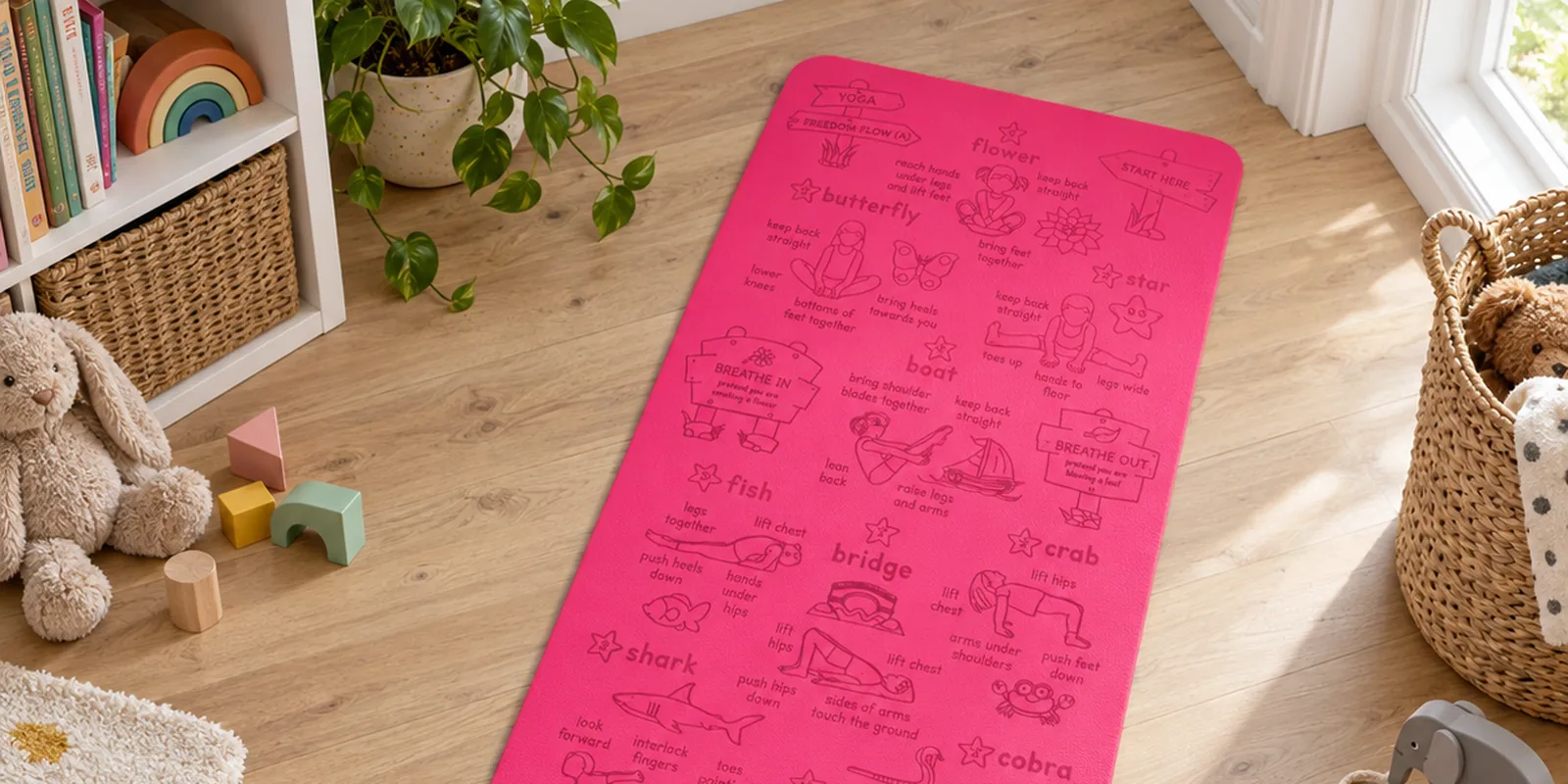
All 30 kids yoga poses with names from our two mats, each with a how-to you can read aloud to a child aged 3 to 8.
Kids yoga poses with names a child already knows, such as mouse, cat, tree and boat, are easy to follow because the name tells them what shape to make. A kids yoga pose is a simple yoga shape made playful, usually named after an animal or an everyday thing. Our two mats carry 30 between them: 15 numbered poses on Sun Salutation and 15 on Freedom Flow.
This page explains every one in plain words you can read out to a child aged 3 to 8.
How do you teach kids yoga poses by name?
Say the name, let your child make the shape, then help with the details. Each pose on this page has one line on what it is, and how to do it in words a child can follow. You can start with any pose, and all you need is a mat or a rug on a dry, flat floor, with room to lie down.
Sun Salutation starts on hands and knees and rises to standing balances. Freedom Flow stays on the floor, sitting, kneeling or lying down, and finishes standing. Both mats have a "Start here" sign at pose 1.
Hold each pose for three slow breaths. Nobody needs to do all 15 in one go.
What are the 15 poses on the Sun Salutation mat?
The Sun Salutation mat starts with mouse at 1 and cat at 3, and ends with eagle, tree and dancer at 13, 14 and 15. The others are cow, downward dog, dolphin, rag doll, mountain, chair, frog, rainbow, airplane and deer. It begins with floor poses on hands and knees, then a forward fold brings your child up to standing for the balances at the end.
1. Mouse
A small, curled-up rest, often called child's pose. "Kneel with your knees wide and big toes touching, sit back on your heels and stretch your hands forward." It's the pose to come back to whenever your child needs a breather.
Cow
A hands-and-knees pose with a dipped back. "Hands under your shoulders, knees under your hips, let your tummy sink and look up." The moo is optional but popular.
3. Cat
The opposite shape to cow. "Stay on your hands and knees, push your back up high like a cross cat and let your head drop." Move slowly between cow and cat, one breath each, and that's cat-cow.
Downward dog
An upside-down V. "Tuck your toes, lift your hips to the sky and push the floor away with your hands, feet hip-width apart." Downward dog for kids is the same shape grown-ups make, and heels don't need to reach the floor. The upside-down view is half the fun.
Dolphin
Downward dog on the forearms. "Put your forearms on the mat, link your fingers together, then walk your feet in and lift your hips high." It's a step up from downward dog, so a few seconds is plenty at first.
Rag doll
A floppy forward fold. "Stand with feet hip-width apart, bend your knees a little, fold forward and let your hands reach for your ankles." Bent knees are allowed, so nobody has to touch their toes.
Mountain
Standing tall and still. "Feet together, shoulders relaxed, arms by your sides with palms facing forward." It looks like nothing, which is exactly what makes it hard for a wriggly four-year-old.
Chair
Sitting on an invisible chair. "Feet together, bend your knees, sit your bottom back and reach your arms up by your ears." Pretending someone might whisk the chair away keeps it playful.
Frog
A low squat. "Heels in, toes out, squat down low and press your elbows against your inner thighs." A hop between frogs is optional. It is not the adult frog pose, as explained below.
Rainbow
A standing side stretch. "Reach both arms up, put your palms together and lean slowly to one side, then the other." Each side makes half a rainbow, and it's gentle enough for the youngest.
Airplane
A balance on one leg. The mat spells it the American way. "Stand on one leg with a soft knee, stretch the other leg out behind you and your arms out like wings." Expect wobbles, and a hand on the wall is fine.
Deer
A lunge with the arms up. "Step one foot forward and bend that knee, keep your back leg straight with the heel lifted, and stretch your arms overhead." It's a strong pose, so swap legs after three breaths.
13. Eagle
A wrapped-up balance. "Bend your knees, sit back a little and hook one elbow into the crook of the other." Wrapping the arms is the tricky bit, so younger children can simply hug themselves instead.
14. Tree
A balance on one leg. "Stand tall, place the sole of one foot on your other calf or inner thigh, and press your palms together." Tree pose for kids works best with eyes fixed on one spot, and branches are allowed to sway.
15. Dancer
A balance holding one foot behind you. "Stand on one leg, hold your other foot behind you, reach your free arm forward and tip gently." It comes last on the mat. Expect several goes, and a wall nearby helps.
If your child loves this sequence, our step-by-step sun salutation for kids is a short routine to try alongside it.
What are the 15 poses on the Freedom Flow mat?
The Freedom Flow mat starts with flower at 1 and star at 3, and ends with happy baby, rabbit and waterfall at 13, 14 and 15. The others are butterfly, boat, fish, crab, bridge, shark, cobra, bow, swan and camel. Fourteen are done sitting, kneeling or lying down, and the last, waterfall, brings your child back up to standing.
1. Flower
A seated balance. "Sit with your feet together, slide your hands under your legs and lift your feet off the floor, back tall." Feet on the floor is a perfectly good flower for a three-year-old.
Butterfly
Sitting with the soles of the feet together. "Sit tall, press the bottoms of your feet together, pull your heels in and let your knees drop." Butterfly pose for kids is a gentle one to start with, and flapping knees are welcome.
3. Star
Sitting with the legs wide. "Sit tall, open your legs wide with your toes pointing up, and put your hands on the floor in front of you." Walk the hands forward a little if it feels comfortable.
Boat
A balance on the bottom. "Sit, lean back a little, then lift your legs and arms so your body makes a V." Boat pose for kids can be done with bent knees, and rocking about at sea is part of it.
Fish
Lying on the back with the chest lifted. "Lie with your legs together, slide your hands under your hips, push your heels down and lift your chest a little." Keep it small and slow.
Crab
A tabletop facing the ceiling. "Sit with your feet flat and your hands on the mat behind you, then push into your feet and lift your hips." Crab-walking sideways afterwards is very much allowed.
Bridge
Lying on the back with the hips up. "Lie down, bend your knees with your feet flat, arms by your sides, then push into your feet and lift your hips." A toy car driving under the bridge makes it a game.
Shark
On the tummy, with a fin. "Lie on your tummy, link your fingers behind your back, lift your chest and look forward." The linked hands are the fin, and the hips stay on the mat.
Cobra
On the tummy, lifting the chest. "Hands under your shoulders, hips down, push the floor away and lift your chest, with a long neck." Hissing is traditional and fully encouraged.
Bow
On the tummy, holding the feet. "Bend your knees, reach back and hold your feet, then lift your chest and thighs off the floor." It's a bigger backbend, so keep it small and come down slowly.
Swan
On the tummy, curving like a swan's neck. "Push the floor away to lift your chest and chin, then bend your knees so your toes point up." It's cobra with a tail, so it follows on naturally.
Camel
A kneeling backbend. "Kneel with your knees hip-width apart, rest your hands on your heels, push your hips forward and lift your chest." It's a big backbend, so go slowly. Hands on the lower back is the easier version.
13. Happy baby
On the back, holding the feet. "Lie flat, bend your knees, open your legs wide and hold your feet." Rocking from side to side is the whole point, and it's a good giggle.
14. Rabbit
A kneeling forward curl. "Kneel, hold your heels, round your back and roll forward until the top of your head rests on the mat." Keep most of the weight in the knees, not the head.
15. Waterfall
A standing stretch to finish. "Stand with your feet hip-width apart, reach your arms overhead, open your chest and lean back just a little." A gentle arch, then stand tall and the sequence is done.
Why is frog pose so difficult?
Frog pose is difficult in its adult form, a hip stretch on all fours with the knees spread wide, which asks a lot of the hips. Frog pose for kids is a different shape, a low squat with the heels close, toes turned out and elbows pressed against the inner thighs, like a frog waiting on a lily pad.
The children's squat is short, playful and easy to come out of. If your child's heels lift, that's fine, and a rolled towel under them helps with balance.
Who should not do frog pose?
Any child with a hip or knee problem should check with their GP before trying frog pose, and any pose that hurts should stop straight away. The NHS advises children aged 5 to 18 to get medical advice about exercising if they have a health condition. Otherwise, the squat on our mat is low to the floor and easy to come out of.
Which poses suit which age?
Start with the floor animals and simple standing shapes, and add the balances and bigger bends once those feel easy. Every child gets there at their own pace. Our mats are designed for ages 3 to 8: three- and four-year-olds copy the animal poses with a little help, and older children lead their own sessions. Under three, we'd wait. For children aged 5 to 18, the NHS advises exercise suitable for their age, ability and experience, started slowly and built up bit by bit.
- Easy starters, age 3 and up: mouse, cow, cat, mountain, rainbow, butterfly, star, bridge, cobra, happy baby.
- A bit more effort: downward dog, dolphin, chair, frog, rag doll, deer, boat, crab, fish, shark, swan.
- Balances, which take practice: airplane, eagle, tree, dancer, flower.
- Bigger bends of the back and neck, go gently and keep them small: bow, camel, waterfall, rabbit. Our yoga safety guide for parents explains why.
None of this is a test. A three-year-old having a go at tree with one toe on the floor is doing tree. For a slower start, our list of easy yoga poses for kids covers twelve gentle ones in more detail.
Which short pose sequences flow well?
A short sequence of three to five poses, held for three breaths each, makes a session of a minute or two. Pick poses that flow into each other, so your child isn't standing up and lying down every few seconds. Three combinations that work:
- Animal warm-up: mouse, cow, cat, downward dog. All start from hands and knees, so it flows.
- Wobbly balances: mountain, tree, airplane. Start still, then add one leg at a time.
- On the tummy: shark, cobra, bow, swan, then rest in a curl like mouse.
The NHS says pre-schoolers aged 3 to 4 should be active for at least 180 minutes a day, and 5 to 18-year-olds should average at least 60 minutes of moderate or vigorous activity a day across the week. A short pose sequence is one small part of that, not the whole of it. The UK Chief Medical Officers' guidelines also ask school-age children to do a variety of activities across the week to develop movement skills, muscular fitness and bone strength, and a few balances are one easy way to add variety. New to all this? Our beginner's guide to yoga for kids explains how to start.
Where can your child find these poses on their own?
Every pose on this page is laser-engraved into a Yogi-Me mat, numbered in order with the name and a few simple cues beside each picture. Because the poses are numbered, a five-year-old can start at 1 and work through to 15 on their own, with nothing to set up and no screen to follow. We've weighed up whether yoga mats with poses help children in a separate post.
Both are designed for ages 3 to 8 and are full length on purpose, at 183 x 61 cm, so there's room to stretch out at three and still at eight. It's the length of an adult mat, so they won't outgrow it, and you can join in. Buying as a grandparent? That means you can have a go at tree pose too. The trade-off: if a three-year-old will be carrying it to nursery on their own every day, a shorter mat is easier for them. Ours weighs 800 g, rolls up and comes with a carry strap.
Each mat is 6 mm thick and made of non-toxic, PVC-free TPE, according to our supplier's specification. After the tummy poses and sticky fingers, wipe it with a damp cloth and a little mild soap, then let it dry flat. Both designs come in seven colours: see them all under full-length yoga mats for children. For size, thickness and grip, see what to look for when choosing a mat.
What if your child won't try the poses?
Some children won't do yoga when asked, and that's normal. Plenty don't like being watched or told how to stand, and some simply want to choose for themselves. Pressing harder usually makes it a battle, so step back, keep the mat out and let the poses become their idea.
Try doing a pose yourself and saying nothing. Let your child choose the number, or call out animals and see who can make the shape first. Leave the mat unrolled in the living room for a week. Some children only join in when nobody seems to mind whether they do.
Frequently asked questions
What are the names of kids yoga poses?
Kids yoga poses are usually named after animals and familiar things, such as mouse, cat, frog, tree, butterfly, boat, cobra and happy baby, so the name tells a child what shape to make. Our two mats carry 30 between them, 15 on each, all listed on this page.
What is cat-cow pose for kids?
Cat-cow is two poses done one after the other on hands and knees. In cow, the tummy sinks and the head looks up. In cat, the back rounds up high and the head drops. Children move slowly between the two, one breath for each.
Do children need to do the poses in order?
No. The numbers help a child follow along on their own, but any pose can be done by itself or in a short set of three or four. Starting with a few favourites and adding one at a time works well.
Can adults do these poses too?
Yes. Every pose here is an ordinary yoga shape with a child-friendly name, and our mats are full length at 183 x 61 cm, so a parent or grandparent can work through the numbers alongside a child. Go at the child's pace, keep it playful, and skip any pose that hurts or that a health condition rules out.
Which mat should your child start on?
Start with Sun Salutation if your child wants to move, and Freedom Flow if they need to settle. Both are the same size, material and price, so the only question is which fifteen poses suit them. See both sequences side by side on our pose-by-pose mat comparison page, then pick the one your child will start on.
Looking for a Christmas or birthday present? This is one they can unroll on Christmas afternoon and still be using on a wet Saturday in February. Each mat is £34.99 with free UK delivery and 30-day returns, and two or more are 10 per cent off if there's a brother, sister or cousin to buy for.