practice
Kids Yoga Lesson Plan: A 30-Minute Session Anyone Can Run
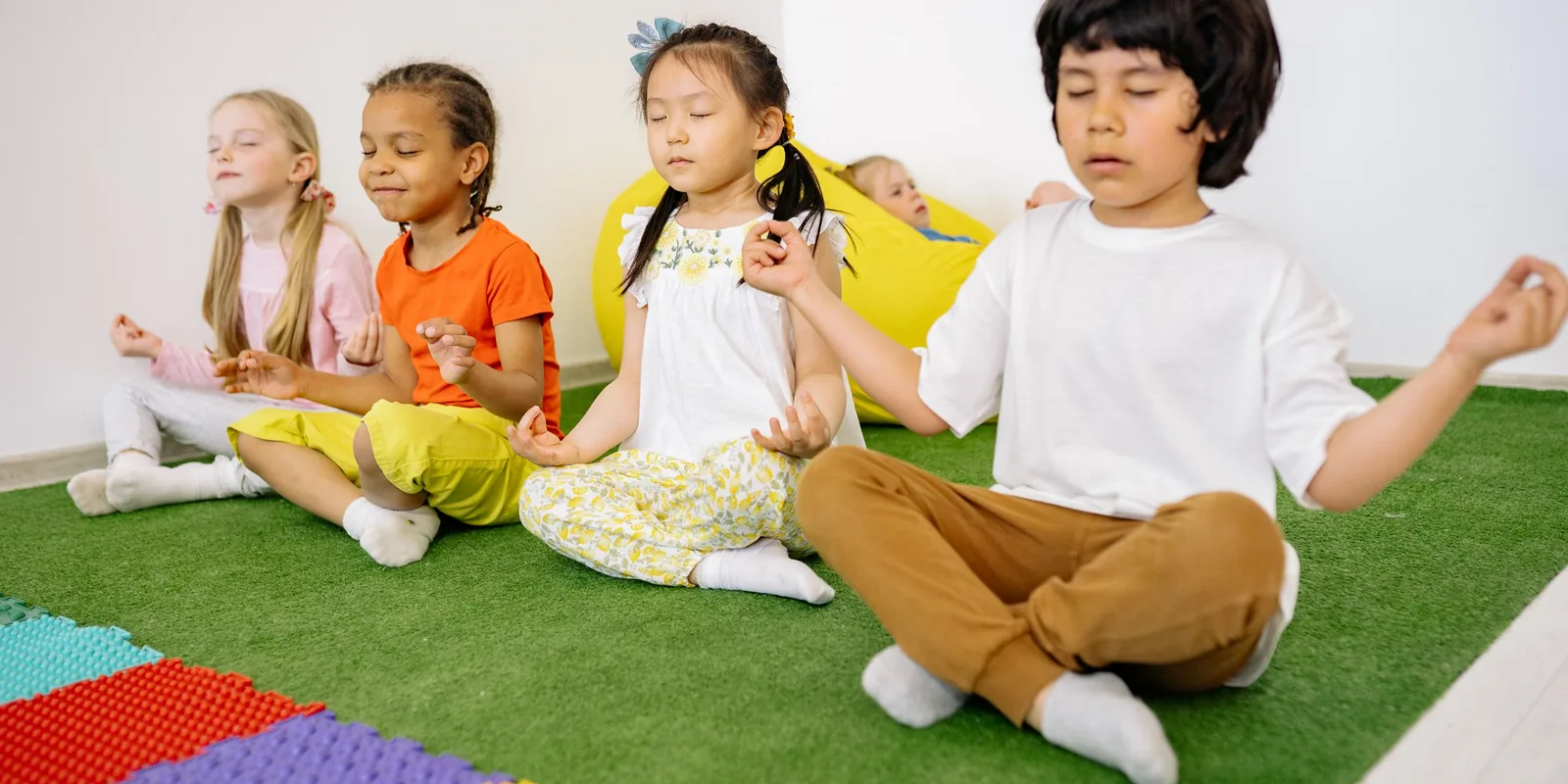
A kids yoga lesson plan for ages 3 to 8, timed to the minute: 30 minutes from hello to rest, with no yoga training, screen or printer needed.
This kids yoga lesson plan is one complete 30-minute session for a group of children aged 3 to 8, timed to the minute: 3 to arrive, 3 to breathe, 4 to warm up, 10 for the poses, 5 for a game, 4 to rest and 1 to close. You don't need yoga training to run it, and every pose comes from one sequence.
It's for the adult who has been asked to "do some yoga with them" on Friday afternoon and has never taught it: a reception or key stage 1 teacher, a teaching assistant, a childminder, a club leader or a parent with a houseful.
What is a kids yoga lesson plan?
A kids yoga lesson plan is a timed outline of one yoga session for a group of children, from the moment they arrive to the last minute of rest, so the adult running it never has to stop and think what comes next. Some people call it a kids yoga class plan.
It isn't a fitness class, a test of who can touch their toes, or something you need a qualification to follow. It uses simple poses with animal and everyday names, and the children do them at their own level. If you're new to yoga yourself, our guide to yoga for kids explains the basics in ten minutes.
What do you need for the session?
You need floor space for every child to lie down with their arms out, one mat or rug each, a clock, and bare feet. No music, screen, cards or printer. Space the mats about an arm span apart, with a wall within reach for the balances near the end.
Every pose in this plan is on our Sun Salutation mat, so with one mat per child, you can call "find the tree" and everyone can see it in front of them. If you're kitting out a room, we have mats for nurseries and schools. With rugs or towels, the plan works the same: you show each pose once and the group copies.
If a child has an injury or a health condition, check with their parent first. The NHS advises that children with a health condition get medical advice about exercising.
Which slot in the day suits a yoga session?
Any time the group isn't straight out of lunch or a big snack, in a room quiet enough to hear a whisper. For a club, the same slot each week helps children know what's coming. Friday afternoon, the end of a wet break or the first half hour of a party all work.
For a teacher, a line of context. In England, the Department for Education's Development Matters guidance says reception children develop "the overall body strength, coordination, balance and agility needed to engage successfully with future physical education sessions". The national curriculum for PE asks key stage 1 pupils to develop "balance, agility and co-ordination". That's what school asks of children, and a yoga session is one setting where they practise it.
What goes in a 30-minute kids yoga lesson plan?
Seven phases, each with its minutes, adding up to exactly 30. Every pose is on the Sun Salutation mat, and only a few go by number: mouse 1, cat 3, eagle 13, tree 14 and dancer 15. The session ends lying still, then sitting up to close.
1. Arrive and say hello (3 minutes)
Shoes and socks off, one child to each mat, sitting at the top end. Say: "Yoga is moving your body into shapes, like a tree or a cat, and breathing slowly while you hold them." Then each child says their name and their favourite animal. Anyone who can't wait curls into mouse, pose 1, as the waiting shape.
2. Breathe (3 minutes)
One breathing game, three or four rounds. Hands on tummies: breathe in through the nose and feel the balloon fill, breathe out slowly and let it go down. Nobody holds their breath or pushes it. Someone will blow a raspberry, so let it pass. Our breathing games for children have more to swap in.
3. Warm up (4 minutes)
On hands and knees, move slowly between cow (tummy dips, look up) and cat (back rounds high), pose 3, for six breaths. Stand up into rag doll and shake out the arms. Finish with rainbow, leaning to each side. Expect at least one cow that moos.
4. The poses (10 minutes)
Walk through the mat together from mouse to dancer, one breath in each pose. Go slowly, and say the name before you show it. Then the children choose three to do again. The balances at the end, eagle 13, tree 14 and dancer 15, are the hardest: younger children can hold the wall or skip them. Our page on every pose on our mats has a line for each.
5. A game (5 minutes)
"Find the pose." You call a pose name, everyone finds it on their mat and holds it for three breaths. After a few rounds, a child calls. With rugs instead of mats, you show the pose once and everyone copies. Someone will always pick dancer. For other ideas, see our yoga games for kids.
6. Rest (4 minutes)
Everyone lies flat on their back, eyes closed if they want. Talk slowly through the body: feet heavy, legs heavy, tummy rising and falling, arms floppy, face soft. Some children will peek, some will fidget, and one may fall asleep. All of that is fine.
7. Close (1 minute)
Roll onto one side, sit up slowly, and curl into mouse for one breath. Each child says one word about how they feel, then rolls up their mat.
Once a group has done this a few times, they know the order, and the poses on the floor in front of them do half your job.
How long should a kids yoga class be?
For most groups of four to eight-year-olds, 30 minutes is about right. Three-year-olds manage 15 to 20, and a group of seven and eight-year-olds can go to 45. That's our recommendation, based on how the plan fits together, not an official rule. Every version uses the same phases.
- 15 minutes, for three-year-olds or a first go: arrive 2, warm up 3, poses 5, rest 4, close 1.
- 30 minutes: the plan above.
- 45 minutes, for older groups: the 30-minute plan, plus 5 more for the poses, a second game of 5 and 5 more of rest.
With preschoolers, keep it shorter, noisier and more animal: more mooing cows and hissing cats, fewer balances. For a ten-minute break between lessons rather than a full session, see yoga in the classroom.
How do you handle children who sit out or giggle?
Let them watch. Development Matters suggests allowing less confident children to spend time "observing and listening, without feeling pressured to join in", and plenty of children who watch the first week join in the second.
Giggling isn't a problem; it usually means it's going well. Give the child who wants to be the teacher the job of calling the game. The child who lies down in the breathing phase and stays there can stay there. If you're running behind, cut a phase rather than rush one, and always keep the rest.
Can you run the plan at home?
Yes. With one or two children it works as it is, just shorter and with a grown-up joining in on the floor. The 15-minute version suits a Saturday morning, and the same day each week makes it a habit.
It works well for a grandparent on a visit, too. The poses are gentle, so you can join in, and children like teaching the order to someone new.
Want the plan on the floor, not in your head? Our mats have 15 numbered poses laser-engraved into the surface, and they're full length at 183 x 61 cm, so an adult can use one too. Each is £34.99 with free UK delivery, and two or more are 10 per cent off for brothers and sisters. See full-length yoga mats for children.
Frequently asked questions
Is there a kids yoga lesson plan PDF?
You don't need one. This kids yoga lesson plan is seven phases with their minutes, short enough to jot on a sticky note: arrive 3, breathe 3, warm up 4, poses 10, game 5, rest 4, close 1. If the children have mats with the poses marked on them, the order is already on the floor.
Do you need to be a yoga teacher to run a kids yoga session?
Not for a session like this one. It's written for any adult who already looks after the group, uses only simple poses with familiar names, and leaves out anything that puts weight on the head or neck. Let children move into each pose themselves, never push or pull them deeper, and stop anything that hurts.
How do you explain yoga to a child?
Keep it to one sentence: "Yoga is moving your body into shapes, like a tree or a cat, and breathing slowly while you hold them." Then show them a shape. Most children understand yoga far faster by doing a pose than by hearing about it, so get to the first one quickly.
What are some kids yoga lesson ideas for themes?
Keep the seven phases and change the story. For space, the mouse becomes an astronaut asleep in a rocket and the tree becomes a tall alien. For the seaside, cat is a crab hiding under a rock and rainbow is a wave. Children often suggest the best themes themselves, so ask them at the start.