guides
Breathing Exercises for Kids to Calm Big Feelings
Simple, playful breathing exercises for kids to calm big feelings, with clear counts, named games and NHS-backed tips on when to teach them.
The best breathing exercises for kids are short games with a long, slow out-breath: flower breath, bubble breathing, balloon belly, bunny breaths and finger tracing. Start with three slow breaths together, in for three and out for three, as the NHS suggests. Practise for a minute in calm moments, such as bedtime, so the skill is ready when a big feeling hits.
Your child is mid-meltdown on the kitchen floor, and "calm down" is doing precisely nothing. You need something they can actually do with their body, not just words they can't hear yet.
Breathing exercises give little ones a simple, portable tool for big feelings. No app, no screen, just their own breath.
Here are the games and counts that work, when to teach them, and how to match them to your child's age.
Why do breathing exercises help children calm down?
Slow belly breathing tells your child's body that it's safe, which helps their heart rate settle and the wave of a big feeling pass. The NHS advises parents of anxious children to practise simple relaxation together, such as taking three deep, slow breaths, breathing in for a count of three and out for a count of three.
Big feelings are physical. When your child is upset, their breathing goes fast and shallow and their body stays in "alarm" mode.
A long, slow out-breath is the off switch. It's hard to stay panicked while breathing out slowly, which is why the exhale matters more than the in-breath.
This isn't a magic cure, and it helps to be honest about that. Breathing supports calm, it doesn't treat anxiety. What it does give your child is a way to ride out a strong feeling instead of being swept away by it.
It's also a lovely screen-free reset. Plenty of parents worry about how much time small children spend on screens, and a slow-breathing moment is a gentle way to come down from an overstimulating day.
What are the best breathing exercises for kids?
The best breathing exercises for kids have a playful name, a clear in-and-out rhythm, and something to picture. Try flower breath, bubble breathing, balloon belly, bunny breaths and finger tracing. Each one turns a slow exhale into a game, which is exactly what makes a small child want to join in.
Here's how each one works.
- Flower breath: breathe in slowly through the nose to "smell the flower", then breathe out through the mouth to "blow out the candle". Simple, and lovely for tears.
- Bubble breathing: use a real bubble wand. A slow, steady out-breath makes one big bubble, a fast one pops it. The bubbles do the teaching for you.
- Balloon belly: pop a soft toy on your child's tummy while they lie down. They watch it rise on the in-breath and sink on the out-breath, so they can see the breath working.
- Bunny breaths: three quick sniffs in through the nose, then one long sigh out. Playful and good for a child who's too wound up to slow down straight away.
- Finger tracing: YoungMinds recommends tracing up each finger as you breathe in and down as you breathe out, gradually making the out-breath longer. It gives busy hands a job to do.
For a child who's really overwhelmed, YoungMinds also suggests pairing breathing with a quick grounding game: naming a few colours they can see, soft things they can touch, or sounds they can hear. It helps them feel present while the feeling passes.
- Flower breath, How to do it: Smell the flower (in), blow the candle (out); Best for age: 3+
- Bubble breathing, How to do it: Slow out-breath to blow one big bubble; Best for age: 3+
- Balloon belly, How to do it: Soft toy on the tummy rises and falls; Best for age: 2 to 5
- Bunny breaths, How to do it: Three sniffs in, one long sigh out; Best for age: 3+
- Finger tracing, How to do it: Trace up each finger in, down out; Best for age: 4+
- Box breathing, How to do it: In for 4, hold 4, out 4, hold 4; Best for age: 5+
When is the best time to teach calm-down breathing?
Teach breathing during calm moments, not in the middle of a meltdown, so the skill is ready when your child actually needs it. A child can't learn a new tool while their body is in full alarm mode. Practising when they're settled means the pattern is familiar later. If it's anger rather than worry, our guide on how to calm an angry child covers what to say.
Make it a tiny daily habit. The NHS notes that you get the most benefit from breathing exercises by doing them regularly as part of a routine, so a minute at bedtime or after nursery is plenty. Teachers can run a mindfulness minute at school the same way.
Bedtime is a natural home for it. A few slow breaths paired with a gentle stretch signals that the day is winding down, and it slots neatly into a wider bedtime yoga routine.
Breathing also works beautifully alongside movement. The NHS encourages children to be active every day and to sit less, and pairing a slow breath with a simple animal pose gives the body something calming to do. There's more on that in our guide to the benefits of yoga for children.
How do you match breathing exercises to your child's age?
Match the prompt to your child's stage. Toddlers and pre-schoolers need short, visual and tactile cues, like watching a soft toy rise on their tummy or blowing real bubbles. From around age five, children can manage counting and box breathing, holding a steady in-and-out rhythm for a little longer.
For under-fives, keep it playful and brief. A toddler won't count to four, but they will blow bubbles or puff out a pretend candle. Let the game carry the breathing.
Older children, roughly five and up, enjoy a bit of structure. Box breathing (in for four, hold for four, out for four, hold for four) feels almost like a challenge, and finger tracing gives them a rhythm to follow on their own.
If breathing is one part of soothing a worried child, our guide on how to calm an anxious child walks through the bigger picture, from routines to reassurance. Our relaxation techniques for kids and emotional regulation activities add calm-down tools beyond the breath.
What if breathing isn't enough?
Breathing is a coping tool, not a cure, and sometimes a child needs more support. If your child's worry is persistent, or it's getting in the way of everyday life like sleep, school or friendships, speak to your GP. YoungMinds also runs a Parents Helpline for advice when you're not sure what to do next.
Trust your instincts here. You know your child, and asking for help early is always the right call.
Frequently asked questions
How many deep breaths should my child take to calm down?
Start with three slow breaths, in line with NHS advice for anxious children: breathe in for a count of three and out for a count of three. If your child is happy to keep going, a couple of minutes of gentle belly breathing is even better.
Can a two-year-old do breathing exercises?
Yes, with the right approach. Toddlers can't count, but they can blow bubbles, puff out a pretend candle, or watch a soft toy rise and fall on their tummy. Keep it short, visual and playful rather than instructional, and do it alongside them so they can copy what they see.
What's the fastest way to calm my child in a meltdown?
Get down to their level, stay calm yourself, and offer a game they already know, like bunny breaths or blowing out a candle. This is why practising during calm times matters, because a familiar breath is far easier to reach for than a brand-new one.
Is breathing the same as yoga for kids?
They work hand in hand. Breathing calms the body, and gentle yoga gives that breath something to do. Pairing a slow exhale with a simple animal stretch on a mat makes both feel natural and fun for young children, and it gives a restless child a way into the breathing.
Give your child a calm-down spot they'll want to use
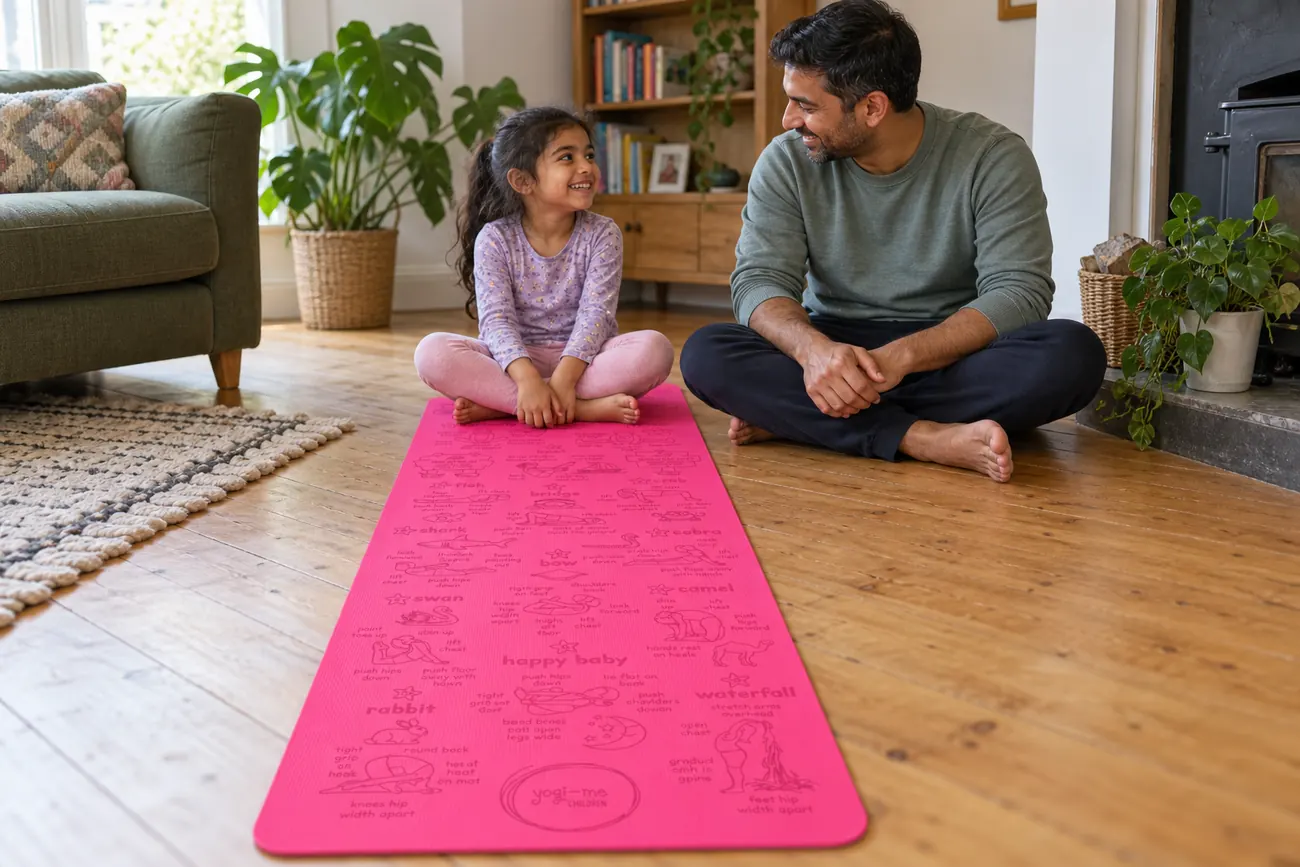
A soft, dedicated space makes breathing practice something your child looks forward to. Our kids' yoga mats turn a corner of the room into a screen-free reset spot, with 15 numbered poses marked into a non-toxic, PVC-free TPE surface, so little ones can breathe, stretch and settle all in one place.