guides
Group Games for Kids: 20 for Parties, Clubs and Classes
20 group games for kids aged 4 to 8, sorted by space and noise, with clear rules, adult jobs and teams that leave nobody picked last.
Which group games fit the space you've got?
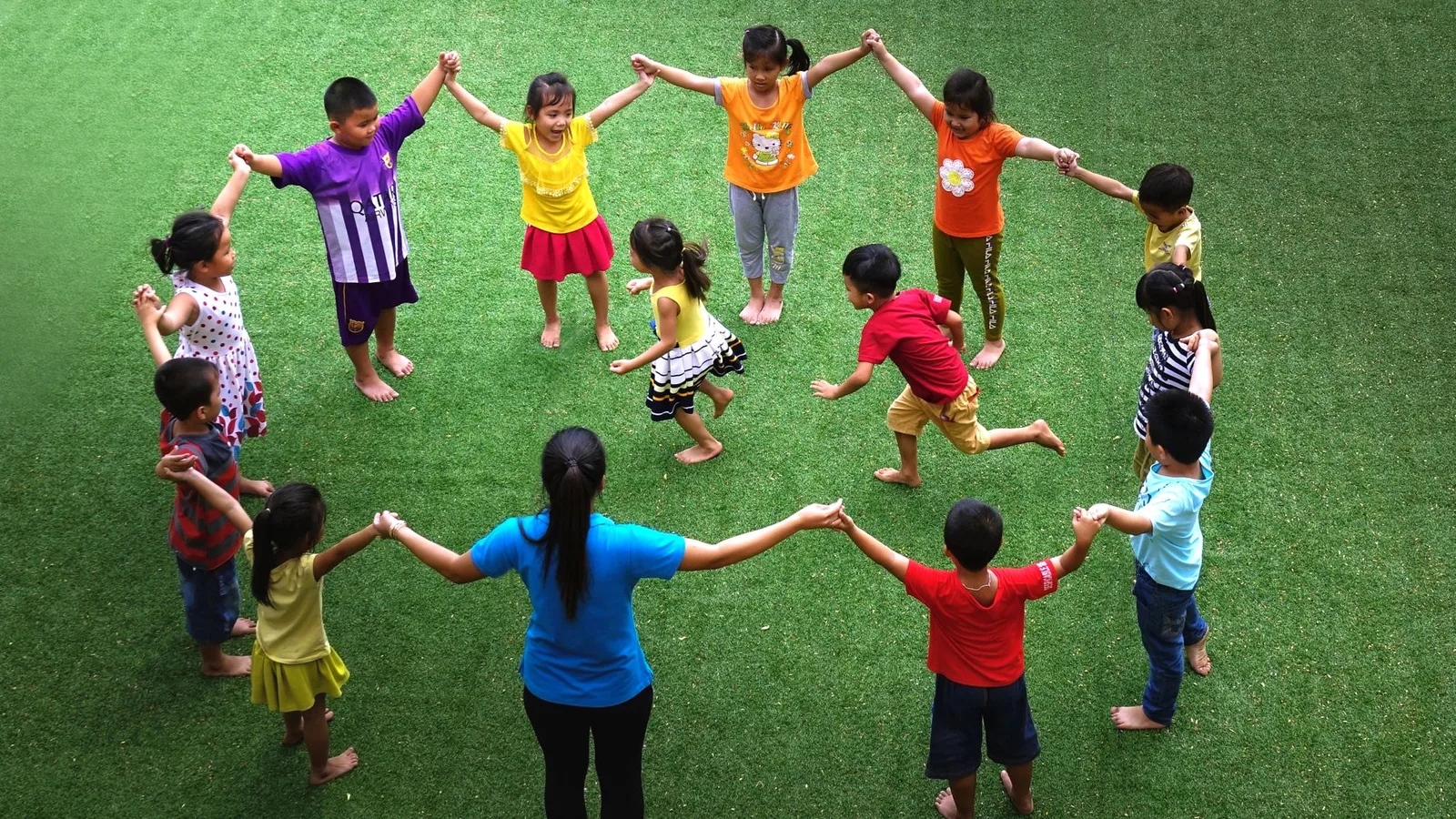
Good group games for kids include Simon Says, Copycat, Traffic Lights and short relays. For ten or more children aged 4 to 8, start with the space: seated circle games in a living room, movement games in a hall and running games on a field. Choose the noise level next, then teach a round before keeping score.
- Living room: Pass the Face and What's Missing? for quiet play; Story Circle and Animal Charades for chatting.
- Hall: Mirror Pairs and Group Pose Challenge for quiet play; Traffic Lights and Musical Statues for movement.
- Field: Grandmother's Footsteps for quiet play; Shuttle Relay and Follow the Leader for moving across the space.
These are suggested formats, with nobody permanently out. Start anywhere. For a smaller home gathering, try our indoor party games.
How do you set up without picking anyone last?
Start in a circle and give children alternating team names: "sun, moon, sun, moon". Matching names make a team; add "star" for another. With mixed ages, arrange the groups yourself. Nobody has to choose classmates, and you can rotate who starts each game.
Most games need nothing. Others use a towel, large household objects, soft balls or cones. Noise labels describe the intended style: quiet means little talking, chatty means conversation, lively means clapping or cheering.
Clear obstacles and mark boundaries, following Scouts' guidance on the playing area. Agree a stop signal and supervise children sitting out too, as its game-planning guidance advises. The Health and Safety Executive recommends weighing play's benefits against real risks.
For ages 5 to 18, the NHS advises matching exercise to age, ability and experience. If a health condition affects participation, speak to your GP or health visitor.
Which games work when everyone stays in a circle?
Choose seated games when you've got room for the children but little room to move between them. These choices use faces, words and gestures, so furniture can stay put. Run a single circle, or smaller circles with an adult leading each if turns take too long.
1. Pass the Face
Quiet. Make a surprised face and turn towards your neighbour. Say: "Copy my face, then pass it round." On the next circuit, someone starts a different expression. Everyone has a turn without speaking. Adult job: start the first face and follow the direction of play.
2. Copycat
Quiet. Choose a detective to turn away while you point to a secret leader. Everyone copies that leader's changing hand movements; the detective turns back and guesses who's leading. Adult job: change both roles when the detective identifies the leader or uses all three guesses. This seated adaptation uses Scouts' Copycat rules.
3. What's Missing?
Quiet. Show a book, hat, wooden spoon, sock and plastic cup. Cover them with a towel, remove an object, then uncover the rest. Say: "Point or tell me what's gone." Adult job: hide the object and invite guesses around the circle. The whole group shares the answer.
4. Story Circle
Chatty. Begin: "A penguin knocked on the door." Each child adds a sentence to the story, or passes. Adult job: repeat the latest sentence if someone loses the thread. End when the penguin gets home. There's no list of previous answers to remember before speaking.
5. Animal Charades
Chatty. Invite a volunteer to mime an animal while everyone guesses. Say: "Show us with your face and hands." Adult job: offer a choice, such as elephant or rabbit, if they're stuck. Children can perform beside a friend, and every correct guess belongs to the group.
6. Yes or No?
Chatty. Think of an everyday object and invite questions you can answer with yes or no. Begin with a category: "It's something in a kitchen." Adult job: answer questions and offer another clue when needed. Go round the circle for guesses, rather than rewarding the loudest shout.
What can you play in a hall with room to spread out?
Use the hall for games where everyone moves at once, or works with a partner. Alternate a lively choice with a quieter one. Demonstrate the action before beginning, then add a twist only when the group has understood the basic rule.
7. Simon Says
Chatty. Give commands such as "Simon says touch your shoulders". Children follow only commands beginning with "Simon says". A mistaken move means a smile and another go, not elimination. Adult job: alternate genuine commands with traps, starting slowly. Everyone stays involved right through the game.
8. Musical Statues
Lively. Clap a rhythm while children dance on their own spots; stop clapping and everyone freezes. Adult job: vary the length of each burst and call out a statue theme, such as robot or footballer. Wobbles don't put anyone out. The changing themes supply the challenge.
9. Traffic Lights
Chatty. Call "green" for walking, "amber" for marching on the spot and "red" for stopping. Adult job: demonstrate each instruction, then mix up the order. Add "car park" for standing in a chosen space. There are no penalties, so a missed instruction doesn't end anyone's turn.
10. Choose a Side
Chatty. Name opposite sides of the hall: "Beach here, forest there." Children walk to their choice, then hear another pair, such as cats or dogs. Adult job: name the sides each time and invite a volunteer to explain their choice. Staying in the middle means "both".
11. Mirror Pairs
Quiet. Partners face each other. Say: "Move your hands slowly while your partner copies, as though they're your reflection." Swap leaders after a short turn. Adult job: demonstrate with a child and signal the swaps. Invite a trio to rotate roles if there's an odd number.
12. Team Shape Makers
Chatty. Give each team a shape to make by arranging where they stand: a circle, triangle or letter. Say: "Make the outline with your team." Adult job: name the shape and let them discuss positions. Use the same challenge for every team, then compare their different solutions.
13. Body Percussion Orchestra
Lively. Start a pattern: clap, clap, pat your knees. Everyone copies, then a volunteer changes it. Adult job: lead the opening pattern and signal when to stop. Divide the room into groups to take turns performing. The others become the audience, then swap back into the orchestra.
14. Group Pose Challenge
Quiet. Copy cat on hands and knees, gently rounding the back, then butterfly, sitting with the soles of the feet together. Adult job: demonstrate and leave room between children. Scouts' animal yoga activity also offers seated interpretations. Take turns choosing the next shape; there's no winner.
Which games make use of a field?
Choose the field for travelling games, relays and wider circles. Use the agreed playing area, rather than sending children across the whole park. Keep the group together for instructions, then send teams to their starting points. The quieter options can bookend the running games.
15. Grandmother's Footsteps
Quiet. An adult faces away while children creep towards a finish line. When the adult turns, everyone freezes. Anyone still moving takes a step back, then carries on. Adult job: vary when you turn and restart once someone reaches the line. There's no need for tagging.
16. Shuttle Relay
Lively. Make teams of four or five, each with a turning cone. Say: "Go round your cone, come back, then send the next person." Adult job: keep teams in separate lanes and offer walking or running. Finish when everyone has completed a turn, then swap the starting order.
17. Team Target Roll
Chatty. Give each team a large soft ball and a cone to aim towards. Children take turns rolling from the starting line. Adult job: reset the ball and adjust the distance. Award a team point for each hit; try to beat that team's total in the next round.
18. Colour Spotters
Chatty. Give each small group a colour and ask them to spot something that matches inside the playing area. Say: "Find it with your eyes, then point it out." Adult job: change the colours and hear each answer. Nothing needs collecting, so a distant flower can count.
19. What's the Time, Mr Wolf?
Lively. The wolf faces away. Children ask the time and take the corresponding number of steps forward. At "dinner time", the wolf chases them towards the home line. Adult job: be the wolf first and explain and monitor tagging. A tagged child becomes the next wolf.
20. Follow the Leader
Chatty. Lead the group along a looping route, changing between marching, tiny steps and waving arms. Say: "Copy the leader until we swap." Adult job: guide the route inside the boundaries and invite volunteers to lead a section. End the expedition back at its starting point.
How do you turn a few games into a short session?
Pick an opening game, a change of pace and a quiet finish. These are suggested running orders, including time to explain and move between games. Repeat a favourite if the group wants more; you don't need to work through the whole list at a party.
- Living room, 12 minutes: allow 3 minutes for Pass the Face, 4 for Animal Charades, 3 for What's Missing? and 2 for explanations and changes. Use the same circle throughout. For another seated choice, browse our circle time games.
- Hall or field, 15 minutes: allow 3 minutes for Simon Says, 5 for Traffic Lights or Shuttle Relay, 4 for Group Pose Challenge and 3 for explanations, drinks and changes. For the field plan, finish with Copycat instead of floor poses.
For a visual prompt during the pose finish, Yogi-Me mats have 15 numbered poses laser-engraved into the surface. An adult can demonstrate while children copy in their own spaces. Choose a mat for your group's pose game.
What if a child would rather watch?
Let them watch without making their decision the group's next topic of conversation. Offer a job, such as choosing the next animal or calling a colour, but make that optional too. A place beside you is enough; joining halfway through can remain an open invitation.
Say: "You can watch this round and join the next one if you like." If performing alone is the sticking point, offer a partner, or choose a game where everyone moves together. If the whole group loses interest, change the game. Finishing early doesn't need a speech or a promised prize.
Frequently asked questions
What are good games for a large group of children?
Simon Says, Traffic Lights, Musical Statues and short relays are useful starting points because several children can play at once. Choose by space first. For games with individual turns, divide a large group into smaller circles, with an adult leading each, so everyone gets a go.
Which group games can you play without equipment?
Pass the Face, Copycat, Story Circle, Animal Charades, Simon Says and Mirror Pairs need no equipment. Musical Statues can use an adult's clapping instead of recorded music. Pick a seated game for a crowded room, or use the whole hall for games that involve travelling.
How do you make teams without anyone being picked last?
Give children alternating team names as you go round the circle, then ask everyone with the same name to gather together. For mixed ages, the adult can arrange balanced groups beforehand. Skip captain-led picking, and rotate who demonstrates or starts so the same children don't always lead.
How can you include different ages in the same group game?
Keep the basic action the same and vary the task. In a relay, offer different turning points; in a guessing game, offer a category clue. Invite older children to demonstrate, but let younger children lead too. Anyone can choose to watch a round before joining in.