guides
Screen Time for Toddlers: A Realistic Day
Screen time for toddlers under UK guidance: what it says for babies, under-2s and 2 year olds, and a screen-light day that still gets tea cooked.
For toddlers under 2, UK government guidance says to avoid screens except shared family activities, such as a video call with grandparents. From 2, it says: "Try to keep it to 1 hour a day. Less if possible." In a real house, that tends to mean a screen-light day planned around the moments you need both hands, rather than no screens at all.
It's ten to five. The pasta water is on, the oven door is hot, and the one thing that reliably keeps a two-year-old out from under your feet is a screen. Every parent of a toddler knows this moment. The guidance doesn't pretend it doesn't exist, and neither does this page.
Here, a toddler means a child of roughly one to three. The rules themselves are explained in full in our page on the UK screen time guidance. This page is about fitting them round a Tuesday.
How much screen time should a toddler have?
It depends which side of their second birthday they're on.
Under 2, babies included. The government's Best Start in Life guidance says: "Avoid screen time other than for shared activities with family that encourage bonding, interaction and conversation." The WHO's guidelines for under-5s go further. For babies under one, "Screen time is not recommended", and for one-year-olds, sedentary screen time "is not recommended".
From 2. Best Start in Life says: "Try to keep it to 1 hour a day. Less if possible." The WHO says sedentary screen time for two-year-olds "should be no more than 1 hour; less is better."
For the age-by-age picture beyond toddlerhood, see our screen time by age guide.
If an hour sounds low, it is low compared with what most toddlers actually get. The government's expert panel reported on a nationally representative study of babies growing up in England. At nine months they spent 29 minutes a day on screens on average. At two, the same children averaged 127 minutes a day, and only 2 per cent didn't use screens daily, according to the independent report on screen use by children under 5. So the hour is a target to work towards, not a description of what's normal.
What does a screen-light day look like with a toddler?
Plan the screens round your jobs rather than round your child. Most screen time with a toddler happens when a grown-up needs two hands: the shower, the phone call, the half hour before tea. Decide in advance which of those gets a screen and which gets something else.
Here's an illustrative day for a two-year-old who naps after lunch and goes to bed at 7pm. Your times will differ; the shape is the point.
- 7.00am, What's happening: Breakfast with the television off; Screen minutes: 0
- 8.00am, What's happening: Your shower, with them on the bathroom floor and a box of things they only get at shower time; Screen minutes: 0
- 9.30am, What's happening: Out: the park, the shops, walking some of the way; Screen minutes: 0
- 12.00pm, What's happening: Lunch at the table, screen-free; Screen minutes: 0
- 1.00pm, What's happening: Nap; Screen minutes: 0
- 3.30pm, What's happening: One slow programme on the sofa together, talking about it; Screen minutes: 25
- 4.30pm, What's happening: Video call with a grandparent; Screen minutes: 10
- 5.00pm, What's happening: Cooking tea: a short programme, or a kitchen job; Screen minutes: 20
- 5.30pm, What's happening: Tea at the table, screen-free; Screen minutes: 0
- 6.00pm, What's happening: Screens off for the hour before bed: bath, book, bed; Screen minutes: 0
- **, What's happening: **Total; Screen minutes: 55
That's under the hour, in three short pieces, with the longest one shared. It isn't perfect, and it doesn't need to be. On the day the call runs long or the programme turns into two, you'll be over, and the next day is a new day.
The shower box is worth the effort. A shoebox of things that only come out at shower time (a torch, some lids, a sock puppet) buys more minutes than a toy they see all day. The same trick works for the phone call you can't avoid.
Is a video call with grandparents screen time?
Yes, it's a screen, but it's the kind the guidance makes room for. Best Start in Life says shared activities "could include video calling with friends and family". For an under-2, a call with Nana is one of only two screen uses the guidance names, the other being looking through digital photo albums together.
The difference is that a call talks back. The government's expert report says video calling "can help maintain and strengthen family bonds", and notes that with babies, calls tend to involve smiling, waving and babbling, with language becoming more central as children grow.
So hold the phone together, keep it short, and let the grandparent do the work: a song, a book held up to the camera, a game of peekaboo. For a two-year-old, count it towards the hour. It's the best use of the hour there is.
Is background TV a problem?
The guidance asks you not to have it on. Best Start in Life says: "Try not to have screens on in the background particularly during family time, meals or playtime", because screens "can distract from beneficial activities for your child such as social interaction and active play."
It doesn't say whether background television counts towards the hour, and you don't need it to. If nobody is watching, switch it off. If the house feels too quiet, the same guidance suggests background music at mealtimes instead. A radio gives you company without the pull of a moving picture.
Is half an hour of telly while you cook tea all right?
For a child of two or more, inside the hour, yes. The government's expert panel recommended that 2 to 5 year olds "keep screen time to no more than an hour a day, ideally through short chunks (30 minutes or less)". It also wrote that "short periods such as 30 minutes of non-interactive receptive watching at a time appear unlikely to be a source of harm."
That's the expert report, not the published guidance, which kept the hour and left out the chunk length. But it's the most useful line in either document for a parent at 5pm. One slow programme while you cook isn't the problem. Three in a row, alone, every day, is what the guidance is steering you away from.
The panel also admits that "parents may find judging an hour a day very difficult as young children tend to use devices in multiple short bursts". Which is why the table above writes the minutes down. A tally on the fridge for a week will tell you more than any amount of guessing.
What can a toddler do instead?
Move, mostly. The NHS says toddlers aged 1 to 2 should be physically active for at least 180 minutes a day, spread throughout the day, and its toddler activities page reassures that "10 or 20 minutes here and there all counts towards the total." It suggests hide-and-seek, an obstacle course, a dance-off and sensory play, and letting them walk some of the way to the park.
One tip from that page is worth taking straight into your day: when they play, be "the narrator, not the director". Saying what they're doing ("you're building a tower") keeps you involved without taking over, and it's exactly the back-and-forth a screen can't give.
Our activities for 2 year olds has a longer list, and yoga for toddlers has a few simple animal poses that work from about two.
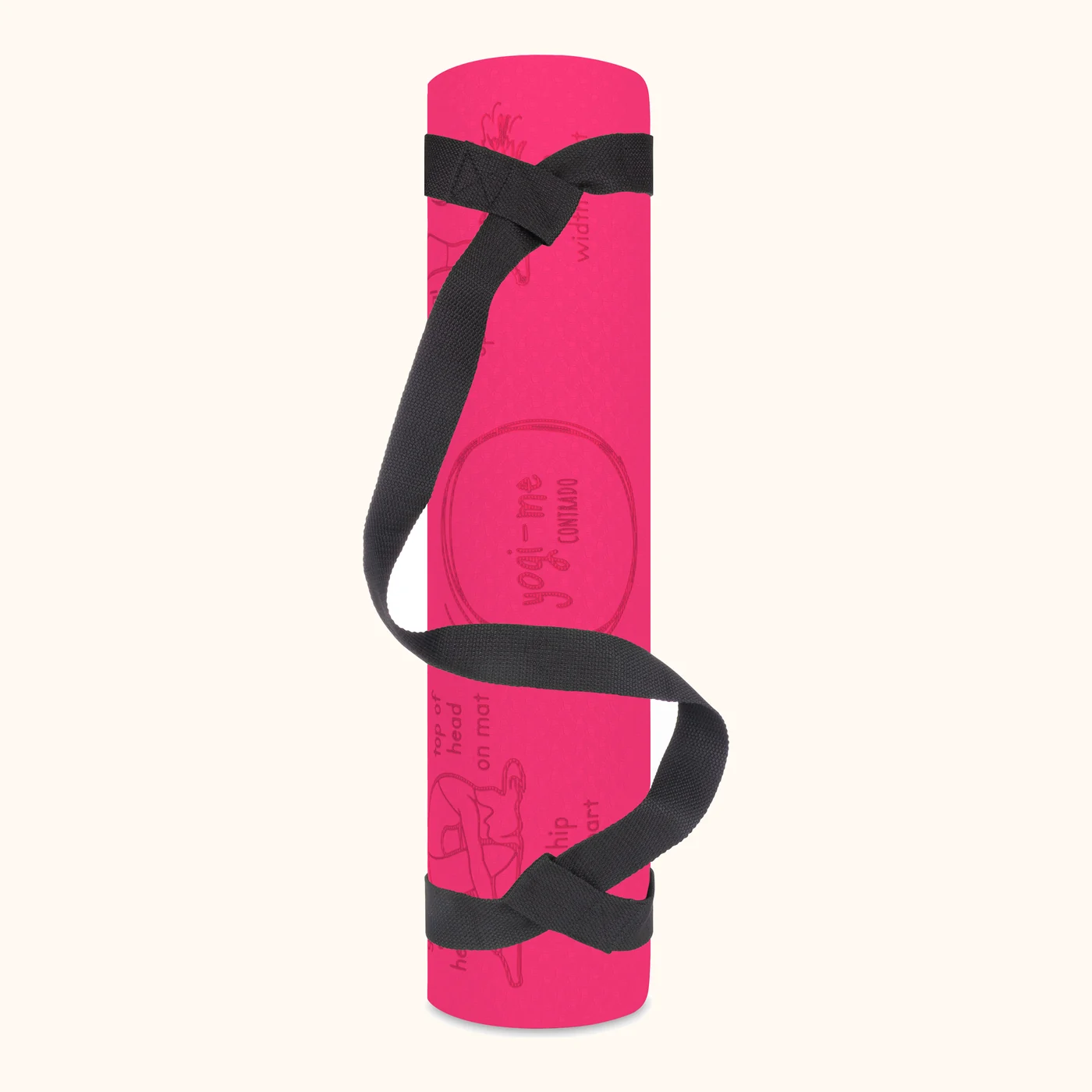
Our own mats are made for children from three, so for now a rug is all you need. When they get there, a children's yoga mat gives them 15 numbered, laser-engraved poses to follow on their own, without a screen.
When is it worth talking to your health visitor?
If you're worried about your toddler's speech, play, sleep or how they react when a screen goes off, or cutting back feels impossible, mention it to your health visitor or GP. You won't be judged for it. They can help you work out whether screens are part of it, or whether something else is going on.
Frequently asked questions
How much TV for a 3 year old?
UK guidance for 2 to 5 year olds is 'Try to keep it to 1 hour a day. Less if possible.' That's all screens, not only TV, and it also asks for screen-free mealtimes and no screens in the hour before bed. The WHO's guideline for 3 and 4 year olds is the same hour, adding 'less is better'. Slow-paced programmes watched together are the kind the UK guidance favours.
What TV shows are overstimulating for toddlers?
The guidance doesn't name programmes, and nor do we. It describes the features instead: 'Fast-paced, over-stimulating social media-style videos' are the ones to avoid, and better content has 'simple stories, fewer scene changes and characters speaking slowly'. The government's expert report adds rapid speech and several characters talking at once to the list.
Is a tablet worse than TV for a toddler?
The guidance doesn't rank devices. What it separates is solo from shared and fast from slow: it asks you to avoid young children using screens alone, and a tablet in small hands is easy to use alone. A slow programme on the television, watched together and talked about, is closer to what the guidance favours than either screen used solo.
How do you avoid screen time for babies?
Keep the television off in the background, especially at feeds and playtime, and watch your own phone use, because the guidance notes children copy your habits. Let shared moments, such as a video call with family or looking through photos together, be the screen time a baby gets. Books, singing and talking do the rest: the WHO encourages reading and storytelling with a caregiver when a baby is sitting still.
Sources
- Best Start in Life (GOV.UK): Screen time guidance for under 5s
- GOV.UK: New screen time guidance for parents of under-5s, 26 March 2026
- GOV.UK: Screen use by children aged under 5, independent report of the Early Years Screen Time Advisory Group
- World Health Organization: To grow up healthy, children need to sit less and play more
- World Health Organization: Guidelines on physical activity, sedentary behaviour and sleep for children under 5 years of age
- NHS: Physical activity guidelines for children (under 5 years)
- NHS Best Start in Life: Activities for toddlers