guides
What Size Yoga Mat Does a Child Need?
Yoga mat size for children by age and height, why weight matters as much as length, plus the thickness and grip points that keep a child steady.
The mat your child does yoga on should be a little longer than they are tall and about 50 to 60cm wide, so they can lie flat and balance without stepping off. For most 3 to 8-year-olds that means at least 120 to 150cm long. Weight matters as much as length: under about a kilogram, a full-length mat is easy to manage and leaves years of growing room.
You've handed your child your own yoga mat and watched them slide off the end of it. Too long, too heavy, too slippery for little hands.
A grown-up mat rarely works for a small body. The good news is that sizing a mat for a child is simple once you know the rule.
This guide gives you a concrete size by age and height, plus the safety and grip points that actually matter for children.
What size yoga mat should a child use?
As a rule, pick a mat that is a little longer than your child is tall, so they can lie flat and stretch fully, and wide enough to stand and balance without stepping off. For most children aged 3 to 8, that lands around 120 to 150cm long and 50 to 60cm wide.
A standard adult mat is roughly 173cm by 61cm. That length is usually too much for a young child to manage, and the extra weight makes it hard for them to carry or roll up on their own.
Those are two separate objections, though, and they are worth pulling apart. Length on its own is mostly a storage question. Weight is the one that decides whether a child can handle the mat without you: a typical adult mat is often well over a kilogram, and that is what makes it hard to carry to the car, unroll straight and put away again.
So if you are weighing up a longer mat, check the weight before you rule it out on length. Under about a kilogram, most children of four and up can manage a full-length mat themselves, and the extra centimetres stop being a drawback and start being growing room. Over that, the numbers above are the safer guide.
If you want the full decision framework, see our guide on choosing your child's first yoga mat, and if you are torn between a padded gym mat and a yoga mat, our gym mat or yoga mat comparison helps.
What is the right yoga mat size by age?
Match the mat to your child's height first and their age second, because children of the same age vary a lot. As a starting point, toddlers and pre-schoolers do well on a shorter mat for floor-based play, while school-age children need a longer mat that keeps pace as they grow.
Use this as a rough guide, then check it against your child's actual height.
- Toddlers (1 to 2), Typical height: up to ~90cm; Suggested mat length: 100 to 120cm; Suggested width: 50 to 60cm
- Pre-schoolers (3 to 4), Typical height: ~90 to 105cm; Suggested mat length: 120 to 135cm; Suggested width: 50 to 60cm
- School age (5 to 8), Typical height: ~105 to 130cm; Suggested mat length: 135 to 150cm; Suggested width: 55 to 60cm
- Older children (9 to 12), Typical height: ~130 to 150cm; Suggested mat length: 150 to 165cm; Suggested width: 60cm
Younger children need floor space for whole-body play, not a scaled-down adult mat. The NHS says toddlers and pre-schoolers should be physically active for at least 180 minutes a day, and a good chunk of that is active, floor-based play.
For children aged 5 and over, the NHS recommends an average of at least 60 minutes of activity a day across the week, and floor-based yoga can contribute to that.
Buy a little bigger for growing room
Children grow fast, so sizing up slightly means the mat lasts a few years rather than a few months. A mat that is a touch long is far better than one your child has outgrown by next term.
How thick should the mat be?
For most children, 4 to 6mm is the sweet spot. It is firm enough that they stay stable in standing and balance poses, and cushioned enough to protect knees and spine on a hard floor. Think of thickness as a trade-off between balance and comfort rather than a fixed rule.
Too thick and your child will wobble in poses that need a firm base, like standing on one leg. Too thin and hard floors become uncomfortable, so they stop wanting to practise.
Balance poses start to emerge in the pre-school years, as children build the coordination to stand and hop on one foot, and that is exactly when a stable surface helps.
We go deeper on this in our guide to yoga mat thickness for kids.
What material is safe and grippy for a child's mat?
Choose a non-toxic, PVC-free material with good grip, such as TPE, natural rubber or cork. Grip matters more for children, who fidget and lose balance more than adults, and easy-to-clean surfaces keep things hygienic. Material safety is the point most parents care about most, and rightly so.
In the UK, certain phthalates are restricted in toys and childcare articles under UK REACH and enforced by the Health and Safety Executive. If a listing does not say what a mat is made from, ask the seller before you buy.
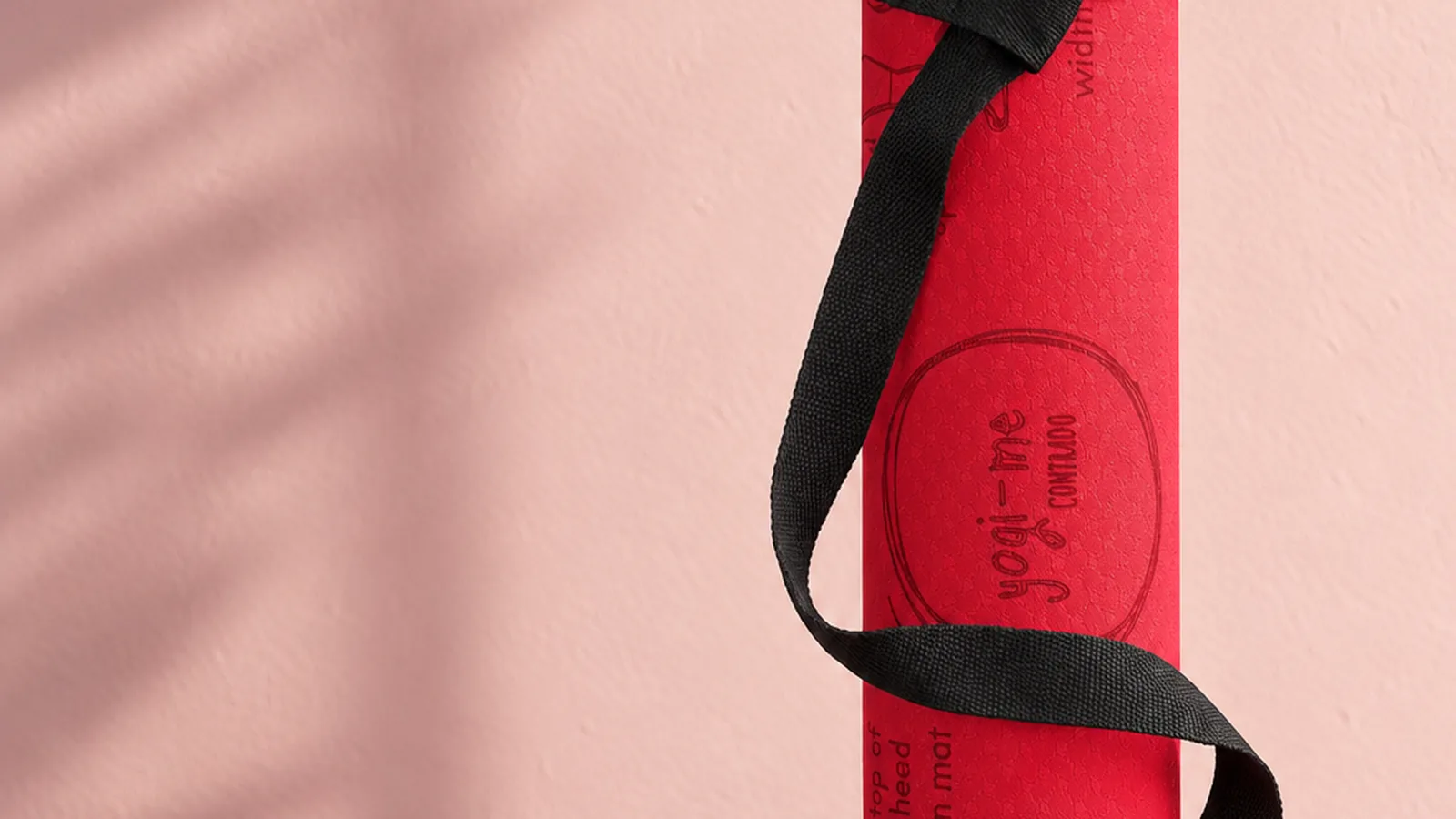
A lightweight mat your child can carry and roll themselves also helps it fit a nursery or school bag. Our kids' yoga mat is made from non-toxic, PVC-free TPE, weighs 800g and has 15 numbered poses marked into it. If a mat curls up once it's unrolled, see flattening a mat that keeps curling up.
Frequently asked questions
Can my child use my yoga mat?
They can, but it is not ideal. An adult mat is usually too long and heavy for a young child to move, stretch on comfortably, or carry themselves. A lighter mat that suits their height helps them practise independently and stay stable in poses.
What is the best mat thickness for a child?
Around 4 to 6mm suits most children. That range keeps them stable in balance poses while still cushioning knees and spine on hard floors. Go to the thinner end for a firmer feel, and the thicker end if you only have hard flooring at home.
What is the safest material for a child's mat?
Look for a non-toxic, PVC-free material such as TPE, natural rubber or cork, with good grip for fidgety children and a surface that wipes clean easily between uses. If the listing does not say what the mat is made from, ask the seller before you buy.
How long will a mat last before my child outgrows it?
If you size up slightly, a well-made mat can last several years. Buying one that is a little longer than your child is now gives growing room, so you are not replacing it every school year. A full-length mat that is light enough to carry is never outgrown at all.
Finding the right fit
Ready to find the right fit? Browse the full Yogi-Me shop for screen-free, PVC-free mats, light enough for a small child to carry, with 15 numbered poses marked into every mat to guide them as they move. For more ideas to get started, try our five animal poses for kids.
Sources
- NHS: Physical activity guidelines for children and young people (5 to 18 years)
- NHS: Physical activity guidelines for children (under 5 years)
- GOV.UK: Physical activity for children and young people (5 to 18 years), UK Chief Medical Officers' guidelines
- WHO: Guidelines on physical activity, sedentary behaviour and sleep for children under 5 years of age
- HSE: Restrictions under REACH