guides
Core Strength and Balance Activities for Kids Aged 3 to 8
Ten core strength activities and balance games for kids aged 3 to 8, with the words to say and the age to start each. No gym, just a rug or a mat.
The best core strength activities for children aged 3 to 8 feel like play, not exercise: bear crawls, tummy-crawling, climbing, swinging, and yoga shapes such as boat and bridge. For balance, try musical statues, a masking-tape tightrope, and standing poses like tree, airplane and eagle.
Below are ten, each with words to say and a starting age.
What is core strength, and how is it different from balance?
Core strength is a child's ability to hold their position and move from the centre of their body outwards. Balance is staying steady, either holding still on one leg or moving along a narrow line. The two are linked: the Department for Education says that if core strength is underdeveloped, children will struggle with gross and fine motor skills, stability and balance.
That is from its advice on core strength and co-ordination. Our guide to what gross motor skills are covers the rest by age.
How much strength and balance activity does a child need?
The NHS says pre-schoolers aged 3 to 4 need at least 180 minutes of physical activity a day, including at least 60 minutes of moderate-to-vigorous activity. Children aged 5 to 18 should average at least 60 minutes of moderate or vigorous activity a day across the week, and do exercises that strengthen their muscles and bones.
Those figures are from the NHS guidelines for under-5s and for 5 to 18-year-olds. At school, England's national curriculum for PE asks key stage 1 pupils to develop "balance, agility and co-ordination".
What do you need before you start?
You need a patch of floor about the length of a child lying down, a rug or a mat, and a roll of masking tape. Bare feet grip better than socks for the balance poses. If you'd like the balances to hand, ours is a full-length mat with fifteen numbered poses marked in, tree, airplane and eagle among them.
Two or three activities a session is plenty, one from each list, stopping while it's still fun. The ages are our suggestions, not milestones.
What activities are good for core strength?
Good core strength activities make a child hold their middle steady while their arms and legs work: crawling, climbing and swinging. England's Development Matters guidance suggests tummy-crawling, crawling on all fours, climbing, pulling up on a rope and hanging on monkey bars. The five core strength exercises for kids below bring most of those indoors.
1. Bear crawl
A bear crawl is crawling on hands and feet with the knees off the floor. Say: "Hands flat, bottom up. Can you creep like a bear without your knees touching?" Racing a grown-up across the carpet is a fair fight. Good from age 3.
2. Tummy-crawl through a tunnel
A tummy-crawl is moving along on the front, pulling with the forearms and pushing with the feet. Say: "Get flat like a lizard. Can you wriggle under the blanket without touching it?" Drape a blanket over two chairs. Good from age 3.
3. Boat pose
Boat is a seated V, leaning back with the legs and arms lifted. Say: "Sit tall, lean back and lift your legs and arms, like a boat." Bent knees count. Holding the V asks the tummy and back to stop the body tipping. Good from age 4.
4. Bridge
Bridge is lying on the back with the feet flat and lifting the hips towards the ceiling. Say: "Feet flat, arms by your sides. Push down and lift your hips so a car can drive under." A toy car underneath is a reason to hold it for a count of five. Good from age 3.
5. Swinging and climbing at the park
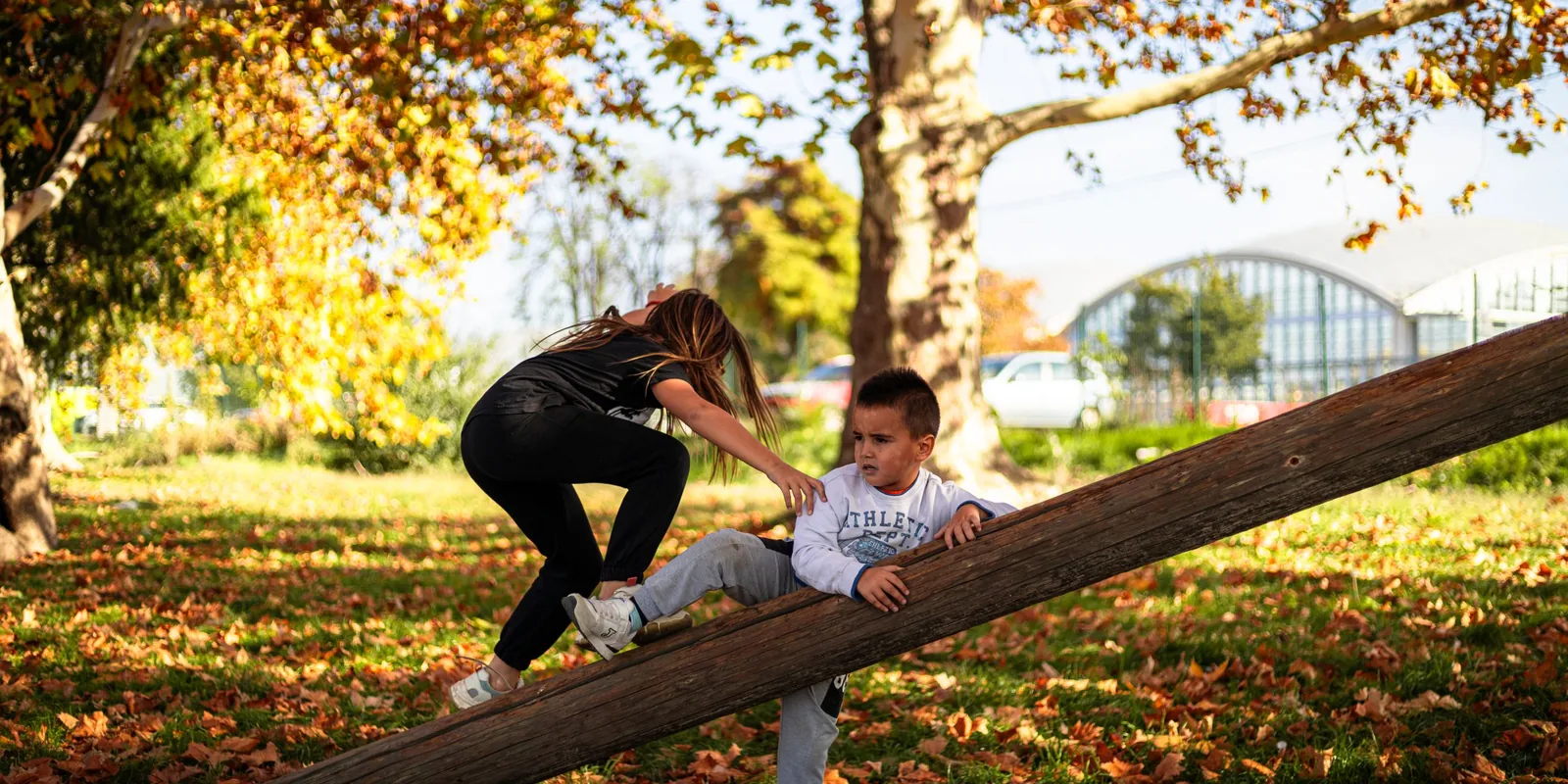
A swing, a climbing frame or a low tree is core work disguised as a trip out. Say: "Can you pump your legs to make the swing go on your own?" The Department for Education says swings and climbing both build core strength. Good from age 3, with you close by.
What are the top 3 core strength activities for kids?
If you only have time for three, make them bear crawl, boat and bridge. One is on all fours, one sitting and one lying down, so the tummy and back hold the body steady three different ways. None needs kit, and all three fit on a rug in under five minutes.
What are good balance activities for kids?
Good balance activities for kids ask them to hold still on one leg or move along a narrow path: musical statues, walking a line, and standing yoga poses such as tree. Development Matters lists standing on one leg and holding a pose "for a game like musical statues" among skills 3 and 4-year-olds are learning. These five balance exercises for kids start easy and get harder.
6. Musical statues
Musical statues is dancing until the music stops, then freezing. Say: "When the music stops, freeze on one leg. Wobble and you're out." Freezing on two feet is enough at first. Good from age 3.
7. Masking-tape tightrope
A tightrope is a straight line of masking tape, about two metres long, on the floor. Say: "Walk the rope. Now backwards. Now on tiptoes. Now with a beanbag on your head." It's an indoor version of the planks Development Matters suggests for balancing. Good from age 3.
8. Tree pose
Tree is standing on one leg with the other foot resting against the standing leg. Say: "Stand tall. Put the sole of your foot on your calf or inner thigh, not your knee. Palms together." A hand on the wall is fine. Good from age 4.
9. Airplane
Airplane is a one-leg balance, tipping forward with the back leg and both arms stretched out. Say: "Small bend in your standing knee. Stretch one leg out behind you and your arms out like wings." Tilting makes it harder than standing upright. Engine noises are compulsory. Good from age 5.
10. Eagle
Eagle is a crouched balance with the arms wrapped together. Say: "Wrap one elbow inside the other. Bend your knees and sit back, like an eagle on a branch." The hardest of the ten. Good from age 6.
How do you turn these into a three to ten-minute session?
Pair a core activity with a balance activity and you have a session of three to ten minutes. Start big and noisy, finish still: Development Matters suggests encouraging children to "conclude movements in balance and stillness".
- Rainy afternoon, five minutes. Bear crawl across the room, tummy-crawl back, tree on each leg.
- Before school, three minutes. Bridge for a count of five, twice, then the tightrope there and back.
- Playdate, ten minutes. Musical statues, airplane landings, then everyone in boat.
For more, try our easy yoga poses for kids, the no-kit gross motor skills activities, or crossing the midline activities for reaching across the body.
What if your child won't join in or keeps wobbling?
Join in rather than instruct, let them pick the next activity, and stop before they're bored. A wobble out of tree is part of the game, not a failure. The Department for Education's advice on climbing applies at home too: encouragement works better than physical support unless a child has a specific physical need. It also says to praise every child's efforts.
If one activity falls flat, change the story. A child who won't "do yoga" will happily be a bear or an aeroplane coming in to land, and our guide on how to start yoga with your child has more ways in. Worried about how your child moves compared with others their age? Our gross motor skills guide covers who to talk to.
Frequently asked questions
Should young children do sit-ups?
The NHS marks sit-ups and press-ups as "for young people" in its muscle-strengthening examples for 5 to 18-year-olds. The examples it gives without that marker are gymnastics, football, jumping and martial arts. For under-5s, England's early years guidance favours play: climbing, crawling and swinging.
How can I improve my child's balance at home?
Play games that ask them to hold still on one leg or move along a narrow line. Musical statues, walking a masking-tape line, and standing poses like tree and airplane all work. Development Matters lists standing on one leg and holding a pose among skills 3 and 4-year-olds are learning.
Why do children need core strength?
Core strength helps a child hold their position and move from the centre of their body outwards. The Department for Education says that if it is underdeveloped, children will struggle with gross and fine motor skills, stability and balance, and that reception children use it to sit with a good posture at a table or on the floor.
At what age can children start core strength activities?
Long before they're ready for anything that looks like exercise. Under-5s build core strength through play such as crawling, climbing and swinging, which is what England's early years guidance favours. Every activity in this guide is for ages 3 to 8 and gives its own starting age. Sit-ups and press-ups can wait until they're much older.
Which of these activities are on a Yogi-Me mat?
Five of the ten are laser-engraved on Yogi-Me mats. Tree, airplane and eagle are on Sun Salutation, the standing design for children who want to move. Boat and bridge are on Freedom Flow, the floor design for children who need to settle. Same size, material and price.
Each mat has 15 numbered poses, so a five-year-old can start at 1 and work through to 15 on their own. A mat won't build core strength by itself. The bear crawls do that. It just means there's nothing to set up and no screen to follow.
They're designed for ages 3 to 8. Three- and four-year-olds copy the poses with a little help; older children lead their own sessions. Under three, we'd wait.
At 183 x 61 cm, each is full length on purpose, so there's room for an airplane at three and still at eight. Buying as a grandparent? You can have a go at tree too. A shorter mat is easier for a three-year-old to carry alone; ours weighs 800 g and has a carry strap.
It's non-toxic, PVC-free TPE, according to our supplier's specification, with 6 mm of cushioning. To clean it, wipe with a damp cloth and a little mild soap, then let it dry flat.
Looking for a Christmas present that still gets used after Boxing Day? A mat with the balances marked in comes out again on a rainy January Saturday, and there are more presents that keep them moving in our gift guide. Two or more mats are 10 per cent off, for brothers, sisters or cousins.
Pick standing or floor, then choose a colour from the Yogi-Me range. Each mat is £34.99 with free UK delivery and 30-day returns.
Sources
- Department for Education, Help for early years providers - Core strength and co-ordination
- Department for Education - Development Matters, updated 4 September 2023
- Department for Education - National curriculum in England: physical education programmes of study, published 11 September 2013
- NHS - Physical activity guidelines for children (under 5 years)
- NHS - Physical activity guidelines for children and young people, reviewed 23 October 2024