practice
Cool Down Exercises for Kids: 5 Minutes After PE or Play
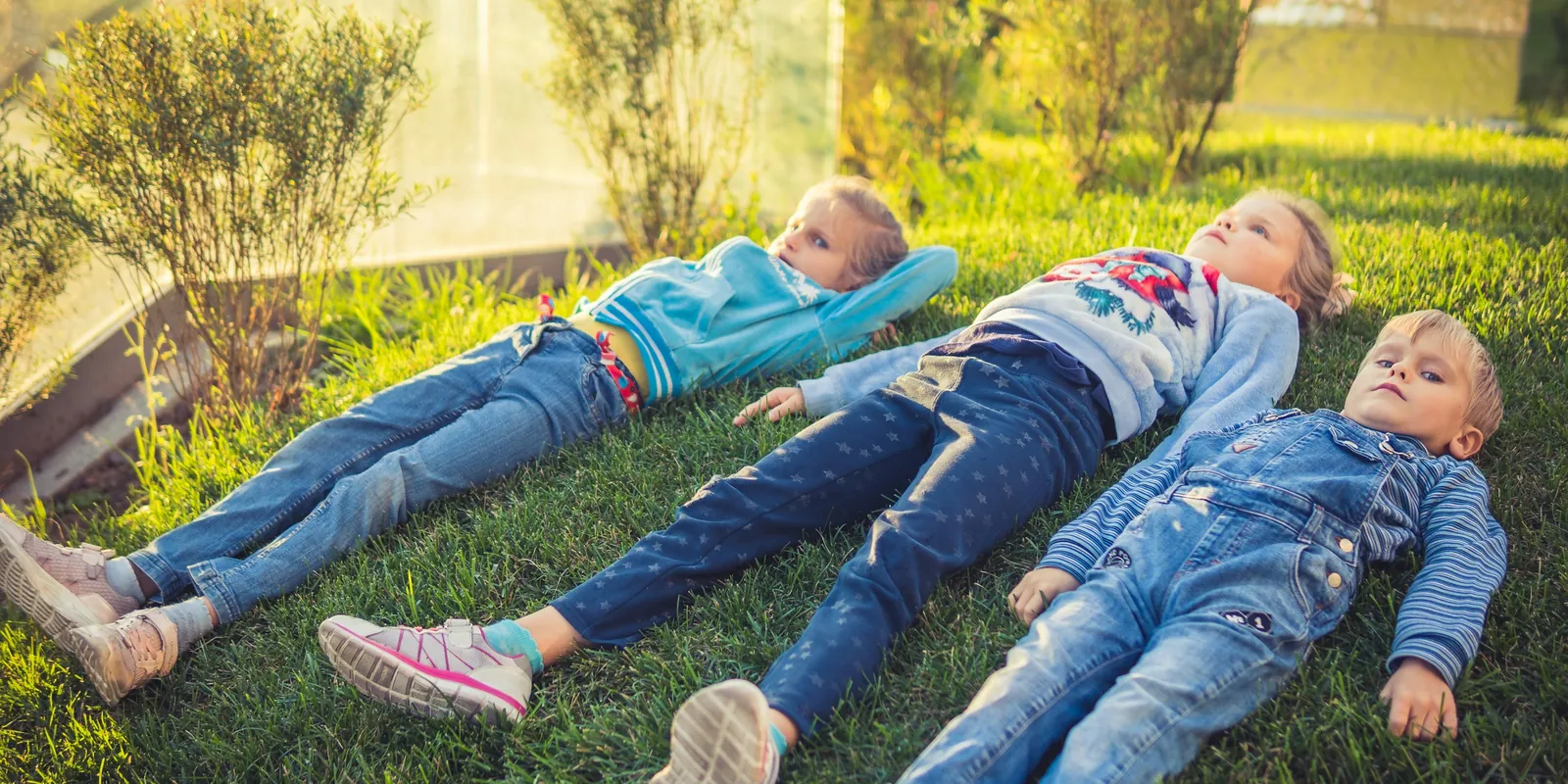
Cool down exercises for kids aged 3 to 8: a five-minute routine for after PE, a party or the park, from a slow march to lying still. No kit needed.
Cool down exercises for kids are slow, gentle movements done for a few minutes after running about, so a child goes from full speed to sitting still in stages rather than all at once. This routine takes five minutes: a slow-motion march, reach and float, butterfly, star, happy baby, then lie still.
Here's the moment it's for. PE ends at 2.10, phonics starts at 2.15, and a class of five-year-olds is still running. It works just as well after a party, the park or football on a Saturday morning.
What is a cool-down for kids?
A cool-down is a few minutes of slower and slower movement at the end of exercise, finishing still. It's for the body after running. A calm-down is for big feelings, and that's a different job.
It isn't a stretching session (that's our guide to stretching for kids), and it isn't a punishment for being noisy. Done well, it's the last game of PE, and the one where the winner is whoever is stillest.
When should children cool down?
After anything that's left them puffed: PE, a party, the park, sports day, swimming club. Above all, before something that means sitting, such as a lesson, the car or tea.
The NHS asks children to be active and to sit less, both at once. For children aged 5 to 18, the NHS suggests breaking up long periods of not moving with some activity. For under-5s, the NHS says they shouldn't be inactive for long periods, except when asleep. A cool-down is the bridge between running and sitting, not a replacement for either. A warm-up is the other half, and our PE warm up games cover that end.
Do kids actually need to cool down?
Not to prevent sore legs. A 2018 review of the research, mostly in athletes and adults, in the journal Sports Medicine found that active cool-downs "do not appear to prevent injuries", and that "most evidence indicates that active cool-downs do not significantly reduce muscle soreness".
The same review found an active cool-down may help the heart and breathing recover faster. The practical reason is simpler: it gets a child from sprinting to sitting in stages, rather than in one step.
A 5-minute cool down routine for kids, step by step
Six steps, in this order: two slow ones standing up, three on the floor, then a minute lying still. The floor poses come from the Freedom Flow mat, but any carpet or patch of grass works.
1. Slow-motion march (1 minute)
"March on the spot at normal speed, then half speed, then slow motion," about 20 seconds each, with the arms swinging low. Expect stomping at first. Let it happen, then call "slower".
2. Reach up, float down (30 seconds)
"Breathe in as your arms float up, breathe out as they drift down like a falling leaf." Do five slow reaches, then sit down. Someone will crash down instead of floating. Do that one again, slower.
3. Butterfly (1 minute)
"Sit tall, put the soles of your feet together and pull your heels in towards you." Flap the knees like wings, then slower, then hold the wings still. Never press a child's knees down.
4. Star (45 seconds)
Star (3): "Legs out wide, toes pointing up, hands on the floor in front of you." Walk the hands forward only as far as feels comfortable. Some children will try to touch their nose to the floor. Tell them that's not the game.
5. Happy baby (45 seconds)
Happy baby (13): "Lie on your back, bend your knees, open them wide and hold your feet." Rock gently side to side, with each rock smaller until they stop. From about five, a child who'd rather curl up can swap to rabbit (14), kneeling and rounding forward.
6. Lie still (1 minute)
"Lie on your back with one hand on your tummy, and watch it rise and fall for five slow breaths." Then roll onto one side and sit up slowly. For a few more ideas for this bit, see our breathing exercises for kids.
That's 1 minute, plus 30 seconds, plus 1 minute, plus 45 seconds twice, plus 1 minute: 5 minutes in all.
In a school hall, a class set of Freedom Flow mats gives every child a space of their own, with star and happy baby numbered so the class can find them without a demonstration.
How long does a cool-down take?
Five minutes for this routine, and there's no official length for children. For under-fives, three minutes is plenty: the march, the reach, then lie still.
On a bad day, a slow-motion march and a minute lying down still counts. A short cool-down done every time beats a long one done once.
What are good cool down activities for kids in a group?
Cool down games for kids work best when the slowest child wins. These three need no kit and suit a class or a party:
- Melting ice lolly, from 3. Everyone stands tall and frozen. The sun comes out, and they melt over a slow count of ten into a puddle on the floor.
- Slow-motion statues, from 3. Walk in slow motion. On "freeze", make a shape. Each shape is lower than the last, and the last one is lying down.
- Follow the slow leader, from 4. One child leads slow moves and everyone copies. The leader changes each turn, and each turn is slower than the last.
At a party, do it before the cake, not after.
How do you cool down a class that won't stop?
Give the loudest child a job. The one who wants to keep running gets to call "slower" for everyone else. A giggling heap in happy baby is fine, because rocking still counts.
If a child won't lie down, sitting is fine. With a class of thirty and no space, do steps 1 and 2 on the spot in lines, skip step 5, and do step 6 sitting at tables with heads down. If it all falls apart, go back to the slow-motion march and start again from there.
Ending every PE lesson and park trip the same way
Use the same six steps in the same order every time, so it becomes the signal that running is over. In school, that's the end of every PE lesson, and our guide to yoga in the classroom has more for the rest of the day. At home, start it when the park gate closes or the football kit comes in.
The same floor poses work again at night: our bedtime yoga for kids is built on that idea.
If you'd like the floor half of this routine under your child, the Freedom Flow design has its 15 poses numbered and laser-engraved into the surface. Choose from our mats your child can roll out after the park: £34.99, with free UK delivery and 10 per cent off two or more.
Frequently asked questions
What are good cool down stretches for kids?
Gentle floor shapes a child can hold without strain: butterfly, star, a knee hug and a curled-up rest. Keep them short and comfortable, and stop anything that hurts. The routine on this page moves slowly through butterfly and star rather than holding each one, and our guide to stretching for kids has a full set of held cool-down stretches.
Can preschoolers do cool down activities?
Yes. Cool down activities for preschoolers work best as games: a melting ice lolly, slow-motion statues, or the first two steps of the routine here. Development Matters, the Department for Education's early years guidance, encourages staff to help Reception children conclude movements in balance and stillness, and to allow time to be still and quiet.
Is a cool-down part of the PE curriculum?
Not by name. The national curriculum programmes of study for PE at key stages 1 and 2 don't mention warm-ups or cool-downs. Key stage 1 asks pupils to master basic movements and develop balance, agility and co-ordination. Schools can still choose to end PE with one, and it's a tidy way to get a class from the hall to the next lesson.
Do you need a mat to cool down?
No. A carpet, a rug, the hall floor or dry grass is enough for every step on this page. A mat helps because it marks out each child's space, and on a mat with the poses engraved into it, a child can find star and happy baby by number without being shown, so they can lead the floor half themselves.
Sources
- Van Hooren B, Peake JM. Do We Need a Cool-Down After Exercise? A Narrative Review of the Psychophysiological Effects and the Effects on Performance, Injuries and the Long-Term Adaptive Response. Sports Medicine, 2018
- NHS - Physical activity guidelines for children and young people, last reviewed 23 October 2024
- NHS - Physical activity guidelines for children (under 5 years)
- Department for Education - National curriculum in England: physical education programmes of study
- Department for Education - Development Matters: non-statutory curriculum guidance for the early years foundation stage (revised September 2023)