guides
Parallel Play and the Stages of Play, Explained
Understand parallel play, Parten's six stages and when playing alone is fine, with UK guidance and practical ideas for home and nursery.
What is parallel play?
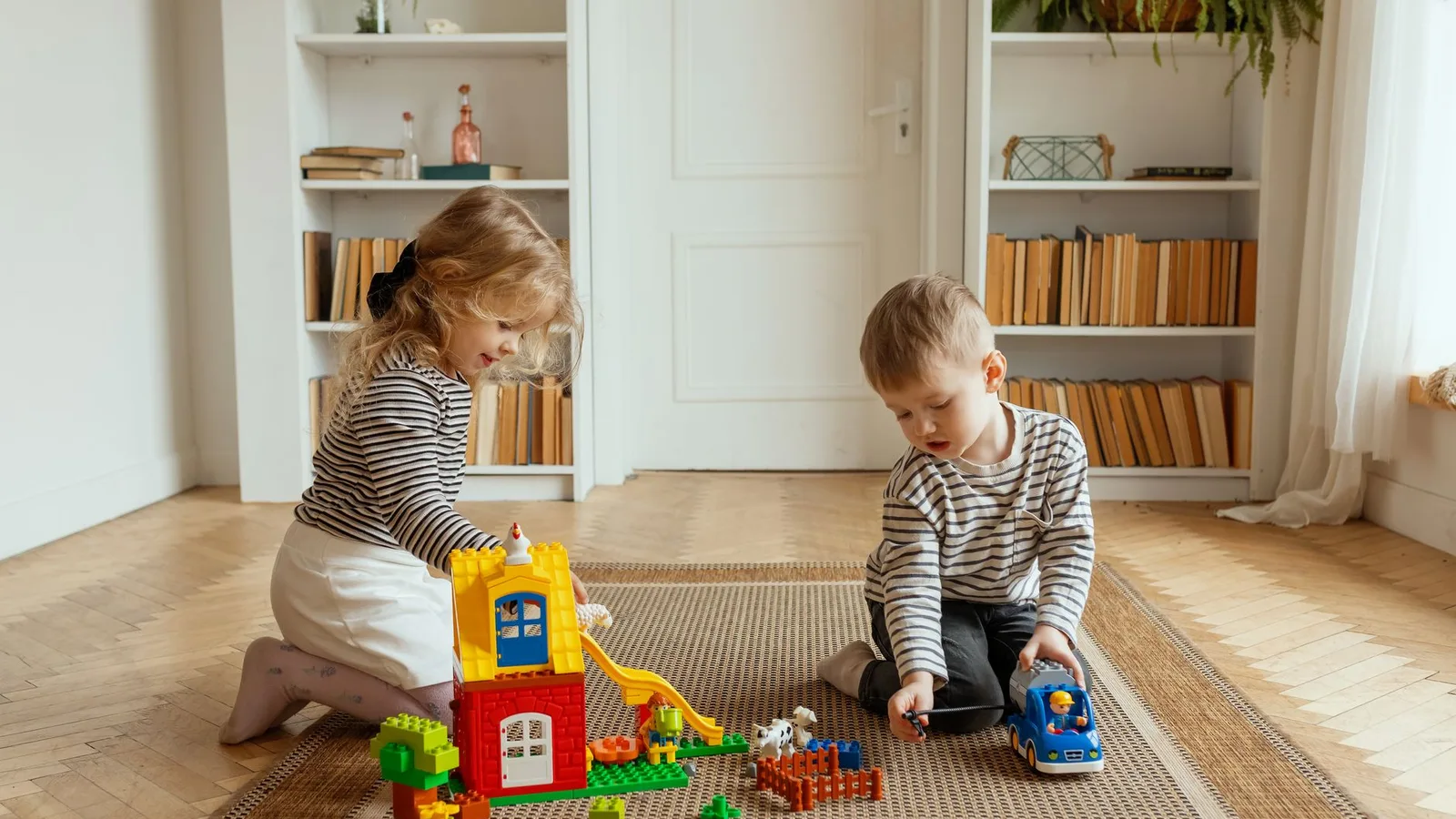
Parallel play is when children play beside one another, each absorbed in their own activity rather than a shared game. Derbyshire Family Health Service describes it as a normal part of learning about social interaction. Here's how to recognise it, understand the other stages of play and decide when to ask for support.
For example, imagine two children on the floor with large building blocks. Each makes their own tower. They're close together and using similar materials, but neither is helping to build the other's tower or agreeing what they'll make next.
That gives you something concrete to look for: are they pursuing separate ideas, or organising something together? Simply sitting at the same table doesn't tell you the answer.
You don't need to turn their separate towers into a joint project. Leave room for their own plans, and notice what they choose to do.
At what age is parallel play normal?
Parallel play is common around ages 2 to 3, rather than something that starts on a particular birthday. Ireland's Health Service Executive gives this usual age range and stresses that children reach stages at different times. Use the ages as a guide to what you might notice.
England's Department for Education guidance, Development Matters, describes children aged 3 and 4 learning to play with others and extend play ideas. It also warns against treating development as a neat sequence or using its guidance as a tick list.
For example, if your three-year-old builds beside a cousin, you don't need to announce that they're behind because a chart says they should be playing together. Look at the play itself and discuss any broader concerns with their nursery.
If you're reading nursery paperwork, our guide to the Early Years Foundation Stage explains the learning areas. The references here are to England's framework.
What are Parten's six stages of play?
The six commonly listed stages are unoccupied, solitary, onlooker, parallel, associative and cooperative play. They describe children's participation with others, from no settled play activity to a shared undertaking. The categories come from Mildred Parten's research, published in 1932.
The descriptions below follow Leicestershire's six-stage guide.
- 1. Unoccupied, What you might see: Looking about or moving around without settling into a play activity.
- 2. Solitary, What you might see: Absorbed in an activity of their own, without involving other children.
- 3. Onlooker, What you might see: Watching another child's game without taking part.
- 4. Parallel, What you might see: Playing beside other children while pursuing their own activity.
- 5. Associative, What you might see: Talking or exchanging materials during play, without an organised shared goal.
- 6. Cooperative, What you might see: Working towards a shared goal or organising roles within a game.
These descriptions concern the social arrangement. The toy alone doesn't decide the category: a pile of blocks could belong to a solo builder, neighbouring builders or a team.
Use the names to describe what happened: “They passed blocks between their separate buildings.” That's more useful than trying to assign your child a permanent stage.
Do children move through the stages in order?
Children can use different forms of play even after they've learned to play cooperatively. WJEC's childcare learning materials explain that children may choose to play alone despite being able to play with others, and that their surroundings and companions can influence the kind of play they choose.
For example, imagine your child helping a friend make a pretend café, then deciding to draw alone. Describe both activities as they happened. The second doesn't erase the shared game that came before it.
You can use a simple observation note if you want something useful to discuss with nursery: what was available, who was nearby and what your child actually did. Record actions such as watching, offering an object or suggesting a role, rather than scoring the afternoon.
Nor do you need to engineer every stage into a playdate. Keep the labels in the background. The children can decide whether today's blocks become separate towers or something they build together.
Is it OK if my child likes playing alone?
Yes, enjoying solitary play can be part of a child's play, including when other people are available. Bolton NHS Foundation Trust describes solitary play as a child happily playing alone without wanting others to join. Start by noticing whether your child seems content, rather than interrupting automatically.
There is a useful distinction in Development Matters: around age 4, practitioners are asked whether a child plays alongside others or always wants to play alone. If playing alone is their consistent preference, talk it through with nursery rather than judging a single afternoon.
Ask nursery what they see. For example: does your child choose to sit near anyone, watch another child's game or accept an invitation? Bring your own observations too, without trying to turn them into a diagnosis.
If your child wants space for a particular drawing or model, you can respect that and offer company later. Our guide to encouraging independent play has practical ways to organise that time. For concerns about development or wellbeing, use the support route below.
How can I encourage parallel play at home?
Start with an activity your child already likes and make space to play alongside them. Lincolnshire Children's Therapy Services suggests joining their chosen activity and copying their play with matching toys. You can begin with what's already out, instead of introducing a new game and explaining its rules.
For example, divide the building blocks into separate piles within reach. Make your own small building nearby. If your child chooses a different shape, let that be their plan rather than correcting it to match yours.
When another child visits, offer enough materials for separate projects. Put paper at each place or give each child their own group of blocks. For more options when you want a change, our playdate ideas cover activities to set out at home.
If both want the same piece, you could say, “You're using that block. I'll help find another one.” Keep the language about what's happening, without asking either child to abandon their whole building.
Choose age-appropriate materials. If an under-3 is joining in, keep small parts out of reach and follow toy age warnings, as the NHS advises. Large blocks avoid turning this into an activity built around tiny pieces.
One set of blocks, three ways to play
You can see the difference between parallel, associative and cooperative play without changing the toys. The examples below apply Parten's distinctions to an ordinary building activity. They're possibilities to recognise, not instructions to move your child through in a single sitting.
- Parallel: put a pile of blocks within reach of each child. Each builds their own house.
- Associative: the children talk about their houses and pass blocks between them, while keeping their own designs.
- Cooperative: they agree to build a house together, with one making the walls and the other making the roof.
Follow whichever version they choose. If you're invited to help, ask what job they want you to do before adding your own design.
For a movement option, explore Yogi-Me's mats, made for ages 3 to 8 with 15 numbered poses laser-engraved into the surface. They offer another activity to choose, without needing to make every play session a shared project.
When should I ask someone about my child's play?
If you're worried about your child's development or wellbeing, speak to your GP or health visitor. The NHS also suggests speaking to a teacher or nursery worker as a first step.
Explain what you've noticed, where it happens and whether it's a change. You could say, “They want to join the other children but seem upset when they try.” That's an example of wording, not a checklist your child must meet. You can ask for advice without first working out which stage describes them.
Frequently asked questions
Is watching other children a type of play?
Yes. It's called onlooker play: your child watches somebody else's game without joining in. Bolton NHS Foundation Trust explains that children can learn from watching others. You can offer a place nearby and leave the invitation open, without making joining in the price of staying.
Is pretend play one of Parten's six stages?
No. Pretend play describes what a child is doing, while Parten's categories describe their involvement with other people. The NHS play guide separates imaginative activities from social stages. For example, pretending to cook can happen alone, beside another child or as part of a shared restaurant game.
Can I practise parallel play with my child?
Yes. Lincolnshire Children's Therapy Services suggests joining an activity your child already enjoys and copying their play alongside them. For example, if they're stacking large blocks, make your own stack nearby. Follow their choice rather than setting a building challenge for them.
Do I need to buy special toys for parallel play?
No. The NHS suggests using things you already have at home for play. For example, offer a sheet of paper each and divide the crayons between you, or split an existing collection of large blocks. Choose something your child wants to use, rather than buying a set to complete a stage.
Sources
- Derbyshire Family Health Service: play ideas for your toddler
- Health Service Executive, Ireland: stages of play
- Department for Education: Development Matters
- National Institute of Informatics: Parten publication record
- Leicestershire Educational Psychology Service: six stages of play
- Mildred Parten: Social Participation Among Pre-School Children
- WJEC: social development and stages of play
- Bolton NHS Foundation Trust: play skills
- Lincolnshire Children's Therapy Services: First call
- NHS: baby and toddler play ideas
- NHS: children's care and support services
- Aneurin Bevan University Health Board: play