guides
How to Encourage Independent Play, Ages 2 to 8
How to encourage independent play from age 2 to 8: why it starts with playing together, how to set it up, and what to expect, with UK early years guidance.
Encourage independent play by starting it together, then stepping back a little at a time. Put out a few open-ended things your child can reach, play alongside them for a few minutes, let them lead, then busy yourself nearby. Expect short stretches at two and longer ones by school age. No UK guidance gives a number of minutes, and the stretch grows when the idea is theirs.
Independent play is a child choosing what to play and how, on their own, while a grown-up is nearby but not running the game. It isn't the same as being left alone, and it isn't screen time. Most parents searching for it want the same thing: twenty minutes to cook tea without the tablet doing the babysitting.
What does the guidance say about children playing on their own?
UK early years guidance doesn't use the phrase "independent play", but it describes it closely. Development Matters, the Department for Education's curriculum guidance, says children from birth to 3 are learning to "play with increasing confidence on their own and with other children, because they know their key person is nearby and available". The confidence comes from the adult being near, not from the adult being gone.
It also tells practitioners how to set things up. "Store resources so that children can access them freely, without needing help." Provide "open-ended resources that can be used in many ways". "Join in with children's play and investigations, without taking over." And take "care not to offer help too soon". All four work at home.
One of the early learning goals in the EYFS framework, Managing Self, describes a child at the end of Reception who can "Be confident to try new activities and show independence, resilience and perseverance in the face of challenge". Much of that gets practised when nobody is helping.
On screens, Best Start in Life, the government's guidance for under-5s, is direct: "Avoid young children using screens alone as it reduces opportunities for social time and active play." So a child watching alone in the next room isn't independent play. It's the thing independent play replaces.
Why does independent play start with playing together?
Because a child who feels they've had you will let you go. The same government guidance puts it plainly: "Young children need attention, interaction and shared moments with their parents and carers to feel secure and supported." A child sent off to play when they're hungry for your attention will follow you round the kitchen. The same child after ten minutes on the floor with you is far more likely to stay put.
The NHS toddler activities page suggests you "follow their lead when they play" and "imagine yourself as the narrator, not the director". That's the hand-over in one line. If you've been directing ("build a tower, now put the man in"), the game stops when you leave. If you've been narrating ("you're making the tower really tall"), the game was theirs all along.
For 3 to 5 year olds, the NHS suggests starting a simple story about their favourite toy "and encourage your child to take the lead". Start the game, hand over the lead, then step back. The toy is already on its way to the beach. You're just not driving.
How long will a child play on their own?
There's no official number at any age, and anyone who gives you one is guessing. What the guidance gives instead are signs of what's typical.
- Around 2. Short bursts with frequent check-ins. Development Matters notes toddlers' "brief need for reassurance as they move away from their key person". Expect them to wander off, come back to show you something, and go again. That's it working, not failing.
- Around 3. Nursery staff look at whether a child "can settle to some activities for a while", one of Development Matters' checkpoints at about age 3. Longer when the activity is their own idea.
- Around 4. The age-4 checkpoint asks whether a child plays alongside others "or do they always want to play alone". At this age, playing alone some of the time and with others some of the time is what you're hoping for.
- 5 to 8. Projects that last. Development Matters, written for the early years, tells practitioners to give children "enough time and space to engage in large-scale projects that may continue over several days", and older children need that just as much. A brick city or a comic that grows a page a day can hold a seven-year-old for a long time, if it's still there tomorrow.
The stretch also shrinks on tired days, ill days and the first week of a new school year. That's normal too.
How do you set up independent play at home?
Put less out. A basket with four things gets played with. A floor with forty gets tipped out and left. Rotate the rest.
Choose things with no single answer. Blocks, playdough, a box of fabric, small figures, a cardboard box. A puzzle ends when it's done. A box of fabric becomes a cape, a den and a picnic.
Make it reachable. Low shelves and open baskets mean a child can start without asking you, which is half of what independent means.
Make the space safe first. Independent play happens in a room you'd be happy to leave them in for a minute: nothing small enough to swallow for under-3s, and nothing to climb that could tip.
Start together, then step back in stages. Sit on the floor for five minutes. Narrate. Then say where you'll be ("I'm going to chop the carrots, I can see you from there") and go. At first, stay in sight. Come back before they come looking for you. That teaches them you return, so they stop needing to check.
Don't interrupt good play. When they're absorbed, it's tempting to praise it. Wait until they look up.
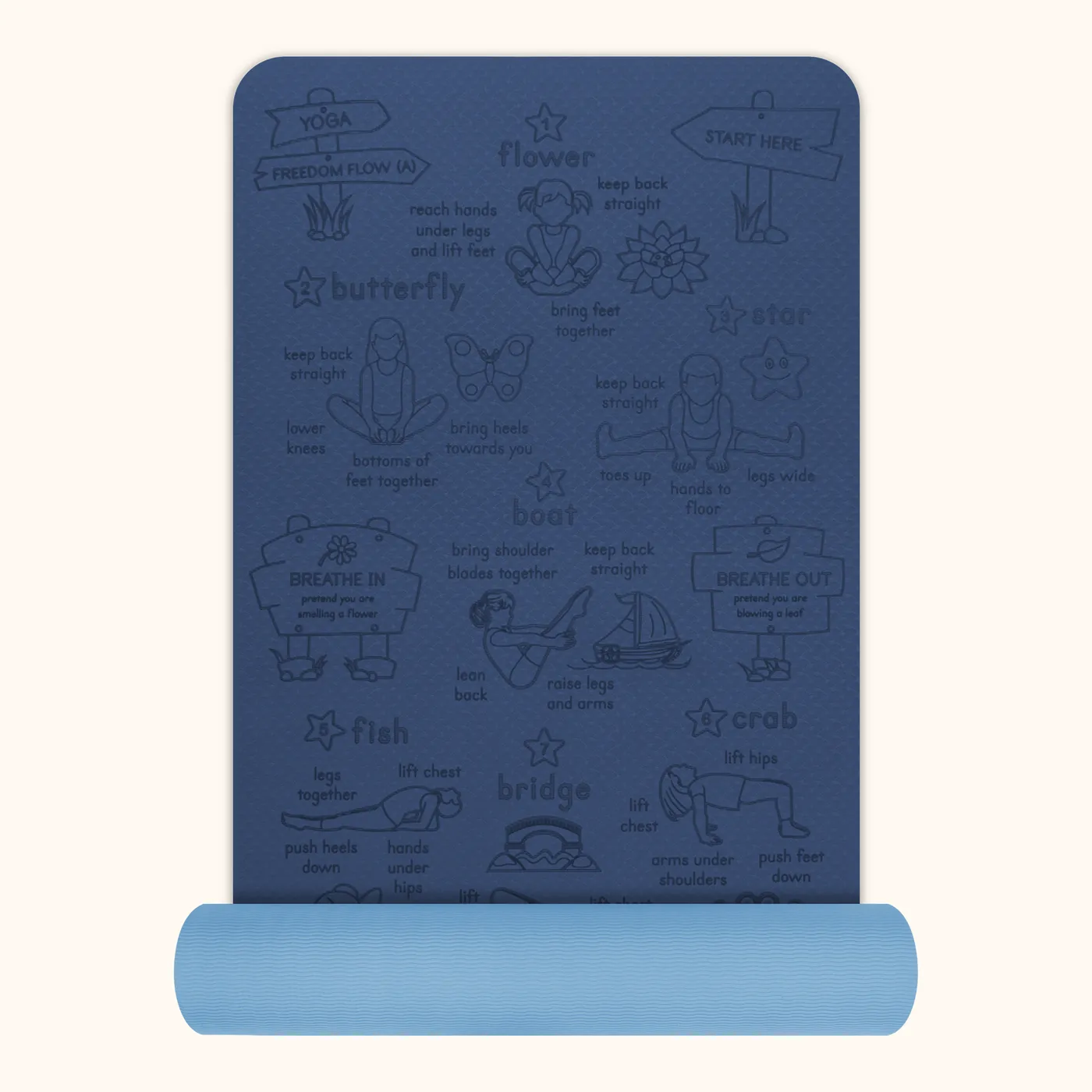
Have one self-led thing for the moments a screen usually fills. For some children that's a box of books or a set of building bricks. For a child who likes moving, a children's yoga mat with 15 numbered, laser-engraved poses lets them work through the shapes on their own without a video to follow. There are plenty more in our list of screen-free activities.
Why does my child struggle to play on their own?
Often it's one of these four, and none of them is a fault in the child.
They haven't had you yet. The first thing to try. Ten minutes of your attention first often fixes it.
There's too much on offer. A child facing a full toy box often does nothing, then wants you.
Something has changed. A new sibling, a new nursery, a house move. Changes like these often make a child want their grown-up close for a while. Expect a dip and go back a stage.
They're used to being entertained. If a screen has filled every gap, playing alone feels slow at first. That's not a reason to give up. Taking back one screen slot at a time makes the gap smaller, and is boredom good for kids explains why the first few minutes of "there's nothing to do" are worth sitting through.
If what you need is a fixed rest hour for a child who's dropped their nap, that's a slightly different job, and quiet time activities covers it.
When to talk to someone about how your child plays
Most children who won't play alone just need more time and a gentler start. But do talk it through with a health visitor, a GP or their key person at nursery if your child can't settle to anything even with you beside them, seems worried, sad or angry much of the time, or if you're concerned about how they play with other children.
Development Matters asks nursery staff to watch for children "who seem worried, sad or angry for much of the time" and to work with parents when they do. If their nursery raises how your child plays, it's an invitation to talk, and you know your child best.
Frequently asked questions
What are some independent play activities for 5-year-olds?
Five-year-olds do well with things they can build on over days: a junk-model town, a marble run, a comic they draw a page of each afternoon, a shop with real tins and a till. Small world play, a den with a torch and a basket of books work too. The best ones have no single right answer, so there's always something left to do next.
Is independent play good for children?
It helps them practise skills the early years framework cares about. The EYFS goal for managing self includes being "confident to try new activities and show independence, resilience and perseverance in the face of challenge", and playing alone is where a lot of that gets practised. It sits alongside playing with you and with other children, not instead of them.
Should I play with my child all the time?
No, and you couldn't anyway. Children need time with you and time on their own. NHS Best Start in Life suggests following your child's lead when you do play together, which also makes it easier to step back. A few minutes of full attention, then letting them carry on alone, is a better rhythm than either constant play or none.
Does watching TV count as independent play?
No. A child watching a programme alone isn't choosing or making anything. UK guidance for under-5s advises against a young child watching alone, as it "reduces opportunities for social time and active play". Its line for 2 to 5 year olds is "Try to keep it to 1 hour a day. Less if possible." Independent play is the thing that time can go to instead.
Sources
- Department for Education: Development Matters
- Department for Education: Early years foundation stage (EYFS) statutory framework
- Best Start in Life (GOV.UK): Screen time guidance for under 5s
- NHS Best Start in Life: Playtime activities and bonding with your toddler
- NHS Best Start in Life: Learning conversations and telling stories, 3 to 5 years