practice
Stretching for Kids: 12 Easy Stretches to Do Together
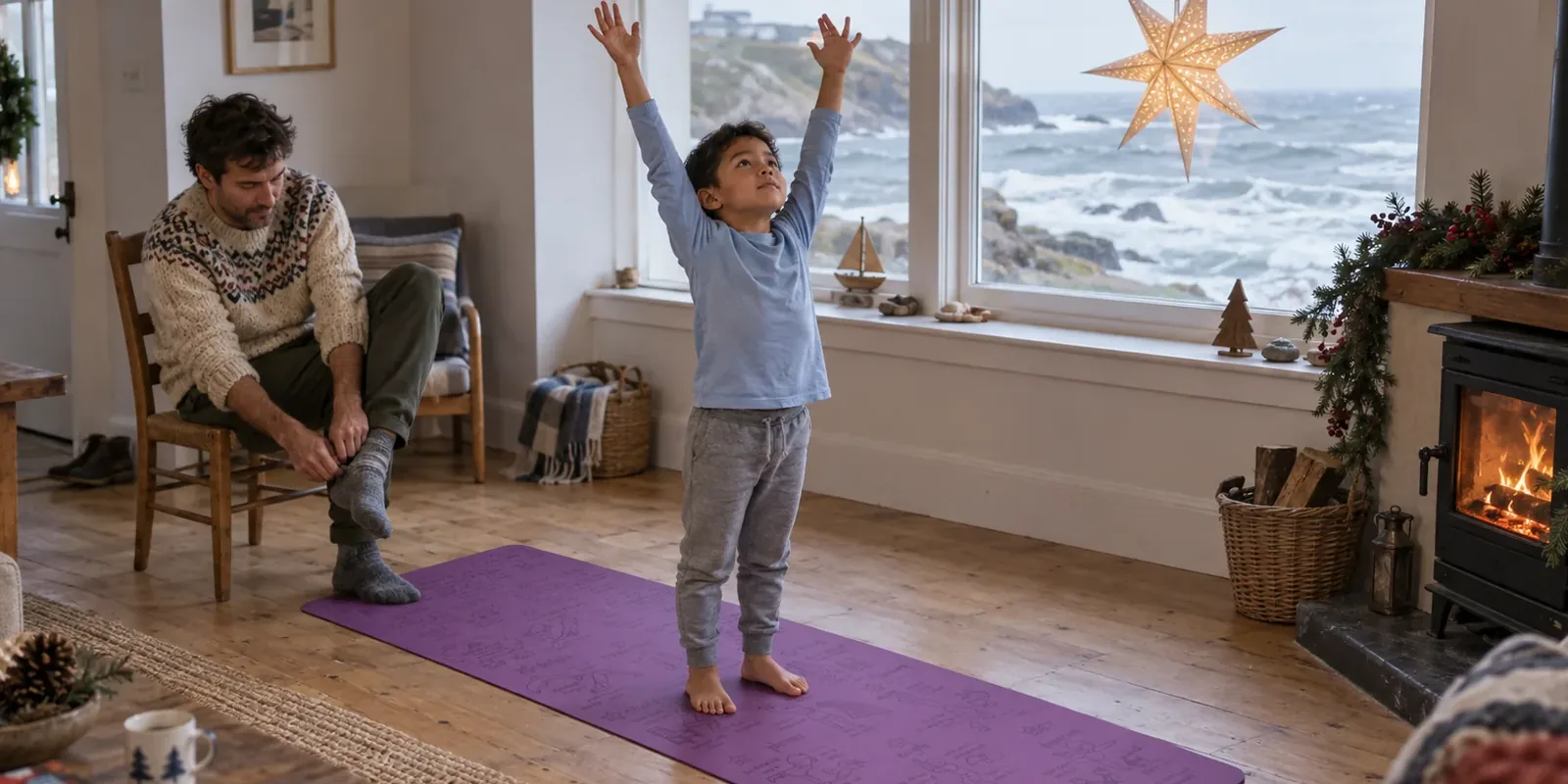
Stretching for kids aged 3 to 8 in two short sets: six moving stretches before sport or play, six held ones after. No kit, a few minutes each.
Stretching for kids works best as two short sets. Before sport or active play, use moving stretches that warm the body up, such as marching, windmill arms and knee lifts. Afterwards, use still stretches held for a slow count, such as butterfly, star and a knee hug. Below are six of each, for ages 3 to 8.
Football has just finished, and your seven-year-old has gone from sprinting to the car seat in ninety seconds. A few minutes of stretching fits in between, with no kit and you alongside.
What is stretching for kids?
Stretching for kids is gently lengthening a muscle until it feels a mild pull, then either moving through that range or holding it still. Neither kind should ever hurt.
For a child of 3 to 8, it's mostly play with a name on it, and sits with the big movements in our guide to what gross motor skills are.
Should kids stretch before or after sport?
Both, but differently. The NHS warm-up routine is all movement and takes at least 6 minutes, and the NHS says to warm up properly to prevent injury. The NHS keeps its held stretches for a separate post-exercise routine of about 5 minutes, to help you gradually relax and slow your heart rate.
Neither NHS routine is written for children, so the sets below borrow the shape rather than the detail: move first, hold later.
What age should kids start stretching?
The NHS activity guidelines for children don't set a starting age for stretching. The NHS guidelines for under-5s say activity of any intensity should be encouraged, including light activity, and we'd count gentle stretching as light activity.
Start with moving stretches, which are easy to copy, and add held ones once your child can keep still for a slow count of 10.
What are some simple stretches for kids?
The simplest stretches for kids have a picture in the name, so a child knows the shape before trying it: cat, butterfly, star, mouse, rainbow. Here are all 12, with starting ages that are our own guide, not an official rule.
- Warm-up, moving, from 3: march on the spot, shoulder rolls, windmill arms, rainbow reach, cat.
- Warm-up, moving, from 4: knee lifts.
- Cool-down, held, from 3: butterfly, star, knee hug, mouse.
- Cool-down, held, from 4: calf stretch at the wall.
- Cool-down, held, from 5: lying leg lift.
What's a good warm-up stretching routine for kids?
A good warm-up for kids is six moving stretches, mostly standing, for about 6 minutes: march on the spot, roll the shoulders, swing windmill arms, lift the knees, reach over in a rainbow, then round and arch the back as a cat. Nothing is held.
1. March on the spot
March for two minutes, swinging your arms, then forwards and backwards. If it turns into running, call "march".
2. Shoulder rolls
Keep marching and roll your shoulders forwards five times, then backwards five times, arms hanging loose.
3. Windmill arms
Swing one straight arm in a big, slow circle, five times each way, then the other arm. Clear a space first, because windmill arms find lamps.
4. Knee lifts
Lift one knee to touch the opposite hand, then swap, for 20 lifts. Expect wobbling, and the odd wrong hand.
5. Rainbow reach
Sweep one arm up and over your head in a rainbow and slide the other hand down your leg. Five slow reaches each side.
6. Cat
On hands and knees, round your back up high like a cross cat, then let your tummy dip and lift your chin. Five times, breathing out as you round.
What are good 5-minute stretches for kids after sport?
Six still stretches make a good cool-down that fits inside five minutes: a calf stretch against the wall, butterfly, star, a lying leg lift, a knee hug, then mouse. Hold each for a slow count of 10, both sides where there are sides, and end with five breaths in mouse.
7. Calf stretch at the wall
Hands flat on a wall, step one leg back, straight, with the heel down and the front knee bent. Hold for 10, then swap.
8. Butterfly
Sit tall, put the soles of your feet together and let your knees drop towards the floor. Hold for 10. If your child flaps their knees like wings, let them flap, then land.
9. Star
Sit with your legs wide, toes up and back straight, then walk your hands forward only as far as is comfortable. Hold for 10. Folding right down and barely leaning are both fine.
10. Lying leg lift
Lie on your back, knees bent. Lift one leg, hold it below the knee and straighten it as far as is comfortable. Hold for 10, then swap.
11. Knee hug
Hug both knees into your chest and rock gently from side to side for a count of 10. It's hard to stay serious while rocking together.
12. Mouse
Kneel with knees wide and big toes touching, then fold forward so your bottom sinks to your heels and your forehead rests on the floor. Stay for five slow breaths, and let the end be quiet.
Butterfly and star are both on our Freedom Flow design, each engraved with its name beside a picture, so a child who can't read yet can still find them and call the next stretch: see the floor-pose mat. Cat, butterfly and mouse are also yoga poses, so easy yoga poses for kids are a natural next step.
Is stretching safe for children?
Keep it gentle, let your child set the pace, and stop if anything hurts. The NHS guidance for 5 to 18 year-olds says children should do exercise that suits their age, ability and experience, start anything new slowly and build it up bit by bit, and get medical advice about exercising if they have a health condition.
If your child is very bendy and also often has joint pain or keeps getting sprains, the NHS suggests seeing a GP about joint hypermobility syndrome.
What if your child won't stretch?
Don't push. Give them a job instead: calling the next stretch, counting the hold, or checking everyone's cat back is properly round. Or stretch next to them and let them join in when ready. If it turns into giggling, make them silly stretches, then come back to a quiet count of 10.
If they'd rather keep moving, try our core strength and balance activities instead.
How do you make stretching a habit?
Tie it to something that already happens. The warm-up goes on before the boots do, and the cool-down starts when the kit bag comes in. Use the same order and names every time, and if you miss a week, start again at stretch one.
Mornings work too, and our morning yoga routine for kids is built for them. Our beginner's guide to kids' yoga covers how to start.
Frequently asked questions
What are some silly stretches for kids?
Silly stretches are ordinary stretches with a story attached. Windmill arms become a helicopter taking off, a knee hug becomes a hedgehog curling up, butterfly knees flap before they land, and mouse hides from the cat. Let your child invent the next one, then finish with a quiet count of 10.
How long should a child hold a stretch?
The NHS pages we used give no hold time for children. The NHS cool-down routine, which isn't written for children, holds each stretch for 15 to 20 seconds. For children aged 3 to 8 we use a slow count of 10, and stop sooner if they wobble out of it or it starts to hurt.
Should stretching hurt?
No. A stretch should feel like a mild pull and nothing more. The NHS says to stop exercising immediately if you feel any pain. If your child says it hurts, ease them out, try a smaller version, and never press them further.
Can children stretch every day?
Yes, a few minutes a day is fine as long as it never hurts. There's no NHS rule on how often children should stretch, so tie it to something they already do: after PE, after the park or before a bath. Keep the holds to a slow count of 10, and skip a day if they're poorly or sore.
A spot of their own to stretch on
Every stretch here works on carpet, a rug or the grass by the pitch, so you don't need to buy anything. If you'd like a space that's theirs, a Yogi-Me mat is a full-length mat for ages 3 to 8 with 15 numbered poses laser-engraved into the surface. Freedom Flow is the floor sequence, which suits the cool-down. Sun Salutation is the standing one, closer to the warm-up.
At 183 x 61 cm it's the length of an adult mat, so your seven-year-old won't outgrow it and you fit alongside for the knee hug. The trade-off is that a shorter mat is easier for a three-year-old to carry alone. It weighs 800 g and rolls up with a shoulder carry strap.
It's 6 mm thick and made of non-toxic, PVC-free TPE, according to our supplier's specification. After a muddy match, wipe it with a damp cloth and a little mild soap, then let it dry flat.
If you're looking for a Christmas present that's still used after Boxing Day, this is fifteen numbered poses laid out ready for every time the kit bag comes in. Buying as a grandparent on Saturday touchline duty? It's full length, so you can do the butterfly too. There are more gift ideas that aren't another screen if you're still deciding.
Each mat is £34.99 with free UK delivery and 30-day returns, and two or more are 10 per cent off if brothers and sisters stretch side by side. Pick floor or standing, then choose a colour for after the next match.
Sources
- NHS - How to warm up before exercising
- NHS - How to stretch after exercising
- NHS - Physical activity guidelines for children (under 5 years)
- NHS - Physical activity guidelines for children and young people (5 to 18 years), reviewed 23 October 2024
- NHS - Joint hypermobility syndrome, reviewed 30 August 2023