practice
Skipping Games: 12 Rhymes and Rope Games for Kids
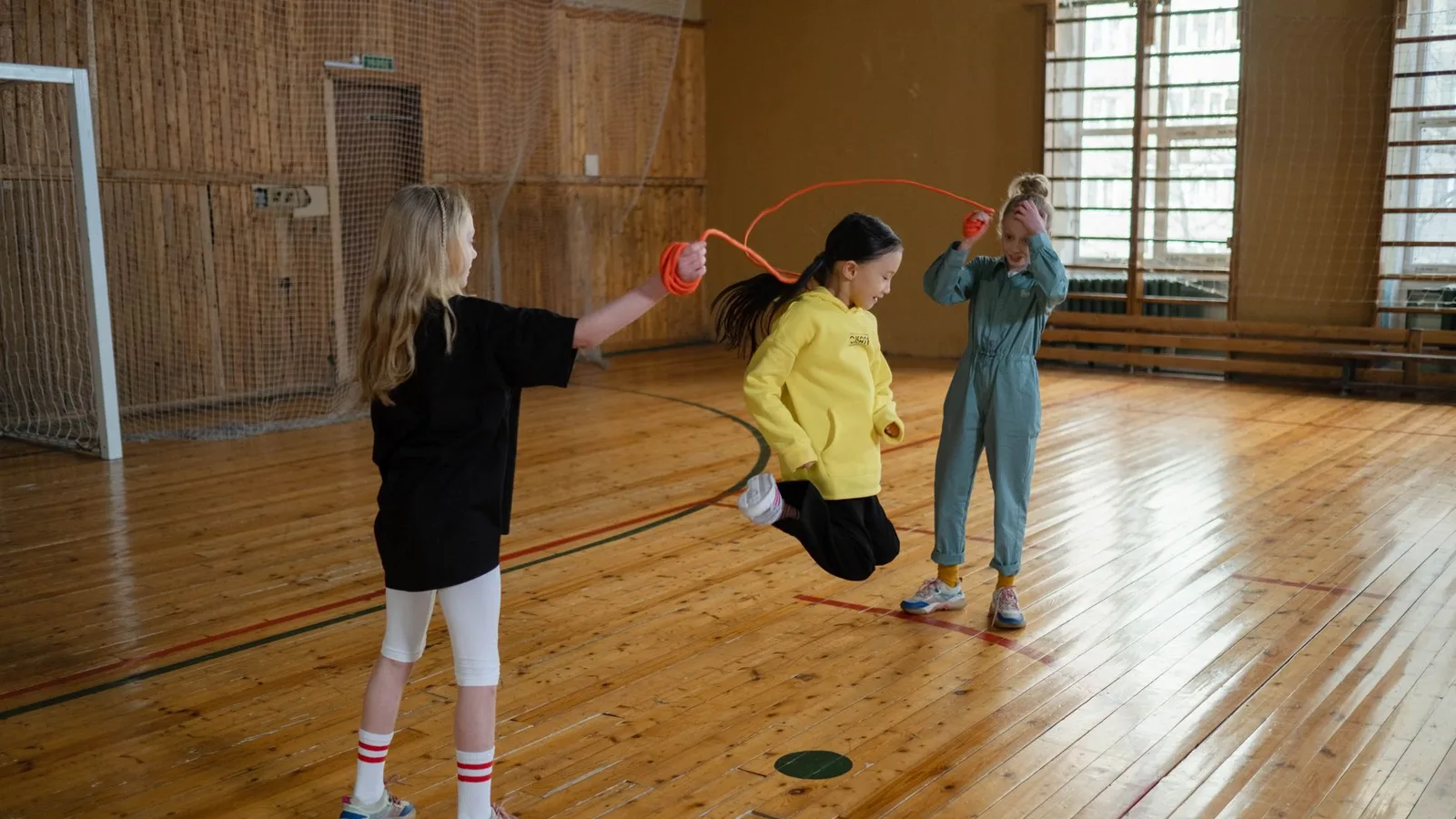
Try 12 skipping games for kids, with traditional rhymes, short and long rope rules, player numbers and simple steps for a first skip.
Which skipping games should you try first?
Skipping games to try include Sleeping Snake for beginners, Count Your Skips with a short rope, and Blue Bells with a long rope. Start with the rope flat on the ground if your child hasn't skipped before. Below are 12 games, including traditional rhymes written out, with the players and space you need for each.
What do you need before the rope starts turning?
Choose a game to match what your child can do today. These ideas are for ages 3 to 8, from ground games to group skipping. For ages 5 to 18, the NHS recommends matching exercise to age, ability and experience, then building up gradually.
For a short rope, have your child stand on its middle: the handles should reach roughly to their armpits, following England Boxing's beginner guidance. Long-rope games below use 2 adult turners.
Before you play: clear obstacles, allow room for the whole rope swing and agree a stop signal, as the Scouts advise. Supervise throughout. Keep ropes away from necks and under-3s, and put them out of reach afterwards: the NHS warns against leaving ropes or cords lying around.
For more games to mix in, browse our traditional playground games.
Which of these 12 rope games fits your group?
The games start with a still rope, move through short-rope challenges, then introduce rhymes and group turns. Pick the stage that fits, rather than working through the whole list. Player numbers include rope holders; solo games still need adult supervision. The jump counts are suggested game rules, so change them freely.
1. Sleeping Snake
Players: 1. Kit: 1 rope. Space: clear ground on both sides.
Lay the rope straight and leave it still. Say, "Step over the sleeping snake without touching it." Next, invite a jump across with feet together, then turn round and come back.
Make the crossing the whole game. Jumping over a rope on the floor appears in this NHS nursery and reception activity programme.
2. Wiggly Snake
Players: 2. Kit: 1 rope. Space: a clear strip of ground.
An adult holds an end and gently wiggles the rope along the ground. Say, "Wait for a gap, then jump across the snake." Keep the movement small and predictable.
Swap back to a sleeping snake whenever your child asks. The moving-rope idea appears in this NHS nursery and reception activity programme; adjusting the rope's timing lets the adult respond to the jumper.
3. Rock the Boat
Players: 3. Kit: 1 long rope. Space: room between the turners and beside the rope.
The adults swing the middle of the rope gently from side to side close to the ground, without taking it overhead. Say, "Jump as the boat comes towards your feet."
Try 3 crossings, then stop and choose another turn. This uses the NHS programme's back-and-forth rope activity. Your child practises meeting a moving rope without handling the turns.
4. Swing, Stop, Jump
Players: 1. Kit: 1 short rope. Space: clearance above, in front and behind.
Start with the rope resting behind your child's feet. Say, "Bring it over your head. Let it land. Step over." Once that's manageable, replace the step with a jump.
This is the slow progression suggested by NHS Greater Glasgow and Clyde. Keep the pause between turns until your child wants to connect them. A single completed turn is the challenge.
5. Count Your Skips
Players: 1. Kit: 1 short rope. Space: a clear full rope swing.
Count each time the rope passes underneath both feet. Say, "Let's see what number you reach." After a catch, stop, reset the rope and start counting again.
Offer another go at their own number, without comparing siblings. If linked skips aren't happening yet, count separate swing-and-jump attempts instead. You can also let your child count your attempts, including the ones that end with the rope round your shoes.
6. Copycat Skipping
Players: 2. Kit: 2 short ropes. Space: separate areas so the ropes cannot meet.
Take turns being the leader. Say, "Watch my pattern, then try it." Begin with 2 skips, a pause and 2 more. Your partner copies after you've stopped.
Let the next leader change the number of skips or the length of the pause. This is a simple adaptation of the follow-the-leader activity in England Boxing's coaching handbook, with each person taking a separate turn.
7. Blue Bells, Cockle Shells
Players: 3. Kit: 1 long rope. Space: a clear full rope swing.
The turners rock the rope backwards and forwards while the child jumps. Chant:
Blue bells, cockle shell,Easy ivy over.
On "over", take the rope right round. These words and actions appear in Somerset's playground activity collection.
Tell your child about that change before starting. Agree to stop after the first full turn, or continue if they're ready. The chant tells everyone when the rope changes direction.
8. Lucy Locket
Players: 1, or 3 with turners. Kit: a short or long rope. Space: a clear full swing.
Skip steadily while someone chants this verse, recorded in Derwent Valley Mills' traditional games resource:
Lucy Locket lost her pocket,Kitty Fisher found it;Not a penny was there in it,Only the ribbon round it.
Say, "Let's finish the verse, then swap." There's no required score. You can chant while your child skips, leaving them to concentrate on the rope.
9. Salt, Mustard, Vinegar, Pepper
Players: 1, or 3 with turners. Kit: a short or long rope. Space: a clear full swing.
Chant:
Salt, mustard, vinegar, pepper.
Traditionally, the rope speeds up.
For this game, agree on a small increase at "pepper", then stop and reset. Say, "Ready for a slightly quicker turn?" Keep the original pace if your child prefers. The caller gets to supply the drama without demanding top speed.
10. Alphabet Skips
Players: 1. Kit: 1 short rope. Space: a clear full rope swing.
Say a letter each time the rope passes underfoot. Choose a finishing letter before starting: "Let's go from A to E." After a catch, resume with the next letter instead of returning to A.
For a different round, spell your child's name, pausing between turns if needed. Someone watching can call the letters. The finish is the chosen letter or name, rather than whoever can keep going longest.
11. Add a Jump
Players: 3 or more. Kit: 1 long rope. Space: a full swing and a waiting area.
Each jumper starts inside the still rope, completes 1 jump and waits for the adults to stop it before leaving. On the next round, offer 2 jumps, then 3.
Say, "Choose your level: stay here or add another." Keep everyone's level separate, so a beginner can repeat a single jump alongside a sibling doing more. This is a suggested counting game, with a clear start and finish for every turn.
12. Whirlwind
Players: 8, including 2 turners. Kit: 1 long rope. Space: a playground with clear entry, exit and waiting areas.
For children already entering a turning rope, try this Scouts game: each player passes through with a jump, followed by the next player on the next rotation.
Say, "One jump, through, then round the outside to the queue." Our suggested change is to count a shared score and restart after a miss, keeping everyone in. Save it for a group ready for continuous turns.
What can you change when the rope keeps catching?
Separate the movements again instead of asking for more consecutive skips. Try the rope turn on its own, then the step or jump over it, with a pause between them. This follows NHS Greater Glasgow and Clyde's approach to learning the skill in parts.
- The rope hasn't reached the floor before the jump, What to try next: Let it land and stop, then step over.
- Turning and jumping together feels too much, What to try next: Return to Sleeping Snake, then practise the arm movement separately.
- A full long-rope turn is too much, What to try next: Try the NHS programme's gentle back-and-forth swing.
- The rope seems the wrong size, What to try next: Recheck the handle height before another attempt.
How do you string skipping games into one session?
Choose a starting game, a challenge and a favourite to finish. You don't need to play everything or keep increasing the difficulty. Here are 2 suggested combinations; repeat a game if it's going well, and leave the next one for another day if everyone's had enough.
- A first go: Sleeping Snake, then Swing, Stop, Jump, finishing with your child choosing how you cross the still rope. Let them demonstrate their chosen crossing before you copy it. If the rope turn isn't appealing, stay with the ground game.
- A group that can already skip: Rock the Boat, then Blue Bells, finishing with Add a Jump. Give everyone a turn before offering another round. Children choose their own jump counts, and the adults stop the rope before each child enters or leaves.
You can add one of our warm-up games before active play.
For a few yoga poses before the rope comes out, take a look at our Sun Salutation mat. Its 15 numbered poses are laser-engraved into the surface, with a standing, more active sequence. Roll it away before skipping.
What if your child would rather call than jump?
Let them be the caller, count your skips or choose the next rhyme. They can take part without having a turn in the middle. If being watched is the sticking point, offer a quiet go together later, without an audience or a score to beat.
You can also put the rope away and choose a different activity from our garden games for kids. There's no need to finish the list.
If you're worried about your child's movement or development more generally, speak to your GP or health visitor.
Frequently asked questions
Which skipping games suit a beginner?
Start with Sleeping Snake, Wiggly Snake or Rock the Boat, where an adult either lays out the rope or controls its movement. Swing, Stop, Jump is the next option for trying a short rope. Choose whichever game your child wants to repeat, without making continuous skipping the goal straight away.
Which skipping games can a child play on their own?
Count Your Skips, Alphabet Skips and Swing, Stop, Jump all work with a short rope and no other player. Sleeping Snake works with a rope lying still. For a child who isn't turning a rope yet, choose the ground game or practise swinging and stepping over, with a grown-up supervising.
What are some traditional skipping rhymes?
Blue Bells, Cockle Shells and Lucy Locket are traditional choices. Salt, Mustard, Vinegar, Pepper is a traditional speed chant. Blue Bells introduces a full rope turn, and Lucy Locket gives you a verse to skip through. The words and suggested rules for each are written out above.
How many people do you need for long-rope games?
For Blue Bells, Rock the Boat and Add a Jump, use 2 adult turners and at least 1 child to jump. Other children can queue for turns. Whirlwind needs a larger group. With only one grown-up, pick a short-rope game or Sleeping Snake and take turns together.
Sources
- NHS: Physical activity guidelines for children and young people
- NHS: Baby and toddler safety
- NHS Greater Glasgow and Clyde: Movement skills
- NHS-hosted Cool Kids Programme: Nursery and reception activities
- England Boxing: Level 2 coaching handbook, skipping section
- Scouts: Skipping skills
- Derwent Valley Mills: Traditional games and skipping rhymes
- Enfield Council: Worries about your child's health or development