guides
Outdoor Activities for EYFS: 20 Ideas by Weather
20 outdoor activities for EYFS sorted by weather, wet, cold, windy, hot and dry, with what the EYFS framework says about outdoor play every day.
Outdoor activities for EYFS children work in almost any weather if you match the activity to the sky. Here are twenty, sorted by wet, cold, windy, hot and dry days, and each is tagged with its area of learning. First, what the EYFS framework actually requires about outdoor access, and what children need to wear, because both shape everything else.
Outdoor learning, in the early years, means using the outside as a place to learn, not only a place to let off steam.
What does the EYFS framework require about outdoor play?
The EYFS statutory framework says every setting must provide children with access to an outdoor play area. Where they can't, they must plan and take children on outdoor activities every day, unless circumstances make that inappropriate.
The example the framework gives is unsafe weather. Drizzle, a cold morning or a muddy field aren't unsafe on their own, so the question is whether being outside is safe, not whether it's pleasant.
Development Matters, the government's non-statutory guidance, goes further. In its birth to 3 guidance, it suggests offering outdoor play every day for at least 45 minutes. For children in Reception, it asks for regular access to outdoor space with a range of surfaces to feel, move and balance on, such as grass, earth and bark chippings.
Health guidance points the same way. The NHS guidelines for under-5s ask for at least three hours' activity daily from age 1 to 4, and name outdoor play as part of it for both toddlers and pre-schoolers.
What should children wear to play outside in any weather?
The right clothes are what make the rest of this list possible. Development Matters suggests checking that children's clothing and footwear are neither too tight nor too large, and talking with them about what the weather means they need.
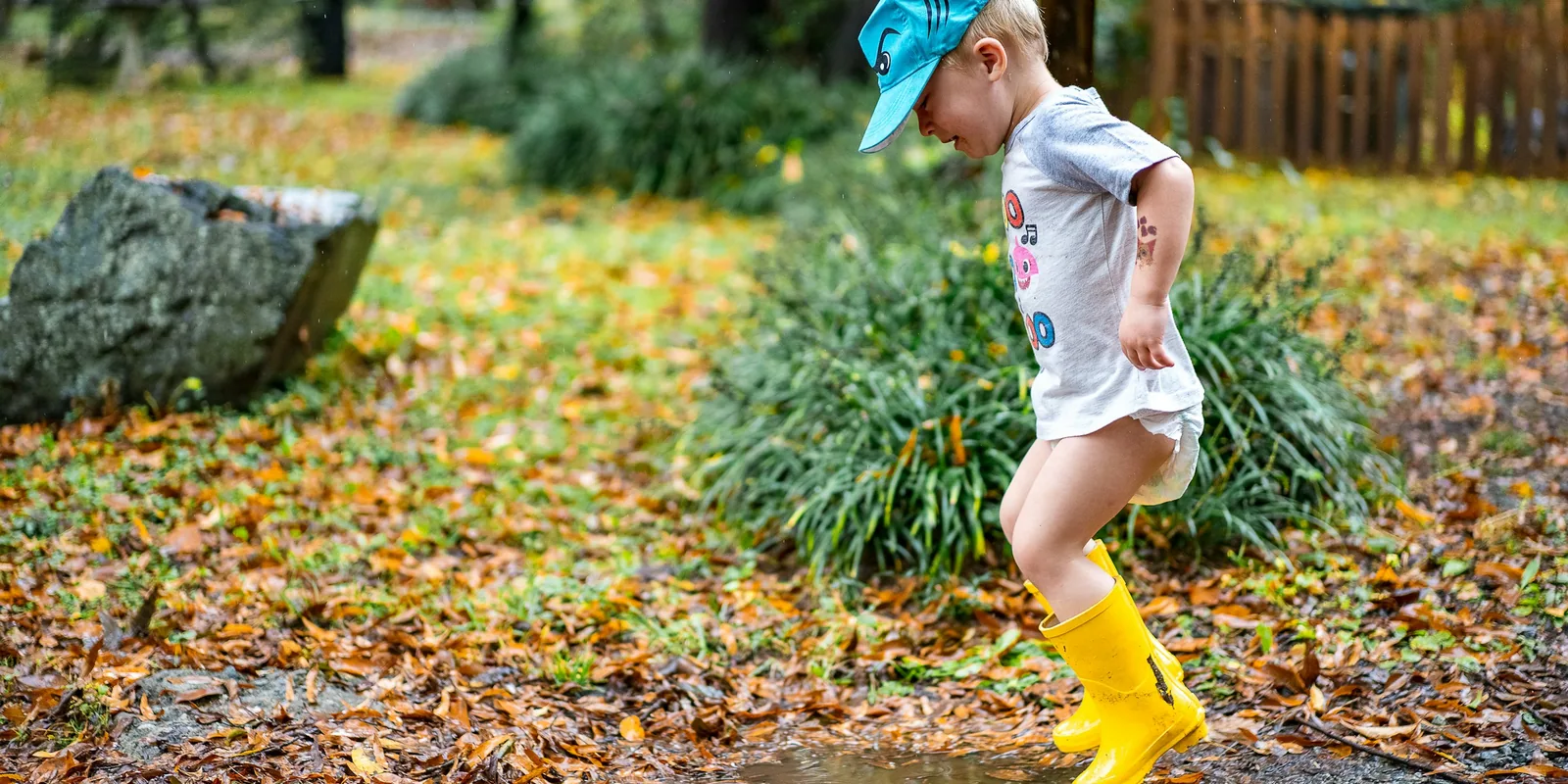
- Wet days: an all-in-one waterproof or waterproof trousers and coat, and wellies.
- Cold days: layers under the waterproof, a hat and gloves. Spare gloves, because one always goes missing.
- Windy days: hoods up and zipped. Keep scarves tucked in during climbing.
- Hot days: a sun hat, covered shoulders and at least SPF30 sunscreen on skin that clothes don't cover, plus shade, particularly from 11am to 3pm. The NHS advice on sun safety has a section for children, quoted in our summer activities for EYFS.
- Every day: a named bag of spare clothes, socks included.
What can EYFS children do outside on a wet day?
Rain changes the playground into something new. These five are better in the wet than the dry.
1. The rain gauge (mathematics)
An adult cuts the top off a clear plastic bottle and sets it upside down inside the bottom half, with a strip of tape marked in centimetres. Children read it every morning and mark the level. Who can guess how much fell overnight?
2. The guttering run (understanding the world, physical development)
Lengths of plastic guttering propped on crates at different heights. Pour water in at the top, or let the rain do it, and race a ball or a leaf to the bottom. Children change the slope and see what happens.
3. The drip orchestra (expressive arts and design)
Upturned pans, buckets, tins and plastic tubs under a dripping roof edge or a tree. Listen to the different notes, move the pots about, and add your own beat with a wooden spoon. Then try it again in heavier rain.
4. The mud kitchen (communication and language, expressive arts and design)
Old pans, spoons, a muffin tin and a bucket of soil and water. Children make mud pies, soups and cakes, and take orders. It's a role-play corner where nobody minds the mess. Wash hands afterwards.
5. Worm watch after rain (understanding the world)
After a downpour, worms come to the surface. Look closely, count them, and talk about how they move. Hold one gently on a damp hand for a moment, then put it back on the soil. Wash hands afterwards.
Which outdoor activities warm children up on a cold day?
Cold days need movement first and stillness later. Start with something that gets hearts going.
6. Ice suncatchers (understanding the world)
On a day when frost is forecast, fill a shallow tray with water, leaves, petals and twigs, and leave it out overnight. In the morning, children turn out the ice and hang it up. Watch it melt through the day.
7. Follow the leader warm-up (physical development)
An adult leads a line round the playground, changing the move every few seconds: march, gallop, hop, skip, tiptoe, stomp. Then a child takes over. Running, jumping, hopping and skipping all appear in the gross motor early learning goal, so add a run and a jump to the moves.
8. Wheelbarrow deliveries (physical development)
A child-sized wheelbarrow or a cart, and a job: move the logs from the shed to the den, or the balls from one corner to the other. In its Reception guidance, Development Matters lists lifting, carrying, pushing and pulling among the physical skills to practise.
9. The tarp den (personal, social and emotional development)
A tarpaulin, some rope, pegs and a fence or two trees. A small group has to agree where the den goes and how to keep the rain out. It takes teamwork, and the den is somewhere to warm hands afterwards.
What can you do outside when it's windy?
Wind is invisible, which makes it the most interesting weather to investigate.
10. Wind detectives (understanding the world)
Tie strips of different materials along a fence: tissue paper, foil, fabric, a plastic bag cut into a strip, and card. Which moves most? Which doesn't move at all? Check again on a calm day and compare.
11. The washing line (physical development, mathematics)
String a low line between two posts, give children dolls' clothes and pegs, and let them hang the washing out. Put it along a fence, away from where children run, and take it down afterwards. Pegs are hard work for small fingers. Check every half hour: which things dried first, and why?
12. Paper windmills (expressive arts and design)
Children decorate a square of paper, an adult helps fold and pin it to a stick, and then everyone tests them. Face this way, then that way. Which way do you need to stand for it to spin fastest?
What works outside on a hot, sunny day?
Keep busy games for the morning and late afternoon, and move to the shade in between. For a whole term of summer ideas, see our summer activities for EYFS.
13. Build a shady den (personal, social and emotional development)
A sheet, some pegs and a climbing frame or fence. Children work out how to make a patch of shade big enough for three of them, then test it: is it cooler under there? Bring the books in afterwards.
14. The watering-can relay (physical development, understanding the world)
Small watering cans, a water butt or tap, and a line of thirsty plants. Children fill, carry and pour, trying not to spill. Talk about why the plants need more water in hot weather.
15. Chalk on the shady side (literacy, physical development)
Big chunky chalks on the playground or a wall in the shade. Draw round each other's hands, make roads for toy cars, or have a go at letters. Rain will wash it away for tomorrow.
Which outdoor activities work on any dry day?
These five need no particular weather, just a dry surface and some space.
16. Plank and crate bridges (physical development, expressive arts and design)
Planks, crates and tyres that children can move themselves. They build a low bridge, walk across it, and rebuild it longer or wobblier. Keep the height low and the planks solid, and let them decide what to change.
17. The different-surfaces trail (physical development)
A route that crosses grass, bark, paving, a slope and a step. Children walk it, then run it, hop it or do it backwards. Our obstacle course ideas for kids have ways to add to it.
18. Stick sorting (mathematics)
Each child collects five sticks, then lines them up from shortest to longest. Who has the longest stick in the group? Can two short sticks match a long one? Put them back in the woodland corner when you're done.
19. Sound map (communication and language)
Children sit in one spot with a clipboard and draw what they hear and where it comes from: a bird up high, a car behind the fence, a door banging. Compare maps afterwards.
20. Balances on the mat (physical development)
On a dry, flat surface, roll out a mat and try the three standing balances that end our Sun Salutation sequence: eagle, pose 13, tree, pose 14, and dancer, pose 15. Then wipe the mat over with a damp cloth before it goes back inside.
How do you plan outdoor time when the forecast keeps changing?
Keep a box of kit for each kind of weather: a wet box with the gauge, guttering and pans, a windy box with strips and windmills, a hot box with sheets, pegs and chalk. Then the plan for the day is just picking two from that day's section and one from the dry list.
Three examples:
- A wet morning: the rain gauge reading, then the guttering run, then the drip orchestra.
- A cold, bright day: follow the leader warm-up, wheelbarrow deliveries, then turn out the ice suncatchers.
- A windy afternoon: wind detectives, the washing line, then plank and crate bridges.
For the balances on the mat, every pose on the Sun Salutation mat is laser-engraved with its number, so children can find eagle, tree and dancer by number. Settings buying a set can see how school and nursery orders work. For seasonal ideas, the autumn activities for EYFS and winter activities for EYFS work alongside this list, and physical development in the EYFS explains why all this movement matters.
When is the weather too bad to go out?
The EYFS framework doesn't set a temperature or a rainfall level. It leaves the judgement with the setting, and the test is safety, not comfort.
Common reasons to come in are thunder and lightning, wind strong enough to bring branches down, and ice on paths that can't be gritted. On hot days, the answer is usually shade and water rather than staying in. If a child is shivering, soaked through or unwell, bring them inside, change and warm them, and tell their parents.
Frequently asked questions
What does the EYFS say about outdoor play?
The statutory framework says every setting must provide children with access to an outdoor play area. Where that's impossible, they must plan and take children on outdoor activities daily instead. The exception, in the framework's own example, is unsafe weather. Development Matters, the non-statutory guidance, adds practical detail, such as a range of surfaces to move and balance on, like grass, earth and bark chippings.
How long should EYFS children play outside each day?
The framework doesn't give a number of minutes. Development Matters suggests at least 45 minutes of outdoor play every day in its birth to 3 guidance. The NHS's three hours of daily activity for ages 1 to 4 names outdoor play as part of the mix. A sensible aim is as much as the day allows.
What are some simple outdoor activities for preschoolers?
Follow the leader, a mud kitchen, a rain gauge, a washing line for dolls' clothes, and a trail across grass, bark and paving. None needs special kit. At home, a garden, a yard or a park does the same job, and most ideas here work with one child as well as a group.
Do children need to go outside when it's raining?
Rain on its own isn't usually a reason to stay in. The framework's example of a reason not to go out is unsafe weather, and wet isn't the same as unsafe. With waterproofs, wellies and a change of clothes, a wet day opens up the best outdoor activities on this list: the rain gauge, the guttering run and the drip orchestra.