guides
Relaxation for Kids: Techniques and a Body Scan Script
Relaxation for kids without a video: a 10-minute wind-down to read aloud, with a body scan script, slow breaths and muscle squeezes. Ages 3 to 8.
Relaxation for kids aged 3 to 8 comes down to four simple techniques: slow breathing, tightening and relaxing muscles, a body scan and picturing a calm place. Most can be tried from about age 3, none needs a video, and together they make a ten-minute wind-down you can read aloud while your child lies on the floor.
Say you put a relaxation video on one Sunday evening. Ten minutes later your six-year-old is wide awake, asking for another one. The video did the relaxing. Your child did the watching.
What are some relaxation techniques for kids?
Relaxation techniques for kids are simple, screen-free ways to help a child's body slow down: slow breathing, squeezing and releasing muscles, a body scan and picturing a calm place. The children's mental health charity Anna Freud lists slowing your breathing, progressive muscle relaxation and guided visualisation among them.
- Slow breathing: in for a count of three, out for three. From age 3.
- Tight and floppy: our name for progressive muscle relaxation for kids. Squeeze one body part hard, let it flop, and work round the body. From age 3.
- Body scan: moving your attention through the body part by part, noticing each bit without changing it. The NHS describes mindfulness meditation as paying attention to things such as the breath or parts of your body. From age 3.
- Safe place: guided visualisation, picturing a calm place your child chose earlier. From age 5.
- Yoga nidra: a guided relaxation done lying still, which we tell children as a body scan story. From age 4.
The starting ages are our own rough guide, not a rule. Anna Freud notes there isn't much academic research on self-care like this for young people living with mental health issues, so treat these as things to try, not a treatment.
When is the best time to do relaxation with a child?
Do relaxation when your child is calm enough to listen, not mid-meltdown: after a run-around, after school or at bedtime. Tie it to something daily, such as bath time, and keep it short. Anna Freud suggests practising visualisation when you're not at your worst, so it comes more easily when you need it.
The NHS advice on sleep and young children suggests a "winding down" bedtime routine starting about 30 minutes before your child usually falls asleep. Ten minutes on the floor fits inside it, with our bedtime yoga for kids routine for the rest.
How do you do a 10-minute relaxation routine with your child?
Start with two gentle floor poses to settle the wriggles, then lie down for three slow breaths, a round of tight and floppy, a body scan and a quiet couple of minutes in a safe place. You do the talking. Your child does the lying still.
1. Butterfly (1 minute)
Sit up tall on the floor, or on a mat with a calmer floor sequence marked in, press the soles of the feet together and flap the knees slowly, like wings. Expect very fast flapping at first, so ask for sleepy wings.
2. Happy baby (1 minute)
Lie on the back, hold the feet, open the legs wide and rock gently side to side. Expect giggles, and that's fine: it's the last silly bit.
3. Three slow breaths (1 minute)
Lie flat with the arms a little away from the sides, palms up, as the NHS breathing exercise describes. Then take three slow breaths, in for three and out for three, which the NHS suggests parents practise with an anxious child. If your child blows out hard, like birthday candles, show them a slow, quiet breath instead.
4. Tight and floppy (2 minutes)
Squeeze the toes tight for a count of three, then let them go floppy, then do the same with the fists, the shoulders and a scrunched-up face. If your child squeezes everything at once, that still works.
5. Body scan (3 minutes)
Read the script below slowly, a breath between lines. If your child peeps, carry on in the same quiet voice.
6. Safe place (2 minutes)
Ask your child to picture a calm place, such as a beach or a grandparent's garden, and notice what they can see, hear and feel. YoungMinds advises agreeing the place earlier, while your child is calm. Then let it go quiet until you say "wiggle your fingers and open your eyes".
What do you say during a body scan for kids?
In a body scan, name one body part at a time, toes to head, and invite your child to notice it rather than move it. Use a slow, quiet voice, pause between lines, and give pictures, such as "heavy like a sleepy cat", rather than "relax your legs".
A script to read as it stands:
- "Let your eyes close, or look at one spot on the ceiling."
- "Notice your toes. Are they warm or cool? Let them go heavy."
- "Now your legs. Imagine they're sinking into warm sand."
- "Your tummy. Feel it go up as you breathe in, and down as you breathe out."
- "Your hands. Let them go soft, like a sleepy cat's paws."
- "Your shoulders. Let them slide down, away from your ears."
- "Your face. Soft cheeks, soft forehead, soft mouth."
- "Now feel your whole body, heavy and still, from your toes to the top of your head."
For a three-year-old, use five lines only: toes, tummy, hands, face, whole body. For a yoga nidra story, send a small warm cloud from the toes up to the knees, and on to the top of the head.
What is a 5-minute relaxation activity for kids?
For a five-minute relaxation, skip the poses and do three slow breaths (one minute), tight and floppy (two minutes) and a short body scan (two minutes). It also works on a bed, and it's the version to restart with after a gap. Over time, YoungMinds suggests encouraging your child to breathe out for one or two counts longer than they breathe in.
What if your child won't lie still?
Expect wriggling, giggling and peeping at first. Keep your voice slow and carry on. If lying down isn't working, sit up and add a pose, or stop after two minutes rather than turning it into a battle.
- They keep sitting up. Give them a job: a soft toy on the tummy to watch rise and fall. Our breathing exercises for kids have more like this.
- They want more poses. Our beginner's guide to kids' yoga has plenty, and our guide to mindfulness for kids has more short, screen-free ideas.
These are for everyday wind-downs, not a fix for serious worry. If your child's anxiety is severe, persists and interferes with everyday life, the NHS says a GP is a good place to start.
A floor for the last ten minutes of the day
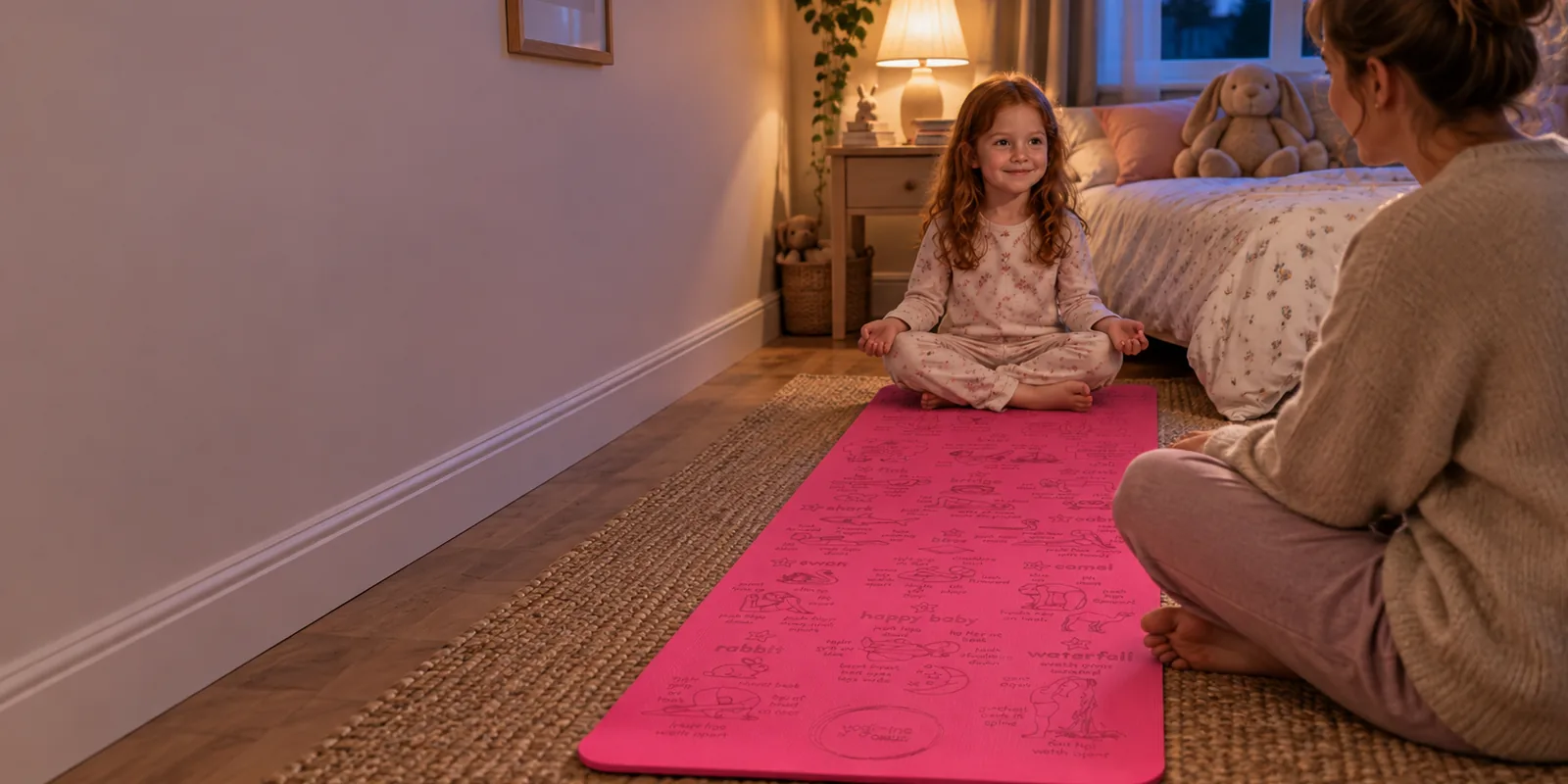
A relaxation routine ends with your child lying flat, so the floor matters. Our Freedom Flow mats are 183 x 61 cm, the length of an adult mat, so there's room to stretch out at three and still at eight. The 15 poses are numbered and laser-engraved into the surface, a calmer floor sequence from flower to waterfall with breathe-in and breathe-out prompts, so your child can roll it out and start at number 1 without you setting anything up or finding a video.
They're designed for ages 3 to 8. Three- and four-year-olds copy the poses with a little help, and older children lead their own wind-down. Under three, we'd wait. Each mat is 6 mm thick, made from TPE our supplier specifies as non-toxic and PVC-free, and weighs 800 g, so it rolls up on its carry strap between bedtimes. Use it on a dry, flat floor, and to clean it, wipe with a damp cloth and a little mild soap, then let it dry flat. If your child would rather move before they settle, our other design, Sun Salutation, has a more active set of 15 poses instead, at the same size and price.
If you're looking for a Christmas present that will still be in use after Boxing Day, this routine is ten minutes on a mat with the poses marked in, on any evening you like. Buying as a grandparent? It's full length, so you can have a go at butterfly too. Two children sharing a bedtime? There's 10 per cent off two or more mats.
For a wind-down with its own spot on the floor, our Freedom Flow mat is £34.99, with free UK delivery and 30-day returns. Choose from seven colours in our full-length yoga mats for children, or, for more presents, see our gift ideas that aren't another screen.
Frequently asked questions
What is progressive muscle relaxation for kids?
It means tightening one group of muscles for a few seconds, then letting go, and working round the body. With children we call it tight and floppy: squeeze the fists hard for a count of three, then let them flop.
What is yoga nidra for kids?
Yoga nidra is a guided relaxation from the yoga tradition, done lying still on the back while someone talks you round the body. With children, we tell it as a body scan story: a warm cloud travelling from the toes to the head.
Can relaxation help my child sleep?
It can be part of a calm bedtime routine. The NHS suggests starting a wind-down about 30 minutes before your child usually falls asleep and, for under-5s, no laptops, tablets or phones in the 30 to 60 minutes before bed. It is not a sleep treatment, so if problems carry on, talk to your health visitor.
What age can children start relaxation techniques?
Most children can start at about 3. Slow breathing, tight and floppy and a short body scan all work from then, because they need no imagining, just following your voice. Picturing a safe place usually lands from about 5. These ages are our own rough guide rather than a rule, so start with one technique and keep it to a couple of minutes.