practice
3 Person Yoga Poses for Kids: 8 Easy to Harder Ideas
Eight 3 person yoga poses for kids and grown-ups, from seated breathing to a standing circle balance. No lifting, no stacking, the easiest from age 3.
The easiest 3 person yoga poses for kids are seated: back-to-back breathing, the train and a blooming flower. Once those feel steady, move on to standing shapes such as a triple tree and a circle of dancers. In every pose here, all three keep their own feet or bottoms on the floor. Nobody is lifted, and nobody stands on anybody.
The eight below run easiest first and work for a parent and two children, two grown-ups and a child, or a grandparent joining in.
What are 3 person yoga poses?
3 person yoga poses, sometimes called 3 people yoga poses or yoga poses for three, are shapes that three people make together by holding hands, leaning on each other or balancing side by side, so the pose only works with all three. The circle, the line and the middle spot are what make three different from two.
Many pictures for this search show pyramids, with a child balanced on a grown-up's back. That's acrobatic yoga, which needs a trained base and a spotter, so nothing here does it.
With one grown-up and one child, try our partner yoga poses for two instead.
How do you use this list?
Start at number 1 and stop wherever it stops being fun. The first four suit ages 3 and up; the four standing poses come in from about 4 to 6. Two mats side by side give enough floor for most of the list; warrior wall needs a longer clear stretch.
- Give the youngest the middle spot, with support on both sides.
- Bare feet on a mat or a rug, not socks on a wooden floor.
- Keep it short. For under-5s, two or three poses is a whole session.
Are 3 person yoga poses safe for kids?
Yes, when everybody stays on their own feet or seat. Safe three-person yoga means holding hands, leaning gently and balancing side by side. The moves that go wrong lift a child, stack people, or pull a stretch further than a child would go alone. Three rules cover it:
- Nobody is lifted, and nobody stands or kneels on anybody.
- Lean, don't pull. Everyone moves slowly and together, and anyone can say stop.
- Never the knee. In tree pose the sole of the foot goes on the ankle, calf or inner thigh.
If anyone has a health condition that affects how they move, ask your GP first.
The 8 poses, from easy to harder
1. Back-to-back breathing for three
Sit cross-legged in a small triangle, facing outwards, backs and shoulders touching. Close your eyes, breathe in for three and out for three, and feel the others breathing through your back. Good from age 3.
2. The train
Sit in a line, legs wide, with the smallest at the front as the driver. The two behind rest their hands on the shoulders ahead. Sway left and right together, and let the driver call "tunnel" for a slow forward fold. Good from age 3.
3. Blooming flower
Sit in a circle facing in, knees bent and toes touching in the middle, and hold hands. Lean back slowly together until your arms are straight, then sit up again, a flower opening and closing. Good from age 3.
4. The dog tunnel
The two biggest people make downward dog, one behind the other, bottoms high, to form a long tunnel. The third crawls slowly through, then swap where you can. Grown-ups hold still while a child is underneath. Good from age 3.
5. Triple tree
Stand in a line, shoulder to shoulder, arms round each other's waists. Everyone lifts the same foot and rests the sole on the other ankle, calf or inner thigh, never the knee. The line balances as one tree. Wobble, reset, then swap feet. Good from about age 4.
6. Warrior wall
Stand in a row, chests facing the same wall, feet wide and front toes pointing the same way. Bend your front knee and stretch both arms out along the row until fingertips touch the next person's hand. Hold for three breaths, then turn round and swap legs. Good from about age 5.
7. Star circle
Stand close in a circle facing in, hold hands, feet wide like a star. Count to three, then everyone leans back a little until your arms are straight, so the circle holds itself up. If one of you is much bigger, that person leans less. Good from about age 5.
8. Circle of dancers
Stand in a circle, all facing the same way round, right hand on the shoulder of the person in front. Bend your left knee, take hold of your left foot behind you and lift it gently. Each person steadies the next, so the circle wobbles together. Turn round to swap sides. Good from about age 6.
Which 3 person pose suits your family?
Match the pose to the least steady person in your three, not the most confident. Seated poses suit toddlers and a grandparent who'd rather stay low. The ages are a rough guide, not a rule.
- Easy, from age 3: back-to-back breathing to calm down, the train, blooming flower, and the dog tunnel to burn off energy.
- Medium, from about 4 or 5: triple tree, with the youngest in the middle, and warrior wall.
- Harder, from about 5 or 6: star circle for timing and trust, and circle of dancers for a challenge.
With four, five or the whole household, try family yoga for the whole family.
Does three-person yoga count as exercise for kids?
Yes, mostly as light activity. The NHS says children aged 3 to 4 should spend at least 180 minutes a day on a variety of physical activities, including at least 60 minutes of moderate-to-vigorous activity. Most of the poses here are gentle, so they add to the variety rather than to that hour. For children aged 5 to 18, the NHS suggests an average of at least 60 minutes of moderate or vigorous activity a day, and breaking up long periods of not moving.
The UK Chief Medical Officers' guidance for 5 to 18 year-olds says physical activity builds confidence and social skills and develops co-ordination. For younger children, Department for Education early years guidance says adults can support balance, co-ordination and spatial awareness by creating games and chances to play.
How do you put a few 3 person poses together?
String three or four poses into a five to ten minute session, then finish with everyone lying flat for ten slow breaths. Three illustrative sessions:
- Before tea: the train, the dog tunnel, back-to-back breathing.
- With a grandparent on the floor: blooming flower, the train, back-to-back breathing.
- Two older children and a grown-up: triple tree, warrior wall, star circle, circle of dancers.
New to yoga with children altogether? Our beginner's guide to kids' yoga covers how long, how often and how to start.
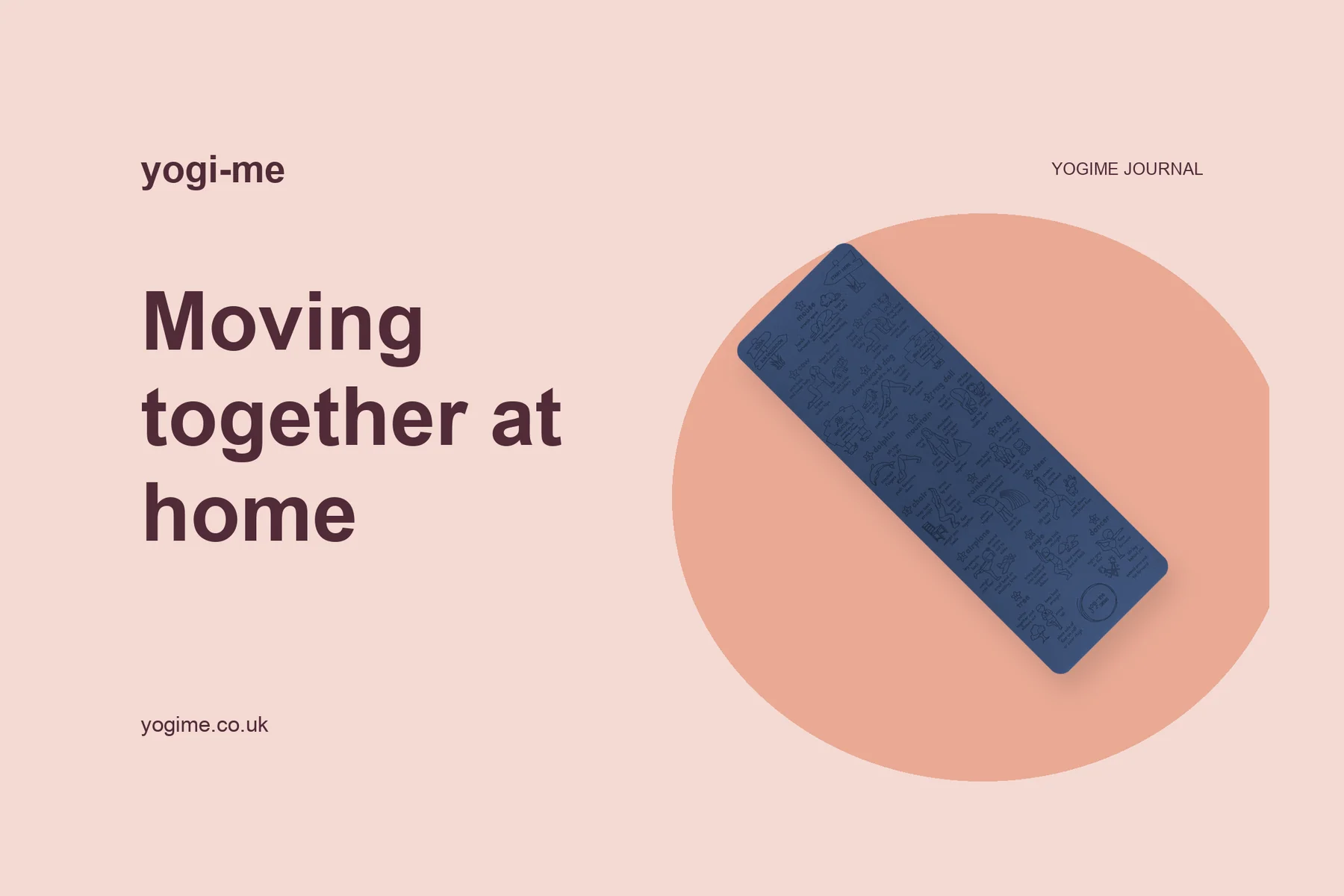
If you'd rather not hold the order in your head, our Sun Salutation design is a full-length mat with fifteen numbered poses marked in, and the solo shapes behind numbers 4, 5 and 8 above are on it: downward dog, tree and dancer. One child can read out the next number while the other two get into place.
What if your child doesn't want to join in?
Some children don't like being watched or held, and three can feel like two plus one left out. Don't push. Give them a job instead, calling the next pose or counting the breaths, or let them do the pose alone beside the other two.
If the poses don't land, turn them into a game. Our yoga games for kids use similar shapes with more running about.
Frequently asked questions
What are easy 3 person yoga poses for kids?
The easiest 3 person yoga poses for kids are seated or on all fours: back-to-back breathing in a triangle, the train, a blooming flower holding hands, and a dog tunnel to crawl through. All four suit children from age 3, need no lifting, and take a minute or two each.
Can a toddler do 3 person yoga poses?
Yes, the simplest ones. A toddler can sit at the front of the train or crawl slowly through a dog tunnel made by two grown-ups who hold still. Skip the standing poses until they're older, and keep it to a minute or two.
Are 3 person yoga poses the same as acro yoga?
No. Acro yoga lifts one person off the floor, with another as the base, and it needs training and a spotter. The 3 person yoga poses here keep everyone on their own feet or seat, holding hands or leaning gently, which is why they suit young children at home.
How much space do you need for 3 person yoga?
A space the size of two yoga mats side by side, roughly 183 by 122 cm, is enough for the seated poses, the triple tree and the standing circles. Warrior wall needs a longer stretch, because three people stand in a row with arms out. Clear anything hard or sharp from the edges first.
Two mats, room for three
Two Yogi-Me mats side by side make a space 183 cm long and 122 cm wide, enough for the seated circle poses and the triple tree above. Each is designed for ages 3 to 8 and is full length on purpose, so there's room to stretch out at three and still at eight. The trade-off is that a shorter mat is easier for a three-year-old to carry alone; ours weighs 800 g and rolls up with a carry strap.
Buying as a grandparent? It's the length of an adult mat, so you can take your place in the triple tree rather than watch from the sofa.
Sun Salutation is the standing sequence, for children who want to move. Freedom Flow is floor-based, for younger children or anyone who'd rather stay low. Both are non-toxic, PVC-free TPE, according to our supplier's specification, with 6 mm of cushioning. Three people means three sets of feet, so wipe the mat afterwards with a damp cloth and a little mild soap, and let it dry flat.
If you're looking for a present that gets used after Boxing Day, this one comes out on Christmas afternoon and again on a rainy January Saturday, with nothing to set up and no screen to follow. Two or more mats are 10 per cent off, so a pair makes a joint present for siblings or cousins. As Becks, a yoga teacher and verified buyer, put it: "I just made the mistake of buying one, instead of two." For more ideas, see our screen-free Christmas gifts.
Make room for all three: pick two colours from our kids' yoga mats. Each mat is £34.99 with free UK delivery and 30-day returns.
Sources
- NHS - Physical activity guidelines for children (under 5 years)
- NHS - Physical activity guidelines for children and young people (5 to 18 years), reviewed 23 October 2024
- GOV.UK (DHSC) - Physical activity for children and young people: 5 to 18 years, text of the infographic
- Department for Education - Help for early years providers: Core strength and co-ordination