practice
Yoga Challenge for Kids: 3 Levels of Poses
A yoga challenge for kids in three levels, green, amber and red, with a five-breath rule, a family scoreboard and the poses we leave out on purpose.
A yoga challenge for kids is a set of poses to work through, with a clear rule for what counts as done. This one has three levels, green, amber and red, all built from poses on our two mats. A pose counts when your child holds it for five slow breaths, and nothing is ever scored for bending further. It suits ages 3 to 8, at home, with no screen.
Search for a kids yoga challenge and the top results are videos. This one is written down, so it works on a rainy Sunday with the television off and a grown-up doing the counting.
How does the five-breath rule work?
A pose counts when your child holds it for five slow breaths, counted out loud by someone else. That's the whole rule, and it keeps the challenge about control rather than about who can stretch furthest.
A few house rules make it fair and safe:
- Bare feet, and a mat or rug that stays put. Socks on a wooden floor slip.
- Three tries per pose per day. Then move on and come back tomorrow.
- A wobble is fine. Falling out and starting again is a new try.
- Anything that hurts stops straight away, and it doesn't count as a fail.
- Three breaths counts for three and four-year-olds. Five is a long time when you're three.
The NHS wants exercise for 5 to 18-year-olds to be "suitable for their age, ability and experience", while new exercise should begin slowly and build gradually. Levels do exactly that. Children with a health condition should get medical advice, from their GP for example, before they start.
Green level: five poses anyone can hold
Green is for everyone, including the youngest. None of these asks for a one-leg balance or for the arms to hold the body up. The hard part is staying still.
1. Mouse
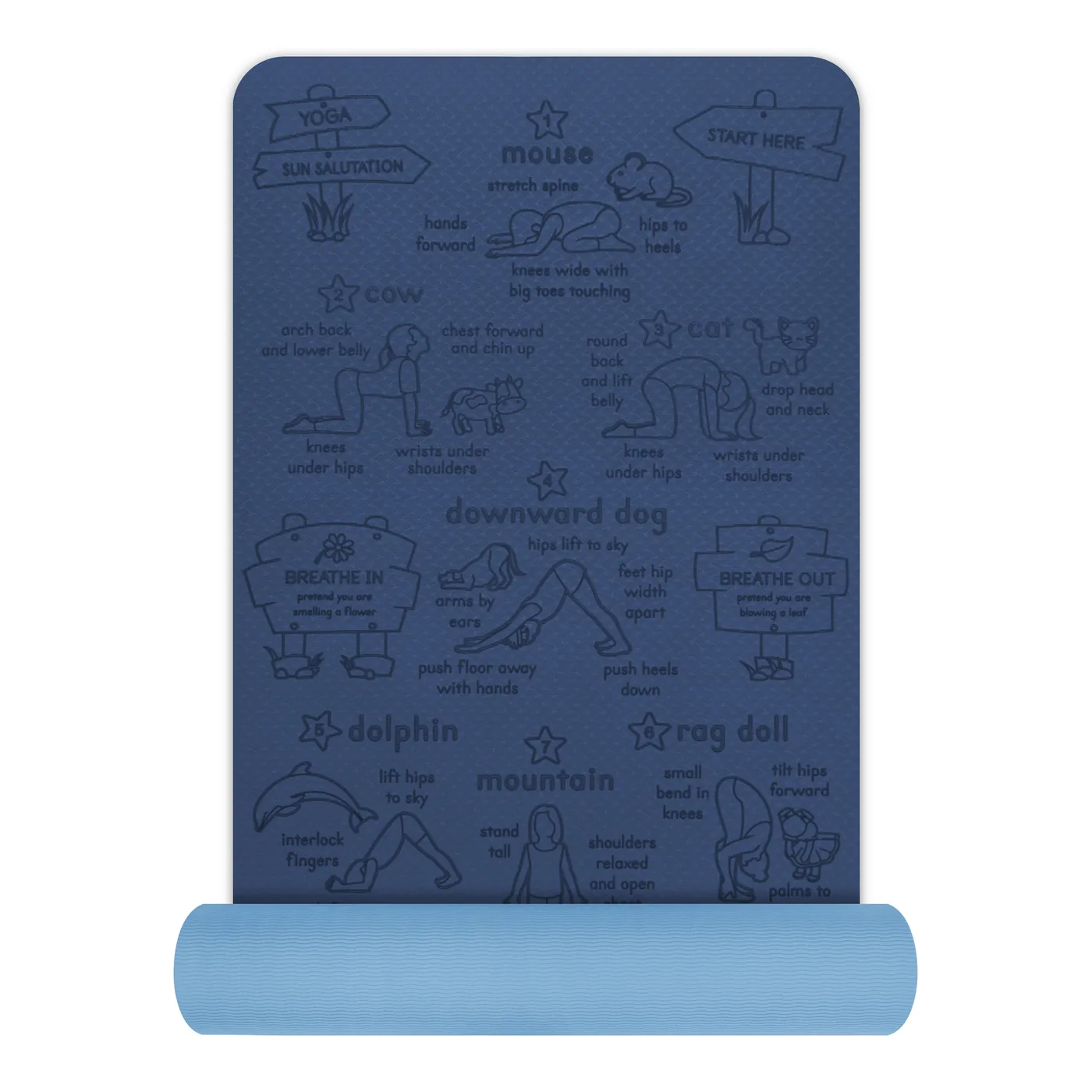
On Sun Salutation it's pose 1. Knees wide, bottom on heels, arms long on the floor ahead and forehead resting down, small as a mouse. It counts when your child stays curled and still for five breaths, without peeking up to check who's watching.
2. Cat
Pose 3 on Sun Salutation. Start on all fours, then arch the spine up towards the ceiling, chin tucked, like a cat that's just seen a dog. It counts when the arch holds for five breaths, rather than sagging back into a flat table halfway through.
3. Mountain
Feet together, arms hanging loose, standing as tall as a mountain. It sounds easy. It counts when your child stays completely still for five breaths, with no scratching, swaying or giggling, which is harder than any balance for some four-year-olds.
4. Butterfly
Sitting up straight, press the bottoms of the feet against each other and let both knees fall open like wings. It counts when the back stays tall and the hands rest on the feet for five breaths. Flapping the wings is allowed before and after, not during.
5. Star
Freedom Flow's pose 3. Sitting down, stretch the legs out wide in a big V, toes to the sky, palms on the floor between them. It counts when your child sits tall for five breaths. How far forward the hands creep doesn't matter, and nobody gets extra points for it.
Amber level: five poses that take strength
Amber poses ask the arms, tummy and legs to hold the body up. These are the ones that make children puff, so leave a rest between each.
6. Downward dog
From all fours, curl the toes under and push the bottom up to the sky until the body is a triangle with the floor. Heels can hover. It counts when the hips stay up for five breaths without the knees sinking back down.
7. Chair
Feet side by side, knees bent, bottom pushed back over an imaginary seat, arms stretched up beside the ears. It counts at five breaths with the bottom still back. Expect wobbly thighs by breath four. That's the challenge.
8. Boat
Sitting, tip back slightly and raise the legs and arms off the floor, so the body is a V floating on the bottom. Bent knees are allowed at amber. It counts when both feet stay off the floor for five breaths, however much the boat rocks.
9. Bridge
Lying face up with knees bent and feet flat near the bottom, press through the feet and raise the hips. It counts when the hips stay up for five breaths. Keep the head still and looking at the ceiling, not turning to see the scoreboard.
10. Crab
Sitting with knees bent, put the hands down behind, then press up until the tummy is flat and facing the ceiling, like an upside-down table. It counts at five breaths with the hips up. A sideways crab scuttle afterwards is optional and very popular.
Red level: five balances
Red is all balance, the part many children find hardest and like best once it clicks. Keep a wall nearby, and expect several days before a red pose counts.
11. Flower
The first pose on Freedom Flow. Sitting with the soles touching, thread the hands under the shins and lift both feet clear of the floor, keeping the back straight. It counts when both feet stay up for five breaths. Toppling backwards is normal, so stay on the mat for this one.
12. Airplane
Airplane, as the mat spells it, is a balance on one leg on Sun Salutation. Tip the body forward, send the other leg back and spread the arms like wings. It counts at five breaths without the lifted foot touching down. Do both legs; both must count.
13. Eagle
Pose 13 on Sun Salutation. Soft knees, bottom back a touch, and the arms wrapped around each other, one elbow resting in the bend of the other. It counts when the wrap and the bent knees hold for five breaths. Younger children can hug themselves instead, and that still counts.
14. Tree
Pose 14 on Sun Salutation. On one leg, place the other foot against the standing calf or inner thigh, never the side of the knee, and bring the palms together. It counts at five breaths without the foot slipping down. Fixing the eyes on one spot helps.
15. Dancer
Pose 15 on Sun Salutation. On one leg, catch the other ankle behind, stretch the spare arm out in front and lean forward a little. It counts at five breaths on each leg. This is the last pose on the mat and the last in the challenge, so it's fair that it's hardest.
How do you run a family yoga challenge for a week?
Give it a week, one level every two days, and a full run on the last day:
- Days 1 and 2: green. Everyone, every pose.
- Days 3 and 4: amber, with green as the warm-up.
- Days 5 and 6: red, with two greens to start and mouse to finish.
- Day 7: the full run, all 15 in order, with rests. Count the ticks.
For the scoreboard, draw a grid with names down the side and the 15 poses along the top, and tick each pose the day it counts. Mixed ages work if everyone starts on their own level: a four-year-old on green, a seven-year-old on amber, a grown-up on red. Better still, keep one family total, so a brother's tree and a sister's boat both add to the same number.
Doing it on our Sun Salutation mat? Every pose on it is numbered, so a child can find tree at 14 and dancer at 15 without being shown. The pose-by-pose mat comparison shows which poses are on each design.
Which poses are left out, and why?
Bigger back bends are deliberately not in the challenge. Bow, camel and waterfall are on our Freedom Flow mat, and rabbit puts the top of the head on the floor. All four are fine done gently and kept small. But a challenge makes children try harder, and trying harder is exactly what a back bend doesn't need. We'd rather nobody pushes a camel to earn a tick.
Headstands, shoulder stands and handstands aren't on our mats and aren't here either. Our guide to whether yoga is safe for kids explains which poses to leave out at home and why.
Poses that need a second person have their own pages. For a challenge with a brother, sister or grown-up, try our partner yoga poses for two, and for a bigger group, 3-person yoga poses.
Why a challenge can still go wrong
Some children love a scoreboard. Others go to pieces the moment they wobble in front of a sibling. If yours is the second sort, drop the individual ticks and keep only the family total, or let them be the one who counts the breaths for everyone else.
Watch for a child who keeps trying a pose that isn't coming, getting crosser each time. Three tries a day is a real rule, not a suggestion. And if the challenge has turned into a fight by day three, stop. The poses are still there next week.
Fifteen poses take ten minutes or so, which is a sliver of the day's activity. Pre-schoolers aged 3 and 4 need 180 minutes or more of activity every day, according to the NHS, spread from morning to evening. Older children need a mix too. The UK Chief Medical Officers' physical activity guidelines ask for "a variety of types and intensities of physical activity across the week". Holding a boat or a tree is a different kind of effort from running about, which is the point of a mix. If yoga with children is new to you, read our beginner's guide to yoga for kids before day one.
Frequently asked questions
What is a good yoga challenge for kids?
One with clear levels, a simple rule for what counts and nothing scored for bending further. A good start is five easy holds, then five that take strength, then five balances, each held for five slow breaths. Children can see their own progress, and a younger brother or sister can still finish a level.
What age can kids do a yoga challenge?
From about three, if the challenge is the right size. Three and four-year-olds can do the green level with a grown-up counting, and three breaths is plenty for them. Many five to eight-year-olds can work through all three levels over a week or two. Go by what your child can do, not by the age on the chart.
How long should a child hold a yoga pose?
We haven't found any UK guidance that sets a hold time for children's yoga. A few slow breaths is enough at home, which is why this challenge uses five, and three for the youngest. The NHS says new exercise for 5 to 18-year-olds should begin slowly and build gradually, so stop well before a pose turns into a strain.
What are some family yoga challenge ideas?
Give everyone their own starting level, so the youngest isn't racing the oldest. Keep one family total rather than individual winners, or have the children judge the grown-ups' red level. A week-long challenge with one level every two days and a full run on the last day keeps it going without anyone doing too much at once.
Ready for day one?
All 15 challenge poses are on our two mats, and the Sun Salutation design carries four of the five red balances, numbered in order. They're 183 x 61 cm, adult length, so the grown-up attempting red can take a turn on the same one. See all our yoga mats for children, or start tonight on a rug and see who reaches red first.