
guides
How to Deal with Tantrums in 3 to 5 Year Olds
How to deal with tantrums at 3 to 5: what to do in the moment, tantrum or meltdown, what helps afterwards, and when to see a GP. From NHS guidance.
To deal with tantrums in 3 to 5 year olds, keep your child safe, stay close and stay calm, and save the talking for later. Don't give in to whatever started it, and don't bribe your way out. Once it has passed, comfort them, name the feeling and keep the chat short.
What changes between 3 and 5 is how often tantrums happen. The NHS says toddler tantrums usually start at around 18 months, and that by the age of 4 they're far less common. So a three-year-old's tantrum is right on schedule. A five-year-old's is rarer, though the Welsh Government's parenting guidance notes older children can still have them.
Say your four-year-old started Reception in September, holds it together all day, then collapses on the hall floor at 3.45pm because their sister opened the front door first. This guide is for that moment.
What is a tantrum?
A tantrum is an outburst of crying, shouting, kicking or flailing that happens when a young child's feelings are bigger than their ability to put them into words. NHS Best Start in Life describes a tantrum as a toddler's way of saying "I need some help with my big feelings". It's a request for help, not a plan to ruin your afternoon.
Once a child can talk more, the NHS says, they're less likely to have them. The simplest triggers are physical: the NHS lists tiredness and hunger, along with frustration and jealousy. If worry seems to be behind the outbursts, our guide on how to calm an anxious child covers the signs.
Are tantrums normal at 3, 4 and 5?
Yes. Tantrums are a normal part of development, and the years from 3 to 5 are when they usually fade rather than vanish. The American Academy of Pediatrics (AAP), on its HealthyChildren.org site, says tantrums happen most between ages 1 and 3, tend to get better after 3, and don't go away entirely. Some children simply have more than others, partly down to personality, so watch the direction over months, not one bad week.
What is the difference between a tantrum and a meltdown?
A tantrum is when a child is still partly in control and may be trying to get something they want. A meltdown is when they're so overwhelmed they can't think or respond. The Welsh Government's Parenting. Give it Time guidance calls these an "upstairs brain" tantrum and a "downstairs brain" tantrum, or meltdown.
The guidance uses Dr Dan Siegel's hand model of the brain: in a downstairs tantrum, the child has "flipped their lid". It says younger children are much more likely to be having the downstairs kind, and need an adult to help them back to calm before anyone corrects the behaviour.
So with a three-year-old, assume overwhelm first. With a four or five-year-old, either kind is possible.
- Upstairs tantrum. The thinking brain is still connected. Stay calm, keep your no a no and offer a small choice. Avoid giving in or bribing with treats.
- Downstairs tantrum, or meltdown. They're overwhelmed and words don't land. Keep them safe, stay close, say very little and soothe. Avoid reasoning, telling off or shouting back.
- With either. Talk about it once they're calm, and keep it brief.
"Tantrum" and "meltdown" are everyday words, not diagnoses. If meltdowns are frequent, mention it to your health visitor or GP.
How do you deal with a tantrum in the moment?
To deal with a tantrum in the moment, make sure your child is safe, stay nearby and calm, and say very little. Don't shout back, reason or bargain, and don't turn a no into a yes to end it. The Welsh Government's guidance on managing tantrums puts it plainly: you can't stop a tantrum. What you can do is see it through well.
1. Catch it early if you can
If you see one building, the NHS suggests distracting your child straight away, even with something out of the window. Sound as surprised and interested as you can.
2. Make it safe
Move anything breakable and steer them away from the stairs. The Welsh Government's guidance says to move them somewhere safe, quiet and calm if needed.
3. Stay close and stay calm
The same guidance suggests a few reassuring words or keeping eye contact, so your child knows you're still there. If your temper is rising, count to ten or take a few deep breaths, and remind yourself, as NHS Best Start in Life suggests, that your child isn't just being naughty. They're learning.
4. Use very few words
When toddlers are upset, NHS Best Start in Life explains, the emotional parts of the brain take over and they find it hard to take in new information. Name the feeling in one short sentence, such as "You're really cross we had to leave the park", and stop there.
5. Hold your no
The NHS says giving in won't help in the long term, because your child learns that tantrums get results, and that bribing with sweets or treats doesn't help either. A small choice is different. The AAP's HealthyChildren.org advice suggests offering small, directed choices rather than yes or no questions, so "Do you want to walk to the car or hop?" gives them a little control without changing your answer.
6. Step in on hitting
The NHS advises against hitting, biting or kicking back. Make it clear that what they're doing hurts and you won't allow it. The HealthyChildren.org advice is to stop hitting or biting straight away, for example by moving your child out of the situation.
What about tantrums in public?
Tantrums often happen in shops, the NHS notes, and embarrassment makes it harder to stay calm. Its advice is to ignore the looks, keep trips short and let your child help. Deal with your child, not the audience.
What should you do after a tantrum?
After a tantrum, reconnect before you correct. Comfort your child, tell them you're proud of them for calming down, then talk briefly about what happened. NHS Best Start in Life calls this regulate, relate and reason: soothe them and name the feeling, show them you're still there, then talk once they're calm enough to learn.
Keep the reason part short. NHS Best Start in Life gives this example: "It's OK to feel angry that you couldn't play with the toy. Everyone feels angry sometimes. But it isn't okay to push others." Then let it go and get on with the evening.
This is where a calm-down routine belongs: after a tantrum, never during one. Three slow breaths, a stretch on the floor, a story on the sofa. Our guide to a calming corner at home gives that routine a spot in the house, and our emotional regulation activities for kids are sorted by when to use them.
How can you make tantrums less likely?
You can't prevent every tantrum, but you can cut out the easy ones. The Welsh Government's Parenting. Give it Time guidance suggests these five.
- Check HALT. Is your child Hungry, Angry, Lonely or Tired? A snack at pick-up is a cheap first move.
- Offer choices. Young children crave independence, the guidance says. "Apple or banana?" counts.
- Plan ahead. Take snacks and small toys when you go out. Our own addition for home: tell your child what happens next before the moments that tend to go wrong, such as leaving the bath or turning off the telly.
- Name feelings as they happen. Naming happy, sad, cross or frustrated helps a child learn the words, the guidance says, so they can express how they feel later.
- Move every day. The guidance suggests daily active play so they can let off steam. The UK Chief Medical Officers recommend children aged 1 to 5 get at least 180 minutes of physical activity a day, from climbing and dancing to games.
For calm skills to practise on good days, try mindfulness for kids or how to start yoga with your child.
When should you speak to a GP or health visitor?
The NHS says to talk to your health visitor or GP if you're seriously concerned about your child's behaviour. The Welsh Government's guidance adds that you can speak to your health visitor if you're concerned in any way.
It's worth a conversation if:
- tantrums are getting more frequent or more intense after age 4, when the NHS says they're usually far less common
- your child often hurts themselves or other people during them
- they seem worried or anxious much of the time
- you're finding it hard to cope, or feeling low yourself
For that last one, NHS Best Start in Life points parents to Every Mind Matters and local Family Hubs, and the NHS points to Family Lives, whose free helpline, 0808 800 2222, puts you through to a trained family support worker.
Frequently asked questions
What is the difference between a tantrum and a meltdown?
In a tantrum a child is still partly in control and may be pushing for something they want. In a meltdown they're too overwhelmed to think straight. The Welsh Government's guidance calls these upstairs and downstairs tantrums. With either, stay calm and don't give in, and with a meltdown, soothe first.
How do I stop a tantrum?
You usually can't stop a tantrum once it has started, so aim to see it through safely. Stay close and calm, say very little, and don't give in or bribe. The NHS suggests distraction can work if you catch a tantrum just as it begins.
Is it normal for a 5 year old to have tantrums?
Yes, now and then. The NHS says tantrums are far less common by age 4, and the Welsh Government's guidance notes that older children can still have them. If they're getting more frequent or intense, talk to your health visitor or GP.
Can adults have tantrums?
Adults lose their temper too. The NHS acknowledges you'll probably feel angry yourself at times, but unlike your child, you can express it in other ways. The Welsh Government's guidance says keeping calm yourself encourages your child to do the same.
A place for the calm-down routine
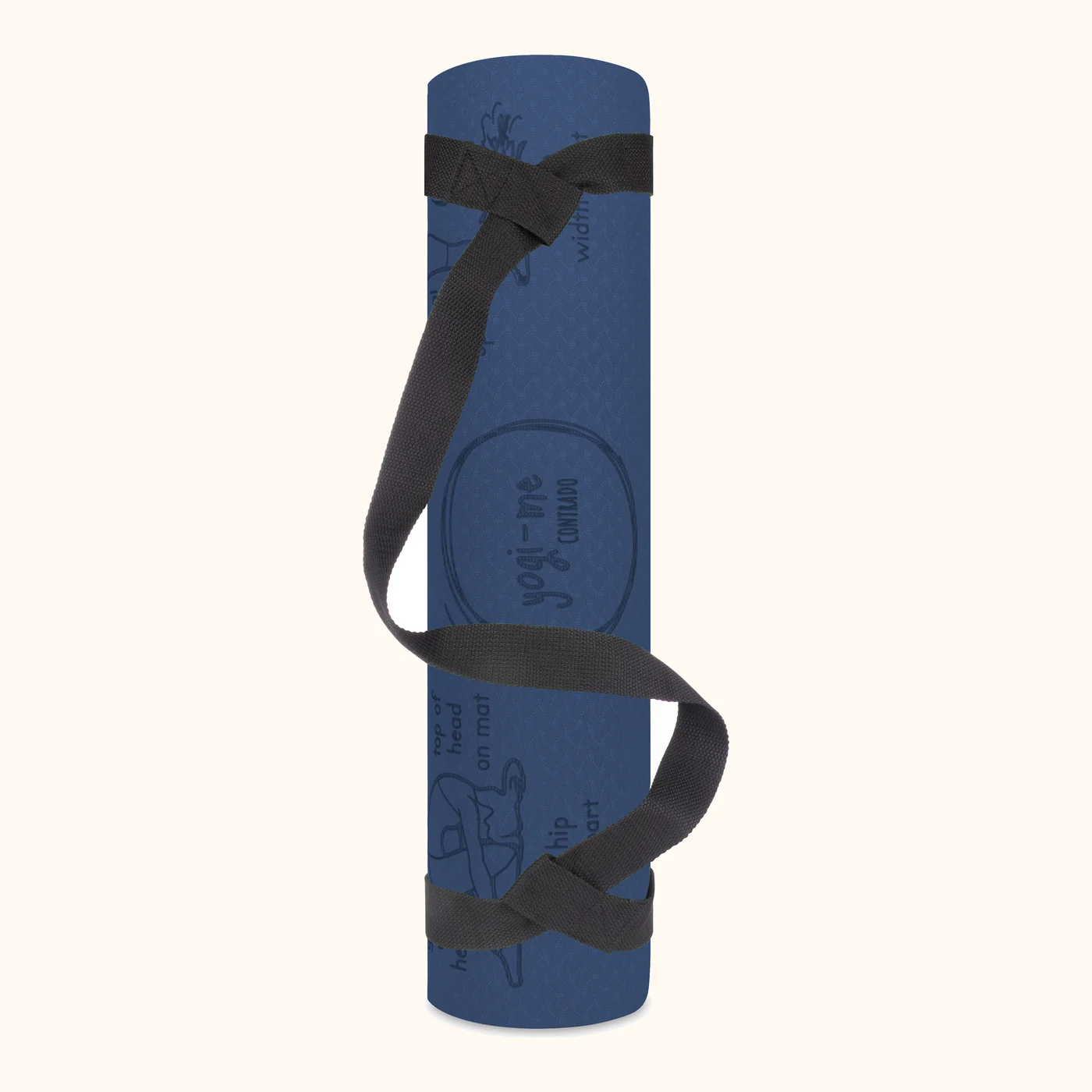
Nothing above needs you to buy anything. If you'd like the calm-down routine to have a spot of its own, this is what we make. Freedom Flow, one of our two kids' yoga mats, has 15 numbered poses laser-engraved into the surface, most of them on the floor, so a four-year-old can start at 1 and work along with no screen to follow. It won't stop a tantrum, and it isn't meant to. It gives the good days somewhere to happen.
It's designed for ages 3 to 8. Younger children copy the poses with a little help; older ones lead their own sessions. At 183 x 61 cm it's full length on purpose, so they won't outgrow it, and at 800g a five-year-old can roll it up and carry it on the strap without help. Wipe it with a damp cloth and a little mild soap, then let it dry flat.
Looking for a present that gets used after Boxing Day? It's as easy to start on a wet Saturday in January as on Christmas afternoon. Buying as a grandparent? There's room for you on it too. If a brother or sister will want their own, two or more mats are 10 per cent off, and our screen-free Christmas gifts list has more ideas.
Each mat is £34.99 with free UK delivery and 30-day returns. For the quiet after a hard afternoon, roll out a mat with a calmer floor sequence marked in.
Sources
- NHS - Temper tantrums, last reviewed 7 November 2022
- NHS Best Start in Life - Help your toddler with their emotions
- Welsh Government, Parenting. Give it Time - Big feelings and big behaviours (tantrums)
- Welsh Government, Parenting. Give it Time - How to manage big feelings and big behaviours (tantrums)
- American Academy of Pediatrics, HealthyChildren.org - Top tips for surviving tantrums, updated 21 April 2021
- GOV.UK - Physical activity for early years, birth to 5 years (UK Chief Medical Officers' guidelines)