practice
How to Play Hopscotch: UK Rules and 8 Variations
Learn how to play hopscotch with UK rules, a chalk grid, a ten-minute first game and eight variations, including one for children who can't hop.
How do you play hopscotch in the UK?
To play hopscotch, chalk a numbered grid, throw a flat stone into the first square, then hop through without landing on that square or the lines. Turn, collect the stone on your way back and repeat with the next number. Be first to complete every number to win: that's the basic British Council version.
Found a playground grid but forgotten the rules? Start below. Like other traditional playground games, hopscotch has variations: agree your rules before the first throw.
What should your chalk grid look like?
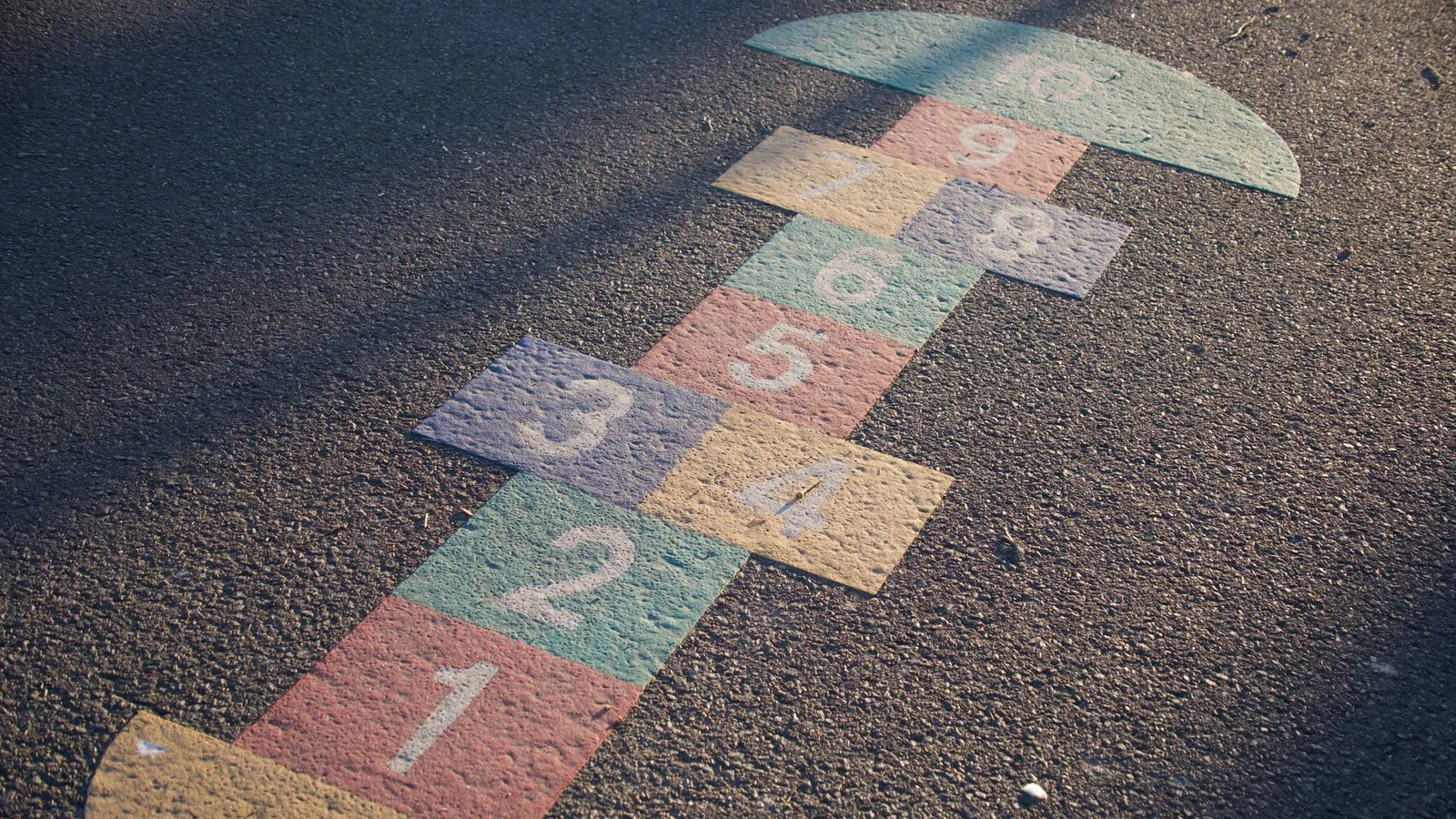
You'll need chalk and a flat stone as your marker. Draw ten connected squares, numbered from the start outwards:
- 1 on its own.
- 2 and 3 side by side.
- 4 on its own.
- 5 and 6 side by side.
- 7 on its own.
- 8 and 9 side by side.
- 10 on its own.
This is one layout to use; the BBC's hopscotch guide allows different combinations of single and double squares. Make each square comfortably big enough for your child's foot.
Keep the play area dry and clear of obstacles, following Royal Society for the Prevention of Accidents advice. Keep stones and broken chalk away from under-threes and children who mouth objects: the Child Accident Prevention Trust warns that small objects can choke young children. Leave out the marker if a younger sibling joins in.
How does a first ten-minute game work?
Try this after school or during weekend play. For ages 5 to 18, the NHS recommends breaking up long periods of sitting with activity. These timings are a suggested introduction, including setup; a full match can carry on afterwards.
1. Draw together, 2 minutes
Say, "Let's draw the boxes, then you can write the numbers," using the layout above and choosing who goes first. If your child would rather decorate the outside, let them: you can add the numbers and keep the playing spaces clear.
2. Try the path, 1 minute
Say, "Walk up the numbers and turn back," leaving the marker out while you demonstrate the route. If the single and paired squares get muddled, point to the next landing place instead of explaining the whole game again.
3. Aim for the first square, 30 seconds
Say, "Stand behind the start and gently throw into number 1," checking that the stone lands inside the border. If it misses, the next player takes a turn under the British Council's rules; during this demonstration, offer another practice throw.
4. Hop past the marker, 30 seconds
Say, "Miss the stone's square, hop into single boxes and land with a foot in each empty pair," following London Play's rules. If the stone occupies 3, land only in 2; touching a line or putting a second foot in a single square ends the turn.
5. Turn and bring it home, 30 seconds
Say, "Turn at the end, come back, and pick up the stone from the space just before it," then skip that square again, as the BBC explains. If reaching while balancing is too much, allow both feet down for practice.
6. Swap turns, 5 minutes
Say, "After a successful trip, aim for the next number on your next turn," continuing towards 10. If someone makes a mistake, keep their target unchanged; agree that when the marker reaches 10, you turn at 8 and 9, collect it and return.
7. Finish with a statue, 30 seconds
Say, "Step off the grid, put both feet down and be a statue while I count to five," then put the chalk and marker away. If the statues wobble or giggle, finish there anyway: nobody needs to win the last moment.
The timings add up to ten minutes. Only have two? Use an existing grid and take a practice turn each, without trying to complete a match.
Which eight variations could you try next?
Change one rule at a time. These are suggested adaptations, so choose the movement your child can already manage.
- Walking trail: for a three-year-old who can't hop yet, draw three squares, leave out the stone and walk through together, saying each number.
- Two-foot jumps: keep the short trail, but jump with both feet together into each square. Add the marker only when your child wants another challenge.
- Place, then play: put the marker in the target square by hand before returning to the start. Keep the hopping rules and remove the throwing challenge.
- Colour caller: replace numbers with coloured chalk circles inside the squares. Walk through the course, calling out each colour as you reach it.
- Countdown return: count upwards going out, then backwards coming home. Keep the usual foot pattern, with no extra jumping distance.
- Other-foot round: a confident hopper chooses the other foot for the next turn. Keep the grid unchanged and leave out the marker while trying it.
- Shared mission: siblings work towards one shared target number. One can walk and the other hop; either child's completed trip moves the team's marker onwards.
- Pose trail: chalk 1, 3 and 14. Walk to a number, then step off the trail for mouse, cat or tree, matching the Sun Salutation sequence.
What if hopping or losing a turn stops the fun?
Make the awkward part easier: place the marker, shorten the path or let your child walk. If rules are causing arguments, try the shared mission above and decide the walking and hopping options before anyone starts.
For example, a three-year-old could walk a short grid while a seven-year-old follows the full hopping pattern. Give each the same number of turns and count completed trips together.
If you're worried about your child's movement or progress, speak to your GP or health visitor. You don't need to turn the game into a test.
How can you make the next game easy to start?
Keep the chalk with your outdoor play things and let your child choose the next variation. After a gap, begin with a walk through the grid again. When they'd rather play something different, choose from these garden games with little equipment.
For the pose trail, Yogi-Me's Sun Salutation design has 15 numbered poses laser-engraved into the surface, for ages 3 to 8. Explore the mats for a numbered pose game.
Frequently asked questions
What happens if the stone lands on a line?
A stone touching the line doesn't count, so your turn ends. On your next turn, aim for that same number again. If you're teaching a beginner, agree to allow another throw during practice, then use the usual rule when you start a match.
Can a three-year-old play hopscotch without hopping?
Yes. Start with a short walking trail and leave out the stone. Your child can step into each square while you call the numbers together. The NHS explains that children learn movement skills at different speeds. Add hopping when your child wants to try it, rather than making it a condition of joining in.
Can you play hopscotch on your own?
Yes, hopscotch works as a solo game. Make up a small challenge before you start, such as a clean run without touching a line. You could keep a chalk tally of successful trips, pause whenever you like and choose a different challenge next time.
What is hopscotch called in Scotland?
Peevers is a Scots name for hopscotch. Dictionaries of the Scots Language also records peever as the name of the stone or counter used in the game. If someone in your family remembers playing peevers, invite them to draw their grid and explain the rules they used.
Sources
- British Council: How to play hopscotch
- BBC: Hopscotch rules of play
- London Play: Play Street Carousel
- Royal Society for the Prevention of Accidents: Playtime
- Child Accident Prevention Trust: Safe from choking
- NHS: Physical activity guidelines for children and young people
- West Yorkshire Healthier Together: Movement
- Dictionaries of the Scots Language: Peever