
guides
Wobble Board or Balance Board for Kids?
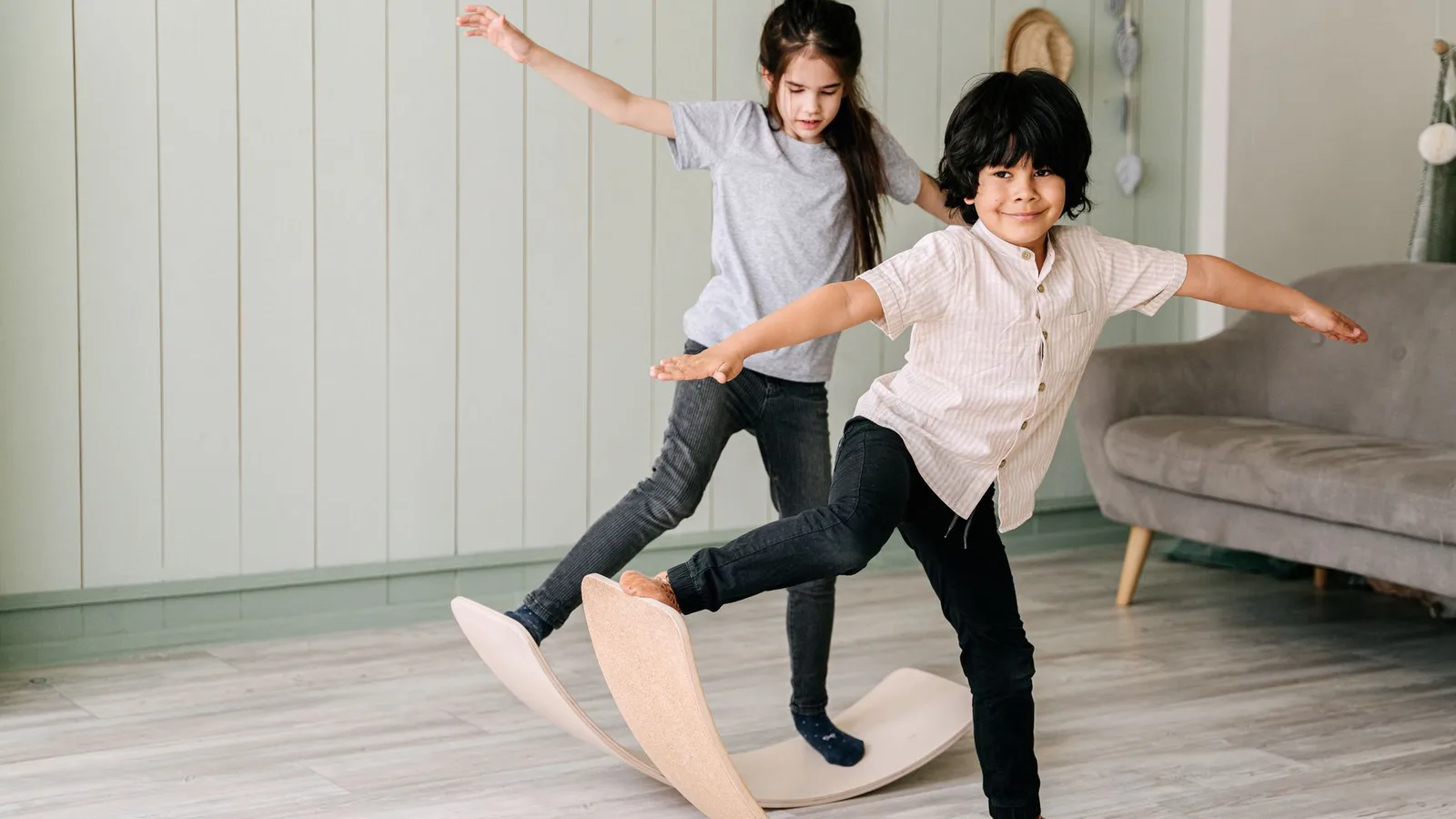
Choosing a wobble board for your child? Compare curved boards, flat rockers and dome-based boards by play, age guidance and floor space.
Which board suits the way your child plays?
Choose a curved wooden wobble board for rocking and make-believe, a flat rocker for back-and-forth balance games, or a dome-based board for tilting in several directions. Balance board is the broader name, so inspect the underside before choosing. The right purchase matches the play your child wants, the model's age guidance and the space you have.
- For a pretend boat: start by looking at curved boards and the play positions their instructions allow.
- For a keep-it-level challenge: compare a flat rocker with a dome-based board, watching how each moves.
- For a gift: ask where it will be used and stored before ordering. Our gift ideas for active children offer other directions if a board won't fit.
In this guide: board shapes, floor space, play, age labels, a comparison table, alternatives and common questions.
Why do the names on the box overlap?
A balance board is a platform that moves beneath you as you shift your weight. Wobble board describes several designs in everyday shopping language, including curved wooden boards. To make the comparison useful, separate the boards by their shape and base, rather than treating the names as competing products.
Curved wooden board
This is the broad wooden curve with raised ends. The curve itself touches the floor and provides the rocking movement. Its shape lends itself to make-believe, such as pretending it's a boat, alongside the uses shown in its instructions.
Flat rocker board
This has a flat standing surface above a fixed curved support or runners. It tilts along a single axis: forwards and backwards, or sideways, depending on how you stand. The top being flat doesn't mean the board stays still.
Dome-based wobble board
This has a flat platform above a rounded central base, allowing tilting in several directions. Look underneath: a dome is different from a loose roller.
Height and base shape also affect movement, as research into board geometry explains. These descriptions aren't a universal easiest-to-hardest ranking.
Will it fit the room as well as the cupboard?
Choose the board with its everyday home in mind. You'll need its dimensions, the manufacturer's floor instructions and any specified clearance, plus somewhere to put it away. A board fitting into a gap beside the sofa doesn't tell you whether that gap works for playing.
Draw its footprint on a simple room plan, then add the clearance in the instructions. Check the storage space separately, including the height of the curve or base. If it means moving the coffee table every time, decide whether you'll actually do that.
For the floor, follow the board's instructions about the surface and any underlay. Softness alone isn't a reason to add an exercise mat.
RoSPA's toy safety advice is straightforward: follow instructions, supervise young children, keep play areas tidy and put toys away afterwards.
Look for a board whose set-up fits an ordinary afternoon, including packing it away.
Does your child want a boat or a balancing challenge?
Choose the curved board if the shape itself is part of the attraction: your child wants to rock and pretend they're at sea. Choose a flat rocker or dome-based board if the attraction is the task of keeping a moving platform level. Both are reasonable reasons to buy.
For example, a child who likes inventing voyages might name their curved board and announce where they're sailing. A child who likes a clear challenge might prefer trying to keep a flat platform centred. These are examples of different interests, not predictions about age or personality.
Keep make-believe within the uses permitted by the instructions. Imagining a boat doesn't require turning the board into furniture or adding a ramp.
When comparing listings, look for a demonstration of the actual movement and instructions showing permitted positions. A photograph of somebody standing still tells you very little about what the board does.
What should the age label tell you?
Choose for the individual model's stated age range, rather than assuming every wooden board suits a preschooler. South Lanarkshire Council's toy safety guidance explains that age warnings concern safety. Being keen to copy an older sibling doesn't change the warning on the younger child's board.
For a child aged 3, shortlist only models whose stated age range includes them. For an 8-year-old, check the individual model just as carefully. Find its maximum user weight, permitted positions and supervision instructions; ask for anything missing.
GOV.UK's guidance for Great Britain says toys must come with appropriate instructions, safety information and warnings. It covers England, Scotland and Wales; Northern Ireland has separate guidance.
Check the board's condition too. The council advises checking hard toys for sharp edges and splinters, and stopping use of broken toys. Check for loose pieces or shedding coverings too: Wobbel's instructions warn that loose material can cause choking and that hands can become trapped beneath the edges. Remove loose material before play and teach children to keep their hands clear of rocking edges.
Look for clear information you can use, rather than a broad promise that a board suits everyone.
How do the board shapes compare side by side?
Use this table to narrow the shape, then compare individual models. The play suggestions are ways to choose between designs, while the measurements and instructions need checking on the actual board. Cost means the complete purchase, including any floor protection the maker specifies, rather than just the board's price.
- Standing surface, Curved wooden board: Curved; Flat rocker board: Flat; Dome-based wobble board: Flat
- What touches the floor, Curved wooden board: The board's curved underside; Flat rocker board: Fixed rocker support or runners; Dome-based wobble board: Rounded central base
- Movement, Curved wooden board: Rocks along its curve; Flat rocker board: Tilts along a single axis; Dome-based wobble board: Tilts in several directions
- Play to consider, Curved wooden board: Rocking and imagined voyages; Flat rocker board: Keeping the platform level along its rocking axis; Dome-based wobble board: Keeping the platform level as it tips in different directions
- Measurements to check, Curved wooden board: Length, width and curve height; Flat rocker board: Platform dimensions and base height; Dome-based wobble board: Platform dimensions and base height
The curved board is itself a kind of rocker. The distinction here is between a curved play surface and a flat platform on a rocking base. A flat board on a separate roller is another design again: the word flat alone doesn't distinguish it.
When is buying no board the better choice?
Keep your money for now if your main aim is simply to offer balance games, or if the board would spend its life behind furniture. Children and Family Health Devon suggests activities including walking along a line and standing on one leg. Neither requires a board.
Try walking along a line on the ground, then a standing balance with your hand available for support. Take turns choosing the next shape. The same NHS resource recommends hand support when children begin standing on one leg.
Our balance poses to explore together give you more ideas away from a moving platform.
For preschoolers, the NHS recommends varied activity across the day, including active and outdoor play. A board can be something your child enjoys within that mix; you don't need to organise the day around it.
What if you're buying because balance worries you?
If you're considering a board because you're worried about how your child moves, speak to your GP or health visitor first. West Yorkshire's NHS development guidance recommends asking for advice about movement concerns, and seeking advice urgently if a child loses skills they previously had.
Describe what you've noticed during everyday play, walking or dressing. If your child already has a physiotherapy programme, ask their therapist which equipment and activities belong in it before buying.
What will you actually get out tomorrow?
Picture the board in use on an ordinary afternoon: the room, the game and who'll be there. That picture is more useful than a long list of possible benefits. If you'd prefer floor-based pose play, explore Yogi-Me mats, with 15 numbered poses laser-engraved into the surface.
Frequently asked questions
Is a wobble board the same as a balance board?
A wobble board is a type of balance board, but shop names overlap. Curved wooden boards and flat boards with a rounded base can both be called wobble boards. Look at the underside and watch how the board moves: that tells you more than the product title.
What age can a child use a wobble board?
There's no single starting age for every board. Follow the individual model's age restrictions. The Child Accident Prevention Trust advises checking these and avoiding contradictory labels. A photograph showing a toddler doesn't override a warning that the toy is unsuitable for young children.
Are balance boards worth it for kids?
They can be worth it if your child enjoys the movement, you've got somewhere to use and store one, and you'll make time to get it out. Before buying, decide whether the appeal is rocking, pretend play or a balancing challenge. Choose for that activity rather than the photograph.
Do you need a mat under a wobble board?
Only use an underlay that the board's manufacturer allows for your floor. Check the instructions before adding one. Don't assume an exercise mat is suitable just because it's soft. If floor protection is specified, include it when comparing the full cost of the board.
Sources
- RoSPA: toy safety
- South Lanarkshire Council: toy safety
- GOV.UK: Toys (Safety) Regulations 2011, Great Britain
- Child Accident Prevention Trust: toy safety factsheet
- Children and Family Health Devon: balance activities
- NHS: physical activity guidelines for children under 5
- West Yorkshire Healthier Together: child development
- Scientific Reports: geometric principles of wobble board design