guides
Schemas in Play: 9 Common Patterns Explained for Parents

Understand the schemas EYFS staff notice, from throwing to wrapping, with nine play patterns, simple home activities and clear boundaries.
What are schemas in early years play?
Education Scotland describes play schemas as repeated actions through which young children explore how things work, such as dropping objects or carrying them around. Use that idea to notice what keeps returning in your child's play, then offer somewhere appropriate to try it. You can still say no to throwing the dinner.
The Early Years Foundation Stage (EYFS) is the framework for early education and care in England, as GOV.UK explains. It isn't the framework for the whole UK. Our guide to the areas of learning in the EYFS explains the wider nursery vocabulary.
The Department for Education's Development Matters guidance asks adults to allow time for repeated activities. It also says the guidance shouldn't become a tick list. You don't need to turn an afternoon of playing into an assessment.
Lists of schemas vary. The nine below are drawn from Bradford Council's early years resources, which also include posting and tipping. Birth to 5 Matters includes assembling in its examples, too. Treat the names as a way to describe an interest, not a programme to complete.
Which of the nine patterns looks familiar?
Look for the action your child returns to, then choose an outlet that fits your home. Below, each pattern has a plain-English explanation and a small activity to try. The activities are suggestions, so use what you already have and skip anything your child doesn't fancy.
The Child Accident Prevention Trust advises checking age restrictions and highlights small parts, accessible button batteries and long cords as hazards, especially for under-3s. The NHS also advises keeping plastic bags out of young children's reach. Use open baskets for carrying and cloths for wrapping toys.
1. Trajectory: throwing, dropping and moving
The National Day Nurseries Association describes trajectory play as exploring how bodies and objects move, including throwing and dropping.
Try rolling a large soft ball towards an empty basket laid on its side. Move the basket closer or further away. Keep the hard toys out of this game.
2. Rotation: round and round
Birth to 5 Matters includes rolling, wheeled toys and watching things spin among rotation examples.
Offer a toy vehicle to turn over and explore its wheels. For a game without toys, draw a big circle in the air with your hand and invite your child to copy it.
3. Enclosure: making a boundary
Education Scotland describes enclosing as making spaces with boundaries, such as fences around toy animals.
Try making a low pen from large blocks, with a soft toy inside. Leave an opening for a gate. Let your child decide whether the pen needs to be wider or narrower.
4. Enveloping: covering and hiding
Education Scotland links enveloping with covering and hiding objects.
Put a tea towel beside a teddy and an open box. Your child can wrap the teddy, uncover it, tuck it into the box and start again. Keep the wrapping game focused on toys.
5. Transporting: moving the whole collection
Birth to 5 Matters describes transporting as carrying or pushing things from place to place.
Set out an open basket and a few soft toys. Offer a delivery route between the sofa and a floor cushion. Use toys you've agreed can travel, so the remote control stays where you need it.
6. Connecting: joining and taking apart
Birth to 5 Matters gives joining train tracks and sticking models together as connection examples.
Offer large interlocking blocks or toy track suitable for your child's age. Invite them to join a long line, pull it apart and reconnect it differently. There's no need to finish a particular model.
7. Positioning: everything in its place
Birth to 5 Matters includes lining up objects among positioning examples.
Give your child a tray and some large blocks or soft toys to arrange. Let them choose a row, a circle or another layout. Ask before moving their arrangement to make room for something else.
8. Orientation: looking from another angle
Education Scotland describes orientation as exploring different viewpoints.
Try looking at a toy house from above while sitting, then from floor level while lying on your tummy. Ask, "What can you see from here?" Keep the activity at floor level, with no hanging from furniture.
9. Transforming: making something change
Bradford Council suggests dough as a resource for transforming play.
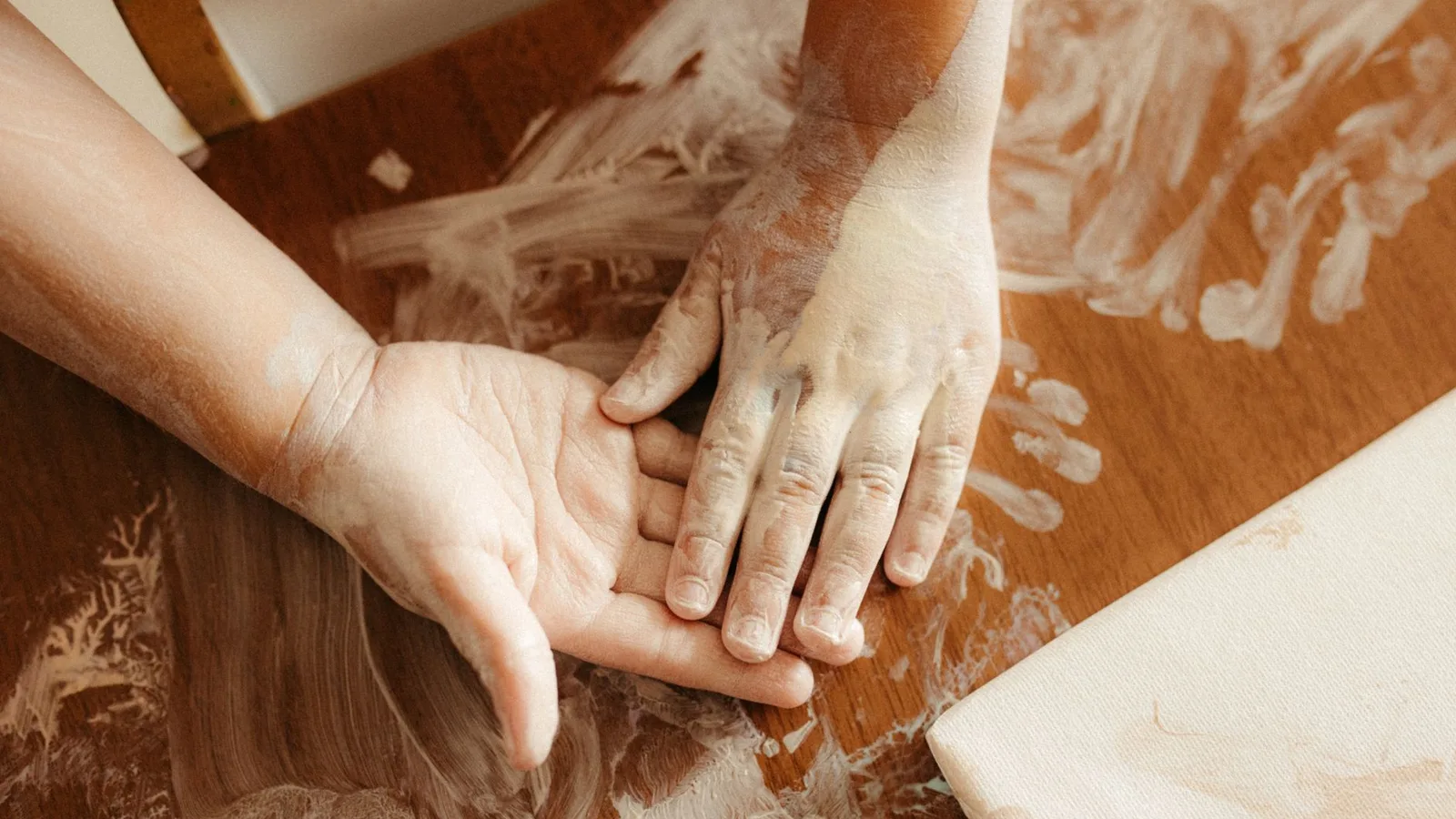
Offer a small amount of age-appropriate play dough on a tray. Roll it into a ball, flatten it and roll it again. Your child can choose the next shape. Follow the dough's age and use instructions. Check ingredients for allergens: play dough can contain wheat. Choose an alternative suitable for your child's allergies. Supervise play and keep the dough out of mouths.
How can you spot a pattern without testing your child?
Notice what happens during ordinary play before adding anything new. Birth to 5 Matters advises observing repeated, involved behaviour and cautions that fleeting interests aren't schemas. You don't need to arrange a test. Watch what your child chooses when they have familiar things to play with.
For example, say your child keeps moving cushions between rooms. Watch what happens after the journey: do they carry them straight back, arrange them around a space, or cover a toy? Describe the action first. Leave the label until later.
If you'd like something concrete to try, jot down:
- What your child chose to do.
- What they did with the same objects next.
- What you could offer another time.
A useful nursery conversation might be: "They keep carrying the soft toys into the hallway. Do you notice that here?" That's a question you can ask without deciding what the behaviour means.
For more ways to set out activities and let your child lead, see our guide to encouraging independent play.
Can you follow the interest and still say no?
Yes. You can offer room for a repeated action while deciding which objects, spaces and people are involved. The Department for Education recommends warmth alongside clear, appropriate boundaries. At home, make the permission specific: what your child can do, where they can do it and what stays off limits.
Here are some example phrases:
- "You can roll this ball towards the basket. The blocks stay on the floor."
- "These teddies can go in your delivery basket. Your sister's model stays on her table."
- "You can change the dough on this tray. The dough stays off the sofa."
A sibling's belongings don't have to become part of the experiment. Agree on a shared collection before the game starts, and let each child keep something out of it.
You can also choose an ending. Try: "After this delivery, the basket goes beside the sofa and we're having tea." If you're happy to save an arrangement, choose a place for it together.
The useful question is practical: what can your child repeat here without involving someone else's belongings or taking over the room?
What could you offer tomorrow without buying a play kit?
Choose an activity from the list and set out only what it needs. An open basket, a cloth or some existing blocks will do for several of the suggestions. Start with an invitation, then leave space for your child to choose what happens next. There's no need to introduce all nine patterns.
For a movement option, take turns choosing a body shape to copy. You can draw your own picture prompts on paper. If you'd like ready-made prompts, Yogi-Me mats for ages 3 to 8 have 15 numbered poses laser-engraved into the surface. Explore the engraved mats for a movement game.
Pick the smallest setup you can easily bring out again. Tomorrow's invitation can be the same basket and the same toys, without a new theme.
When is it worth asking someone about the repetition?
Speak to your GP or health visitor if you're worried about how your child plays, moves, speaks or learns. Hounslow Healthier Together's NHS guidance recommends seeking advice about developmental concerns, and seeking advice urgently if a child loses skills they previously had. Don't let a schema label put you off asking.
You can also talk to your child's nursery or school about what they notice. Bring concrete examples: what happens, when it happens and what concerns you. You don't need to decide which schema fits before asking for help.
Frequently asked questions
What are the nine schemas in play?
The nine covered here are trajectory, rotation, enclosure, enveloping, transporting, connecting, positioning, orientation and transforming. Bradford Council's resources include these patterns, alongside others such as posting and tipping. Use the names to choose play ideas, rather than treating them as a checklist your child needs to complete.
What's the difference between enclosing and enveloping?
Education Scotland describes enclosing as making boundaries, such as fences around toy animals, and enveloping as covering or hiding things. Imagine a teddy inside a ring of blocks, then the same teddy hidden under a cloth. Those are useful examples to try if the names feel too similar.
Should my child show all nine play schemas?
No. Education Scotland says some children show several schemas, some have a dominant one and some don't show schematic play. Use this guide to notice an interest, rather than to score your child. If you can't spot a pattern, start with an activity they choose.
Does throwing everything mean a trajectory schema?
It can fit: the National Day Nurseries Association includes throwing, dropping and kicking in its description of trajectory play. The useful next step is to choose an appropriate throwing game, such as aiming a large soft ball at a basket. Keep your rule about leaving hard objects on the floor.
Sources
- Education Scotland: Schemas, learning through play
- GOV.UK: Early years foundation stage
- Department for Education: Development Matters
- Bradford Council: Developmentally appropriate toys in early years
- Birth to 5 Matters: Schemas, repeated patterns of behaviour
- National Day Nurseries Association: Supporting Schemas
- Education Scotland: Schemas, learning through play booklet
- Child Accident Prevention Trust: Toy safety
- NHS: Baby and toddler safety
- Hounslow Healthier Together: General information about child development