guides
Risky Play: What It Is and Where to Draw the Line
What risky play means, its six original categories and where to draw the line, with UK guidance and practical examples for the park.
Is risky play something to encourage?
Risky play involves challenge, excitement and the possibility of getting hurt, as Play Wales explains. Yes, you can make room for it. Play Wales advises matching challenges to your child's abilities and managing the danger of serious harm. You can let them have a go without leaving every decision to them.
That might mean watching them tackle a climbing frame, rather than automatically saying no. It doesn't mean persuading them to climb higher. The useful question is: what can they try here, with the support and boundaries they need?
What does the Health and Safety Executive say?
The Health and Safety Executive (HSE) supports challenging play, with attention to serious dangers and hazards children cannot reasonably foresee. It asks providers to weigh up benefits and risks, accepting that mistakes and accidents can happen even when an activity is managed responsibly.
Its key line is:
"the goal is not to eliminate risk, but to weigh up the risks and benefits"
What are the six kinds of risky play?
Ellen Beate Hansen Sandseter's original research, published in 2007, identified six categories. They describe different kinds of challenge, from heights and speed to tools and exploration. Use them to understand what the term covers, without treating them as a list your child needs to complete.
These are everyday illustrations of the categories:
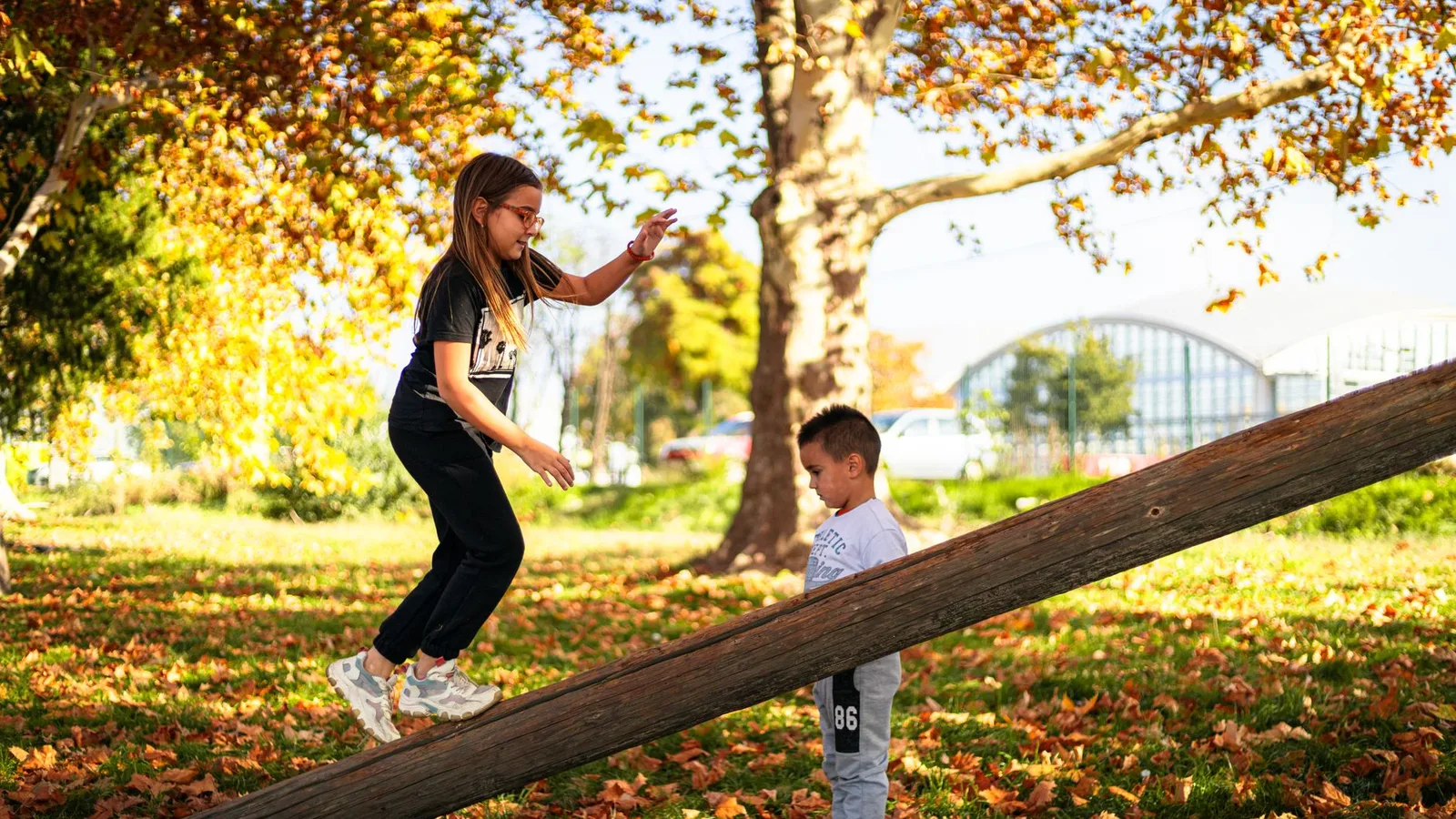
- Heights, What it can look like: Climbing, hanging or balancing above the ground.
- Speed, What it can look like: Swinging, sliding or running fast enough to feel a thrill.
- Tools, What it can look like: Using a real hammer or saw during a supervised activity.
- Dangerous elements, What it can look like: Activities near fire or water, where the surroundings carry a hazard.
- Rough and tumble, What it can look like: Play wrestling or other physical play with body contact.
- Disappearing or getting lost, What it can look like: Exploring somewhere unfamiliar or experiencing being out of an adult's sight.
The last label isn't an instruction to let a young child wander off. For a family outing, you could offer an exploring game within an agreed area while staying with them.
Tools, fire and water need particular care. Around fire, agree a boundary that keeps children back from the heat, and don't allow running or playing close to it, as Play Wales advises. The Forest School Association says tools and fires should be used only when appropriate to the children and after a risk assessment. The London Fire Brigade advises supervising children at all times in or around water and keeping them within reach.
What's the difference between a risk and a hazard?
A hazard is something that could cause harm; risk concerns how likely that harm is and how serious it could be. Those are HSE's definitions. At the park, ask both questions: what could hurt your child, and what might happen in these particular circumstances?
A climbing frame involves a possible fall. Your decision includes the height, the landing area, your child's ability and the help available. A broken fitting adds a different problem: it needs reporting and avoiding, rather than being accepted as part of the challenge. HSE's play guidance specifically warns against ignoring dangers caused by poor maintenance.
Here's an illustrative comparison:
- Your child wants to try a lower climbing route., A useful response: Look at the route and surroundings, then decide what support is needed.
- You cannot see the ground beyond a wall., A useful response: Check the other side before considering it for climbing.
- A branch looks dead or damaged., A useful response: Choose somewhere else to climb.
Play Wales' climbing guidance specifically flags hidden drops and decaying branches as dangers children may not recognise. A child's confidence doesn't settle those questions for you.
How do you decide when to watch, help or stop?
Start with the child and the situation in front of you. Play Wales says adults need to consider whether a challenge fits a child's current abilities. Use that principle to make a decision today, without assuming that yesterday's choice automatically fits a different afternoon.
For example, say your 4-year-old wants to climb while you're also looking after a younger sibling. Ask yourself whether you can give this activity the attention it needs. If you can't, choose something you can supervise together, or return with another adult. You can say, "We'll come back when I can stay beside you."
Then make your response specific:
- Watch: stay attentive while your child works out a manageable next move.
- Help: offer a prompt or the assistance they ask for.
- Stop: step in when there's a danger they can't manage, or they want to finish.
For climbing, Play Wales suggests helping children find secure places for their hands and feet, taking their time and using their route up to come down. It also advises against shouting "be careful".
Try a prompt such as "Where could your foot go next?" or "Would you like help coming down?" Give them time to answer, and help them down if they ask.
Afterwards, ask what they'd like to try another time. You can also explore our everyday ideas for encouraging confidence. Keep the conversation about their choices, without comparing them with the child who reached the top.
What if the worry goes beyond the playground?
Look at whether worry is affecting everyday life. The NHS advises seeking help when anxiety is severe, persistent and interfering with ordinary activities. If that describes your child, speak to your GP and, where relevant, their school. You don't need to solve it through a bigger physical challenge.
For concerns about how active a younger child is, the NHS suggests speaking to your GP or health visitor.
Before that conversation, note what your child avoids, what they still enjoy and what they say worries them. Take their own words along, without trying to fit them to a label.
What could you try on your next outing?
Offer a choice your child can accept, adapt or leave. The Department for Education advises patience, time and encouragement when physical confidence develops in smaller steps. You can apply that at the park by offering an easier starting point and letting your child decide whether to continue.
Start with a familiar park and offer a choice:
- Climbing: your child chooses a manageable part of the frame. Ask them to show you how they'll get back down.
- Speed: offer the swing or a running game in an open area you've checked. Let your child decide whether to join in.
- Exploring: let them lead you between familiar landmarks, such as the gate, a bench and a tree. Stay together.
These are suggested starting points. The NHS includes climbing, swinging and running around the park among activities for toddlers and young children.
You could agree simple words before starting: "Tell me if you want help" and "You can finish whenever you want".
If you want more options for a family outing, browse our outdoor activity ideas for young children.
For a separate indoor yoga session after your outdoor adventure, explore Yogi-Me's engraved pose mats. They're for ages 3 to 8, with 15 numbered poses laser-engraved into the surface.
Frequently asked questions
What are the benefits of risky play?
According to Northern Ireland's government service, nidirect, challenging play helps children discover their limits and learn to handle risk. Give your child room to choose and try. You don't need to turn a visit to the park into a test or ask them to copy a friend.
Is rough and tumble the same as fighting?
Play Wales distinguishes playful wrestling and chasing from deliberate hurting. Look for shared enjoyment, and agree that anyone can stop the game. Clear hard or breakable objects from the space first. If a child wants out or someone is being hurt, stop and help them choose something else.
How does risky play fit into the early years foundation stage?
The early years foundation stage (EYFS) applies in England, as GOV.UK explains. The Department for Education encourages physical challenges matched to each child's development. Ask your nursery how it balances the activity's benefits, supervision and hazards, and how children can choose a smaller challenge or decide to stop.
Can children get injured during risky play?
Yes. Play Wales says injuries can range from grazes to broken bones. Adults still need to assess each activity carefully and act to prevent serious harm. Enjoying a challenge isn't a reason to ignore broken equipment or let an unsafe situation continue.
Sources
- Play Wales: Risk and safety when your child plays
- Play Wales: Play and risk
- HSE: Children's play and leisure
- Ellen Beate Hansen Sandseter: Categorising risky play
- Forest School Association: Principles and criteria
- London Fire Brigade: Water safety advice for parents
- HSE: Managing risks and risk assessment at work
- Play Wales: Climbing and balancing
- NHS: Anxiety in children
- NHS: How to keep your baby or toddler active
- Department for Education: Gross motor skills
- nidirect: How play helps children's development
- Play Wales: Play fighting and rough and tumble
- GOV.UK: Early years foundation stage