guides
Educational Gifts for Kids: 12 That Don't Feel Like Homework
12 educational gifts for kids aged 3 to 8, sorted by school subject, from reading and maths to science, music and PE. All play, no homework.
The best educational gifts for kids aged 3 to 8 are things they'd choose to play with anyway that happen to practise what nursery or school is teaching: a dice game, a toy till with real coins, a magnifying glass, seeds to grow, a percussion set, a yoga mat with numbered poses. If it needs a worksheet, it's homework.
Below are 12 ideas sorted by school subject, for parents, grandparents and godparents. Nothing needs a screen. If you'd rather browse by type, our guide to screen-free Christmas gifts covers ages 3 to 8. For ideas sorted by the kind of play they start, see our presents for kids guide.
What makes a gift educational?
An educational gift is a present that lets a child practise something they're learning at nursery or school, through play, without it being set as work. It doesn't need "educational" printed on the box. A dice game and a grown-up to play it with is a maths present.
The Department for Education's early years foundation stage (EYFS) framework, the standards nurseries and Reception classes in England follow for children from birth to 5, says "play is essential for children's development".
From Year 1, at age 5 to 6, the national curriculum takes over. Its compulsory primary subjects include English, maths, science, design and technology, art and design, music, and PE.
How do you stop an educational gift feeling like homework?
Choose something a child can start on their own, can't get wrong on the first go, and gets better at with practice. If it comes with a right answer or a grown-up checking their work, it will feel like school. If it comes with a game, a mess or a challenge, it won't.
The EYFS framework wants children in early maths to "'have a go', talk to adults and peers about what they notice and not be afraid to make mistakes". A quick check:
- They can start without you.
- Mistakes are part of it. A tower that falls down is a result.
- There's a next level. One more coin, one more pose.
- Nobody marks it. No worksheets, no quizzing at teatime.
What are the best educational gifts for kids?
The best educational gifts for kids aged 3 to 8 cover the subjects they meet at nursery and primary school: a book of poems for reading, a letter-writing set, a yoga mat for PE, a dice game, a toy till, a clock and scales for maths, a magnifier and seeds for science, a wheeled building kit, art materials and instruments.
1. Reading: a big book of poems and rhymes
A book of poems grows with a child: rhymes to join in with at three, longer poems to read alone at eight.
The Year 1 English curriculum has children listening to and discussing poems, stories and non-fiction "at a level beyond that at which they can read independently", so read the harder ones aloud together.
2. Writing: a letter-writing set
Notepaper, envelopes, a few stamps and a good pen. Write a thank-you letter together after Christmas and post it, so their first piece of writing has a real reader.
3. PE: a yoga mat with numbered poses (ours)
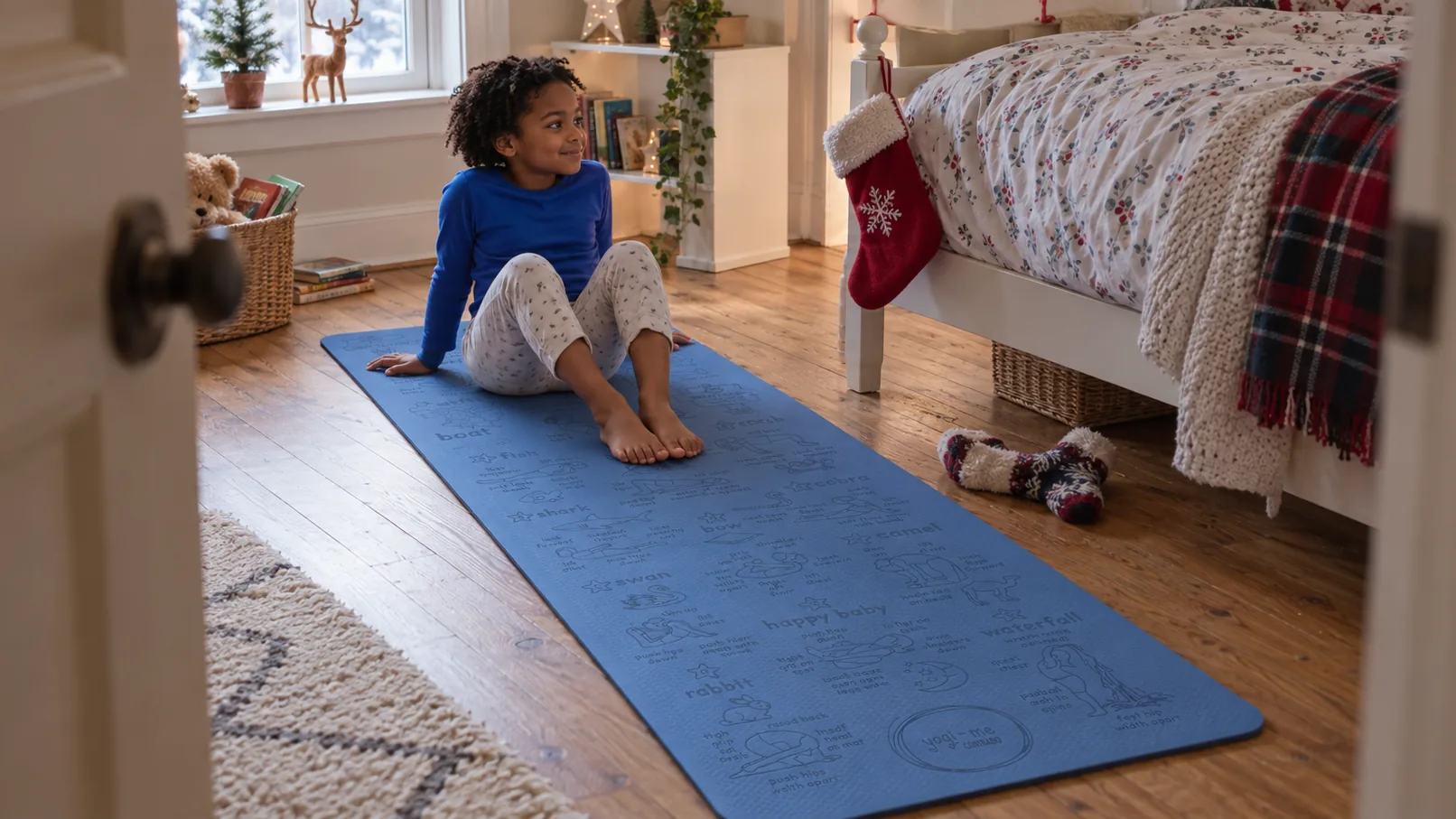
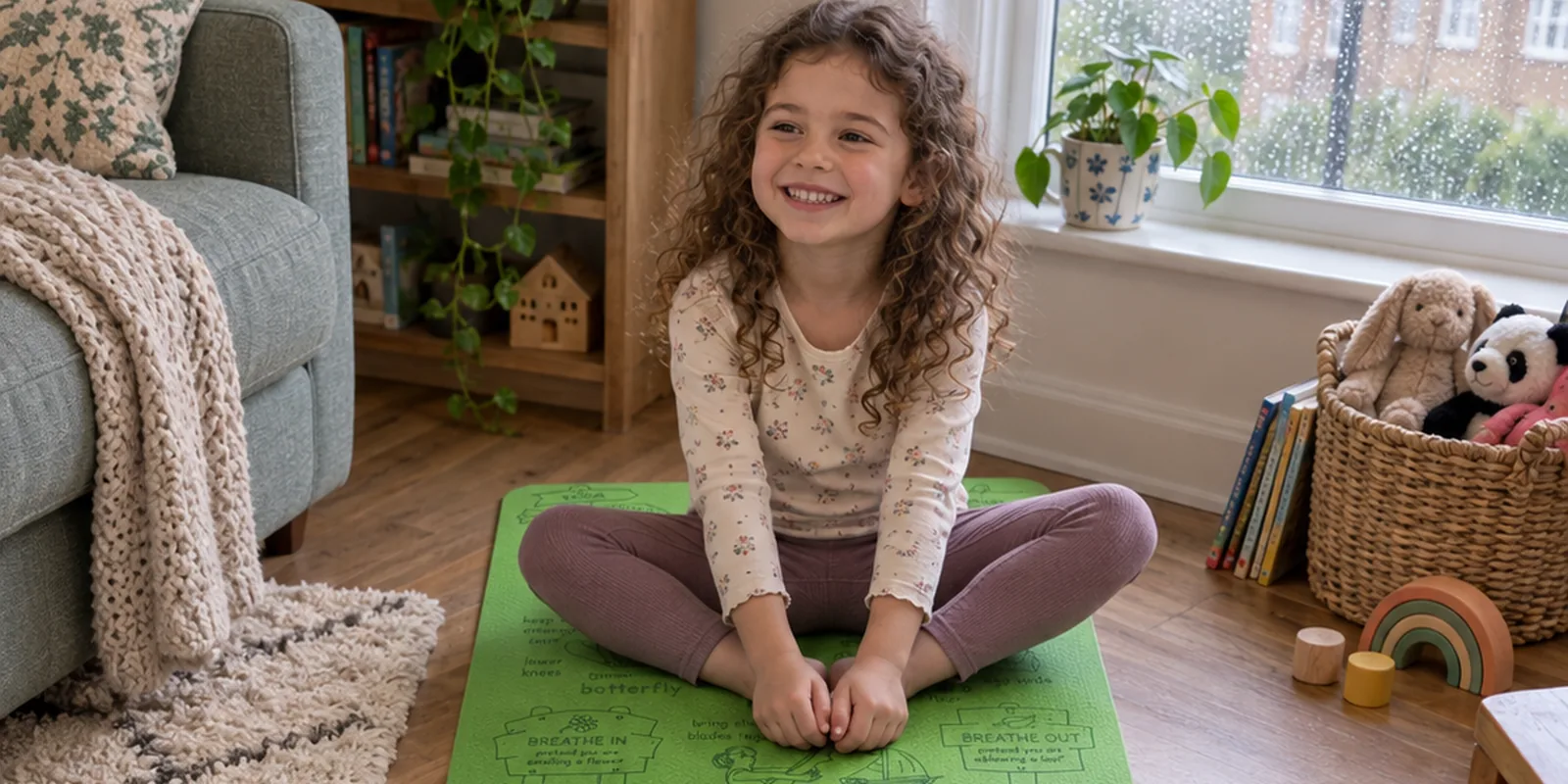
A yoga mat with poses on it gives a child balances and stretches to try, with no screen to follow. This one is ours, so weigh that. Our Sun Salutation mat has 15 poses laser-engraved into the surface, numbered 1 to 15, so a five-year-old can start at mouse and count their way through to dancer on their own.
Will it just gather dust after Christmas? There's nothing to set up or charge, so it comes out on a rainy January Saturday as easily as on Boxing Day.
New to it yourself? Start with our beginner's guide to kids' yoga.
4. Maths: a board game with dice
A simple race game puts counting, taking turns and losing gracefully in one box. Count the spots out loud, then let them move the counter.
The EYFS framework wants children to "count confidently" and to learn to "persist and wait for what they want", which describes waiting for a six quite well.
5. Maths and money: a toy till with real coins
A toy till, price labels and a purse of real pennies and 10p pieces turn the kitchen table into a shop.
The Year 1 maths curriculum asks pupils to "recognise and know the value of different denominations of coins and notes".
6. Maths and time: a wall clock with hands
An analogue clock in their bedroom makes the time part of the day, not a lesson. Start with "seven o'clock, breakfast". Year 1 maths covers the hour and half past, and the Year 2 guidance has pupils "become fluent in telling the time on analogue clocks".
7. Maths and measuring: their own kitchen scales
Kitchen scales and a simple recipe turn baking into weighing practice that ends in cake. Keep the oven a grown-up job. Year 1 maths has pupils "begin to use measuring tools such as a ruler, weighing scales and containers".
8. Science: a magnifying glass and a bug pot
A magnifying glass and a clear bug pot turn the garden into a field trip. Lift a log, count the legs, put every creature back.
The Year 1 science curriculum suggests observing plants closely, "perhaps using magnifying glasses", and returning animals "safely after study".
9. Science: a sunflower kit for spring
Sunflower seeds, compost and a few pots: opened at Christmas, sown in spring. Mark the sunflower's height against your child's. Year 2 science asks pupils to "observe and describe how seeds and bulbs grow into mature plants".
10. Design and technology: a building kit with wheels
A construction set with wheels and axles lets a child build something that moves. Set a challenge: a car that rolls the length of the hall. The Key Stage 1 design and technology curriculum includes mechanisms such as "wheels and axles".
11. Art: air-drying clay and a sketchbook
Air-drying clay, a sketchbook and decent paints give a child proper materials, not a kit with one right answer. The Key Stage 1 art and design curriculum asks pupils to use "drawing, painting and sculpture to develop and share their ideas".
12. Music: a percussion set and a glockenspiel
A glockenspiel plays notes; a drum or a shaker keeps a beat. Put on a song they know and let them keep time. The Key Stage 1 music curriculum asks pupils to "play tuned and untuned instruments musically". Agree a quiet hour before you wrap it.
Which educational gift suits which age?
Match the gift to your child's stage at school, not the number on the box. In England, Reception is the end of the early years, Key Stage 1 is Years 1 and 2, and Key Stage 2 starts in Year 3, at age 7 to 8, according to gov.uk's guide to the national curriculum.
- Age 3 to 4, nursery or pre-school: a book of rhymes, a yoga mat, a dice game, a magnifying glass or a percussion set.
- Age 4 to 5, Reception: any of those, plus kitchen scales, clay or a sunflower kit.
- Age 5 to 7, Years 1 and 2: a toy till with real coins, a clock with hands, a letter-writing set or a building kit.
- Age 7 to 8, Year 3: the harder end of each, such as a bigger building kit or a glockenspiel with a songbook.
More by age: Christmas gifts for 4 year olds starting school and Christmas gifts for 7 year olds.
What are good educational presents for 5 year olds?
Good educational presents for 5 year olds match what Year 1 brings: phonics, counting, coins and the time. A dice game, a toy till with real pennies, a clock with hands, a book of rhymes and something active to balance all the sitting still make a strong list.
Most five-year-olds in England this Christmas will be in Year 1, where gov.uk says pupils take the phonics screening check; the youngest will still be in Reception. Our Christmas gifts for 5 year olds has more.
What are some good educational gifts for a 10-year-old?
Good educational gifts for a 10-year-old cover the same subjects at a harder level: a more complex building kit, a real instrument, a cookbook with grown-up recipes, or proper art materials. Our list stops at 8 because that's the age range our mats are designed for.
How do you check an educational toy is safe?
Buy from a seller you trust, follow the age label, and check for small parts, magnets and button batteries before you wrap. That's the core of the Office for Product Safety and Standards' advice, Buy toys safely this Christmas (15 November 2021).
- Small parts. The OPSS warns they can be a choking hazard. Keep coins and dice away from younger siblings.
- Magnets. The OPSS says magnets can look like toys and should be kept away from children. Some science and building kits contain them.
- Recalls. Search the gov.uk list of product safety alerts, reports and recalls before you buy.
What are the best educational toys available in the UK?
The best educational toys available in the UK are the ones a child keeps playing with, not the ones with the longest list of skills on the box. Look for open-ended things that match what they're learning: books, dice games, building kits, art materials, instruments and something active. We don't rank brands, because the right one depends on your child.
Frequently asked questions
Are learning gifts for kids the same as educational gifts?
Yes. Learning gifts for kids, educational presents and educational toys all mean the same thing: a present that lets a child practise something they're learning, through play. The label on the box matters less than whether your child picks it up again the next day without being asked.
What's the hottest kids toy right now?
Hot toys come and go, so we don't chase them. A Christmas craze can be forgotten by spring, while a dice game, a building kit or a set of poses to work through always has a next level. If the hot toy is on the list, pair it with one present from this guide.
Is a yoga mat an educational gift?
It can be, in the way PE is a school subject. Physical development is one of the three prime areas in the EYFS framework, and PE is compulsory at primary school. A mat with numbered poses gives a child balances and stretches to try, and numbers to count along, but it's a present for moving, not a maths lesson.
Are educational gifts linked to the school curriculum?
The ones in this guide are matched to subjects children meet in the EYFS framework and the national curriculum at key stages 1 and 2: reading, writing, maths, science, design and technology, art, music and PE. The present doesn't need to follow a lesson plan. It just gives a child more practice at something nursery or school is already asking of them.
A present for PE
If PE is the gap on your list, our Sun Salutation mat has 15 numbered poses, from mouse to dancer. It's designed for ages 3 to 8: three- and four-year-olds copy the poses with a little help, and older children lead their own sessions. Under three, we'd wait. For a child who needs to settle rather than move, Freedom Flow has a calmer floor sequence at the same size and price.
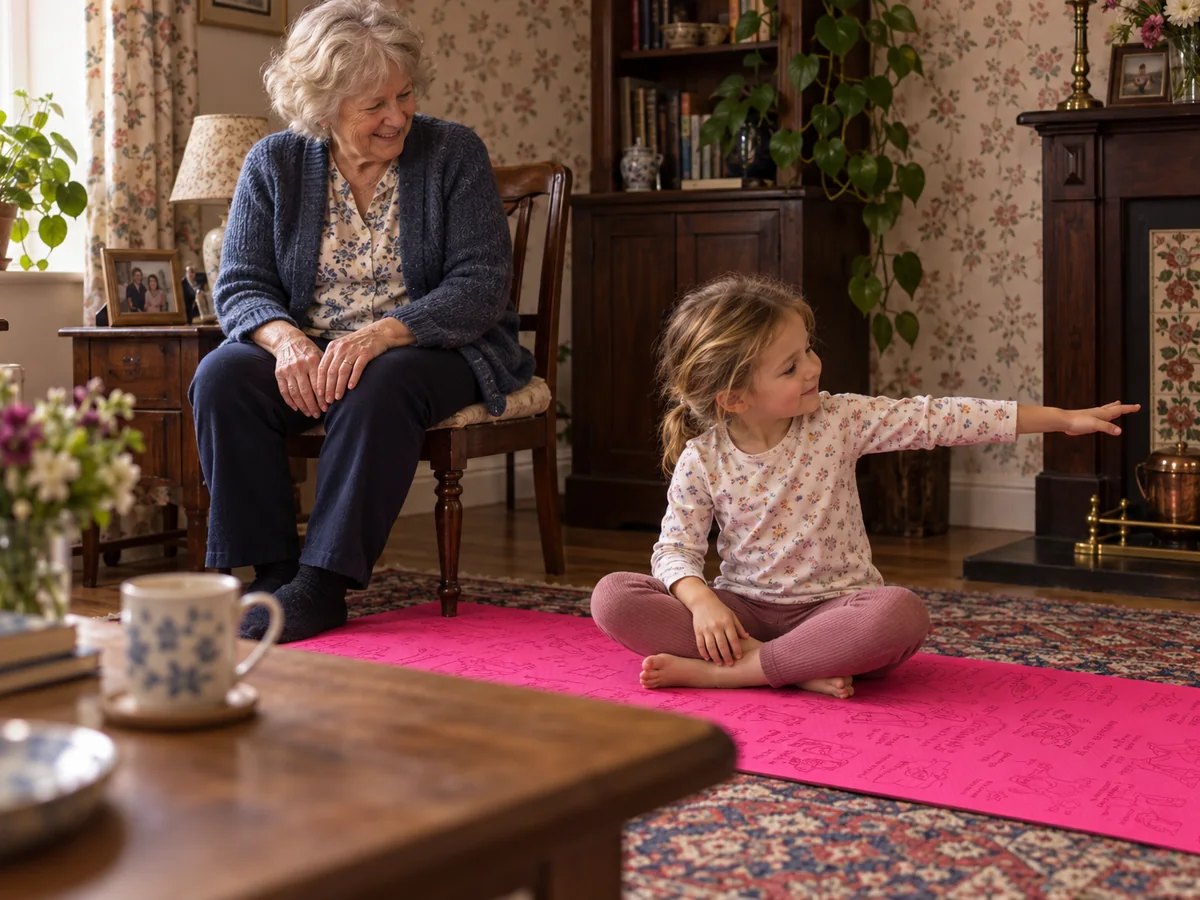
Buying as a grandparent or godparent? It's full length at 183 x 61 cm, so you can have a go at the tree pose alongside them, and they won't outgrow it at eight. If they'll carry it to nursery on their own every day, a shorter mat is easier. Ours weighs 800 g and rolls up with a carry strap.
It's 6 mm thick, made from what our supplier specifies as non-toxic, PVC-free TPE, and best used on a dry, flat floor. If it meets the clay from idea 11, wipe it with a damp cloth and a little mild soap and let it dry flat.
Buying for a brother, sister or cousin as well? Two or more mats are 10 per cent off.
Mats are £34.99 with free UK delivery and 30-day returns. Pick a colour for the PE present from our kids' yoga mats.
Sources
- Department for Education: Early years foundation stage (EYFS) statutory framework
- gov.uk: The national curriculum, key stage 1 and 2
- gov.uk: The national curriculum, key stages and year groups
- Department for Education: National curriculum in England, English programmes of study (updated 16 July 2014)
- Department for Education: National curriculum in England, mathematics programmes of study (updated 28 September 2021)
- Department for Education: National curriculum in England, science programmes of study (updated 6 May 2015)
- Department for Education: National curriculum in England, design and technology programmes of study (published 11 September 2013)
- Department for Education: National curriculum in England, art and design programmes of study (published 11 September 2013)
- Department for Education: National curriculum in England, music programmes of study (updated 26 March 2021)
- Office for Product Safety and Standards: Buy toys safely this Christmas (15 November 2021)
- gov.uk: Product safety alerts, reports and recalls