guides
Montessori Toys: What Counts, by Age
Find out what Montessori toys really are, with simple ideas for ages 1 to 6, things you already own and safety checks before you buy.
What actually counts as a Montessori toy?
Montessori toys are hands-on playthings inspired by Montessori education, usually with a clear purpose such as matching, fitting or pouring. The Association Montessori Internationale (AMI) describes purposeful materials and practical tasks as part of its approach. At home, look at what your child can do with an object. Wood and a Montessori label aren't enough on their own.
You don't need to clear out the toy box. The NHS suggests using things you already have and joining in with play, without making it expensive.
It helps to separate specific Montessori classroom materials from activities inspired by the approach. Cylinder blocks are a classroom material described by AMI; matching socks on a tray is a home activity. Both give you something concrete to consider, beyond the word on the packaging.
How can you see past the Montessori label?
Read the description for an actual activity: what your child handles, what they do with it and what happens next. Use these checks to compare a toy with Montessori principles. Treat a claim such as “educational” as a starting point for questions, not your reason to buy.
- A clear focus. AMI's glossary explains that sensorial materials isolate a quality such as size or colour. As a home adaptation, try matching plain socks before adding a mixed pile with different patterns.
- Something for your child to do. Look for an action you can name: post, pair, carry, pour or wipe. If a listing promises “brain training”, ask what the child actually does.
- A result they can check. AMI calls feedback within an activity control of error. A cylinder that won't fit its remaining socket is an example. You aren't required to announce every mistake.
- A useful purpose. A cloth can wipe an actual spill; a jug can pour a drink. You can offer a real job without buying a miniature household set.
Wood, natural textures and tidy shelves may appeal to you. They don't answer those questions. Before paying for another set, compare it with something you own: does it offer a different activity, or another version of the same one?
For a child who already has nesting cups, a second stacking set might add little to your plans. You could try a different kind of activity, such as matching laundry, before deciding what to buy.
Which Montessori toys suit ages 1 to 6?
Start with your child's current interests, then check the product's age warning. AMI advises following the child's interest rather than treating teaching ages as deadlines. These examples are home suggestions for ages 1 to 6, not a development checklist or a replacement for the safety label.
- 1, Something to look for: Large nesting cups labelled for that age; Something you may already own: A few clean, unbreakable bowls to put inside one another
- 2, Something to look for: A simple large-piece inset puzzle; Something you may already own: Two pairs of adult socks to match on a tray
- 3, Something to look for: A small unbreakable jug and cup; Something you may already own: Containers for pouring a little cold water, with you alongside
- 4, Something to look for: An activity using a real fastening; Something you may already own: A zipped coat laid flat, ready to open and close together
- 5, Something to look for: A counting or matching activity; Something you may already own: Plates and spoons to lay out, one of each for everyone at tea
- 6, Something to look for: A ruler and paper for measuring; Something you may already own: Two books to compare by length and record on paper
If you're choosing Montessori toys for 3 year olds, the jug-and-cloth option gives you a clear job: pour, then wipe up. Start with that, rather than adding a quiz about colours and numbers while they're trying it.
The same equipment can come out again with a different invitation. With socks, for example, begin by finding a matching pair; another time, arrange pairs from smallest to largest. These are suggested variations, not levels to pass.
Buying a present for a toddler? Our gift ideas for 2 year olds offer a wider choice beyond the Montessori label.
What changes when a younger sibling can reach it?
Set up the play area for the youngest child who can reach it, not just the child a toy was bought for. The NHS advises keeping older children's toys away from babies and toddlers because they may contain small parts. An open shelf needs the same check.
In a shared room, apply that NHS advice by storing the older child's small-piece activities out of reach and bringing them out separately. Use a tray to gather the pieces afterwards, then return the whole activity to its storage place.
Keep the safety check straightforward:
- The NHS says toys marked unsuitable for children under 36 months mustn't be given to under-3s, and advises checking for sharp edges and small parts.
- NHS home safety advice says to keep small objects, button batteries and loose cords away from babies and toddlers. Leave loose beads, coins and lacing cords out of their activity trays.
- For pouring, the NHS says never to leave a young child alone with water. Its toy advice also says battery compartments should be secured with a screw.
When buying, GOV.UK explains the marking rules: CE or UKCA in England, Scotland and Wales; CE, sometimes accompanied by UKNI, in Northern Ireland. Check for the maker's name and contact address, plus clear instructions and warnings. “Montessori” isn't a substitute for those checks.
How can you try the idea with what you own?
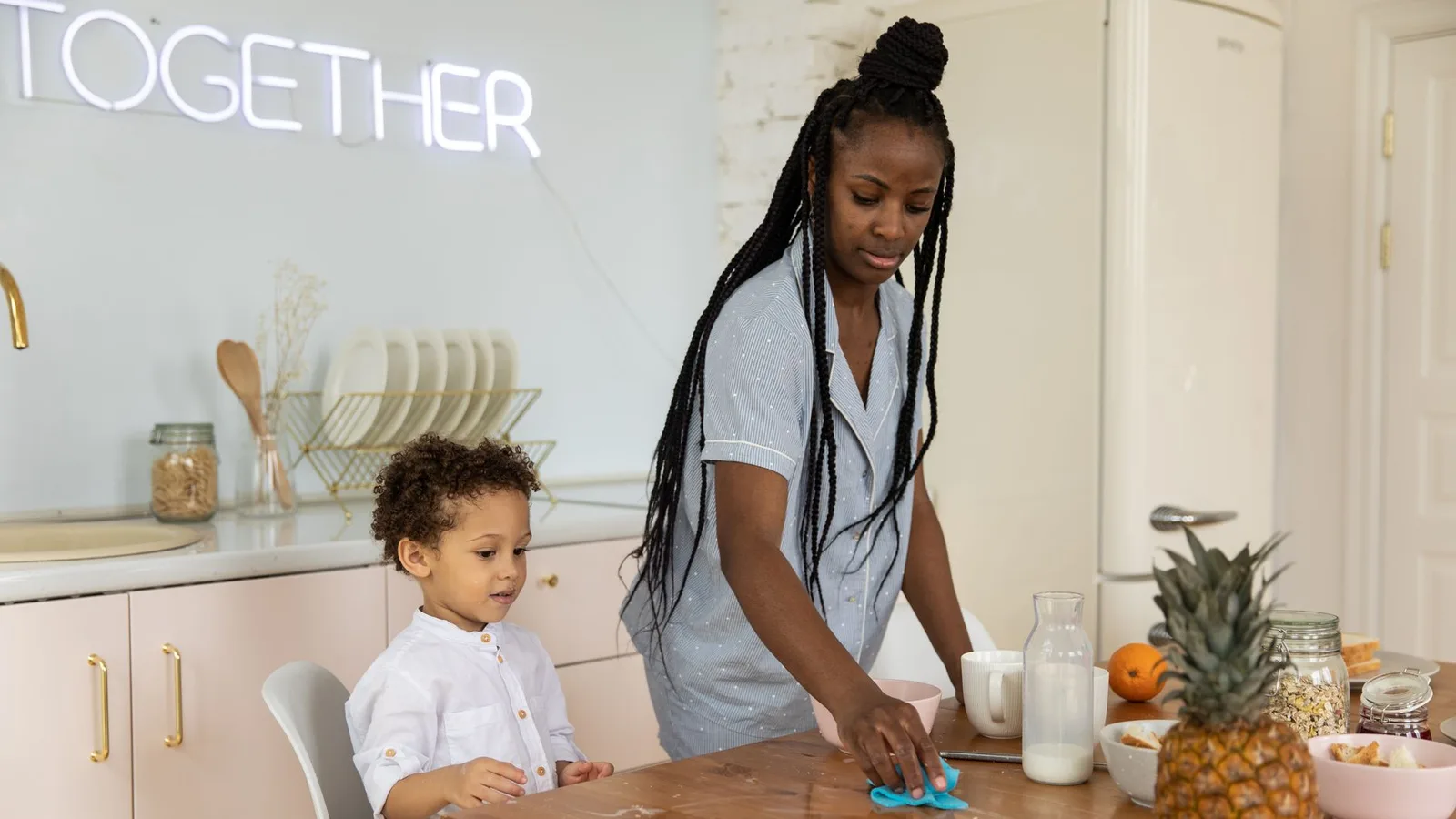
Pick a real job or an existing toy, gather what it needs, and show the action before handing it over. For a first try, use a damp cloth and a small patch of table that needs wiping. Leave the rest of the kitchen out of it.
- Make the job manageable. Put the cloth on a tray beside the table. There's no need to present every household task at once.
- Show a slow example. AMI's guidance on presenting activities describes demonstrating step by step with few words. Wipe the patch, then put the cloth back.
- Offer a turn. Invite your child to have a go. Stay available, but leave room for them to make their own attempt.
- Finish without a score. Put the things away together. If the activity isn't chosen, set it aside and offer something else another day.
You can apply the same setup to an existing puzzle: find its pieces, show where they belong and leave it ready to use. Our ideas for encouraging independent play explore how to make room for play without planning every moment.
Movement can be another real activity to choose. If your child already enjoys yoga, Yogi-Me's mats are for ages 3 to 8 and have 15 numbered poses laser-engraved into the surface. Explore the mats for hands-on yoga as one optional addition alongside household activities and toys you already own.
What if you're worried about how your child plays?
If you're worried about your child's development, follow the NHS advice to speak to your GP or health visitor; you can raise concerns between scheduled reviews. Explain what you've noticed in everyday life, including play, rather than using the age band on a toy as a test.
Make a short note of what concerns you and any questions you'd like to ask. You can also ask their nursery or school what they've noticed. Bring that information to the conversation, rather than buying more challenging toys as a way of checking.
Frequently asked questions
What toys are considered Montessori?
Look for a clear hands-on activity, such as fitting or matching. The Association Montessori Internationale describes sensorial materials that isolate a concept such as size or colour. A simple shape puzzle may borrow that approach, but it isn't automatically one of the specific classroom materials.
Do Montessori toys have to be wooden?
No. The Montessori Society describes classrooms containing wooden shapes alongside ceramic jugs and bowls. It also describes brightly coloured materials, so beige isn't a requirement. Choose around what your child will do with an object, rather than making the whole toy cupboard match.
Which Montessori toys suit a 2-year-old?
Start with a large-piece posting toy or simple puzzle labelled for their age, or try wiping a table together. The Montessori Society includes posting, puzzles and cleaning in its infant activities. These are starting points for choosing something to try, not tasks your child must master by their second birthday.
Does Montessori mean no pretend play?
No. The Association Montessori Internationale says Montessori wasn't opposed to children's pretending. Its emphasis on real experiences doesn't require you to remove dolls or dressing-up clothes. You can invite your child to wipe the table before lunch and still accept a pretend cup of tea from them afterwards.
Sources
- Association Montessori Internationale: Glossary of Montessori Terms
- Association Montessori Internationale: Control of Error
- Association Montessori Internationale: Supporting Renewed Engagement
- NHS: Baby and toddler play ideas
- NHS: Baby and toddler safety
- GOV.UK: Toys (Safety) Regulations 2011: Great Britain
- NHS: Your baby's health and development reviews
- Association Montessori Internationale: Sensorial Materials Promoting Learning
- Montessori Society AMI UK: Children's House
- Montessori Society AMI UK: Infant Programmes
- Association Montessori Internationale: Montessori, Imagination, and Young Children