guides
Pencil Grip Stages: What's Normal From 2 to 6
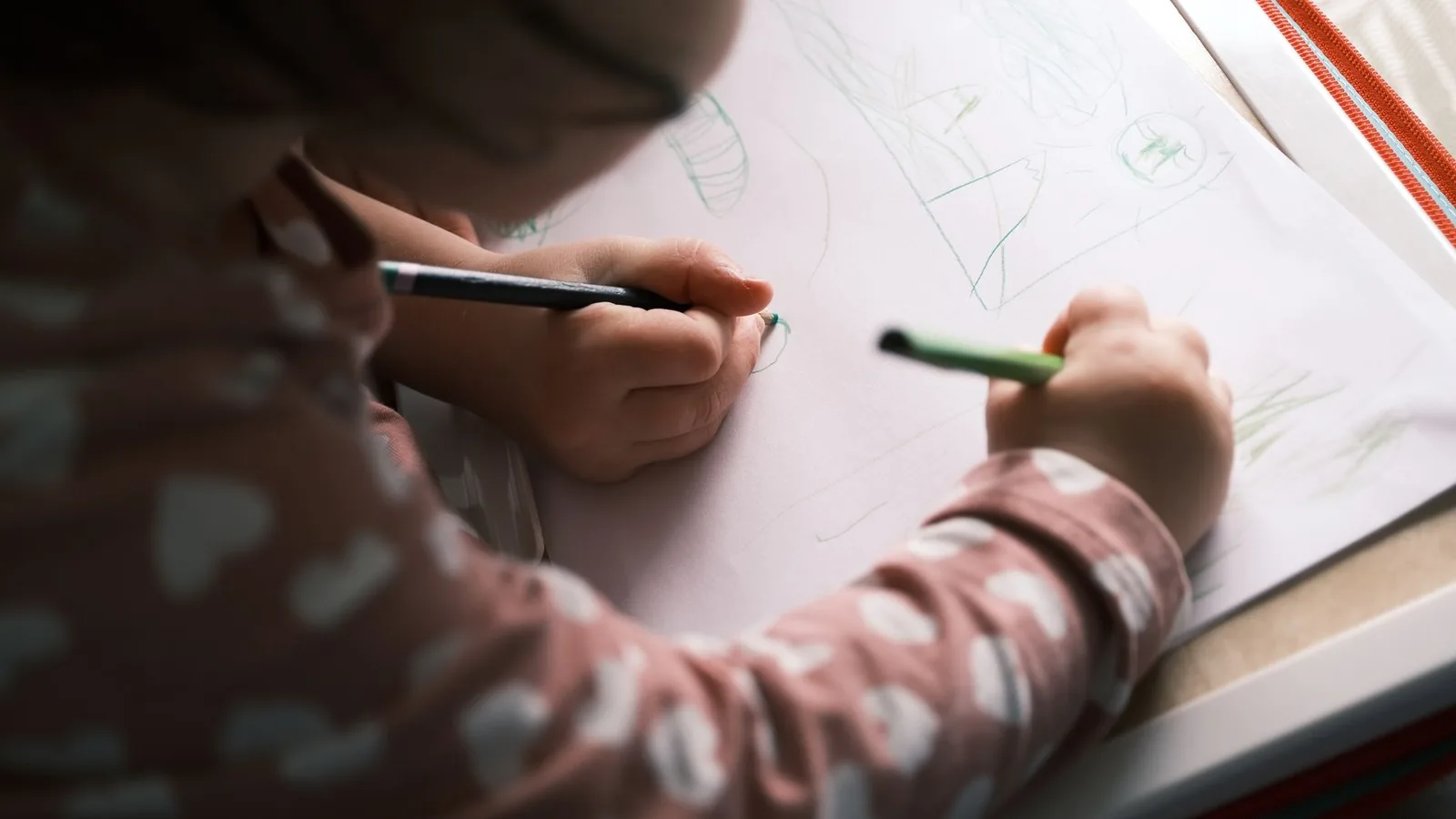
Understand pencil grip stages from 2 to 6, what comfortable writing looks like, practical play ideas and when to ask school for help.
Is your child's pencil grip a worry?
Pencil grip usually develops from a whole-hand hold towards finer finger control, but a different-looking grip isn't automatically a problem. East Cheshire NHS Trust says a comfortable, functional alternative can be appropriate. Look at whether your child can make marks comfortably and control the pencil, then use the stages below to understand what you're seeing.
Start with the job their hand is doing. A photo of their fingers tells you less than watching them draw something they want to draw.
Which pencil grip stages might you see?
The familiar progression is from a fist to a palm-down hold, then towards a tripod grip using the thumb and fingers. The Black Country Children's NHS occupational therapy toolkit gives the following age guide. Read it alongside what your child can do, rather than as a birthday deadline.
- 12 to 18 months, the earlier stage, Grip: Whole-hand fist, or palmar supinate; What it looks like: The pencil sits in the fist.
- 2 to 3 years, Grip: Palm-down, or digital pronate; What it looks like: Fingers wrap around the pencil with the palm facing down.
- 3 to 4 years, Grip: Static tripod; What it looks like: The thumb, index and middle fingers hold the pencil, but the arm still supplies the movement.
- 4 to 6 years, Grip: Static or developing dynamic tripod; What it looks like: Movement becomes more controlled by the fingers.
The East London NHS Foundation Trust guide explicitly notes that some children fall outside its age ranges and advises against forcing a change of grasp. These are broad developmental descriptions, not a home assessment.
That gives you a useful starting point for a conversation: "They're holding it in their whole hand" is clearer than "Their grip is bad". Describe what happens next, too. Are they making the marks they want, or asking you to take over?
Why does school ask for a tripod grip?
In England, the Department for Education's fine motor early learning goal expects children to hold a pencil effectively, using a tripod grip in almost all cases. That wording explains why a teacher may mention tripod, even when you've also read that other comfortable grips can be appropriate.
The Department for Education's Early Years Foundation Stage profile handbook places the assessment at the end of Reception, usually in the school year a child turns 5. It explicitly says the profile isn't an entry assessment. This is England's framework, so don't apply it as a school-entry rule across Scotland, Wales and Northern Ireland.
Read the school expectation and the NHS advice together. One describes an educational goal; the other asks whether the way an individual child holds a pencil works for them.
If the messages seem different, ask the teacher: "Is the concern how the grip looks, or what it's making difficult? What would you like us to practise at home?" Ask for a demonstration, rather than trying to decode a grip name from a note.
For the wider picture, see our guide to what children need before starting school.
What should you look at besides their fingers?
Watch the whole drawing session, including the seat, the paper and how hard your child presses. Oxford Health NHS Foundation Trust considers posture, paper position, pen grasp and pressure together. That gives you more useful things to notice than repeatedly asking your child to hold the pencil differently.
Begin with the setup. Berkshire Healthcare NHS Foundation Trust recommends supported sitting, feet on the floor or a footrest, and forearms resting on the table. If they're perched on an adult chair with dangling feet, check the furniture before buying another pencil.
Then observe without turning it into a test:
- The task: what did they choose to draw or write?
- The experience: did they describe it as easy, tiring or sore?
- The paper: did it stay in place, slide around or tear?
- The change: was anything different when you adjusted the setup?
For example, say your child abandons a drawing after the paper keeps sliding. Note that detail and mention it to the teacher. "The paper moves whenever they draw a line" gives you something concrete to discuss.
Keep a dated example if you're planning that conversation. Include your child's own words about how it felt, without labelling the grip as lazy or wrong. You're collecting a useful description, not setting up a daily inspection.
What can you try before another page of letters?
Offer a mixture of whole-body play, hand activities and drawing. The Department for Education describes fine motor skills, the small movements used for handling things, as part of whole-body development. Its guidance includes cooking and manipulating materials as foundations for later pencil use.
Choose something from the options below according to what your child fancies.
Give shoulders a job
Berkshire Healthcare's core stability guidance includes animal walks and playground activities among its suggestions for developing strength in the trunk, shoulders and hips. Try a short animal game before coming back indoors, or choose a climbing activity your child already uses. Our gross motor activity ideas offer more ways to vary the play.
Make dough do the work
Choose playdough labelled for your child's age and check its ingredients for allergens such as wheat, avoiding any your child is allergic to. Supervise closely and keep it out of mouths because playdough can be a choking hazard. Put a lump on the table. Invite your child to roll a sausage, flatten it into a pizza and pinch the edge. The Department for Education recommends rolling and flattening dough as practice in coordinating both hands. No letter cutters or finished model needed.
Draw somewhere different
Gloucestershire's NHS occupational therapy service suggests large shapes and drawing on a vertical surface, such as paper on a wall. Make a road with broad lines, then invite your child to add bends or roundabouts. Use drawings they can enjoy without needing to form letters.
Keep pencil practice purposeful
For a child who's already writing, ask school for a letter formation to practise and use it in something real, such as a label for a drawing. For earlier mark-making, offer a large sheet and draw together. Let your child tell you what their marks mean.
For younger children and siblings, follow age warnings and keep loose pencil grips and broken crayon pieces out of reach. The NHS's toy safety advice warns about small parts children could swallow and says not to give under-3s toys marked for older children.
For a yoga break between drawing sessions, explore Yogi-Me's mats, made for ages 3 to 8 with 15 numbered poses laser-engraved into the surface.
Who can help if drawing is uncomfortable?
Talk to nursery or school about persistent difficulty, rather than waiting for the next birthday on a chart. Liverpool City Council's occupational therapy guidance recommends speaking to school first when a child struggles to hold a pencil, has writing that's difficult to read or feels pain when writing.
Ask what happens in class, what support they can try and when you'll review it together. If you're worried about your child's development, speak to your GP or health visitor, as Hounslow's NHS Healthier Together service advises. Take your observations and a sample along.
Frequently asked questions
What are the four pencil grip stages?
The common sequence is a whole-hand fist grip, a palm-down grip, a static tripod and a dynamic tripod. East London NHS Foundation Trust describes these stages and notes that children may develop outside its age ranges. Use the names to understand the progression, rather than treating them as a pass-or-fail test.
Does every child need a tripod pencil grip?
No. Hampshire and Isle of Wight Healthcare NHS Foundation Trust says some alternatives can be almost as efficient, and considers a grip functional if it allows legible, efficient writing. Discuss difficulties with the teacher, but don't assume a different-looking grip needs changing simply to match a picture.
How can I show my child how to hold a pencil?
Gloucestershire's NHS occupational therapy service suggests encouraging your child to hold the pencil with their thumb, index finger and middle finger. Show them alongside your own drawing, then let them try. Ask nursery or school to demonstrate the cue they use so you can keep the message consistent.
When should I worry about pencil grip?
Pain, tiring hands and persistently slow writing are reasons to ask for help with pencil grip: Oxford Health NHS Foundation Trust says these can justify reviewing the grasp. Tell the teacher what you've noticed and ask what happens in class. Take a drawing or writing sample along to make the conversation specific.
Sources
- East Cheshire NHS Trust: children's occupational therapy
- Black Country Children's NHS occupational therapy toolkit
- East London NHS Foundation Trust: pre-writing skills
- Department for Education: gross and fine motor early learning goals
- Department for Education: Early Years Foundation Stage profile handbook
- Oxford Health NHS Foundation Trust: handwriting, the four Ps
- Berkshire Healthcare NHS Foundation Trust: handwriting information sheet
- Berkshire Healthcare NHS Foundation Trust: core stability
- Department for Education: fine motor skills
- Gloucestershire Health and Care NHS Foundation Trust: children's occupational therapy
- NHS: baby and toddler play ideas
- Anaphylaxis UK: guidance for parents and carers of children in early years settings
- Poison Control: playdough safety
- Liverpool City Council: handwriting support
- Hounslow NHS Healthier Together: hand skills
- Hampshire and Isle of Wight Healthcare NHS Foundation Trust: handwriting and fine motor skills